Last night I found a small Striped Marsh Frog at Kim and Peter's home in Sutton Forest. The night before I found a MicroBat. It is jumping with Wildlife at their place, (literally) as there is a Grey Kangaroo with Joey living in the dense Native Plant hedge along their driveway.
And there are birds everywhere.
A BLOG ABOUT THE NATURE OF ROBERTSON, NSW, AUSTRALIA
ABOUT THINGS WHICH GROW HERE, NATURALLY; SOME OF MY SPECIAL INTERESTS - NATIVE PLANTS AND INSECTS, AND CULTIVARS OF PEONIES AND ROSES WHICH I GROW.
AND ABOUT LIFE IN ROBERTSON, TOO.
Christmas Bells
Christmas Bells - Blandfordia nobilis
Friday, March 13, 2015
Thursday, February 26, 2015
Moving On
I am sitting at Cafe Rockabella in Robertson tonight (surrrounded by noisy children - but in fairness, their parents are paying customers, and I know they will all go home early).
This morning I handed in the keys to the house I have called home for 13 years.
That is a scary thing to do.
So Lulu is asleep in the car.
Robertson has not disappointed me, however. We just had a cloudburst event.
This morning I handed in the keys to the house I have called home for 13 years.
That is a scary thing to do.
So Lulu is asleep in the car.
Robertson has not disappointed me, however. We just had a cloudburst event.
This gives me confidence that Life in Robertson will continue, as normal after I have left the Village.
OF COURSE IT WILL..........
Friday, February 20, 2015
Sawfly guarding eggs at same time as last year.
https://www.facebook.com/media/set/?set=a.10153623725144829.1073742022.809229828&type=1&l=491e935fb5
Please read the notes on the various pictures posted at that Facebook Album.
Anyone can read the notes on pictures when you open the various pictures.
Please read the notes on the various pictures posted at that Facebook Album.
Anyone can read the notes on pictures when you open the various pictures.
Thursday, February 19, 2015
Friday, January 30, 2015
Wonga Pigeon survived crash into a window
A Wonga Pigeon survived a crash into my front window. I was working inside the house and I heard a bang, followed by a scrabbling sound, as if a piece of furniture, or a stick leaning against my house had been dislodged by the wind.
In response to the noise, I checked and the first thing I saw was Lulu looking spooked (she normally sleeps on a blanket on front verandah). Then I saw grey feathers, so I knew to look for a Wonga Pigeon.
I found it where it had bounced to, amongst ground-cover plants below the front deck.
The bird appeared to be in shock, but it was not bleeding from the beak (a common result of head injuries for birds).
So I decided to pick it up and take it inside for closer inspection (and for photographing details which otherwise one seldom gets to see). See for example, the photos of the feet. One friend has commented that the feet made him think of dinosaurs. I can see what he means.
At one stage the bird escaped my grasp (their wings are very powerful, and it managed to force its wings out of my hands). When It escaped it flew into a wall in the lounge-room, and fell back down and landed on a settee.
It was not hurt further in this escape and the subsequent recapture.
I threw a jumper over it, and decided it needed to be calmed down so I wrapped it up and covered its head.
A little while later, my friend Matt Doyle and his son Zac came along to have a look at the bird. I had rung Matt to see if he wanted to see the Wonga Pigeon up-close. Then I released it from my back deck. The bird flew strongly, straight down a "laneway" between some large shrubs in the back yard, and turned a corner at the far end of the gap and disappeared. A good result, I reckon.
There is a Facebook photo album which is open to the public and you do not need to sign up for anything to view it. If you read the notes on each page, it will make full sense to you.
In response to the noise, I checked and the first thing I saw was Lulu looking spooked (she normally sleeps on a blanket on front verandah). Then I saw grey feathers, so I knew to look for a Wonga Pigeon.
I found it where it had bounced to, amongst ground-cover plants below the front deck.
The bird appeared to be in shock, but it was not bleeding from the beak (a common result of head injuries for birds).
So I decided to pick it up and take it inside for closer inspection (and for photographing details which otherwise one seldom gets to see). See for example, the photos of the feet. One friend has commented that the feet made him think of dinosaurs. I can see what he means.
![]() |
| Wonga Pigeon standing on my settee. Note the way the feet splay out flat. They are "Walking Feet" not "Gripping Feet" |
It was not hurt further in this escape and the subsequent recapture.
I threw a jumper over it, and decided it needed to be calmed down so I wrapped it up and covered its head.
A little while later, my friend Matt Doyle and his son Zac came along to have a look at the bird. I had rung Matt to see if he wanted to see the Wonga Pigeon up-close. Then I released it from my back deck. The bird flew strongly, straight down a "laneway" between some large shrubs in the back yard, and turned a corner at the far end of the gap and disappeared. A good result, I reckon.
![]() |
| Laneway where the Wonga flew after it had recovered. |
Monday, January 26, 2015
Tom Uren has died.
Tom Uren has died today.
He demonstrated a great sense of timing to the last.
He was a favourite of the Hard Left in ALP politics, and is well regarded to this day.
He did a terrific job under Whitlam as Minister for Urban and Regional Development (the Department was known as DURD). He bought back a large amount of the suburb of Glebe, in Sydney, from the Anglican Church, and turned it into a public housing estate.
"At its south-eastern end is the Glebe Estate, an area of Housing Commission properties purchased by the government of Gough Whitlam as a massive urban renewal project to provide public housing for the needy. This area has the third highest Aboriginal population in Sydney" (Wikipedia)This was probably his greatest achievement in office.
He was Minister for Territories when I ran a campaign to get Glebe Park in Canberra declared a permanent (and formal) Park.
I made such a bad impression on him that he called me a "Revisionist".
I had to look it up (after our meeting). But I knew I was striking a nerve with him, because I knew it was a classic insult much favoured by the old Left. Anyway, I kept on pressing him. I figured any damage to my cause was well and truly done by then, if he was reaching into his post-Cold War bag of insults.
We out-flanked him and got his Department Head on side, and eventually the Minister was persuaded to declare Glebe Park a Public Park. The previous old bastard Minister for the Capital Territory, (Michael Hodgman) had wanted to turn the whole area into a Casino and Hotel complex. That defeat of Michael Hodgman's plan is my fondest memory from those days.
Glebe Park was formally declared as a Park in 1983.
"A community campaign to save the trees resulted in a park being proclaimed in 1983 and heritage listing by the National Trust of Australia (ACT) and the Australian Heritage Commission."
It is nice to know the work of the "Save Glebe Park Committee" is recognised by Wikipedia.
There are some nice photos on the Glebe Park, Canberra site in Wikipedia.
He demonstrated a great sense of timing to the last.
He was a favourite of the Hard Left in ALP politics, and is well regarded to this day.
He did a terrific job under Whitlam as Minister for Urban and Regional Development (the Department was known as DURD). He bought back a large amount of the suburb of Glebe, in Sydney, from the Anglican Church, and turned it into a public housing estate.
"At its south-eastern end is the Glebe Estate, an area of Housing Commission properties purchased by the government of Gough Whitlam as a massive urban renewal project to provide public housing for the needy. This area has the third highest Aboriginal population in Sydney" (Wikipedia)This was probably his greatest achievement in office.
He was Minister for Territories when I ran a campaign to get Glebe Park in Canberra declared a permanent (and formal) Park.
I made such a bad impression on him that he called me a "Revisionist".
I had to look it up (after our meeting). But I knew I was striking a nerve with him, because I knew it was a classic insult much favoured by the old Left. Anyway, I kept on pressing him. I figured any damage to my cause was well and truly done by then, if he was reaching into his post-Cold War bag of insults.
We out-flanked him and got his Department Head on side, and eventually the Minister was persuaded to declare Glebe Park a Public Park. The previous old bastard Minister for the Capital Territory, (Michael Hodgman) had wanted to turn the whole area into a Casino and Hotel complex. That defeat of Michael Hodgman's plan is my fondest memory from those days.
Glebe Park was formally declared as a Park in 1983.
"A community campaign to save the trees resulted in a park being proclaimed in 1983 and heritage listing by the National Trust of Australia (ACT) and the Australian Heritage Commission."
It is nice to know the work of the "Save Glebe Park Committee" is recognised by Wikipedia.
There are some nice photos on the Glebe Park, Canberra site in Wikipedia.
![]() |
"An open area in Glebe Park"
by Cfitzart - Own work.
Licensed under CC BY-SA 3.0 via Wikimedia Commons
|
Monday, January 19, 2015
Hindmarsh history re-lived
Yesterday, my friend Gordon accepted a suggestion from me to
help Dr Michael Hindmarsh, from Gerringong. go to the bottom of Belmore Falls. I had met Michael at the Kiama Community Recognition Awards ceremony on 12 December 2014. He happened to mention that he wanted to find a particular tree below Belmore Falls and I said that I could recommend an excellent Bushwalking guide. I had Gordon in mind, and I put them in contact with eachother.
Naturally enough, their starting-off point was Hindmarsh Lookout. So already you can see there is a lot of history involved.
![]() |
| Gordon at Hindmarsh Lookout |
As best I can remember, Michael is a 5th generation descendant of the Hindmarsh family who were amongst the first settler in Robertson. These people walked up from the Gerringong area, via Hoddle's
Track, up past Saddleback Mtn and up onto the Barrengrounds Plateau, and on
towards the basalt capped hills of Robertson.
The basalt soil was what these pioneer settlers were seeking to claim under the Robertson Land Act of 1861. More history involved. It was Land Reform, pure and simple. The Squatters hated John Robertson for this breaking of their monopoly on land ownership.
"History
In 1861, the powerful Premier of New South
Wales, John Robertson, was determined to break the long-established monopoly of
the squatter-pastoralists in land-holding in the colony. He forced two Acts
through the Parliament, opening up free selection of Crown land by permitting
any person to select up to 320 acres, on the condition of paying a deposit of
one-quarter of the purchase price after survey, and of living on the land for
three years.
Robertson intended to give poorer purchasers access to land and to increase farming and agricultural development in New South Wales. Great conflicts between the squatters and the selectors ensued, and corruption and scheming in acquiring land became rife."
Source: Crown Lands Acts 1861 (NSW)
Robertson intended to give poorer purchasers access to land and to increase farming and agricultural development in New South Wales. Great conflicts between the squatters and the selectors ensued, and corruption and scheming in acquiring land became rife."
Source:
Anyway,
after their bushwalk to the Barrengarry Creek, below Belmore Falls, Michael and
Gordon came back to Gordon's place, where I was awaiting their arrival.
Lulu was with me, of course, and she really likes Gordon. But she took a shine to Michael too.
In particular, what was really fascinating her was the bloody leech bites on
Michael's legs.
She set about cleaning Michael's legs for him.
This scene reminded me of something I had learnt in Bible Studies, namely Lazarus (the leper, not the one who was raised from the dead) who was licked by stray dogs, which cleaned his wounds.
(Luke 16:19-31)![]() |
| Dogs showed compassion toward Lazarus the beggar, even when people did not. Public domain |
Labels:
Belmore_Falls,
Dr_Michael_Hindmarsh,
Gordon,
Hindmarsh_Lookout
Wednesday, January 07, 2015
Birds and Butterflies on a clear sunny morning
My photos from this morning are visible on a Facebook Album.
https://www.facebook.com/media/set/?set=a.10153503966749829.1073742010.809229828&type=1&l=4d0e0eac00 This album is completely accessible to the public. You do not need to be a member, or to join anything to view it. There is also a short video with lousy photos, but nice calls of the Grey Shrike-Thrush.
https://www.facebook.com/video.php?v=10153503700659829
https://www.facebook.com/media/set/?set=a.10153503966749829.1073742010.809229828&type=1&l=4d0e0eac00 This album is completely accessible to the public. You do not need to be a member, or to join anything to view it. There is also a short video with lousy photos, but nice calls of the Grey Shrike-Thrush.
https://www.facebook.com/video.php?v=10153503700659829
Labels:
Grey_Shrike-Thrush,
Jezebels,
Painted_Lady_Butterfly,
Video
Thursday, January 01, 2015
Last Year, and New Year - on the cusp.
Firstly, just a few photos of a small party on New Year's Eve, at Vicki and Owen's place and a few photo of a beautiful rose flowering outside my bedroom window.
As usual these are found at a Facebook Album which is accessible to everyone freely.
No need to sign up for anything.
https://www.facebook.com/media/set/?set=a.10153465684089829.1073742007.809229828&type=1&l=64a7f57127
It behoves me to publish an annual figures for rainfall at my house for 2014.
I can confirm that my record is very close to the official Bureau of Meteorology figure for Robertson village, despite notable variations on a month by month basis. They got an annual total for 2014 = 1728.3 mm.
![]() |
| Lousy photo through glass just to show it is a real Blue Wren |
| Going Up Male Superb Blue Wren chasing his own reflection |
![]() |
| Adult Crimson Rosella looking for yesterday's left over Watermelon |
![]() |
| A lovely photo of a lovely rose. Just Joey as it was on New Year's Day. |
Labels:
house,
Rainfall_2014,
Robertson,
Rosellas,
Superb_Fairy_Wren
Tuesday, December 09, 2014
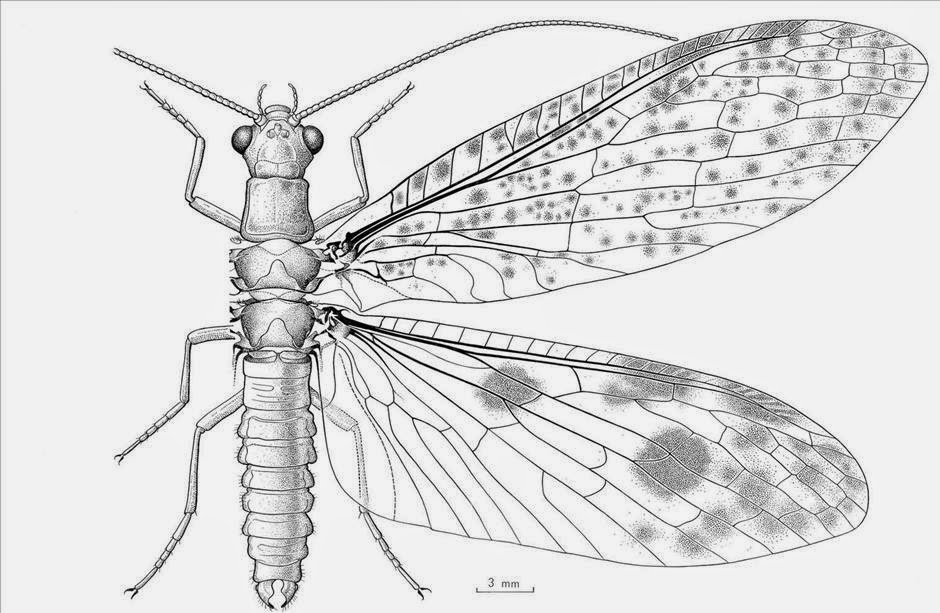
Dobsonfly - Archichauliodes species.
I always find Dobsonflies to be slightly strange insects.
They are as big as Dragonflies, but they fly with a weak, fluttering motion which immediately sets them apart from Dragonflies. They are partially aquatic. Eggs are laid on land (on rocks or vegetation). Then Larvae crawl to fresh water and become completely aquatic, until such time as they are ready to pupate.
From: http://www.ento.csiro.au/education/insects/megaloptera.html
DJW Notes:
They are not completely Aquatic in larval stage of their life-cycle (again, unlike Dragonflies).
Back to CSIRO site:
This was found on the edge of the Wingecarribee Swamp, in late November 2007. On a flowering Tea Tree (Leptospermum sp.) But that fits with its aquatic larval lifecycle. My insect, from yesterday, was also attracted to the flowers of relative of the Tea Tree (Astartea fascicularis).
Here is another page from CSIRO, to show some of the differences between Dobsonflies and Ant Lions and Lacewings.
http://www.ento.csiro.au/education/insects/neuroptera.html
Since publication, I have been contacted and provided with a working link to the "What Bug Is That?" site.
It is http://anic.ento.csiro.au/insectfamilies/index.aspx
Thanks to the ever alert members of the scientific community.
You know who you are :)
They are as big as Dragonflies, but they fly with a weak, fluttering motion which immediately sets them apart from Dragonflies. They are partially aquatic. Eggs are laid on land (on rocks or vegetation). Then Larvae crawl to fresh water and become completely aquatic, until such time as they are ready to pupate.
From: http://www.ento.csiro.au/education/insects/megaloptera.html
Megaloptera: dobsonflies and alderflies
CharacteristicsThis is a very small order of Australian insects commonly known as alderflies and dobsonflies. They are medium to large sized insects with a wingspan ranging from 20 to 100 millimetres. Alderflies and dobsonflies can be recognised by the following features:
|
- Long, soft, flexible bodies, usually dark coloured
- 2 pairs of membranous wings of similar size, often bearing dark patches.
- At rest the wings are held roof-like over the body
- Mandibulate mouthparts
- Long filiform antennae which taper towards the end
CORYDALIDAE is a widespread family of dobsonflies and well represented in Australia.
Archichauliodes species are inhabitants of cold-water streams and can be found from southern Australia to north Queensland. Adults of this species can usually be recognised as they have 4 or 5 large spots on their hind wings in addition to many smaller spots towards the edges of the wing.
The larvae of alderflies and dobsonflies are aquatic, appear caterpillar-like and possess gills along the sides of their abdomens.
Archichauliodes species (CORYDALIDAE) |
They are not completely Aquatic in larval stage of their life-cycle (again, unlike Dragonflies).
Back to CSIRO site:
"All species have aquatic larvae and mating occurs on the vegetation close to freshwater streams. Female alderflies and dobsonflies may lay up to 3000 eggs on rocks or debris close to the stream but not in the water. When the larvae hatch they enter the water and live a permanently aquatic life until they are ready to pupate. At this stage the larvae move out of the water into the adjacent leaf litter or soil where they pupate for several weeks. The complete life cycle may take only one year in warmer areas or up to 5 in colder climates."
Here was my first ever photo of a Dobsonfly.
It took me ages to get a proper ID on it, because, apart from specialist Entomologist site, there is not much readily available on them. At first I thought this was a Stonefly, but it is not. Nor is it a Giant Lacewing (with which it might be confused).
Here was my first ever photo of a Dobsonfly.
It took me ages to get a proper ID on it, because, apart from specialist Entomologist site, there is not much readily available on them. At first I thought this was a Stonefly, but it is not. Nor is it a Giant Lacewing (with which it might be confused).
![]() |
| Dobsonfly on Tea Tree. Wingecarribee Swamp, Nov 2007 |
![]() |
| Archichauliodes species (CORYDALIDAE) |
http://www.ento.csiro.au/education/insects/neuroptera.html
Since publication, I have been contacted and provided with a working link to the "What Bug Is That?" site.
It is http://anic.ento.csiro.au/insectfamilies/index.aspx
Thanks to the ever alert members of the scientific community.
You know who you are :)
Labels:
Dobsonfly,
Home,
Lacewing,
Robertson,
Upland_Swamps,
Wingecarribee_Reservoir
Thursday, December 04, 2014
Wedge-tailed Eagle making "Lazy circles in the sky" over my house.
It is great to see one of a pair of Wedgies which flew over my house yesterday.
https://www.facebook.com/media/set/?set=a.10153381283594829.1073741993.809229828&type=1&l=12da12be84
One stayed to "make lazy circles in the sky" - a la "Oklahoma".
http://youtu.be/hpNeHMlJiD4
https://www.facebook.com/media/set/?set=a.10153381283594829.1073741993.809229828&type=1&l=12da12be84
One stayed to "make lazy circles in the sky" - a la "Oklahoma".
http://youtu.be/hpNeHMlJiD4
Monday, November 24, 2014
Privets and Hay Fever
This morning I woke with my house filled with the nauseating scent of Privet everywhere.
It is overpowering on humid nights (like last night) and mornings like this morning.
The culprits are the custodians of the Railway Line (who would probably be ARTC). But also the next offenders are the non-existent Committee in charge (nobody is actually in charge) of the School Forest.
Privet is the problem.
Privet is in the same family as the Olive - a fact which only comes obvious when the little black seeds develop in a couple of months. Small birds love them, So do bowerbirds unfortunately, and so also do White-headed Pigeons which last year swarmed all over these same trees and bushes, eating the fruit, and thus spreading the seeds. Damn.
Hay Fever is directly triggered by the sweet and overpowering scent of Privet. However, technically, it is classed as an allergy. Hence runny eyes as well as sneezes and difficulty in breathing. In fact, the scientists say that the problem with Privet is a direct irritation of the sensitive mucus membranes of the nose. I'll leave that for the experts to sort out.
It is overpowering on humid nights (like last night) and mornings like this morning.
The culprits are the custodians of the Railway Line (who would probably be ARTC). But also the next offenders are the non-existent Committee in charge (nobody is actually in charge) of the School Forest.
Privet is the problem.
Privet is in the same family as the Olive - a fact which only comes obvious when the little black seeds develop in a couple of months. Small birds love them, So do bowerbirds unfortunately, and so also do White-headed Pigeons which last year swarmed all over these same trees and bushes, eating the fruit, and thus spreading the seeds. Damn.
![]() |
| White flowers of Ligustrum sinense The Small-leaved Privet |
![]() |
| Flowers and small, slightly crinkled edged leaves of Privet Leaf margin referred to as wavy, which is good word. It helps people trying to weed out Privet seedlings. Because the leaf edges are distinctively wavy when plants are very small. http://www.iewf.org/weedid/Ligustrum_sinense.htm |
![]() |
| This is why I get cranky about the lack of responsibility for these plants. They are not on railway land, but have spread from the close-by Railway easement to the "School Forest". |
![]() |
| The Railway line is visible on far left of this image. The Laurence Langley Memorial Redwood Grove is visible in the background. |
![]() |
| An as-yet unknown (to me) Moths which was on my fly screen this morning. |
Wednesday, November 05, 2014
Bearded Tylophora flowering inside my Study
As I write, my Study is being invaded by a branch of
Tylophora barbata, the “Bearded Tylophora”.
Ever since moving to Robertson in 2002, I have been aware of this small “climber” but have never known why it got its bearded reference. Just this last week, I realised that one of these small plants had made its way up from below my house, snuck in between the external cladding and then having entered the house structure, it has followed a tiny shaft of light, through a hole. Thus it has entered my Study.
I have ignored it for many months. My reward for doing that is that when I looked at the plant in late October, I realised that there were some flowering structures “Umbels” with small, dark flowers attached.
This surprised me. So I grabbed the camera.
And this is what I found. Flower of Tylophora barbata held against a 5 cent coin for scale.
Ever since moving to Robertson in 2002, I have been aware of this small “climber” but have never known why it got its bearded reference. Just this last week, I realised that one of these small plants had made its way up from below my house, snuck in between the external cladding and then having entered the house structure, it has followed a tiny shaft of light, through a hole. Thus it has entered my Study.
I have ignored it for many months. My reward for doing that is that when I looked at the plant in late October, I realised that there were some flowering structures “Umbels” with small, dark flowers attached.
This surprised me. So I grabbed the camera.
And this is what I found. Flower of Tylophora barbata held against a 5 cent coin for scale.
![]() |
| Tylophora barbata held against a 5 cent coin - for scale purposes. |
The first thing which struck me was the extreme geometrical
construction of the flower. It also reminded me of a Hoya flower which my
mother used grow. Indeed they are in the same family.
Here is a closer image.
![]() |
| Tylophora barbata Note the 5 segments of the flower and the dark nodular glands and the 5 white segments in centre which are where the anthers are located. |
This shows the structure of the sexual organs of the plant:
“Calyx segments 5, sometimes with small
basal glands inside. Corona of 5 spreading fleshy obtuse knobs fully fused to
staminal column”. So the stamens are in the central white structure. The dark
knobs are glands, presumably to emit scent to attract tiny insects as
pollinators. My nose is not sensitive enough to detect any scent.
This next shot
(using a different lens and flash setup) shows that there are short, silvery
bristles all over the inner parts of the flower.
That takes me back to the name of the plant. The generic name is derived from the Ancient Greek tylos "knot", and phoros "bearing", from the swollen staminal coronal lobes. Barbata means "bearded" from Latin.
In “The Guide to the Yarrawa Brush” it says: “There are small hairs on the petals, hence the name Bearded Tylophora”.
![]() |
| Tylophora barbata - note the fibres on petals. |
So how does this plant get inside my house?
![]() |
| Paired leaves ("Opposite") of Tylophora barbata |
Here is the plant outside my hose, climbing up one of the
brick piers.
It likes to grow in dark, moist places, under trees, or in this case under a house.
In fact, it has snuck up between the outer cladding of the house and found a small hole in the floor. The vine stems are so fine that it can enter just about anywhere it wishes to explore.
One it grew to the appropriate height, because it is in a dark area, it would then follow any shaft of light, to grow up towards the light, Thus it is easy to work out how it appears to have a "sense of direction". The light give it that direction to follow.
Labels:
Bearded_Tylophora,
Climber,
Native_Plants,
Robertson,
Tylophora_barbata
Monday, October 27, 2014
Two days in Kangaloon
As happens these days, I create albums in Facebook and post links here,
You do not need to be a Facebook Member to view the Albums. No need to sign up for anything.
Yesterday's Album has the iconic Critically Endangered Thelymitra kangaloonica - the Kangalooon Sun Orchid. Also a very nice specimen of the Copper Bearded Orchid, Calochilus campestris.
Copper Bearded Orchid Calochilus campestris

Kangaloon Sun Orchid Thelymitra kangaloonica

Various other annoying non-Orchids found their way in front of my Lens.
https://www.facebook.com/media/set/?set=a.10153291225959829.1073741980.809229828&type=1&l=88e51e9c76
Red Bearded Orchid Calochilus paludosis

And my favourite "Pretty" the diminutive Pink Sun Orchid Thelymitra carnea
You do not need to be a Facebook Member to view the Albums. No need to sign up for anything.
Yesterday's Album has the iconic Critically Endangered Thelymitra kangaloonica - the Kangalooon Sun Orchid. Also a very nice specimen of the Copper Bearded Orchid, Calochilus campestris.
Orchids and some others, from Kangaloon yesterday
https://www.facebook.com/media/set/?set=a.10153290458894829.1073741979.809229828&type=1&l=2790308e7eCopper Bearded Orchid Calochilus campestris

Kangaloon Sun Orchid Thelymitra kangaloonica

Margot and Bryan visit Kangaloon
Today's Album had several nice Orchids, especially the Red Bearded Orchid and a nice (open for a change) Thelymitra carnea - the tiny Pink Sun Orchid.Various other annoying non-Orchids found their way in front of my Lens.
https://www.facebook.com/media/set/?set=a.10153291225959829.1073741980.809229828&type=1&l=88e51e9c76
Red Bearded Orchid Calochilus paludosis

And my favourite "Pretty" the diminutive Pink Sun Orchid Thelymitra carnea
Labels:
East_Kangaloon,
Kangaloon_Sun_Orchid,
Leek_Orchids,
Margot,
Orchids
Wednesday, October 15, 2014
My garden is looking pretty good after the big storm last night.
Here is a link to a Facebook Album of recent photos.
https://www.facebook.com/media/set/?set=a.10153261668544829.1073741968.809229828&type=1&l=09b8db7493
You do not need to join Facebook - this album is fully public to everybody.
Here is a sample. My favourite Waratah flower growing just outside my front door. It is looking at its prime right now.
https://www.facebook.com/media/set/?set=a.10153261668544829.1073741968.809229828&type=1&l=09b8db7493
You do not need to join Facebook - this album is fully public to everybody.
Here is a sample. My favourite Waratah flower growing just outside my front door. It is looking at its prime right now.
![]() |
| The styles (the pointy bits in each flower) are now opening out well. The whole head of flowers is called a "conflorescence" About 50% of the individual flowers are now open. |
Labels:
Hakeas,
Home,
House.,
Native_Plants,
Robertson,
Solomon's_Seal
Friday, October 10, 2014
Spring Orchids of Robertson and Kangaloon
Here is a link to a Facebook Album of photos taken over the last few days.
This album is open to the public. You do not have to be a Facebook Member to see these photos.
https://www.facebook.com/media/set/?set=a. 10153242702784829.1073741963.809229828&type=1&l=efb6c7d14f
This album is open to the public. You do not have to be a Facebook Member to see these photos.
https://www.facebook.com/media/set/?set=a. 10153242702784829.1073741963.809229828&type=1&l=efb6c7d14f
![]() |
| Add caption |
Wednesday, September 17, 2014
Prunus glandulosa 'Sinensis' - Double-flowered Dwarf Almond
![]() |
| Double-flowered Dwarf Almond Prunus glandulosa 'Sinensis' |
![]() |
| Bush seen from 2 metres. |
![]() |
| Close-up of Dwarf Flowering Almond Prunus glandulosa "Sinensis" |
There is a white-flowered variety as well. My friend George grows that.
Tuesday, September 09, 2014
Petalochilus mentiens - a delightful Spring surprise
I have been away from Robertson for several weeks and more specifically I have not been out Orchid hunting in the local area for about a month.
In that month it has rained and rained and rained. I have had 560mm since 17 August.
So I was delighted to find that the tiny, (minuscule one might say) Petalochilus mentiens has just started to flower. It is a Caladenia, of course. These plants are all less than 2 inches high (in the old money) or 50mm if you prefer.
One of them was a delightful pale pink. The others were all white or cream
In that month it has rained and rained and rained. I have had 560mm since 17 August.
So I was delighted to find that the tiny, (minuscule one might say) Petalochilus mentiens has just started to flower. It is a Caladenia, of course. These plants are all less than 2 inches high (in the old money) or 50mm if you prefer.
![]() |
| Petalochilus mentiens. Note the erect dorsal sepal, the tightly hugging labellum wings and the protruding labellum tip and the prominent v shaped tip of the labellum. . |
![]() |
| Pink specimen of Petalochilus mentiens |
In each case,the dorsal sepal was held erect, and the labellum wings are tightly curved around the column, but the labellum tip is prominent, and very tightly v shaped (but not re-curved).
In one area there were about 8 plants within several metres, One shot shows 4 plants - a restriction of my macro lens and my inability to walk back to the car to change lenses.
Labels:
East_Kangaloon,
Petalochilus_mentiens,
rain,
Tourist_Road
Friday, September 05, 2014
Is Pru Goward capable of being an Environmental Hero?
![]() |
| Cranky Koala, with an endangered Gang-gang Cockatoo and Batwoman all characters, of course. (thanks to Lindy Boyko, Alex Walker and Mark Selmes) |
This mine will greatly increase Global Warming when the coal (which is currently safe in the ground) is dug out and burnt for electricity in Australia, or sold off to India or China. Either way, it still adds to global pollution, leading to Climate Change, and of course, acidification of the Oceans.
Who would think that the humble Local Member for Goulburn has such power?
More to the point, why does she do nothing with it?
Send her a letter at office@goward.minister.nsw.gov.au
http://www.southernhighlandnews.com.au/story/2539322/coal-mine-protest-in-bowral/?cs=262
![]() |
| Mark Selmes in character as Cranky Koala He is in fact "conducting" the Choristers of Ecopella |
![]() |
| The members of Ecopella, spell out their message. |
![]() |
| Two more Super Heroes for the Environment, Spidergirl and the Incredible Hulk both asking the question what does Pru Goward think is more important? |
![]() |
| Cranky Koala and his young off-sider, Pesky Possum. |
Subscribe to:
Posts (Atom)


