Christmas Bells

Christmas Bells
Christmas Bells - Blandfordia nobilis
Showing posts with label Moss_Vale. Show all posts

Monday, February 04, 2013

On legalised Shooting in National Parks

I have been challenged in my opposition to legalisation of shooting in National Parks in NSW. That occurred on the Canberra Ornithologists Group email forum.
  • Hi All,
    Maybe I'm just ignorant, but why are you against this hunting? From what I understand, the hunt will be on invasive large mammals, which are unbelieveably destructive in a lot of National Parks. Isn't it a good thing to allow people who want to shoot them for free shoot them? The parks will be closed during the hunts, so what's the danger to the public? 
    Also, according to this website, duck hunting cannot take place on National Parklands.

    Cheers,
    (name removed to protect the innocent)
  • Re shooting in National Parks, my main concern is personal safety.

  • Dear (blank)
    Last year there was a tragic accident when a NZ shooter mistook a school teacher for a deer, and shot and killed her.
    Such "accidents" are not unknown - though usually shooters shoot other members in their own group.

    I live adjacent to the huge Morton National Park (see map attached). 

  • the huge Morton National Park
    accessible from 4 totally separate areas
    with no common Media service.

    It has two State Main Roads which run through it, the Braidwood to Nowra Road (Main Road 92) and Fitzroy Falls to Nowra road. And it can also be accessed from the Ulladulla side.
    And it has numerous other entry points (especially around Kangaroo Valley).

    The media for these far-spread  areas are controlled in Nowra, Goulburn and Bowral.
    One cannot listen to all sources of media in any one point. There are at least three local newspapers which purport to "cover" their own regions (but they do not co-ordinate)..
    How are they going to get the word out to me that the Park is closed?

    There is no way they can possibly close main roads of economic and strategic significance leading to and from Canberra to Nowra. So, short of blocking 100 minor roads, how do they "close" this Park?
    NPWS have inadequate staffing to do that at the best of times - let alone when the NPWS Staff are openly hostile to the idea.

    The NSW Game Council, the State Organisation "responsible" for this Shooting Program has hardly any staff at all. It really exists as a revenue raiser for NSW as the Licensing body for the Shooters.

    Beyond issues of safety, my personal interest is in rare and endangered Orchids (of which this Park is well endowed). What chance is there that a bunch of ill-informed shooters will take any notice or concern for tiny Orchids in the leaf litter, when slipping and sliding down a steep hill-side, in search of their prey?

    They would have no idea of what damage they might be doing.
     
  • Need I really go on?

    Incidentally, in the hundreds of hours I have spent in this Park I have never seen any Deer, nor Goats and only one suckling Pig which I reported to the nearby farm from which it had escaped several days before.

    This is a vastly different situation from the large numbers of wild Pigs and Goats in the Far Western region, near Broken Hill.

    Incidentally,. my personal experience of shooters I have known is that they like to take their "Pig Dogs" out in the bush and let them chase "Game". The usual result is badly mauled Wombats and Kangaroos - both of which are protected species.

    Mark Clayton has already affirmed that after hundreds of banding trips to Charcoal Tank and Buddigower, he has seldom seen any "game animals" in those Nature Reserves (both listed on the Parks to be opened to shooters)
  • Denis Wilson

Sunday, July 01, 2012

Chestnut-breasted Shelducks (Mountain Ducks)

This morning I was planning to go bird watching at Bundanoon, joining with the good folk over there, for a Winterfest event. After rising at 6:30 am to check for a early emails, before I was to go out for the day, I sat at the computer for about 15 minutes, and realised my toes were aching with cold. 

I retreated to my bed (with an electric blanket turned on).
Apologies to the good folks of Bundanoon, but some things seem unreasonably painful.

Later in the day, (much later) I went out heading towards Bundanoon (no doubt out of a sense of guilt).

I got as far as the wonderful farm dam close to the Nowra Road turn-off, (from the Illawarra Highway). This wonderful dam is part of Sowter's Dairy, Nowra Road, Moss Vale. It never fails to reveal a small community of ducks whenever I drive towards Moss Vale.

As I drove past, I checked it out (as I always do) and I thought I had spotted a pair of "Mountain Ducks" (Australian Shelducks, or Chestnut-breasted Shelducks).
 
These birds are decidedly uncommon in the Southern Highlands of NSW, so I immediately turned back, and pulled up opposite the dam. The birds responded by moving to the far side of the dam (naturally). I managed to get a few half-way decent photographs. At least they show the differences between the male and the female birds.


Female Australian Shelduck, Chestnut-breasted Shelduck
note the white eye mark and white spot on beak
chestnut breast is darker than the male bird.
Female Australian Shelduck, Chestnut-breasted Shelduck


Male "Sheldrake"
Note his cinnamon coloured breast
and the clear ring mark on the neck.
Australian Shelduck, Chestnut-breasted Shelduck
When I was learning about birds, these birds were called
"Mountain Ducks"

Ignore the confusing names
This is a handsome bird
and he knows it!
And so does his lady friend.
Here are some other links to bird reference sites for ths species.

And a link to a fabuous photo of a male bird:

Finally a note about the terminology.
The name which was featured in the bird books when I was a kid was Mountain Duck.
Then they became known as Chestnut-breasted Shelduck.
The irony of this is that the name perfectly describes the female of the species, but not the male.
He would be better described as "cinnamon-breasted Sheldrake". That is the one option which has never been used.


Then with the internationalisation of names, they became the Australian Shelduck.
But linguistic tradition has it that the male birds ought be Sheldrakes.
  • They were originally known as "sheldrakes", this remained the most common name until the late 19th century. The word is still sometimes used to refer to a male shelduck. (Wikipedia)
But it does not "fit" with scientific terminolgy to apply a name to a species, which specifically refers to only the male birds.

As an example of how we can get caught up in ridiculous linguistic conundrums, consider the genus Pavo: "The male is called a peacock, the female a peahen, and the offspring peachicks"
Modern terminology has settled on Peafowls, but hardly any birdwatcher, or keeper of tame birds of this genus would not call them "peacocks" in a relaxed moment, at the end of a day.

Tuesday, March 29, 2011

Gang-gang Cockatoo hit by car.

Near Moss Vale the other day I saw a mid-sized grey lump beside the road. Naturally I stopped (you know me well enough, dear Reader).


Image alert:
If you are distressed by seeing images of dead birds (no matter how interesting I may find these images) please look no further. Kindly come back tomorrow
.
.
.
The good news is that I also have images of live Gang Gangs further down the page (and a link to the sweetest "lovey-dovey" image of a pair of Gang-gangs you could ever hope to see). You can skip right to the end, if you wish (check the link in the very last paragraph).
.
.
This road-killed bird is a female Gang-gang Cockatoo. (Callocephalon fimbriatum)
 Note the light-textured crest feathers.
Female Gang-gang Cockatoo (a road-killed bird)
 Viewed from beneath you can see 
the diagnostic coloured marks on the chest and abdomen.
"The adult female has a dark grey head and crest, 
with the feathers of the underparts edged pink and yellow."
Note also the light-textured crest feathers
Female Gang-gang Cockatoo (a road-killed bird)
One of the things which always fascinates me
is the different structures of birds' feet.
With a bird in the hand, even a dead one,
I like to study how the toes are structured.
Toes of a Gang-gang Cockatoo.
This image shows the two rear toes - (one on each side)
and the two front toes curled neatly between them.
This structure is known as "zygodactyly"
It is found in all Parrots and Cockatoos
and in other birds, including Cuckoos.

Here is a link to the very different foot structure of a Sacred Kingfisher
The King-parrot has the same structure as the Gang-gang, of course.
The Painted Button-quail has a totally different structure,

 I promised you photos of live Gang-gang Cockatoos.

Here is a female, chewing on Hawthorn Berries.
Note she is using the left foot to hold the food.
Female Gang-gang Cockatoo eating Hawthorn Berries

This male is also holding his food in the left foot
The tendency to use the left foot is noted
in the Birds in Backyards information on this species.
(See the box: "Did you know" below the map on that site)
Male Gang-gang Cockatoo also eating Hawthorn berries.
This image shows why Gang-gang Cockatoos 
are subject to road accidents
(Click to enlarge)
A flock of Gang-gangs in a Hawthorn tree
These birds, when they find a good food source, 
tend to sit there.
Often they feed low down.
But being relatively large birds, as they start to fly
they tend to drop down in order to gain speed, 
as they fly off (from their perch).
Being perched as low, as they are here, 
that means they tend to fly off at car height.
Bang!
And now something to cheer you all up, here is a lovely image of a pair of Gang-gang Cockatoos grooming eachother. The image was taken by Julian Robinson and is on the Canberra Ornithologists Group photo gallery. With such loving attention between the male and the female, it is no wonder these birds are reputed to mate for life!

Friday, October 29, 2010

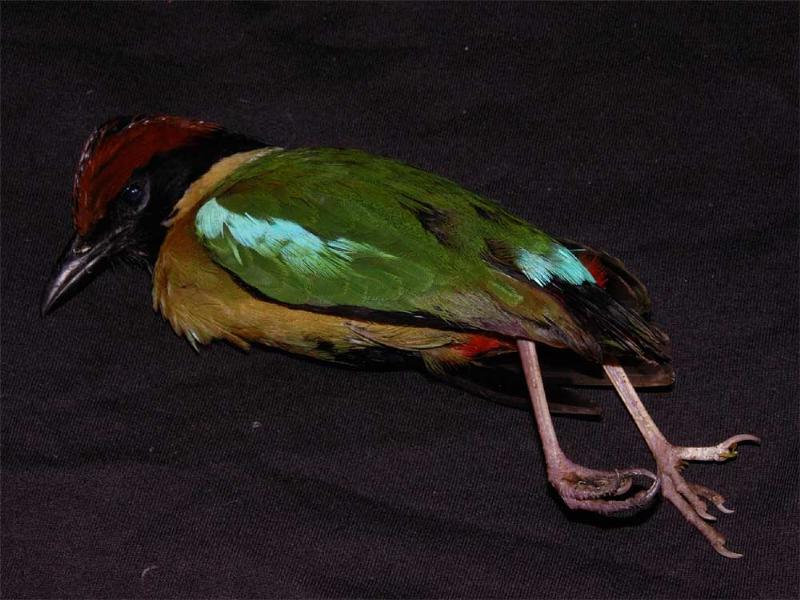
Noisy Pitta found near Berrima

Several days ago a Noisy Pitta (Pitta versicolor) was found near Berrima, in the Southern Highlands of NSW. This is a long way outside its normal range, and in a very unusual habitat for this species, which is a classical "rainforest bird".

Berrima is approximately 40 Kms west from Robertson (which itself is just above the Illawarra Escarpment, the closest true rainforest habitat to Berrima). The bird was presented by a "soft mouthed" Golden Retriever, to the dog's owner. Fortunately, the dog was very gentle, as befits a properly bred "retriever".

Unfortunately, the story does not have a happy ending, for although the bird was carefully handled (minimal handling), and was kept covered, and fed and watered appropriately, it was handed over to WIRES, but it died before it had fully recovered from its ordeal. Whether it was unwell to start with, is not known. After all, it was outside its normal range, and well away from its normal habitat, being a tropical rainforest bird.

Noisy Pittas normally live in dense tropical and sub-tropical rainforest. Their range is normally only as far south as the "Barrington Tops" (Hunter Valley Region). There are apparently some reports from the Mt Keira area, on the Illawarra Escarpment. (*** - see note below) The open farmland setting where the bird was found, is way outside its normal range and habitat preference.

IMAGE WARNING

IN KEEPING WITH THIS BLOG'S POLICY
OF PRESENTING INTERESTING AND UNUSUAL RECORDS
INCLUDING OCCASIONAL PHOTOS
OF DEAD ANIMALS AND BIRDS
I HAVE TAKEN SEVERAL IMAGES OF THE DECEASED BIRD.

I REGARD THIS AS AN EDUCATIONAL SERVICE.
HOW OFTEN DOES ONE GET THE CHANCE
TO SEE A NOISY PITTA IN SUCH DETAIL?

ANYWAY, IF YOU ARE LIKELY TO BE OFFENDED
BY PHOTOS OF A DEAD BIRD,
PLEASE GO NO FURTHER.

Kindly check back onto my blog again tomorrow.


*****

I have formally registered the "sighting"
(as such records are known).
There is no doubt as to the validity of the sighting
(photographic evidence).
The query was asked if this bird might have been
a caged bird "escapee"?
That seems unlikely, as few people would have the facilities
to keep a bird such as this in a private aviary.
They are certainly not "normal" caged birds.
Only the Taronga Park Zoo (Sydney) is likely to have a Noisy Pitta.

So there is no reason
to doubt the authenticity of the record as being
entirely a natural occurrence.

Location: The bird was found between Berrima and Moss Vale,
Southern Highlands, NSW.
Habitat: open pasture land, with residual mature Eucalypts
Date of finding: 26 October 2010

*****

Birdline NSW

Cumberland Bird Observers Club
Birding NSW

Report Receipt

Thank you for your report which has been recorded as follows:

Species: Noisy Pitta
Date: 28 Oct 2010
Site: Berrima, NSW
Notes: Bird retrieved by dog. Not obviously damaged by dog, however, it died, subsequent to it being handed over to local WIRES people. Bird was located in open farm land in Southern Highlands, between Berrima and Moss Vale. Cleared pasture, with large remnant Eucalypt trees. Nearest rainforest (Illawarra escarpment) is 55 Kms away, at Macquarie Pass. Mt Keira (apparently this species has been reported from there) is approx 90 Km away. Photo of bird taken after it died.
Observer: Denis Wilson
Photograph:


And here are the images:

Note the brilliant electric blue flashes on the wings and rump.
This colouring would really show up in low light conditions
when the bird is on the forest floor.
The back and wings are a brilliant emerald green,
The head is a rich brown.
The bird has large feet and strong legs
as befits its ground dwelling nature.
The beak is very powerful suiting its preference
for snails and ground dwelling arthropods (insect relatives)
This awkward looking image is shown to reveal
the brilliant patch of red feathers
in the ventral area and the under-tail coverts.
The dark patch on the belly is diagnostic of this species.
The throat is very dark, so it is almost invisible in this image.
This image shows the rich brown head
and the patches of white on the wing
(fully visible only when wings are fully extended)
Pittas have extremely short tail feathers.
The tail does not extend beyond the wings (or the legs).
Here you can get an idea of the white wing patches.
"Rigor Mortis" had set in by the time I collected the bird,
two hours after it had died.
So I was unable to open the wings properly,
for risk of damaging the specimen. I did not want that.

The rump is electric blue,
the tail feathers are black, but with emerald green tips.
The wings have traces of brown on the tips of the flight feathers.
The dominant colour is
bright emerald green on the back and wings.

The bird is stored safely (wrapped and frozen) and its body will be passed on to the CSIRO in Canberra, shortly, for inclusion in the Australian National Wildlife Collection.

I wish to express my appreciation to the lady who found the bird in the first place, and who looked after it appropriately. She tried to get it cared for by WIRES. Also, my friend Kim, who suggested that I be contacted to see if I could help.

Unfortunately, even with my local contacts, we were still not able to prevent the bird dying. However, at least the bird will not have died in vain, as it will go into the peak scientific collection of bird skins.

*** Postscript: I received the following comments from
Alan Morris, Moderator Birdline NSW.
Alan said that:
  • "Noisy Pittas are on the move south. There are three separate places on the Central Coast where you can hear them call (but not all the time) at the moment!
  • "While the southern normal breeding limit is the Barrington Tops/Gloucester area (not Coffs Harbour), they are being seen more regularly further south.
  • "There are regular reports for the Illawarra Region too although mostly in winter, but birds are now being reported all year round near Mt Keira I think!"
My response:
  • Thanks to Alan for the update on changing distribution of Noisy Pittas. With global warming seemingly occurring, that changed pattern makes sense. Many birds are extending their range from what we humans have regarded as "normal" (i.e., the distribution recorded since European settlement). Another which is recognised as moving "further south" is the Channel-billed Cuckoo.
  • I still regard this bird turning up near Berrima, in farmland, as an unusual record. The climate and altitude are the most significant differences from the areas on the Illawarra Coast mentioned by Alan.
  • Berrima district is approx 670 metres above sea level, and being away from the coast, is subject to much colder temperatures and is much drier, than even the highest places on the Illawarra escarpment which were mentioned by Alan as places where Noisy Pittas have been reported previously.

Monday, June 28, 2010

Big Frost last night

Robertson does not have an automatic weather recording station (official one, anyway). So the closest is Moss Vale.
I know I was trying to do some important writing last night, but I could not keep going, as I was so cold.
Anyway, this morning I checked the Moss Vale Weather site, and it said -5.8* Celsius. That is about 25 Km west,a nd admiotedly is more likely to be colder than Robbo. But because our climate is so moist, we get really dense white frosts, once the temperature drops low enough.
I have a sloping site, below a line of tall hedging trees, so, in winter it is in total shade all day.
Late in the afternoon (4:40PM) there was still an unmelted frost on a sand pile. There was still a "permafrost" (little crystals of ice underneath the soil, lifting up small pebbles and rocks).
I forgot to look at the Tree Dahlia, but I am sure it will have been knocked back to the ground (as it has been in previous years). I shall check tomorrow.

Wednesday, February 10, 2010

Weird and wonderful "Starfish Fungi"

My friends Toni and Les, from Moss Vale, sent me some photos several days ago of a "Starfish Fungus" (Aseroe rubra). Most of these images were taken by Toni. Some are mine. Each image is credited appropriately.
Toni photographing some of the Starfish Fungi "eggs".
DJW image (of course).
Group of Aseroe rubra - by Toni Valentine.
These collapsing fungi look like "calamari" -
If so, they would be "The ones John West rejected".
Image by Toni Valentine.
I was very keen to get some photos of my own (as I have only seen this fungus twice before). So I went over there yesterday, but the hot morning sunlight had taken its toll on these delicate structures.
Delicate, you ask?
Well, yes, in the sense that they do not last long, in their "prime".

Broken Starfish Fungus, plus "eggs"
One of the "Stomachs" is just starting to rupture.
DJW image.
Aseroe rubra, with 3 flies.
In fact this is the broken fungus turned over again.
It is still attractive to flies. DJW image.
Starfish Fungus, with fresh "goo***" and 4 flies.
Image by Toni Valentine.
In their "prime", as this one is,
it is busy secreting the sticky goo*** which it uses to attract flies.
Image by Toni Valentine.
They were drying out badly.
*** The "goo" is called "Gleba", but we might as well call it sticky goo.
The "goo" serves to spread the spores of the fungus. These Fungi fall within a large group which are all known as "Stinkhorns". Hence the attraction to the flies.
A mature Fungus, plus many "eggs" developing.
Image by Toni Valentine.
These remarkable fungi are in a group known as "Stomach Fungi" (Gasteromycetes) because "these fungi produce their spores inside the fruiting body that, at least initially, is enclosed within an outer skin".

Unlike many other types of fungi, this group, including Puff Balls, need to "rupture" in order to disperse their spores. The ANBG site is careful to point out that this description "does not signify close evolutionary relationships between all the members. The name is simply one of convenience - rather than being one of classificatory importance."
Close-up of the developing "eggs" of Aseroe rubra.
These are the "stomachs" which are gelatinous egg-like sacs.
You can see the "arms" just starting to poke through the sac.
Image by DJW.
The throat of the Aseroe rubra is seen in fascinating detail here.
Fly is standing to attention.
Image by DJW
Two images I took of two of the many flies which came to these fungi.
My Blogging colleague, Gaye from the Hunter has written about the Aseroe rubra fungus.

Friday, July 25, 2008

A Doctor for Robertson?

Hey folks, this is important news.

I live in a rural village, 40 Kms from both Bowral and Moss Vale. We have a population of 1206 people within the village, and 1901 in the total district (approx 5 Km radius) - based on 2006 ABS Census data.

We used have a Doctor's surgery open 3 part days per week. But at least we did not have to drive to Bowral or Moss Vale. Anyway, that arrangement ceased about 4 months ago.

The locals signed petitions and contacted local politicians (as you do). Not much help.

Now I have heard that a Doctor who has a Medical Practise in Bowral will open up in the old consulting rooms - and it will be staffed 5 days a week.

It might be too good to be true. But lets hope this story does prove to be true.

Having gone to a meeting last night of the CANWin Transition Shire movement, where we saw a film called "The End of Suburbia", and afterwards discussed the future need for local communities to be self-sufficient, the idea of not having to drive 80 Kms (round trip) to visit the Doctor is great news to me - and to many other residents of Robertson.

Tuesday, July 01, 2008

Winds tearing the Southern Highlands apart

We have had strong winds in the Southern Highlands. They started yesterday - during the day. Then we had a short, sharp and violent thunderstorm last night. And this morning even more winds. Strong violent winds.

I took some photos of "wind" at home this morning. Firstly, just below the house, the Blackwood Wattles were swirling around. With their pale yellow-green straight leaves (phyllodes), they look like a plate of Spinach-flavoured Tagliatelli.
Across the road, a row of young Eucalypts (Brown Barrells), being taller, and thinner, were whipping around.I drove to Bowral, and took these photos. Before I got there, a tree had come down, across the Sheepwash Road. Workers were clearing the road, and as there was a traffic hazard, I did not take any photos, for risk of making the hazard worse. However, on the way back I was able to take this photo of the trunk of the large tree, completely snapped in half. It is a smooth-barked Eucalypt, probably one known (appropriately) as "Brittle Gum". It is noteworthy that right beside it is another old tree trunk, also one which snapped in half. That suggests a problem with many of the trees in this location.
In Bowral, I took more photos of wind blowing trees around. This first is a blue-grey Eucalypt, perhaps an "Argyle Apple" (Eucalyptus cinerea). Its thin branches were whipping and swirling to make this picture.
In East Bowral, there was a Council Worker cutting a tree which had clearly fallen from Council lands, across a fence, and had damaged the roof of the house. As there had been some temporary repairs to the roof (black plastic sheeting nicely weighted with sandbags and lashed down) I assume this was an SES repair conducted after the violent thunderstorm last night.
Here is the tree trunk, snapped in half. Clearly it is growing outside the fence, which has been damaged. The tree is obviously diseased, almost certainly damaged by termites. Oh dear, another bill for Council?On the drive back to Robertson, I took photos of snapped and broken trees. This one is a medium-sized Cootamundra Wattle (Acacia baileyana), simply snapped off at mid-trunk level.
Back at Sheepwash Road, there was a second tree across the road. At first I thought that the workers had left the first tree halfway across the road. Surely not! Perhaps it was a safety issue, that there was a risk of further branches coming down. No. In fact, I was able to check and the first tree had been cleaned up very nicely indeed by the emergency workers. However, a second tree had snapped off a large branch, about 200 yards further down the road form the first tree.This wider shot shows both the trunk of the first tree (high on the right) and the second tree across the road, in the distance.And this mature Gum Tree in the middle of a paddock simply fell over - snapped at the roots.
All in all, it has been a wild 36 hours in the Southern Highlands.

The Moss Vale weather station records the maximum wind gust as 56 km/h. That of course, is for the 24 hours till 6:00 a.m. this morning, so it covers last night's storm, but not the winds today.

Sunday, June 29, 2008

Working bee at the Big Potato revamp

Robertson Gold - a bag of freshly picked Robertson potatoes - on sale today as a fund-raiser for the Big Potato Revamp project. Thanks to Judy and Allan Hollis and all the volunteers who helped out today and yesterday, and who donated their services, and plants, and who donated funds towards this community effort.
Girl Guides from the Moss Vale troop (many are local Robertson girls), turned up to assist the other volunteers in completing the basic landscaping around the Big Potato in Robertson.
The weather was warm and sunny, which was fantastic. On other days, people might have been less keen to get out and about, shovelling road base material, or carting mulch around in buckets.
A path now encircles the Big Potato. This hard surface should make access to the Big Potato easier, especially in wet weather.
There is another path which leads around the back of the park, amongst the newly transplanted Japanese Maple Trees and tall Weeping Cherries.
It was a happy group of people, kids and adults.
Allan and Roden are planting Camellias on the eastern side of the park.
Roden relaxing with some of the other workers, after the main rush was over.