Christmas Bells

Christmas Bells
Christmas Bells - Blandfordia nobilis
Showing posts with label family. Show all posts

Sunday, March 15, 2009

Dalmeny wildlife (South Coast, NSW)

Over the last few days I have stayed with my brother Brendan and his wife, Beth, at Dalmeny, NSW.

I have been away from Robbo for a few days, for medical tests, and then I took the weekend off and went south, to stay at Brendan and Beth's place, just north of Narooma, on the far south coast of NSW. I have visited with them before, but not for some time.

Unfortunately, I got caught out without my camera being fully operational, as I had spent Wednesday with Alan Stephenson and Colin and Mischa, checking out yet more rare Orchids in the Shoalhaven region. I will have photos later on. Trouble was I took lots of "flash" images, and I ran my battery down, without having brought my battery charger with me on my trip.

So, when I got to Dalmeny several days later, and I wanted to take some images of special wildlife, my camera would not display its "menu" data (nor "review" images I had just taken, so I was literally "shooting blind", without even being able to set the exposure time and aperture. That's really amateurish of me.

The first images are of a very co-operative Royal Spoonbill (Platalea regia), which was feeding beside a "boardwalk" in the estuary at Narooma. The beak is wonderfully adapted to feeding by "dabbling" in the estuary environment, amongst water weeds, hunting by feel for shrimps and other small aquatic creatures. As the bird feeds "blind" - i.e., by feel, the broad soft beak is an advantage to it. Other "wading birds" of similar size, such as the Herons and Egrets, have forward focussing eyes and razor sharp beaks. That enables those birds to see their prey firstly, then seize them with great precision. Spoonbills have eyes placed on the side of their heads (for good all-round vision) and they are working with a beak form similar to two kitchen "spatulas". This structure, with greatly increasing the "touch sensitivity" of their beaks, compared to a Heron or Egret. The Birds in Backyards website says: "The spatulate bill has many vibration detectors, called papillae, on the inside of the spoon, which means the bird can feel for prey items even in murky water and can feed by day or night."You can see the yellow eye-lids, and the red mark above the beak, in the middle of this bird's forehead. Click to enlarge the image.When feeding, the bird sweeps the bill sideways, through the water, "dabbling" the beak open and closed quickly, all the time, until it feels an object it wants to eat (there are fine sensors in the beak to tell the difference between a prawn, a fish or a crab - and a stone). Once it decides the object it has touched is "food", it "freezes" for just a moment, and then literally throws its prey down its throat, by a very fast reverse neck movement - bringing the beak suddenly backwards, then opening the beak and straightening its neck out forwards again, swallowing the prey. In this image, the prey has just disappeared backwards, down its throat. The entire movement was too quick for me to capture on my camera. High definition video cameras come into their own for capturing such moments.Here is a tame (but entirely "wild") Red-necked Wallaby, (Macropus rufogriseus) having breakfast in Brendan's back yard, just below the back patio. There are apparently three of these Wallabies which live near Brendan and Beth's house.
Here is a totally wild Fur Seal, "sun-bathing" (*** see note below) in the estuary at Narooma. It was just floating there, with its front flippers folded across its very full belly. The Seal was mostly just floating on its back, and lowering its head backwards into the water, and looking around underwater. It would bring its nose up to the air briefly, about every minute or so, and resume its restful sun-bathing, while paddling very slowly backwards and forwards, using just one of its rear flippers. The other rear flipper (foot) was held out of the water for extended periods of time. You can see that the left (rear) flipper is quite dry.This Seal was in the stone-lined entrance to the Estuary, known as Wagonga Inlet, just inside the breakwater. It was in a corner of the channel, out of the main current, which was flowing into the Inlet, very fast, a mere 30 metres away from this Seal. Several powerful fishing boats came into the Inlet, while this Seal was just floating the day away, without a care in the world.
You can see how close it was to the rock wall, from where Brendan was watching it. Fur Seals live at Montague Island, some 9 Kms off the coast from Narooma.

(***) Apparently, this habit of "waving" flippers out of the air is part of a thermo-regulation practice, to help cool the animals down. (So perhaps it was not "sun bathing" after all). That interpretation of the behaviour surprises me, given that they live in relatively cool water (compared to the air temperatures, anyway). But then again, I am not a Seal, nor a Seal biologist.

Tuesday, March 27, 2007

27 March - My late Mother's birthday

I set out to write something else entirely, but writing that date reminds me that it is the birthday of my late mother, Nonie Wilson, who died, just over a year ago (19 March 2006), just short of her 90th birthday.

There was no sadness that she did not make it to that milestone - she was not really "with us" any more, and such arbitrary events become meaningless, when there is little awareness - just pain.


I miss the woman she was.

Not the poor, suffering creature she became, at the end. She served her God, and her husband and family to the best of her ability.

Requiescat in Pace.

Tuesday, May 23, 2006

The Nature of Emus

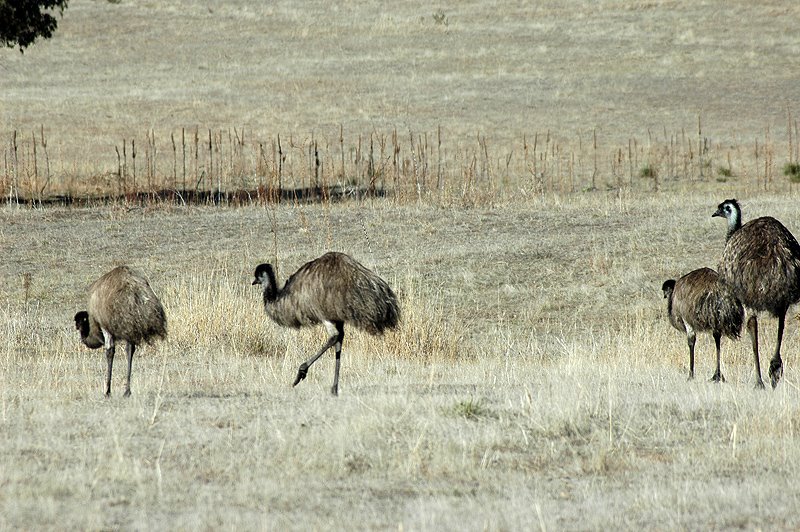
There are no Emus (Dromaius novaehollandiae) in Robertson, and there are no truly wild Emus in Canberra, but there were Emus there when the first settlers arrived. That fact is documented in a book by my father, Steve Wilson, called "Birds of the ACT - two centuries of change" (published by the Canberra Ornithologists Group).


When Tidbinbilla Nature Reserve was first established, sometime in the 1970s, Emus were re-introduced to the area, to recognise the fact that they were originally in the area. There were occasional reports of wild Emus in the high plains country, very high in the Alps, during the 1980s. Anyway, some of the Emus of the Tidbinbilla area survived the devastating bushfires of January 2003, and are still roaming the sheep paddocks below the main area of the Reserve.


Emus are said to be extremely primitive birds, and along with the Cassowary, Ostriches, Rheas and the diminutive New Zealand Kiwi they are grouped together in a Order of birds called Ratites. All are flightless birds, with coarse feathers. They do not have a deep bone on their sternum where normal birds have their strong wing-beating muscles attached. (- for contrast, have a look at the chest bone of the next Chicken you consume).


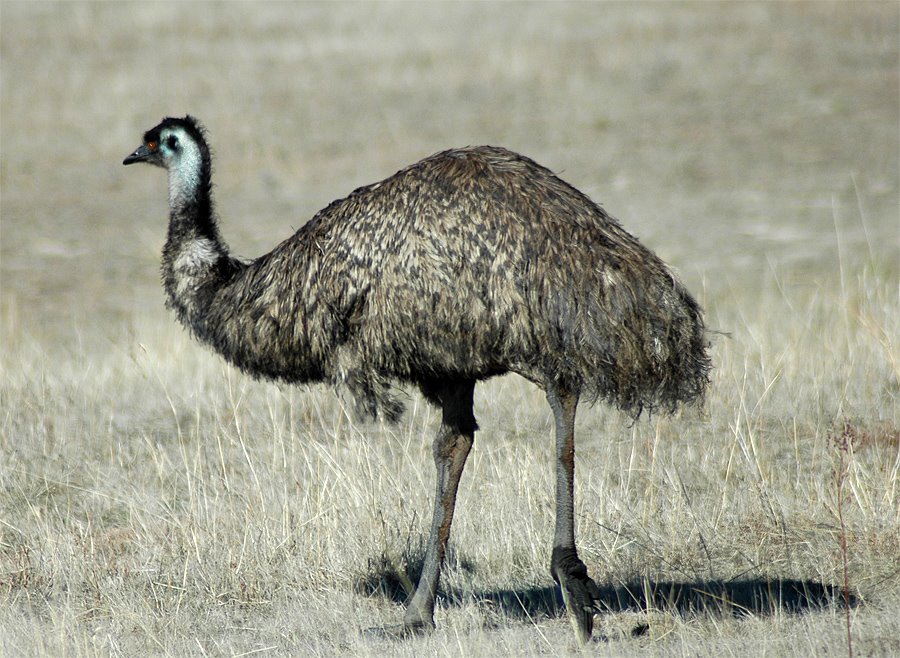
From my point of view, I consider that Emus and other Ratites are in fact highly evolved birds, which have abandoned the power of flight. They do have wings, just remnant wings which are totally useless for flight. To me, it makes sense to regard these as obsolescent organs, remnants of formerly useful structures, which they no longer need.


The left wing of this Emu is clearly visible in the photo at left, just in front of the leg. It is hanging down below the line of the body.


Female Emus lay their eggs in autumn and winter, and the male then sits on the eggs, and broods the young, and raises them. This apparent "family group" might be a female (the larger bird) and a male, in the middle with two chicks from two years ago. Alternatively, it might be a male. with three chicks. I cannot tell, but I favour the first explanation, as the middle bird is showing some of the adult blue colouring on its neck. The only problem is that Emus are not sentimental birds, and do not tend to hang around in "family groups". Partly this is explaimed by the need of the female to be able to reproduce by laying large clutches (up to 15 eggs) of huge eggs, which is a great reproductive burden. To do this, she needs to be in peak physical condition.


So the Nature of Emus is something of a mystery.

Friday, May 19, 2006

The Nature of Kangaroos

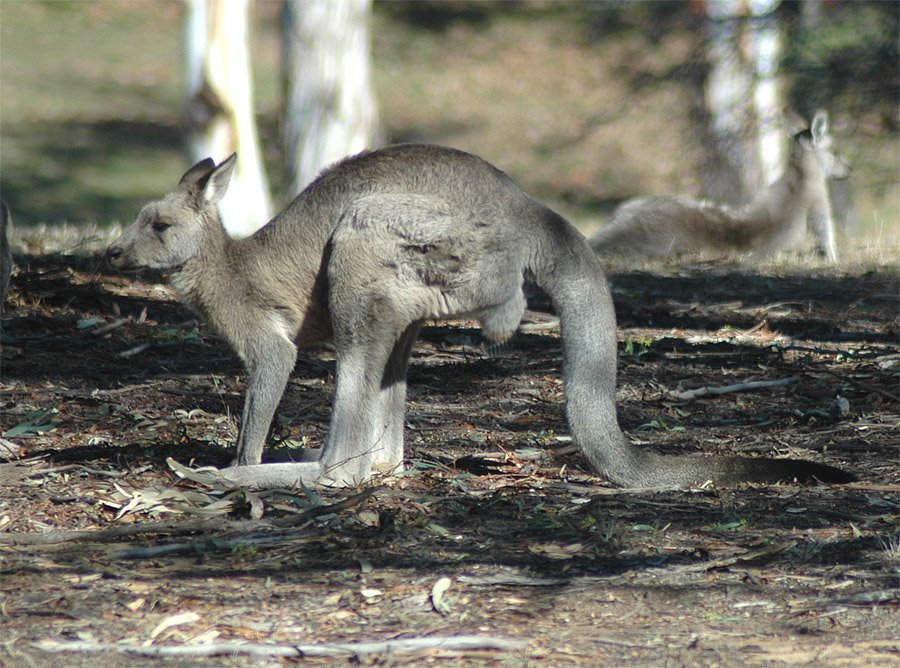
Here are a few quiet "family" shots of some Eastern Grey Kangaroos (Macropus giganteus). I am posting these today because Zoe took the photos on the weekend, and because Anni wrote about a large "mob" of Kangaroos in her blog yesterday.


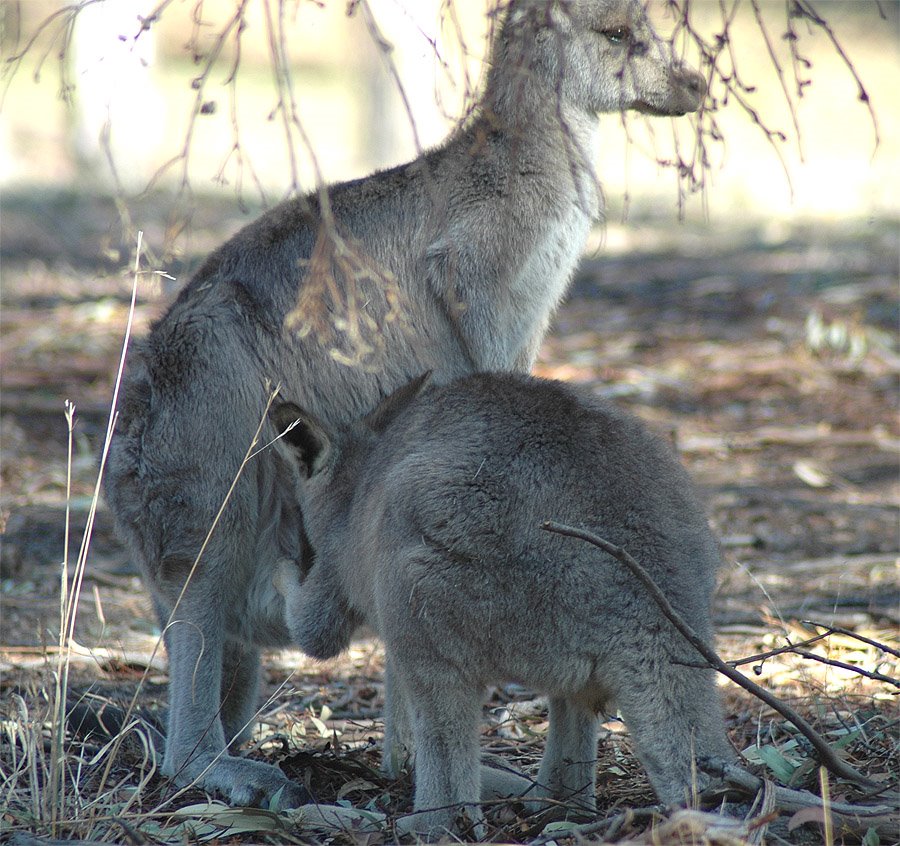
Anni wondered what they do all day. In a word, they rest. Most of the "mob" will be females, and all the mature ones will all be pregnant, or carrying a "Joey", or have a "Joey" at foot, as in the second photo. Some may be in all three stages of motherhood at once.


The other thing about such a "mob" of Kangaroos is that they feed in the early evening and early morning, when the grass is most likely to have some dew on it, allowing them to drink and feed at the same time. During the day, the "mob" usually rest under a stand of trees, where they can get some shelter from the sun.


Zoe was quite pleased to get a photo of the male taking his weight on his tail, just about to propel himself across the ground at ultra-slow speed, using the tail as a "prop" while sliding his huge back feet forward.


She was even more pleased to get a photo of a grown Joey having a bit off a feed from Mum, even though she is nearly as large as Mum is.

CSIRO biologists have studied the amazing fertility of Kangaroos, and one fact they have discovered is that the female (a "doe") can simultaneously produce milk at different stages (from different teats) to suit the developmental needs of an "independent" Joey, like this one, and a smaller one which is almost certainly a permament resident of the pouch.

Wednesday, April 19, 2006

Welcome to Squeaky Oscar

I have a brand new nephew, Oscar Alexander Finn. Actually I have a seemingly inexhaustable supply of nephews, but this one is precocious. He has his own blog site - at 9 days of age. Not bad going, Oscar! (tasteful photo courtesy of his blog site). Hope he does no have a team of copyright lawyers, already!


Have a look folks, at the hot-link above, and it is now linked in the side-bar as well! (the green writing on the side of the blog.) ("The Squeaky View")


Anyway, welcome to the world of blogging, Oscar, and welcome to the World, kid. You have a bright future ahead of you.

*****
Canberra continues to turn on brilliant autumn weather, and the deciduous trees are beautiful - not that I am taking any photographs of them. After all, the official raison d'etre is "The Nature of Robertson" and deciduous trees in Canberra do not qualify - on any basis.

I have been hanging out at the Australian National Botanic Gardens this week, and have enjoyed nice lunches there - today will Gillian. It was good to catch up with her. Gill was armed with photos of her new grandchildren. We appear to be in an age of grand-child breeding.

While at the Gardens, this week, I have also been tracking down several of those unusual plants which I commented about last week.

It turns out that one is Pomaderris glauca - the specific name means grey, or dusty, or something simlar. Certainly it has that grey appearance on its leaves. It was good to be able to see the plant "in the flesh" at the Gardens, and to be able to confirm the identification which was at best "probable" from the botanical descriptions and line drawings. Strangely, this species does not make it to the (otherwise wonderful) PlantNET site, but it is clearly described in Gwen Harden's Flora of NSW.

The other plant I saw last week, and photographed, is Eriostemon trachyphyllus (in the old books), now probably Philotheca trachyphyllus. The main identifying characteristic was, as I observed at the time, its size. It grows to a large shrub, almost a small tree. That alone makes it quite distinctive in that family of small to medium shrubs. This boring photo (at left) is just there to demonstrate that this plant has a definite "trunk". Technical photos are sometimes necessary, no matter how boring.

Other photos (not good ones, unfortunately) were displayed last week in the Bodalla State Forest blog.
*****
Incidentally, for those of you who understand these things, my brand new Macro Lens (actally a Nikon "Micro" lens) is back with the company for servicing, or replacement, as it would not "register" that the lens was connected, all the time. For the money I payed, that is not good enough!


It ought click into position positively, and be ready to work. I ought not have to hold the lens in a particular position, to make it work!. I do hope "Fletchers Fotographics" are reading this blog (and Maxwells, the Australian Agents for Nikon). After all, what's the point of running a blog, if you cannot give someone a hard time, occasionally?

I promise to thank them all, most humbly, in due course, when I hear that the problem has been solved! Smile for the Birdie! Click! :-))

Thursday, March 23, 2006

Saying Goodbye to my Mother

Dad was impatient to be up and dressed this morning - worried that he would be late (as if!).


The rest of us tried to keep things calm, perhaps privately dreading the inevitable tears, and hoping that they would remain more-or-less private. And I write that, having yesterday published the Graeme Connors text. Anyway, I guess I can acknowledge that we all choked up at various points, but we got through the formal processes of the day.


The Requiem Mass was modest, but with nice hymns, appropriate readings and prayers. Importantly, many, many people came to pay their last respects to Mum and to express their support to Dad and the rest of the family. There was a good crowd of people, including friends and relations, including many visitors from Melbourne, Sydney and Brisbane. It was great to meet again some people who I had not seen in 40+ years.


I was worried that Dad would "lose it" when Mum was buried, but he was very dignified. Once Mum's body had been lowered, those who wished to, added a symbolic scoop of gravel, as our participation in the burial process. To me this simple ritual allowed me to participate in the actual interment process, making it seem more real, less clinical, and closer to my heart. Today I helped bury my Mother, with dignity.
Interestingly, some of the great-grandchildren added some little rainbow coloured "sparkles" (star-shaped tinsel pieces), presumably to brighten Grandma's new world. A nice touch, which Nonie herself would have appreciated.


After the funeral we returned to the parish hall, where Dad met and talked with nearly everybody who attended the funeral. The rest of us got on with catching up with particular relatives and friends. The day went off as well as anyone could possibly have hoped for.