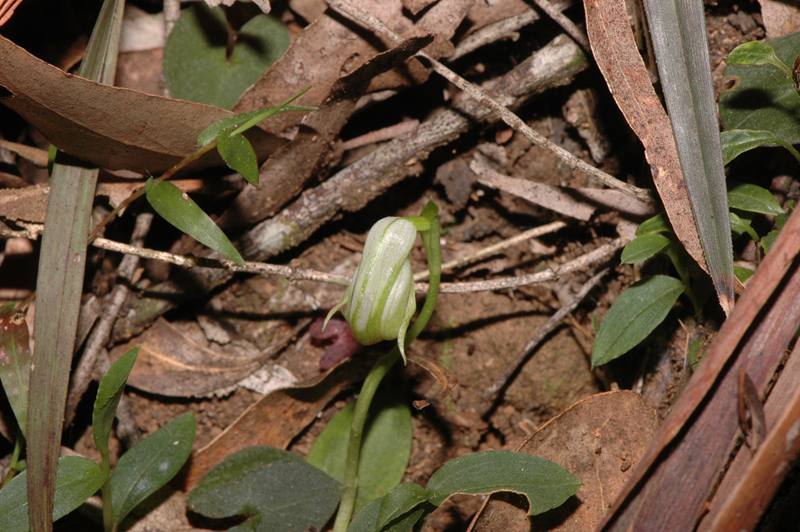
Christmas Bells

Christmas Bells
Christmas Bells - Blandfordia nobilis
Showing posts with label Macquarie_Pass. Show all posts

Monday, September 02, 2013

Dry August, but the Macquarie Pass Orchids are going gang-busters

Well, it is official, August saw Robertson (well, my house at least) got 1.5mm of rain, in two separate "rainfall events". Yep, folks, its hard to get much drier than that.
But we got a lot of rain (428mm) back in June, and so the tiny Greenhoods down on Macquarie Pass are blooming as I have never seen them bloom before.
But before we delve into the intricacies of thousands of Greenhoods, and Maroonhoods, here is a bird which brazenly walked across the roadway, in the gaps between heavy traffic rolling down the Pass. It is a native thrush, about the size of a European Blackbird, (slightly heavier, in fact).
It is a Bassian Thrush (which I once knew as a "Ground Thrush" - before the taxonomists brought Australian bird names into lock-step with the international naming conventions).

"If a Bassian Thrush is disturbed it often runs a short distance and then freezes, relying for defence on the camouflage of its mottled plumage against the leaf-litter of the forest floor."
That quote from Birds in Backyards site perfectly explains what is going on in the next shot. It scurried to the edge of the leaf litter,t hen "froze". It took me ages to even realise I had photographed the bird in the leaf litter. The yellow oval marks where it is. Look for the bird's eye.
Bassian Thrush camouflaged perfectly.
Check out the yellow oval ring, then look for the bird's eye.
The first Orchid colony
seen from across the Macquarie Pass roadway.
Pterostylis erecta colony

Pterostylis hildae and some Pterostylis erecta

A classic Pterostylis hildae
Mixed clump of Pterostylis hildae and erecta


Mixed clump of Pterostylis hildae and erecta

Nodding Greenhood - Pterostylis nutans

Mixed clump of Pterostylis hildae and erecta

A hybrid between Pt. hildae and Pt. erecta

A likely cross between Pt hildae and nutans


A likely cross between Pt hildae and Pt. erecta

Pterostylis hildae

Cross between Pt. nutans and Pt hildae

the final colony of Pt erecta and Pt hildae.


Friday, October 05, 2012

Dirty skies, hot day, and Flying Termites

Today was one of the most unpleasant days (climatically) I can recall in ages.
Sure there have been much worse days, but we in Robertson need a bit of acclimatisation to these hot north-westerlies. 

OK it was only 27.1 C (max), but the humidity is the clincher. Close to 100% at present.
I can't get a retrospective reading on that, from the Fire Brigade Weather Station, unfortunately. But it was "sticky as...." (as the young people say).


This is what the sky looked like at Albion Park Airport, at lunchtime.

Normally one can see the Illawarra Escarpment
really clearly from here.

This is the view from the top of the Macquarie Pass
Under the dirty cloud
(which is not pollution, by the way)
one can normally see Lake Illawarra
and the Port Kembla Blast Furnaces.
This is simply a result of nasty atmospheric conditions.

The immediate effect of the burst of hot weather was an enormous swarming of Termites.
All the way up Macquarie Pass (through the rainforest)
I was driving through clouds of flying Termites.
If you look at this image closely, you will see little creamy "dots"
They are the wings (the only things clearly visible on these insects)
of hordes of flying Termites.
Termites swarming in the hot air.
There are probably 80 or so in that one frame.
and that was literally a single "snapshot"
of one place, at one time.
The drive up the Pass is about 6 Km long.
How many Termites hatched today?

Late in the day, the sky turned a dirty yellow
with the sun just about to disappear.
This was at 7:02PM
Strange colours. Not a classic sunset at all.
Lets hope tomorrow is a better day.

In writing this, I am aware that there have been bushfires in the Central Coast area, and I am not trying to compare our conditions to theirs. But the "dirty sky" is not smoke haze from burn-offs, and certainly not smoke drifting down from those fires. It was just a very strange day.

Wednesday, September 12, 2012

Mysterious Ant Orchids

I cannot help myself saying this - I have done it before.

These plants are supposedly different species of Ant Orchids - of the Myrmechila genus.

But I have found these plants growing together, half way down Macquarie Pass
and they grow very closely together, yet somehow manage to keep their "differences".
It defies understanding (well, obviously, MY understanding).

Logic would dictate that the ancestors of one strain of these plants plants might well have found their way there.

But to postulate that two separate strains (or "species" if you like) have found their way to this isolated clearing within a rainforest (surrounded by unsuitable habitat for them); and that each species has established itself in this one little "opening" in the forest; yet they remain separate species, just seems so unlikely to me.

So, I fall back on the old Logical Saw of Occams Razor:
  • "It is a principle urging one to select from among competing hypotheses that which makes the fewest assumptions."
Basically, how could such an unlikely event occur?

Or, put more simply, I want to be an Orchid Heretic here, and suggest that these variations which are evident are merely individual variations between particular flowers, and NOT representatives of different species at all.

Shock horror. I may be expelled from the Australasian Native Orchid Society for saying that.

Having said all that, I note that these "species" have been recognised for a very long time. They were raised to species status by Robert FitzGerald Australia's first great Orchid specialist. "His extraordinary skills gave rise to a volume of work completed over seven years called Australian Orchids".
"The standard author abbreviation Fitzg. is used to indicate this individual as the author when citing a botanical name."
Source: http://en.wikipedia.org/wiki/Robert_D._FitzGerald#Australian_Orchids

So if FitzGerald was not troubled by my "doubts", I shall accept his species as valid and good.

Of course, the newer taxonomists have played with his original naming (which were then both classed as "Chiloglottis"). But I am following the "new names", because this name is used to separate the Spring-flowering species of this tribe. They also have their lateral sepals held out to the side of the flower, not recurved under the Labellum (as with the true Chiloglottis group).

This species (M. formicifera) has 
the labellum diamond-shaped
7–10 mm long, 6–7.5 mm wide, 
with a narrow, shiny, black, ant-like callus (gland)
extending from the base to the apex.
Myrmechila formicifera
This species (M. trapeziformis) has 
the labellum 
which is spade-shaped to diamond-shaped,
7–10 mm long, 6–8 mm wide, 
with a short, shiny, black, ant-like callus (gland)
occupying the basal quarter of the upper surface.
In other words, the lower labellum is clean
on the part furthest from the flower stem.

Myrmechila trapeziformis

Saturday, August 18, 2012

Early-flowering Orchids of Macquarie Pass and Albion Park

This morning I took my Orchid colleague, Bruce Smith down the hill, to Macquarie Pass, and on to Croom Reserve, at Albion Park, to see some of the local Orchids.
Pterostylis hildae

Pterostylis hildae

Pterostylis hildae
A lovely dark specimen of the Maroonhood, Pterostylis pedunculata
Pterostylis pedunculata

Pterostylis pedunculata

Pterostylis pedunculata

Bruce photographing a nice specimen of Pt. curta.

Pterostylis curta,
showing its famous twisted labellum

Pterostylis curta,
showing its famous twisted labellum
and in this case the "pollinia" are visible

Pterostylis curta,
this species has much fatter "bum"
than Pterostylis hildae
 Just a few of these small-flowered Black-tipped Greenhoods were in flower.
Hymenochilus bicolor

A nice grouping of Hymenochilus bicolor

Wednesday, August 08, 2012

Pterostylis hildae - the Rainforest Greenhood

This Greenhood (Pterostylis hildae) is unusual in that it likes to live in clearings in heavy wet Eucalypt forest and rainforest, halfway down Macquarie Pass. It is at the southern end of its range here. I have not found this species growing on top of the Robertson "plateau", but it is always possible that it might occur here, or a little further up than where I found it. For example, I would expect that it might be found around Vandenbergh Road, or on Knights Hill, or out at the top of the Jamberoo Pass (near the Barren Grounds, but not in the heathland there).

Pterostylis hildae

side view of Pterostylis hildae

Rear view of Pterostylis hildae

Note the slightly pointed "galea" (hood)
of Pterostylis hildae

Also the bronze colouration on the tip
of Pterostylis hildae
This colony of Pterostylis hildae has not flowered well, this season. It has been quite dry for the last two months. That would appear to have limited their flowering, this season, compared to last year, when there were literally hundreds in flower in this particular locality.

This species is closely related to Pterostylis curta, but that species has a larger, heavier flower, and a distinctive twisted labellum.

Thursday, March 22, 2012

Some Butterflies and Moths of Robertson district.

Several nights ago I found this Moth on my front verandah - for the very first time.

I believe it is Eudocima materna, The abrupt rise in the line of the wings is quite distinctive. It matches the scalloped-out shape in the upper wings which becomes apparent (over the upper abdomen) when the wings are seen partly opened (second image).

Probably Eudocima materna

Probably Eudocima materna
If it is not that species, then I am pretty confident that it is in that genus. My problem is that the only other species in this Eudocima genus which is shown as entering NSW is Eudocima salaminia, which has quite distinctive (and dissimilar - from my specimen) markings on the upper wings. The other five species shown in Australia (according to Don Herbison-Evans' website) are all tropical moths.

This genus of moths is known as an agricultural pest, known as "fruit piercing moths". Mostly they attack Citrus but they also attack Lychees where those fruit are grown commercially. Their native "host plants" are mostly in the Menispermaceae family, best known in the Illawarra region for the Snake Vine and Pearl Vine.

Switching to the Butterfly tribe I was lucky enough to capture these images yesterday, at Clover Hill Falls track, half way down Macquarie Pass. These Butterflies were quite common along that track, amongst rainforest undergrowth underneath the Eucalypt upper-storey.

 
Wonder Brown Butterfly - female

What I did not realise at the time was that these dull brown Butterflies are the females of the species (only). They are Wonder Brown Butterflies (Heteronympha mirifica). Apparently the male of this species look like the more normally coloured forms of  "Brown Butterflies" (this term is used informally).
Wonder Brown Butterfly - female
Don Herbison-Evans shows both the males and the females. He says: "For many years it was thought the sexes were from different species, as the males also tend to congregate towards the tops of hills, and the females prefer the moist gullies below". That's why I didn't realise there were distinct males and females, as I was only seeing the females in the moist gullies.

One of the things I noticed about these Butterflies was their habit of sitting with the wings held totally flat.
Wonder Brown Butterfly - female
On the slow walk back along Clover Hill Falls track to the Illawarra Highway, I came across this stunning and dangerous-looking creature. At first I was suspicious that it might have been a Wasp. I have read about these Moths which resemble Wasps, but this was the first time I had seen one close up - close enough for meaningful photos.

The "experts" seem to be very cautious in naming species of these Wasp Moths. But with the small orange dots on the wings, (as distinct from large transparent patches on the wings) this seems the best "fit" in appearance and geographical range (as far as I can check). The Atlas of Living Australia seems to be having service difficulties tonight. 

If any reader can advise me if I am not correct, I would appreciate being set right.

Eressa angustipenna
Click to enlarge image.
You can see the coiled up mouth-parts
(known as a proboscis)
Eressa angustipenna
What an amazing-looking Moth. I think you can see why I was wary of it at first.

Thursday, March 08, 2012

In the Eye of the Storm

Last evening I wrote about how a particular storm was "coming to get us"
We scored a hit, here in the Southern Highlands of NSW, and our colleagues just to the north - in the George's River catchment.

I have received 86 mm of rain overnight.
The southern edge of Sydney is on flood alert - Menangle, Liverpool, Engadine, Wolli Creek, and Audley Weir in the Royal National Park is closed (though it goes out at regular intervals). I have just heard that the Nerriga Road has water across the road, 4 Km south from the village. There are no warning signs and no police there, apparently. Jerrara Dam (water storage for Kiama - between Kiama and Jamberoo) is on "Orange Alert" - indicating a possibility of some prospect of inundation. Apparently an alert system is in place, for persons living down stream for the Dam.

I repeat the comments made previously, please do not cross any flooded roads.

There have been landslips on the Moss Vale Road (into Kangaroo Valley). A Policeman apparently was assisting with the clean up, when the road edge gave way while he was there. He was carried down the hillside some 30 metres. Radio reports said he ended up being saved by vines entangling him, and preventing him slip further. He was eventually rescued at about 3:00am, and taken to Nowra Hospital. At least he came out of it OK.

There have been rock falls on Macquarie Pass, but the road is said to be open - one may drive down the Pass with caution.

Here is the RTA "Traffic Live" web page screenshot.
Traffic Live site 8 March 2012.
If you go to the Traffic Live webpage where you may check local conditions. The blue icons will open up a box telling you the local details. Around the Upper Lachlan, and Goulburn-Mulwarree Shires, and of course, further down river at Forbes and further south at Wagga, lists of flooded roads will appear for your information.

It is a useful site to store, for future reference.

The strong winds accompanying this storm worry me more than the rain. Not that I have many huge trees on my block, but I would not like to try to take any of the main roads in and out of Robertson today. Huge trees get loosed in the wet soil, and can come down.

This is what is driving this weather.
 The high has move east since last night, and the low is sitting off Bega, dumping rain onto us and Sydney.

You can update your information from the Weather Bureau's Barometric Chart page