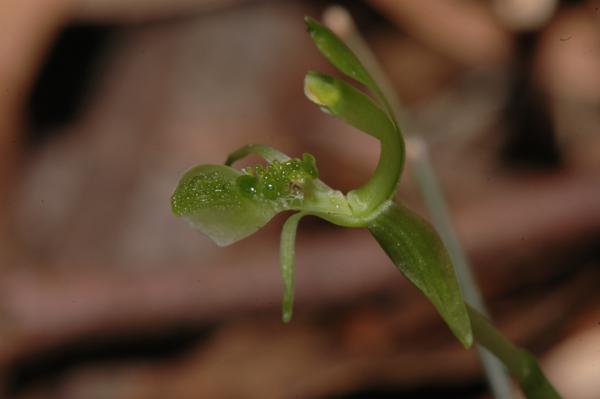
Christmas Bells

Christmas Bells
Christmas Bells - Blandfordia nobilis
Showing posts with label Spring_11. Show all posts

Tuesday, November 01, 2011

Tiny details of difference reveal the hybrid origins. (Well, maybe not)

I referred yesterday to the "hybrid" forms of the Spotted Sun Orchid, Thelymitra ixioides. In this case the form is known as Thelymitra x irregularis.

EDIT: My friend Colin Rowan has persuaded me that these plants are in fact colour variants of Thelymitra ixioides, NOT hybrids. The "true hybrid form" is shown from last year, at the end of this post. It has the yellow "brushes", not just the yellow pappilose tips to the column. Colin says that is the only true hybrid form in this set.

Tonight I will show a few examples of the same group of plants which were growing in a tight cluster, around two adjacent trees, within 30 metres of eachother.

As a base-line point of reference, I will start with one "standard form" of Thelymitra ixioides

column details of Thelymitra ixioides - Nowra, 28/8/2011
 Here is the other reputed parent of the hybrid forms illustrate today.
Thelymitra carnea has the pink colour and 
the yellow top of the column - the "post-anther lobe".
Thelymitra carnea - the Pink Sun Orchid.

Here is the botanical illustration of what I have photographed 
of Thelymitra ixioides (first image above).

PlantNET botanical illustration - note the "papillose-toothed tips"
To make matters worse, here is the botanical description from PlantNET.
"Column to 5 mm long, erect, bluish. 
Midlobe with a dense rows of long, variable, colourful calli; 
accessory lobes columnar, erect with papillose-toothed tips. 
Lateral arms obliquely erect, 
with terminal tufts of white, pink or mauve hairs." 

"Papillose" literally refers to the "nipple-shaped" tips at the back of the column.
Don't blame me - its the botanists who invent and use these terms.


See the illustration for "pappilate" - middle level, 3rd from left.
Anyway, having established what we are looking at, lets move on.

************
This is yesterday's plant, which is closest to the lilac coloured form 
which is illustrated in David Jones's book (P. 256)
as "Thelymitra x irregularis".
The ring of pappilose nodes in the back of the column
are yellow in this one.
They are black in the "species" form.
Colin points out Jones shows a plant with yellow brushes
not white as in my plant.
See the two last images in this post for the true hybrid form
Column details for Thelymitra ixioides.
This is one is the clearest pink of the hybrid plants I photographed today. 
This one has a red collar 
underneath the golden pappilose nodes.
One of the pink forms of "Thelymitra ixioides".
And my personal favourite image of these column details.
This flower was in-between pink and lilac in colouration.
I like the way the 'arms" turn away from eachother.
Thelymitra ixioides
This next specimen looks as if something has interfered with the pollinia.
From the looks of it, there is a pollen sac stuck on top of the 
 "accessory lobe" the yellow protruding structure
on my left-hand side of this image.
Thelymitra ixioides
***********************

Last year, at Penrose cemetery I even photographed a pink hybrid form
with golden coloured lateral arms 
(instead of the normal white or bluish fluffy "brushes").
So, although it is outside today's "cluster" of hybrid plants,
it is worthwhile showing, for the full contrast it offers.
Pink hybrid Thel. x irregularis - note the golden column arms.
I have never photographed such a flower before.
 This image is a view of the column of the same flower,

photographed from the side view. 

It shows both the golden "pappilae" at the back of the column
and, more significantly, the yellow "arms".
All the other plants photographed have white column arms.

Colin agrees this is the true hybrid form
Thel. x irregularis note the yellow "brushes".
This is an even more extreme hybrid form than any I have seen this year. Interestingly, Colin and Mischa's images of this species, also taken in 2010, might well be of the same plant as I photographed last year on the ANOS Southern Highlands excursion.

Wednesday, October 26, 2011

Hot weather burst finished some Orchids, kick started others

After three weeks of cold weather, with the Sun Orchids sitting there refusing to open, suddenly we got a burst of hot weather (27.9 C max). Two things happened (well three really) - my Peonies got burnt off (but I'm not going to talk further about them now), and then the little pink Caladenia type things nearly all shrivelled up, and in response to hot weather (which suits them) the Sun  Orchids, Beard Orchids and Flying Duck Orchids all popped open. So, it is a case of win some, lose some.

Firstly, the most prolific Sun Orchid which is found along Tourist Road 
The Spotted Sun Orchid - Thelymitra ixioides
The Spotted Sun Orchid - Thelymitra ixioides var ixioides.


Here is another example - a Spotted Sun Orchid with hardly any spots.
Thelymitra ixioides - a form with few spots
This flower is brand new, and the "column" has not yet fully developed.
It was just expanding, in the warm weather.
A newly opened Thelymitra ixioides
As a matter of record, these are the very first of this species of Sun Orchid to open, in Kangaloon, on 24 October 2011. The same species was rampantly in flower in Nowra, on 28 August, when I went down there with Alan Stephenson, to check out the Depot Road powerline easement - (an equally great spot for Orchids as Tourist Road, Kangaloon).
  • Similar habitat - both are slashed grasslands on sandstone base soil.
  • Different altitude - approx 60 metres in the Nowra case, and approximately 600 metres in the case of Kangaloon.
  • Difference in flowering time: 7 weeks delayed flowering - owing to the altitude and cooler climate.
The next "new season" Orchids to open in the heat were these Leek Orchids. This is an as-yet un-named species of Prasophyllum. The closest species is probably Prasophyllum fuscum, which means I can safely refer to this one as "Prasophyllum sp. aff. fuscum".
Prasophyllum sp. aff. fuscum

And finally (for tonight's Blog post) here is the Flying Duck Orchid - Caleana major. Once again, this is the first of this species to open in Kangaloon this year. I saw one last weekend, at Dharawal State Conservation area, but that is lower and more coastal. So, that time difference is not surprising.
Flying Duck Orchid - Caleana major
I love this weird little flower. it is my favourite "challenge" to the pro-Dawkins lobby, for Richard Dawkins is a keen supporter of the "Blind Watchmaker" view of evolution. I just cannot figure that something this cute, effective (and good looking) is the result of "randomness coupled with cumulative selection". But I stress I am not arguing for an "Intelligent Design" view of the origin of species. I am simply expressing my admiration for the result of some 60 million years of Evolution, in what I like to categorise as one of the marvels of the Nature of Robertson.


Thursday, September 29, 2011

Diuris pardina at Medway.

I went a few weeks ago to a favourite spot at Medway, south-west from Berrima. There were no Orchids in evidence then, alas.

I tried again today, and found lots and lots of Diuris pardina in flower. The little yellow ears were waving everywhere, in the strong wind blowing today.

My Blogging colleague Martin reported on this plant seen at 6-mile TSR, near Bungendore, a few days ago. I have previously seen them at Goulburn, on Governor's Hill.
Diuris pardina from front, and side of  a second flower

Diuris pardina - flat creamy ears, lateral sepals twisted under flower

Note the fine spots on the rear of the "ears" of Diuris pardina
Here is a comparative image of Diuris maculata (left)  
and Diuris pardina (on right).
Diuris maculata and Diuris pardina
Note the clearer yellow colour on D. maculata, and the fewer spots behind the "ears" (see image two-above for that feature).

I have previously posted better images of this species, from Goulburn. I hope to get back there to try to get cleaner photos, on the weekend when the weather improves.

Saturday, September 10, 2011

Green forms of Myrmechila formicifera on Macquarie Pass

Today I was showing Colin and Mischa (of Retired Aussies.com) some of our local Orchids.

We were having fun, watching out for not squashing some tiny Myrmechila formicifera (AKA Chiloglottis formicifera) plants, which so small, and dark-coloured that they are virtually impossible to see when one is standing up. 
Myrmechila formicifera - normal coloured plant.
Colin was busy repelling the persistent Leeches. 
Colin's pet Leech

Then suddenly he said "Oh look, there's a Green one" (referring to an Orchid).
Sure enough, there were in fact at least 5 green plants.
Here are some images of these beautiful little oddities.

Here is one "front on".
Such a lovely surprise.
A green form of Myrmechila formicifera

In "form" (shape and positioning of the glands) these plants are clearly properly formed as Myrmechila formicifera. They are simply an "alba form" (i.e., lacking normal pigmentation).

Click to enlarge the image, to see the detailed view of the glands.
They have the same "bubbles" of glands on the lower end of the labellum.
That's what defines it as M. formicifera.

I will write more in a few days 
about some others of these plants, 
which seem to be of the related Myrmechila trapeziformis.
There will be more discussion of those plants, 
when we have all had a chance to review Colin and Mischa's photos as well. 

Here is one of mine - 
to show the difference in the labellum glands.
Clean end of the Labellum. 
The "insectiform glands" are concentrated at the head of the labellum 
(close to the main part of the flower). 
Contrast that image with the first image.
Myrmechila trapeziformis at Macquarie Pass
From the PlantNET botanical illustration,  
(AKA Myrmechila trapeziformis)
there seems to be little doubt that we have found
Myrmechila trapeziformis

Botanical illustration from PlantNET for "Chiloglottis trapeziformis"
While drafting this I got an email back from Alan Stephenson
confirming his advice that it is indeed Myrmechila trapeziformis.

 Ah, is it any wonder we love getting out and around in the bush?
As Colin mentioned today, it is remarkable how much more 
a few people can find when working together, 
than a single person will ever find.

Is this the most fun one can have standing up?
Hang on, I spend most of my time down on the ground,
or on my knees,
(taking photos) !!!

Tuesday, September 06, 2011

Whipbirds feeling the Love

It was a Springtime afternoon as far as a pair of Eastern Whipbirds were concerned.

They chased each other round and round under a couple of low shrubs outside my front verandah.

They even ran along a Park Bench made out of an old Railway Sleeper.
Then remarkably this guy actually appeared in the open, long enough for me to take a couple of snaps.

They're not great shots, but given how rare this encounter was, I will accept the opportunity gratefully.
Whipbird was calling actively, and chasing another Whipbird

Whipbirds are notoriously secretive, and have an ability to judge how to sit on the far side of any bush.
Front-on view of the white cheek patches of the Whipbird
I hear these birds every day, and recently they have been calling loudly and frequently, but this afternoon's performance was notable.
I only heard the male calling. There was no female answering call. (Listen to both calls: click on the sound file sign at top of the COG Gallery page here) 

So, was this a mating ritual or a display of territorail behaviour to chase off another male bird? I really do not know. There were two birds present, but only one calling, and only one was prepared to allow itself to be photographed.

Saturday, August 27, 2011

Spring Is coming in a rush, in the "bush".

This post will primarily be about Orchids, but let me just say that the "bush" is coming alive in the Illawarra and Southern Highlands. And it looks great!

Wattles are in flower everywhere, lining the roads and tracks, and the Pea flowers are climbing, scrambling or in the case of the shrubby ones, just standing up and flowering their little heads off.

But amongst these shrubs, the spring-flowering Orchids are just coming into flower too.

Just down my local hill, below Macquarie Pass, at Albion Park, the rare and endangered Illawarra Greenhood - better known simply as "gibbosas", have started to flower. 

The name Oligochaetochilus gibbosus amounts to the unpronounceable in search of the "bent over". 

Gibbous means humpbacked. The other part of the name, refers to its few spiky hairs on the labellum.

It is listed under the EPBC Act as Endangered, because of its limited distribution.

Here is the flower seen from the side
It is demonstrating its "gibbous" posture.
Oligochaetochilus gibbosus
And from the front, with the labellum "set"
Oligochaetochilus gibbosus
The EPBC Act recovery plan for this species includes this Pterostylis gibbosa drawing by A. W. Dockrill (reproduced from The Orchardian Volume 12, Number 3, March 1997 with the permission of the Editor)
">Botanical drawing of this species by AW Dockrill
In the same area, is found a cousin of that first species, Hymenochilus bicolor
It is a Midget Greenhood which has been renamed. In common parlance it is called the Black-tip Greenhood, in reference to its labellum. 
Black-tip Greenhood Hymenochilus bicolor

***************

In the same area I found the first of the regular spring "Caladenias"

This is Petalochilus carneus, best known as "Pink Fingers"
Petalochilus carneus
 There is often considerable variation between different flowers.
Pink Fingers Orchid  Petalochilus carneus
There will be many more of these "Spring Orchids" over the next few days. 
Time and space are running out on me.

Friday, August 19, 2011

Better weather, better photos of Bird Orchids

Following on from yesterday's post on the Bird Orchids on the Budderoo Plateau, the weather was better today (at least not raining), and the flowers were one day more mature, and hence more open.

We found this particularly fine plant today,
just begging to be photographed.
Illawarra Bird Orchid - Simpliglottis chlorantha
While waiting to take these photos, I noticed that the labellum 
is very subject to movement on the wind.
These plants have a hinge in the labellum stalk.
The movement of the labellum was quite noticeable.

Here is a close-up shot of the osmophores (scent glands)
on the labellum of one of the flowers.
Compare the real thing 
with the botanical illustration below, (from PlantNET)
Labellum detail of the Illawarra Bird Orchid ("osmophores" or scent glands)
Unless you actually see these strange scent glands, 
it is hard to imagine that they are real. 
They look like green and red dobs of jelly, 
but are more solid than they look.
Illawarra Bird Orchid - Botanical illustration from PlantNET
As a fringe benefit, I realised that there was tiny Flower Spider 
hiding up inside the column of one of these Bird Orchid flowers.
The yellow pollinia sacs are the point where
the Orchid needs a pollinator to come to. 
And that's where the Spider is waiting!
Flower Spider waiting besides the yellow pollinia of the Bird Orchid
Cunning little things, aren't they?
It was tiny - not much bigger than a match-head.

Tuesday, August 16, 2011

Daffodils "Tete-a-Tete" in flower (early) and Spring Wattles

Last year I published photos of these lovely little Miniature Daffodils "Tete-a-Tete" on 27 August. It coincided with Daffodil Day.

This year, these same plants are flowering two weeks earlier than last year.
Miniature Daffodils "tete-a-tete"
They are lovely little flowers, which I always find to be "cheerful" plants. Linguistically, I should say the make me feel cheerful.

The other thing which also makes me feel cheerful, at this time of year, are the Wattles. In fact I had some assistance today to clean up several trailer loads of branches of Wattles which were damaged several weeks ago, in the heavy winds which caused havoc around Robertson. So, this is a photo from two years ago. But the flowers were just as spectacular this year.
Acacia decurrens in my yard.
But this next one is a puzzle. The only truly natural wattles in Robertson are the Blackwood Wattles - Acacia melanoxylon. This other plant, however, is self-seeded in my front yard, but does not actually belong here.

It is now well over 2 metres tall, but I have been waiting for it to flower, so I could identify it, before deciding whether or not to let it grow. I wanted to know what it was, and where it might have come from, before making that decision. 

Acacia longifolia grows commonly at my friend Jim's place, at Carrington Falls, on the sandstone plateau there, in the heavy, black soil. It is rampantly in flower down there at present. My plant is just starting to flower.
Acacia longifolia - a native wattle which is not natural in Robertson
The leaves of this species are very variable, as demonstrated by these leaves taken from three separate plants, all growing along the same roadside edge, at Cloonty Road, Carrington Falls.

The top leaf is 230mm long.  The shortest leaf is approximately 130mm. These were all mature leaves - the longest ones on each branch I selected from. In other words, the shortest one was not just a small (undeveloped) leaf, on the end of a branch.
Acacia longifolia leaves - very variable in length.
Acacia longifolia - note "pulvinus" and gland at base of leaf.

"pulvinus: the swelling at the base of the petiole, often capable of changing form to bring about movement of leaf, sometimes glandular or responsive to touch. A similar swelling near the apex of a petiole is referred to as an upper pulvinus."

Flowers of this species of Wattle are in a "rod" formation.

Here is a better image of the flowers of another specimen of A. longifolia growing at Ulladulla - in flower last Saturday.
Acacia longifolia - flowers
I have tagged this post as "Spring 2011", even though that is technically incorrect. It looks, smells and feels like Spring, so damn it, I am going to call it a Springtime post.