Christmas Bells

Christmas Bells
Christmas Bells - Blandfordia nobilis
Showing posts with label Whipbird. Show all posts

Tuesday, September 06, 2011

Whipbirds feeling the Love

It was a Springtime afternoon as far as a pair of Eastern Whipbirds were concerned.

They chased each other round and round under a couple of low shrubs outside my front verandah.

They even ran along a Park Bench made out of an old Railway Sleeper.
Then remarkably this guy actually appeared in the open, long enough for me to take a couple of snaps.

They're not great shots, but given how rare this encounter was, I will accept the opportunity gratefully.
Whipbird was calling actively, and chasing another Whipbird

Whipbirds are notoriously secretive, and have an ability to judge how to sit on the far side of any bush.
Front-on view of the white cheek patches of the Whipbird
I hear these birds every day, and recently they have been calling loudly and frequently, but this afternoon's performance was notable.
I only heard the male calling. There was no female answering call. (Listen to both calls: click on the sound file sign at top of the COG Gallery page here

So, was this a mating ritual or a display of territorail behaviour to chase off another male bird? I really do not know. There were two birds present, but only one calling, and only one was prepared to allow itself to be photographed.

Monday, December 28, 2009

Creatures which revel in the fog.

There are some creatures in Robertson which revel in the Fog.
It is their natural environment. These are secretive, skulking birds which avoid being seen. So when the fog is thickest, they come out to "Party".

I refer to the Whipbirds (Eastern Whipbirds - Psophodes olivaceus to be precise).

I have lived here for about 7 years, and have only ever taken photos of whipbirds once before, yet I "live with" these birds every day. I just do not see them.

When Whipbirds are around, they are nearly always on the other side of any bush --- hiding away from people. They lurk in the bushes, they scold you through the bushes, with their hoarse, scratchy, croaky voices.(Courtesy of Lamington National Park website - recorded by Dave Stewart).

And then suddenly the male starts his call - a long drawn-out pure whistle, followed by a "crack" sound - hence their name, from the sound of the Stockwhip being cracked. (Click here to listen to a recording - courtesy of Fred Van Gessel, from the "Birds in Backyards" website).

The female, if she is around, usually answers with two or three "Chew, Chew, Chew" calls - immediately after the male's "Crack" call. I say three, because in Robertson they girls do triple calls, but elsewhere, it is normal for them to give only two answering calls.

This morning, I heard very loud whip-cracking going on just outside my kitchen window. I looked through the balcony slats and saw this:
No other bird looks like this. The white cheek patches of the Whipbird are totally distinctive. Also the fact that the bird was mostly hidden also fitted with its secretive nature.

The surprise was that when I appeared on the deck, camera in hand,
the Whipbirds - for there was a pair - did not flee. The sky was still misty and that may have helped them feel at home.
I had to open the camera right up to get any images at all.
Apologies for the poor quality
but they are worth publishing - for the rareness.
They were playing around on a pile of cuttings from a tree
which had been felled in a recent storm.The male twists his tail sideways as he begins his extraordinary call.
You can see that is is wedge-shaped, and has a few white dots on the end of the tail.

After putting up with me trying to sneak some shots of this rare display, suddenly the Whipbirds decided that I had over-done it, and they departed suddenly.

This is a typical shot of a Whipbird - flying fast and low, with the long, wedge-shaped tail spread, as it disappears from view - heading for dense cover. But even at speed, the white cheek patches are distinctive.
Vale little birds - see you in another 3 or 4 years time.
I'll listen to you tomorrow morning, though!

Tuesday, July 04, 2006

The Nature of birds in winter

This week has seen the continuation of winter (of course). A rich and varied pallette of weather, from cold and dry and sunny, to cold and wet and windy. Whatever the weather, the birds still need to keep on doing their thing.

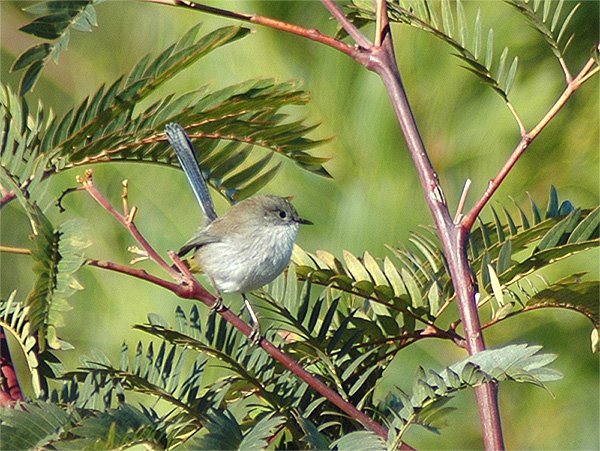
On a cold clear day, earlier this week, there was a Superb Fairy Wren, (Malurus cyaneus) male in "eclipse plumage", sitting outside my study window. These birds which look like the female, differ by having the distinctive blue tail feathers of the male, and dark eyes and beak, not the reddish brown colours of the female Wren.

The "Blue Wrens" (to use the more popular name) are often seen busily scurring amongst the shrubbery looking for insects. But this little fellow was happily sunning himself for a few moments, before ducking off in his usual busy manner.

Its call may be heard if you download the MP3 file from this site (item no: 36).


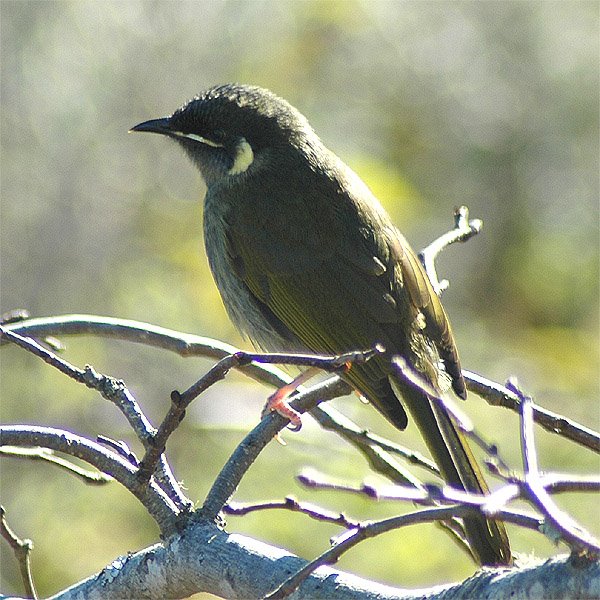
Another bird which is commonly seen around Robertson in winter (well, all year, actually) is the Lewin's Honeyeater (Meliphaga lewinii). For a true Honeyeater, (by which I mean not a Wattlebird), this is a large Honeyeater.

It has the distinctive yellow ear patch, a yellow "gape" (mouth marking) at the edge of the beak.

This bird is quite common in Robertson, but it likes to be in the heavy shrubbery. Consequently, it is more often heard than seen.

The ABC site linked here below will allow** you to download a file which will play the call of this bird for you. It has a rapid and repeated piping call.

** Note: the links to the bird calls on the ABC's site require you to have, or to install "Real Player" , which is available for downloading from that site. If you do not wish to proceed with that process, I can understand. It is not necessary to listen to these calls, if that process is troublesome for you.

For a Honeyeater, this bird is distinctive in that a large part of its diet is made up of fruit and berries. It is also fond of certain flowers in my garden, for their nectar.

However, this bird was hanging around in the Ink Bush (Phytolacca sp) for the purpose of gathering the ripe "inky" berries, which it loves.
*****
Other birds which are commonly seen and heard in winter, are the Bowerbirds, which come out into the paddocks to feed on insects (specifically in winter).
Crimson Rosellas are common, but often difficult to photograph, unless one has a bird feeding table.
Wonga Pigeons and the Eastern Whipbird (Psophodes olivaceus) (image visible at this site) are still around, but very hard to photograph. The Whipbird's distinctive call may also be downloaded from the ABC's site here.

Wednesday, February 01, 2006

Enjoy the Nature of Robertson

I concluded yesterday's posting with with a little item about the call of the Lyrebird. I then added: "Enjoy! It is part of the Nature of Robertson". I think that point warrants being fleshed out.


There is so much about the nature of life in Robertson which is enjoyable. The people are decent, caring individuals, for a start. What - all of them, you ask? All the time?

Who knows? But most of them, most of the time, I will attest.


Unlike city dwellers (and I include local towns of Bowral and Moss Vale in that generalisation), the people of Robertson are very closely attuned to Nature. The farmers work the soil or their animals. In the Village, gardeners work the soil, but they know they have to compete with the Bowerbirds to harvest their crop of fruit, or berries, or even flowers like Roses.


As with Anni's recent trip away, when you get back, you have things to deal with in the garden, like overgrown lawns, and swollen Zucchinis. When I was away last year, for medical reasons, I was constantly aware of what might be happening in the garden - the weeds swamping the Peonies, or new flowers coming into bloom.


Very often we see Wombats standing, or walking slowly, beside the roads. Property-owners just on the edge of town live with them burrowing under fences, or even under houses. If you leave a shovel out in the garden a Wombat will poo on the blade over night - to mark it as his territory, not yours. How lucky are we to have the animals to remind us of that bold fact?

There are people who take their dogs for a walk down to the Cemetery, every day. In so doing they hear the Whipbirds (Psophodes olivaceus) "cracking" from the shrubbery, or hear the Black Cockatoos (Calyptorhynchus funereus) wailing like "Banshees" out from the trees overhead. I wake to the sounds of bird calls, every morning. How sweet is that?

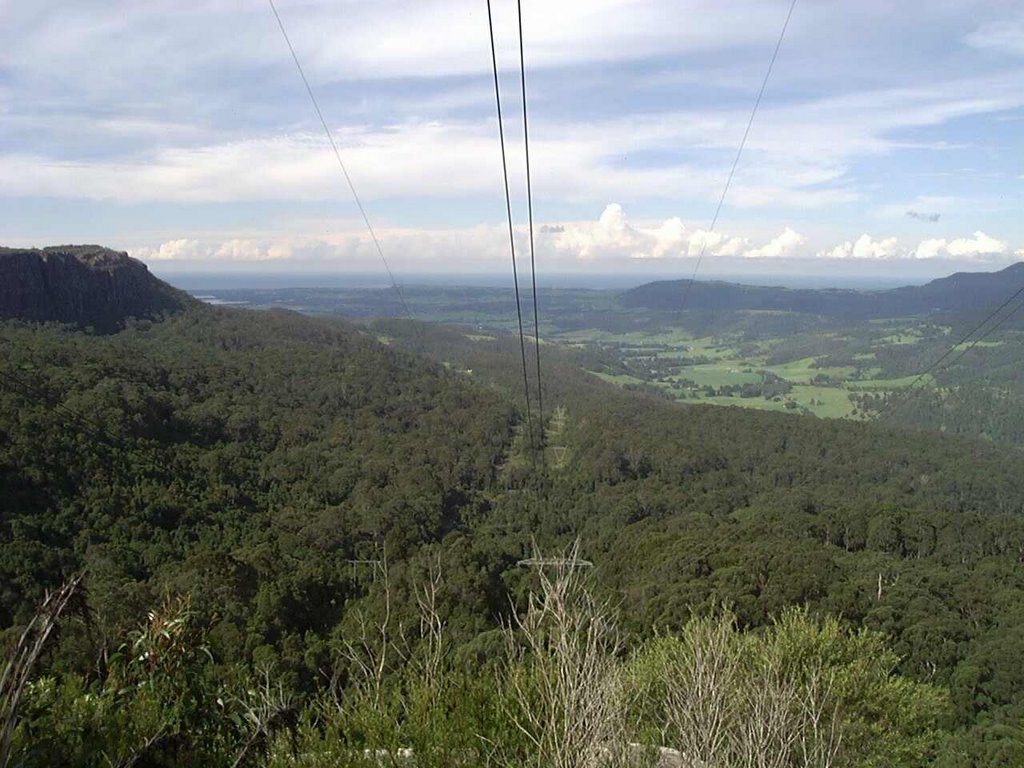
Every time I look out the window, I see trees, greenery, flowers (and yes weeds, of course). But Nature is there - in my face, every day. If you live on a hill, as I do, you will have a view of distant mountains. Or, if you are lucky, out to the coast. How good must that be? (Take a bow, you McGuinness Drive residents, especially).


Alternatively, on foggy days, you are yearning for the fog to break, so you can see where your place is, in the world, again. You know you are "grounded". But without being able to see it, you know something is missing. It is such a lovely feeling to see the surrounding environment again, after a fog.


The weather in Robertson does not allow you to ignore it. It is such a dominant force. If you live here, you know you are part of Nature. That is what gives us all the "edge" - in being able to enjoy what is happening around us - the awareness that we are part of a system, something far greater than mere human endeavour.


We are part of the Nature of Robertson. And we enjoy it.