Christmas Bells

Christmas Bells
Christmas Bells - Blandfordia nobilis
Showing posts with label Dobsonfly. Show all posts

Tuesday, December 09, 2014

Dobsonfly - Archichauliodes species.

I always find Dobsonflies to be slightly strange insects.
They are as big as Dragonflies, but they fly with a weak, fluttering motion which immediately sets them apart from Dragonflies. They are partially aquatic. Eggs are laid on land (on rocks or vegetation). Then Larvae crawl to fresh water and become completely aquatic, until such time as they are ready to pupate.

From: http://www.ento.csiro.au/education/insects/megaloptera.html
Megaloptera: dobsonflies and alderflies
CharacteristicsThis is a very small order of Australian insects commonly known as alderflies and dobsonflies. They are medium to large sized insects with a wingspan ranging from 20 to 100 millimetres. Alderflies and dobsonflies can be recognised by the following features:
Archichauliodes species
Archichauliodes species (CORYDALIDAE)
  • Long, soft, flexible bodies, usually dark coloured
  • 2 pairs of membranous wings of similar size, often bearing dark patches.
  • At rest the wings are held roof-like over the body
  • Mandibulate mouthparts
  • Long filiform antennae which taper towards the end
CORYDALIDAE is a widespread family of dobsonflies and well represented in Australia.
Archichauliodes species are inhabitants of cold-water streams and can be found from southern Australia to north Queensland. Adults of this species can usually be recognised as they have 4 or 5 large spots on their hind wings in addition to many smaller spots towards the edges of the wing.
The larvae of alderflies and dobsonflies are aquatic, appear caterpillar-like and possess gills along the sides of their abdomens.
Archichauliodes species
Archichauliodes species (CORYDALIDAE)
DJW Notes:
They are not completely Aquatic in larval stage of their life-cycle (again, unlike Dragonflies).

Back to CSIRO site:


"All species have aquatic larvae and mating occurs on the vegetation close to freshwater streams. Female alderflies and dobsonflies may lay up to 3000 eggs on rocks or debris close to the stream but not in the water. When the larvae hatch they enter the water and live a permanently aquatic life until they are ready to pupate. At this stage the larvae move out of the water into the adjacent leaf litter or soil where they pupate for several weeks. The complete life cycle may take only one year in warmer areas or up to 5 in colder climates."

Here was my first ever photo of a Dobsonfly.
It took me ages to get a proper ID on it, because, apart from specialist Entomologist site, there is not much readily available on them. At first I thought this was a Stonefly, but it is not. Nor is it a Giant Lacewing (with which it might be confused).
Dobsonfly on Tea Tree.
Wingecarribee Swamp, Nov 2007
This was found on the edge of the Wingecarribee Swamp, in late November 2007. On a flowering Tea Tree (Leptospermum sp.) But that fits with its aquatic larval lifecycle. My insect, from yesterday, was also attracted to the flowers of relative of the Tea Tree (Astartea fascicularis).


Archichauliodes species (CORYDALIDAE)
  • Great photo of a Dobsonfly
    originally sourced from CSIRO "What Bug is That?"
    Unfortunately that site appears to be
    no longer being maintained.

    Thanks Mr Abbott.
    Dobsonfly on my front porch - attracted to the light
    4 December 2013
    Seems they like to fly at this time of year.
Here is another page from CSIRO, to show some of the differences between Dobsonflies and Ant Lions and Lacewings.
http://www.ento.csiro.au/education/insects/neuroptera.html


Since publication, I have been contacted and provided with a working link to the "What Bug Is That?" site.
It is 
http://anic.ento.csiro.au/insectfamilies/index.aspx
Thanks to the ever alert members of the scientific community.
You know who you are :)

Friday, December 06, 2013

A hot, mothy night in Robbo, (last night)

It is cold and windy tonight and no moths are around.

By contrast, last night was "one of those nights" when one could not move for the moths around the front porch light.

Also a Dobsonfly which I have only previously seen close to the Wingecarribee Swamp, and last New Year's Eve when one flew into a Party at Dan Beville's place.


Have a quick look at these photos of insects and moths from last night.
Few names as yet, but I hope to track down some names for the more distinctive ones over the next week or so, I shall add any names I can track down,

Feel free to email me with name suggestions.
peonyden (at) gmail (dot) com.

https://www.facebook.com/media/set/?set=a.10152423797124829.1073741868.809229828&type=1&l=3594a60638

Monday, January 02, 2012

When is a Stonefly not a Stonefly? Ask Mr Dobson.

Well, the first problem is that nobody seems to know who Mr Dobson is or was.
  • "References to the names "dobson" and "hellgrammite" (both referring to the larvae) date back at least to the late 1800's, but to date there is only speculation as to the actual origin of these names" (Source: Wikipedia)
But according to convention I shall stick with the established name "Dobsonfly" for this insect.
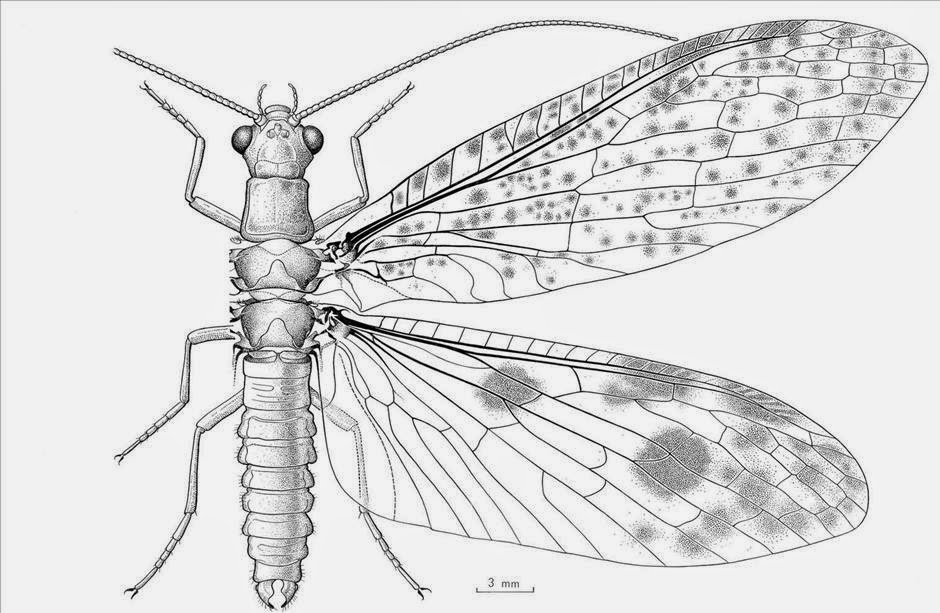
CSIRO ILLUSTRATION OF A DOBSONFLY - Archichauliodes sp., adult

I did say that this "sighting" occurred at a New Year's Eve party, which accounts for the very fine shoes and stockings in the image. But trust me, they are incidental to the real story - the identification of the insect. No discussion nor comments will be entertained, except re the insect. Foot Fetishists are not welcome here.

In this image you can clearly see the long antennae raised up over the head.
Then there is the long neck, with two orange coloured sections.
Then the semi-transparent wings with grey spots on them.
A Dobsonfly - found at a party.

Dobsonfly showing the neck, with 3 legs visible.
In this next image kindly ignore the "masking off"
I had to engage in here.
It served to remove the underneath of a shoe
upon which the insect was crawling.
The image of the sole of the shoe 
was so bright (owing to the Flash used)
that everything else in the image was barely viewable.
With a little help from Photoshop 
I have been able to tone the image down somewhat.

You can at least see the Dobsonfly's lower abdomen
- the yellow, soft body -
(under its wings - the long grey objects above the body) 

This image is useful, if "weird". The abdomen clearly lacks any "filaments"
The point of that image is to demonstrate that 
this insect's "rear end" does not have any 
long "filaments" protruding out the back
So, it is not a Stonefly.

This next image was an attempt to check the mandibles.
Only partially successful.
But BugGuide shows me that males of at least some species of Dobsonflies
have large "pincer-like mandibles" held straight out in front.
This one clearly does not have those, 
So I conclude that this is probably a female.
You can also check this image from Wikipedia.
Female Dobsonfly, with small mandibles. My hand - for scale purposes.

Many thanks to James who had his Mobile Phone Camera at the ready.
He professes not to be an Entomological Photographer
But in truth, he did  a better job 
than I was able to do (without my camera).

What's that old adage, Denis?
Never leave home without your camera!
I chose not to take it to a New Years Eve Party 
(for good and sensible reasons)
But I should have at least had it safely stowed away in the car.
Never leave home without your camera, Denis!
Post-script:
Three years ago I wrote about Stonefly larvae I found on the local sandstone plateaux. I included in that post an image of what I then believed was an adult Stonefly.
Having seen this Dobsonfly (above) and photographed it from several angles, and compared those images with a host of other CSIRO and other Internet sources, I now conclude that my supposed Stonefly image, was in fact, almost certainly  a Dobsonfly.
Dobsonfly, not a Stonefly, as first thought.
 

Wednesday, May 13, 2009

Stonefly larvae in pools on the sandstone.

Here is a tiny pond creature I found in a pool of water beside a track, out on a sandstone plateau. It was only about 0,5cm long (5mm). It is equipped with a formidable set of jaws, and its other most noticeable feature is the prominent paired cerci (tail appendages). I knew enough to know that Mayflies have distinctive triple cerci. So what was this? Obviously not a Mayfly larva.

Here is one of these tiny creatures photographed from the underside.
Another image of the same specimen. Unfortunately, some pool debris is attached to the tail, confusing me as to its proper shape. Fortunately the dual tail antennae are clearly visible in the first shot.
"Stoneflies, order Plecoptera, are distinguished by two long thin tails projecting from the rear of the abdomen. The body is somewhat flattened, and there are two claws that extend from the three pairs of segmented legs. Stoneflies are considered crawlers and crawl around looking for food. They are not tolerant of water pollution."

After some time studying this pool, it was obvious that there are other far smaller creatures moving around in there, which I would need a laboratory magnifying lens or microscope to study. Stonefly larvae are classed as "crawlers" by people who study pond life.What surprises me about finding many 
of these tiny larvae
is that I have only once identified*** an adult Stonefly.
It was a moderately large flying insect (as large as an average Dragonfly). This one was found beside the Wingecarribee Swamp in November 2007. But here were lots of Stonefly larvae out on the sandstone plateau, but I have never seen adult Stoneflies there. A puzzle to me.

***
The "puzzle continues" On New years Eve, 2011 I found an insect which looks very similar to this one, (above).
With the aid of a friend's Mobile Phone/Camera we got enough "angles" on that insect to indicate it is a "Dobsonfly".
That ID casts doubt on the validity of the ID of this adult insect (above) as being a Stonefly..
The larvae are OK, though.
Check my Blog for January  2, 2012 for the other information.

Denis