Christmas Bells

Christmas Bells
Christmas Bells - Blandfordia nobilis
Showing posts with label Robertson. Show all posts

Thursday, February 26, 2015

Moving On

I am sitting at Cafe Rockabella in Robertson tonight (surrrounded by noisy children - but in fairness, their parents are paying customers, and I know they will all go home early).

This morning I handed in the keys to the house I have called home for 13 years.

That is a scary thing to do.

So Lulu is asleep in the car.
Robertson has not disappointed me, however. We just had a cloudburst event.


This gives me confidence that Life in Robertson will continue, as normal after I have left the Village.

OF COURSE IT WILL..........

Thursday, January 01, 2015

Last Year, and New Year - on the cusp.


Firstly, just a few photos of a small party on New Year's Eve, at Vicki and Owen's place and a few photo of a beautiful rose flowering outside my bedroom window.

As usual these are found at a Facebook Album which is accessible to everyone freely.
No need to sign up for anything.
https://www.facebook.com/media/set/?set=a.10153465684089829.1073742007.809229828&type=1&l=64a7f57127

It behoves me to publish an annual figures for rainfall at my house for 2014.

Monthly totals - January through December, and Total for 2014.
I can confirm that my record is very close to the official Bureau of Meteorology figure for Robertson village, despite notable variations on a month by month basis. They got an annual total for 2014 = 1728.3 mm.
Lousy photo through glass
just to show it is a real Blue Wren


Going Up
Male Superb Blue Wren chasing his own reflection
Adult Crimson Rosella looking for yesterday's
left over Watermelon


A lovely photo of a lovely rose.
Just Joey as it was on New Year's Day.

Tuesday, December 09, 2014

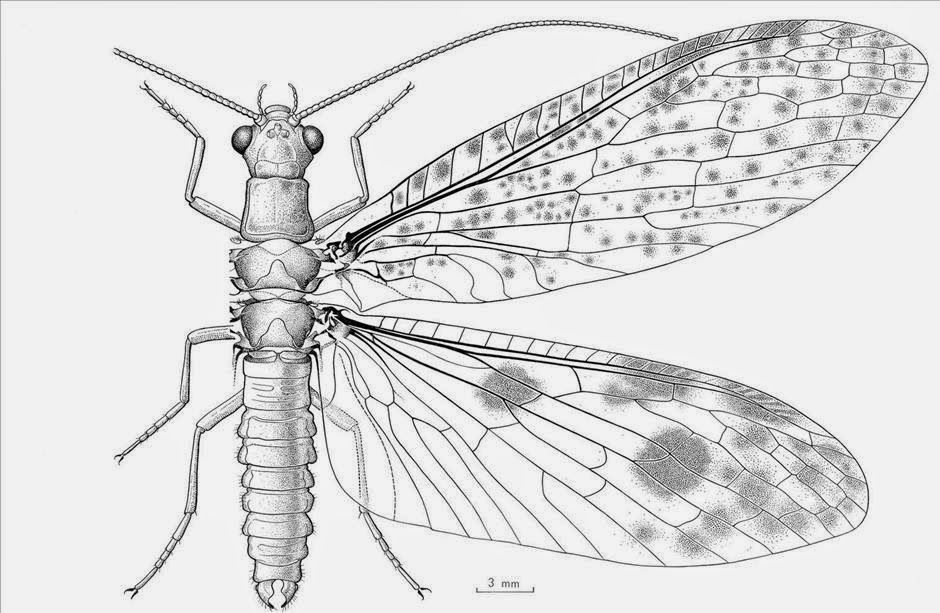
Dobsonfly - Archichauliodes species.

I always find Dobsonflies to be slightly strange insects.
They are as big as Dragonflies, but they fly with a weak, fluttering motion which immediately sets them apart from Dragonflies. They are partially aquatic. Eggs are laid on land (on rocks or vegetation). Then Larvae crawl to fresh water and become completely aquatic, until such time as they are ready to pupate.

From: http://www.ento.csiro.au/education/insects/megaloptera.html
Megaloptera: dobsonflies and alderflies
CharacteristicsThis is a very small order of Australian insects commonly known as alderflies and dobsonflies. They are medium to large sized insects with a wingspan ranging from 20 to 100 millimetres. Alderflies and dobsonflies can be recognised by the following features:
Archichauliodes species
Archichauliodes species (CORYDALIDAE)
  • Long, soft, flexible bodies, usually dark coloured
  • 2 pairs of membranous wings of similar size, often bearing dark patches.
  • At rest the wings are held roof-like over the body
  • Mandibulate mouthparts
  • Long filiform antennae which taper towards the end
CORYDALIDAE is a widespread family of dobsonflies and well represented in Australia.
Archichauliodes species are inhabitants of cold-water streams and can be found from southern Australia to north Queensland. Adults of this species can usually be recognised as they have 4 or 5 large spots on their hind wings in addition to many smaller spots towards the edges of the wing.
The larvae of alderflies and dobsonflies are aquatic, appear caterpillar-like and possess gills along the sides of their abdomens.
Archichauliodes species
Archichauliodes species (CORYDALIDAE)
DJW Notes:
They are not completely Aquatic in larval stage of their life-cycle (again, unlike Dragonflies).

Back to CSIRO site:


"All species have aquatic larvae and mating occurs on the vegetation close to freshwater streams. Female alderflies and dobsonflies may lay up to 3000 eggs on rocks or debris close to the stream but not in the water. When the larvae hatch they enter the water and live a permanently aquatic life until they are ready to pupate. At this stage the larvae move out of the water into the adjacent leaf litter or soil where they pupate for several weeks. The complete life cycle may take only one year in warmer areas or up to 5 in colder climates."

Here was my first ever photo of a Dobsonfly.
It took me ages to get a proper ID on it, because, apart from specialist Entomologist site, there is not much readily available on them. At first I thought this was a Stonefly, but it is not. Nor is it a Giant Lacewing (with which it might be confused).
Dobsonfly on Tea Tree.
Wingecarribee Swamp, Nov 2007
This was found on the edge of the Wingecarribee Swamp, in late November 2007. On a flowering Tea Tree (Leptospermum sp.) But that fits with its aquatic larval lifecycle. My insect, from yesterday, was also attracted to the flowers of relative of the Tea Tree (Astartea fascicularis).


Archichauliodes species (CORYDALIDAE)
  • Great photo of a Dobsonfly
    originally sourced from CSIRO "What Bug is That?"
    Unfortunately that site appears to be
    no longer being maintained.

    Thanks Mr Abbott.
    Dobsonfly on my front porch - attracted to the light
    4 December 2013
    Seems they like to fly at this time of year.
Here is another page from CSIRO, to show some of the differences between Dobsonflies and Ant Lions and Lacewings.
http://www.ento.csiro.au/education/insects/neuroptera.html


Since publication, I have been contacted and provided with a working link to the "What Bug Is That?" site.
It is 
http://anic.ento.csiro.au/insectfamilies/index.aspx
Thanks to the ever alert members of the scientific community.
You know who you are :)

Thursday, December 04, 2014

Wednesday, November 05, 2014

Bearded Tylophora flowering inside my Study

As I write, my Study is being invaded by a branch of Tylophora barbata, the “Bearded Tylophora”.

Ever since moving to Robertson in 2002, I have been aware of this small “climber” but have never known why it got its bearded reference. Just this last week, I realised that one of these small plants had made its way up from below my house, snuck in between the external cladding and then having entered the house structure, it has followed a tiny shaft of light, through a hole. Thus it has entered my Study.

I have ignored it for many months. My reward for doing that is that when I looked at the plant in late October, I realised that there were some flowering structures “Umbels” with small, dark flowers attached.

This surprised me. So I grabbed the camera.
And this is what I found. Flower of Tylophora barbata held against a  5 cent coin for scale.

Tylophora barbata
held against a 5 cent coin - for scale purposes.
The first thing which struck me was the extreme geometrical construction of the flower. It also reminded me of a Hoya flower which my mother used grow. Indeed they are in the same family.

Here is a closer image.

Tylophora barbata
Note the 5 segments of the flower
and the dark nodular glands
and the 5 white segments in centre
which are where the anthers are located.

This shows the structure of the sexual organs of the plant: “Calyx segments 5, sometimes with small basal glands inside. Corona of 5 spreading fleshy obtuse knobs fully fused to staminal column”. So the stamens are in the central white structure. The dark knobs are glands, presumably to emit scent to attract tiny insects as pollinators. My nose is not sensitive enough to detect any scent.

This next shot (using a different lens and flash setup) shows that there are short, silvery bristles all over the inner parts of the flower. 

That takes me back to the name of the plant.
The generic name is derived from the Ancient Greek tylos "knot", and phoros "bearing", from the swollen staminal coronal lobes. Barbata means "bearded" from Latin.
In “The Guide to the Yarrawa Brush” it says: “There are small hairs on the petals, hence the name Bearded Tylophora”.
Tylophora barbata - note the fibres on petals.

So how does this plant get inside my house?

Paired leaves ("Opposite")
of Tylophora barbata
Here is the plant outside my hose, climbing up one of the brick piers.
It likes to grow in dark, moist places, under trees, or in this case under a house.


In fact, it has snuck up between the outer cladding of the house and found a small hole in the floor. The vine stems are so fine that it can enter just about anywhere it wishes to explore.

One it grew to the appropriate height, because it is in a dark area,  it would then follow any shaft of light, to grow up towards the light, Thus it is easy to work out how it appears to have a "sense of direction". The light give it that direction to follow.

Wednesday, October 15, 2014

My garden is looking pretty good after the big storm last night.

Here is a link to a Facebook Album of recent photos.
https://www.facebook.com/media/set/?set=a.10153261668544829.1073741968.809229828&type=1&l=09b8db7493

You do not need to join Facebook - this album is fully public to everybody.

Here is a sample. My favourite Waratah flower growing just outside my front door. It is looking at its prime right now.
The styles (the pointy bits in each flower)
are now opening out well.
The whole head of flowers is called a "conflorescence"
About 50% of the individual flowers are now open.
 

Monday, July 28, 2014

Great sunset colours this evening Monday 28 July 2014

While working on my computer, this afternoon,
I noticed an eerie pinkish glow in the western sky.
Of course, it was sunset.
But such rich colours, with a distinct purplish tinge.

Looking to the far-south-west.
Main patch of colour around to the right (west).

The tall conical tree is the Sassafras I regularly photograph.
The light changes, the range of visibility changes,
depending on conditions.

Similar angle, slight change in light as sun set changes colour.

Taken from the western side of my house.
Looking through deciduous trees.

Friday, April 04, 2014

Scorpion in Robertson

I have heard of Scorpions being in Robertson, but I have not seen one before.
This specimen was captured by a friend, and I asked to take its photo. It was already deceased when I was told about it.
It had walked into my friend's house, near Fountaindale Road.
It was trying to crawl under a sofa. This is reported widely as common behaviour of Scorpions in Australia.
A small Scorpion, probably a "Southern or Wood Scorpion",
Genus Cercophonius (most likely)
The general advice from Australian websites is that our Scorpions inflict painful stings, but are not fatal for humans. Good news for us in Australia. It is different in other countries.

"The Australian species can inflict a painful sting that results in swelling and pain for several hours, but there have not been any confirmed deaths of people from stings from Australian scorpions. Medical advice should be sought if you are stung by a scorpion." Museum Victoria

This Scorpion appears similar in size and general form to the Victorian species (plural) known as Southern or Wood Scorpions.  Apparently there are at least six species in the genus 
Cercophonius.   


Most likely this is a
Southern or Wood Scorpion
Cercophonius squama, it is a very small species (~25mm). It tends to spend most of its life buried down under rotting logs where it consumes many small insects, incuding termites. It rarely faces predators head on (in open battle). As such is one of our least toxic scorpions.


Head on view of the Scorpion
I thought that the "pincers" (pedipalps)
were single only, but of course they are dual parts
just very finely matched, so that they appear as a single unit
when not opened to clasp prey.


Close-up shot of the pedipalp
Only in close-up can one see both sides to these pincers.

I have never had any close contact with Scorpions previously.
When we turned it over, we were surprised to see these brush-like structures
underneath the second body section of the Scorpion.
"a pair of featherlike sensory organs known as the pectines"
Source: Wikipedia


The comb-like "pectines" are visible underneath
the "mesosomal section" of the Scorpion.
Sorry about some extraneous fibres visible in this photo.
"The second segment has the pectines, sensory organs that are unique to scorpions.  The pectines are paired, comblike structures attached to a small plate called the basal piece; evidence suggests that the pectines function in evaluating textures of surfaces the scorpion is walking on and in detecting chemical substances (pheromones) used in sexual attraction." 
Source: http://www.vaejovidae.com/Anatomy.htm


Tuesday, March 25, 2014

Luminous Fungi

I have seen Omphalotus nidiformis previously, but on Saturday I found some really nice, fresh ones.
Omphalotus nidiformis as seen in daylight.
scalloped edge cup with golden and grey tones on top
underneath, creamy gills resembling the "oyster mushroom" group.
They are toxic (producing vomiting), but not lethal apparently.
I certainly do not recommend ingesting them,

I decided to try something I had heard about, namely, trying to photograph them glowing in the dark.


Fortunately, my friend David Wallace was having a birthday, and he happens to have a Camera tripod. So, I cut two of the Fungi and took them to David's Birthday Party.
Happy Birthday, David - can I put these luminous fungi in a dark room, please?
What's weird about THAT?

After Liz offered the use of the main bedroom for a "dark room", I set up the tripod.
I can only set the exposure time (on my Nikon DSLR) for 30 seconds, and to get any "glow" to register, I had to opt for the maximum ISO setting available to me. So the results are very grainy.
However there are some results to see.

This is the first time I have done this.

It surprised me that they look green (on the camera) because by the naked eye, they just look dull white. But someone suggested that in fact the colour on the camera is probably accurate, just that our human eyes do not register colour in very low light conditions. Something to do with our "rods and cones".
"The retina contains two types of photoreceptors, rods and cones. The rods are more numerous, some 120 million, and are more sensitive than the cones. However, they are not sensitive to color."
Source: http://hyperphysics.phy-astr.gsu.edu/hbase/vision/rodcone.html


So there it is. In order to see in low light, we sacrifice the colour sensitivity.
The things one can learn from studying Luminous Fungi.

Omphalotus nidiformis
The gills are clearly visible in their own light


Omphalotus nidiformis
Two fungi together.
The stems are showing up black, not bioluminescent
but the gills show up really well.
The funniest thing for me, was explaining to many of the other people at David's Birthday Party what the Weird Guy in the Hat was doing showing people into Liz and David's bedroom.

It usually took people's eyes about 20 seconnds to adjust to the dark, and I discovered that the Fungi glowed more strongly when I sat on the bed and held the Fungi against my leg. Seemingly the warmth promoted the biological function which produces the luminosity.

So, nothing weird about that, right?

Happy 50th Birthday, David.

Saturday, February 15, 2014

Sawfly guarding eggs on Rubus nebulosus

Bob McInnes, of REPS, brought me an interesting insect this morning. It is a female Sawfly Philomastix macleaii (apparently renamed Philomastix glabra) which was guarding a set of eggs she had laid on the underneath side of the leaf of the Green-leaved Bramble, Rubus nebulosus, a very sharply thorned Bramble with pinnate (5-foliolate) leaves. The specimen of leaves (and associated insect and eggs) came from Tony and Anna Williams's (not "Windsor" - apology for previous typo) property in Robertson. 

They have a very fine patch of "Cool Temperate Rainforest" on their hill. It differs somewhat from the rainforest in the Robertson Nature Reserve, as it is largely dominated by Lilly Pilly Syzygium smithii and Blackwood Wattle Acacia melanoxylon but their patch of Rainforest has some other uncommon trees, such as the Acronychia oblongifolia and the Black Olive berry (Elaeocarpus holopetalus) and their forest also has many large Birds Nest Ferns. (No doubt there are other differences which I have overlooked.)

The Sawfly is well reported to "guard" its eggs and larvae.
In the case of a closely related species, the guarding behaviour is described as follows.
"Females place their eggs in groups of 30-40 on the leaf underside on both sides of the midvein and later position themselves at the base of the leaf where the larvae feed on, with the head directed towards the stem."

Source: Pergidae of the World : An online catalogue of the sawfly family Pergidae (Symphyta)

That description matches exactly what this insect was doing - guarding her eggs.


Green-leaved Bramble, Rubus nebulosus
Philomastix macleaii female guarding eggs
Note how she is positioned at the 'base" (stem end) of the leaf.
This is to protect the eggs (and subsequently the larvae)
from crawling insects, such as ants.

Note similarities of this image with another image
guarding her eggs laid underside of
a Rubus moluccanus.
Similar posture, similar food plant.
Similar appearance, including long yellow antennae.
Philomastix macleaii 
female Bramble Sawfly

Eggs of the sawfly. Philomastix macleaii
Unlike eggs in earlier linked image, these are dark.
presumably well advanced towards hatching,
Check this image of similar purple eggs
of a Raspberry Sawfly.
Females of Philomastix spp. pierce the leaf from above and place the egg on the underside of the leaf (Macdonald & Ohmart 1993). All species of this genus exhibit maternal care. Females stand near their egg mass and young larvae or near the leaf petiole with the head directed to the stem and when disturbed they shake and create a buzzing sound with their wings (Macdonald & Ohmart 1993, Naumann & Groth 1998). This behaviour lasts until they die.
Source: http://www.pergidae.net/philomastix.htm


Click on image to enlarge.
There are tiny cuts in the upper surface of the leaf
presumably each cut relates to where the egg is underneath.
Does she protrude her "ovipositor" through the leaf?
That's the only thing which makes ergonomic sense
otherwise it would require the female to go to both sides of the leaf
and match up the cut with the egg.
Ockhams Razor would rule that out.

Friday, February 07, 2014

Imperial Hairstreak Butterfly in Eucryphia bushes in Robertson

Today I was amazed to find a Butterfly I had read about, but never seen before, in the iconic plant of Robertson, the Eucryphia.

This plant, Eucryphia moorei is also known as "Pinkwood". There are a few growing well in "Pinkwood Park" which is a small park directly uphill past the Post Office, on the Illawarra Highway, Robertson. These young trees are growing well, having been planted there a few years ago, by members of Robertson Environment Protection Society, under the guidance of Dr David Tranter. They are currently in full flower.


The Butterfly I saw is seldom seen
more than 20 metres from a food plant.
In this case an Acacia melanoxylon is visible
in the background of the photograph.
Imperial Hairstreak Butterfly
Jalmenus evagoras
(synonym: Common Imperial Blue)

This pale-looking Butterfly has
blue colourings on the upper side of its wings.
But it also has these strange little protrusions
on the tail ends of its hind-wings.
This is said to be a decoy pattern,.*** 
to make the rear end of the wing
look like the head-end of a different insect
Here you can see the blue patch
on the upper side of the wings.
Males are brighter blue than this (presumed) female

On this shot you can see the
uneven edge to the hind wing
which is said to be part of a decoy pattern
to confuse a possible bird predator.

The fully ripe flower of the Eucryphia,
with dots of pollen grains visible on the stamens.
The sweet perfume of these flowers was very evident
in the warm weather today.

 The first thing I ever heard about these Butterflies is that they have an symbiotic association with Ants. The ants protect the larvae of the caterpillar, in return for obtaining an extrusion from the caterpillar. Normally one would expect the ants to regard the caterpillar as food (prey) rather than a food source. However, in this genus of Butterflies, ants actually protect the caterpillars from wasps and other predatory insects and spiders. This is described as an "ant-related mutualism" and is well described in this brief article.

These Butterflies are very closely associated with plants of the Acacia genus (the food plants of their caterpillars). Robertson is well supplied with Blackwood Wattles, Acacia melanoxylon, a recognised food plant for these insects.

*** Decoy Pattern
The coloured tails of the butterfly look like white-tipped antennae on bright red/orange and black colourings which, with wings folded (the habitual posture) makes the back end of the butterfly look like the front end (the actual head and antennae being quite bland). This is perhaps a decoy perhaps in case of bird strike.
See this photo
That text about the decoy pattern is courtesy of the Butterfly House website.

Wednesday, January 22, 2014

Yellow-throated Scrubwren nesting record

Several days ago I was with Allan Styles in the Robertson Nature Reserve. We were photographing ferns and Allan was helping me with correct IDs for them. He is very experienced with Ferns, and more generally with the plants of the Robertson Rainforest. He was one of the lead authors in compiling the "A Guide to the Yarrawa Brush".

Anyway, while we were looking there for ferns I happened to notice a pendant nest, which I knew to be a nest of one of the Scrubwren species. I actually thought it was likely to be the nest of the Large-billed Scrubwren, which I have seen nesting high in a pendant Dagger Orchid plant, growing on a tall Coachwood tree. I have seen nests of the Yellow-throated Scrubwren before, but usually in wet gullies, often suspended over a creek.

Anyway, I resolved to go back today, in the hope that, with the cool moist weather, I might find the parent birds at home. I got lucky.

It turned out to be a Yellow-throated Scrubwren. Sericornis citreogularis
Yellow-throated Scrubwren
in her pendant nest.
It surprised me, as I have not seen that species up here in Robertson. I have found nests of that species lower down in the wet forest close to Tourist Road, in East Kangaloon. But not up here in Robertson - until today. This species is commonly found in the wet coastal forests. As far as I know, this is a first record for the Robertson Nature Reserve. I would welcome any advice of other records from birdwatchers.

I have reported this find to the Robertson Environment Protection Society, as their Journal "Eucryphia" is a journal of record, as far as reports of such items.

Tuesday, January 21, 2014

Foggy Day in Robbo

These photos were taken at 12:15 PM (lunchtime, or after breakfast, if you keep the same hours as I do).

They were taken at the bottom end of the Old Road, Robertson, where it links back to the Illawarra Highway. This is about 500 metres from the Pie Shop. 

This is about 60 metres from the Illawarra Highway.
The sign ahead (on left) is close to the corner.
I could hear cars and trucks driving past,
on the highway,
but I could not see them through the fog.
Taken at the corner, looking back to my parked car.
The head lights are on, but barely visible.
The car is about 60 metres away.
Looking down the Illawarra Highway.
There is a  car with lights on approaching.
My concern is that to drive back into the village,
I had to be sure there was no traffic coming
either way.
Best way to do that was to open left and right windows,
and listen closely for any road sounds.

This shot shows a car and trailer having passed me.
  
Another car passed me,
closely followed by a second car (clearly visible)

In hazardous driving conditions like this, my advice is 
SLOW DOWN
DRIVE WITH HEADLIGHTS ON (OF COURSE)
SLOW DOWN SOME MORE
AND
IF APPROACHING AN INTERSECTION
LISTEN FOR CAR NOISES, AS WELL AS WATCHING OUT.
As described above,
wind down left and right door windows
and listen for road noises,
before deciding to enter fast-moving traffic.
This works surprisingly well on wet roads.


50 metres visibility, or 60 or even 70 is just not enough to be completely safe.
The road safety people say the three second rule should apply.
In difficult conditions, I would extend that interval (gap between cars).