Christmas Bells

Christmas Bells
Christmas Bells - Blandfordia nobilis
Showing posts with label Owls. Show all posts

Wednesday, February 24, 2010

Big mouth - Frogmouth

I am in the process of re-building the back of the house. This is a huge task, and I will not bore you with the details. My brother is doing most of the work, but it serves to explain why I have been off the air for a few days.

However, Brendan arrived on Monday with a fresh road-killed Frogmouth which he picked up south from Nowra. He knew I would be interested. Personally, I think he has a magnetic attraction for Frogmouths, for I have previously shown photos of his neighbour's Frogmouth - a lost "fledgling".
The Tawny Frogmouth (Podargus strigoides) (the NSW and Victorian forms at least) tend to be silvery grey, with prominent spots on the wings and finely marked plumage on the body, which aids its main defence, which is camouflage (pretending to be part of a tree).

The wings are long, relative to the length of the bird,
which indicates it is a strong, efficient flier, 
even if it spends a large proportion of its time sitting in a tree (by day), 
or on a fence post (by night) 
listening for insects crawling around in the leaf litter.
The feathers are very soft, which aids in silent flight.

Here is is as seen from above, rear.


Now you can see how the Frogmouth earns its living, and its name.
This very wide beak, which for some reason has a pale yellow gape
allows the Frogmouth to capture small prey, mostly insects 
and occasionally small  rodents.
The beak is very wide, but quite powerful.
Good for crunching its prey.

I used assume that because the beak is so wide, that it caught insects on the wing (as does a Swallow or a Swift, or even a Grey Fantail)
but apparently they actually perch on low vantage points and pounce on their prey.


From the side view, one can see also, the fine feathers
which help to camouflage the lines of the head.

*****
The Frogmouth's feet are relatively weak.
This birds toes serve to allow it to perch on a branch - not much more than that.
By contrast, Owls have formidable talons for gripping live prey.
Compare this image below, with these Powerful Owl claws.
Those are the most formidable talons I have ever seen.

Thursday, October 29, 2009

Surprises at Tarlo, north of Goulburn.

Today I went with Alan Stephenson to hear a lecture by Mark Clements, a CSIRO expert Orchid researcher from the Centre for Plant Biodiversity Research. It was an interesting talk, about the challenges ahead in managing the CSIRO/ANBG Orchid Collection. One of the issues he raised was the possibility of having a self-sustaining commercial operation where they might grow and sell Orchids. That will scare the conservative management of the Dept of Environment which is the ultimate manager of the Botanic Gardens (ANBG). He also spoke about the work he has been doing for years, reclassifying Orchids (what is seen as simply re-naming Orchids), but it is obviously much more than that. There were several people in the audience who spoke critically of the "new names".

After the lunchtime lecture, Alan and I headed back up the Highway, to Goulburn and then on the Taralga Road to a district named Tarlo. We had been invited there by Lynette, a local property holder who had found some unusual Greenhood Orchids at her place.

From a photo which she had sent us, it was clearly one of the "rufa group" of Greenhoods, or "Rustyhoods" as they are known.
Indeed they are in the "rufa" group.

A quick look at the labellum revealed this.
The shape of the labellum and the lateral sepals
indicates it is Oligochaetochilus squamatus
This plant was previously known as Pterostylis squamata
Click to enlarge the photo and see the diagnostic bristles on the labellum.
Here is a flower with the labellum "triggered"
From directly in from, this is what the flower looks like
(with the labellum snapped closed - up inside the flower).
This is what the plants look like, in situ.
This plant was about 8 inches tall (approx 200 mm).
Here are two plants growing close together (amongst grass)
Here is the leaf rosette.
the leaves are dying off,
which Alan explained is normal once these plants start to flower.
This was very satisfying as it was a new species for all of us.
Lynette (who had found the plants, but didn't have a name for it)
and myself and Alan and also it was new for
Mark Selmes, from Mt Rae, had joined us to inspect these plants..
So it was a genuine thrill for all concerned.

For the record, these plants are 15 kms north-east of Goulburn, growing on sandstone and shale hillside, in dry stony conditions. This is well outside the previous recorded range for this species.

*****
*****

After studying these flowers, we went off to see a "dead bird" which Lynette had also found.
This was the thing which had interested Mark Selmes most of all.
All she knew was that it was a large grey and silver bird.
It had been suggested it might have been a Tawny Frogmouth.
A quick glance showed it was a very large Owl
Almost certainly a Powerful Owl.
The talons are immensely powerful.
I am convinced it is a Powerful Owl (Ninox strenua)
The bird had been dead for a long time, and was quite dried and "leathery".
I estimate it might have been dead for several months,
and had seemingly died in natural circumstances.
The body was more or less intact.

As it is an Endangered Species, Mark is very keen to get the remains positively identified and the record formally reported.

Too much excitement for one day!

Monday, November 24, 2008

Spring Babies

I mentioned the other day that the Spring season has transitioned to a stage where birds are busy feeding their babies. Here is a family of Wood Ducks, with 6 ducklings going for a walk, a bit close to a main road, but the parents seem to know what they are doing.
I now know a bit more about the responsibilities of parenthood. I have adopted a baby Magpie.
I was aware of the nesting pair of Magpies at the back of the CTC building. Indeed I mentioned the presence of this Magpie's nest in the minutes of the CTC Management Committee, in case the parents got a bit "protective", and started swooping passers by. They didn't, as it turned out.

However, on Saturday, when we had huge winds here in Robertson, one of the chicks fell out of the nest. It was fully feathered, but not yet able to fly. Close, but not yet ready.

Anyway, I found this little chick on the ground, under the Pine Tree where the nest was located. The branch was a long, nearly horizontal branch, and the nest was flung around in the wind, and one of the chicks fell out. I found it, and tried to let the adult birds know the baby was "down". No success. I decided to throw it up and over a low flat branch of the Pine Tree - hoping the youngster could land on a platform of pine branches. That worked, eventually.

However, the next morning the chick was down on the ground again. As this area is popular with people walking their dogs, I figured the chick had no chance of survival, without intervention. So, I brought it home, and stuck it in foam box. As it is quite well feathered, it can self-regulate its temperature, and so has a pretty good chance of survival.

I have since added an old lamb's wool slipper, for it to sit on.
Feeding this bird has also been a learning experience for me. For some silly reason, I expected the bird to peck at the food in my hand. That's didn't work. Then I realised I needed to think like a Magpie chick. It is used to having food presented to it, from above. So I put some mince on my finger, and brought it down from above. Bingo! It opened its beak wide to receive the food. Not exactly a passive action, but it cannot "hunt" or even "peck" at food. But when food is presented from above (the position where Mum and Dad arrive and present it food) then it knows full well what to do.

So that's the arrangement we have at present. I provide food. It opens up, squawks a bit (which Lena the Schnauzer thinks is very interesting) and then it swallows the food.

In this next image, you can clearly see the tongue structure of a typical "perching bird", with the tongue being relatively hard (almost plastic-like), and triangular in shape, with two strong points pointing backwards. This helps the bird to swallow food. As much of the food which birds eat is "live", it helps ensure the prey does not escape. This linked article explains this, and mentions that some other birds have different specialised tongue shapes. I know that Cockatoos have a thick, rounded, blunt tongue, which allows them to position a seed against the tips of their bills, to "shell" the hard coatings.

It is worth watching a Cockatoo eating, if you get the chance. However, if you have a friend with a pet Corella, watch out. It will try to eat your fingers. My friend George has a Long-billed Corella, "Pierre", who is very keen on biting my fingers. But it means you can see his thick, blunt, grey tongue. It is very flexible. Quite unlike the Magpie's tongue.After every feeding session, the baby Magpie lifts its tail feathers, and delivers a "fecal sac". This is its "poo", but perching birds have evolved a system of packaging the excrement in a coating, which allows the parent birds to remove the sac without it fouling the nest. My baby Magpie is doing this for me, and it means there is less "mess", provided I get there quickly enough before the skin of the sac breaks down. If I am too slow, then I have to clean up the mess.
Interestingly, the Magpie also regurgitated a "pellet" which is made up of insect shells. I did not examined it in great detail, but I was surprised. It is well known that Currawongs and Owls both "throw up" indigestible material in this way. But I had not heard of Magpies doing this - but it makes sense. This is regurgitated through the mouth (beak), and is quite dry, and "clean".

I am not sure what thrills lie ahead for me with this baby Magpie. Can I teach it to fly? I hope I do not have to jump off the back deck to show it how to fly!

Monday, October 06, 2008

Barking Owl call - origin of "lost child" stories?

I have tonight written a bit of an essay on the call of the Barking Owl, as a possible source of the "Lost Child" theme in Australian Art and Literature.

On another forum I had written that the Barking Owl has this famous screaming call which is linked to the early colonial anxiety about the alien land in which the early settlers felt themselves to have been abandoned. Someone on that other forum had the temerity to scoff at my comment (which pissed me off a bit). This guy said he had never heard that story about a Barking Owl making a scream. I got a bit stroppy about that, as I have heard this call myself, once, and it is remarkable.

Once heard, one will never forget it. I could not provide a link to anything other than the 'woof-woof" call for which the bird is named.

Fortunately, another member of the forum came to support my claim, with a link to the "wavering human-like scream" call of the Barking Owl. Click here to listen to the call.

The full article on the Barking Owl is found at:
http://www.owlpages.com/owls.php?genus=Ninox&species=connivens
From there you can jump to other related Ninox genus owls, or search by name for other Australian owls. It is a pretty extraordinary website.

Lost Child themes.

"Lost Children" stories are abundant, and reveal the anxiety of early settlers in a strange and alien land. It is important in early colonial art, e.g., McCubbin's famous painting: "lost child".
http://www.artistsfootsteps.com/html/McCubbin_lost.htm

Lest you think I am being facetious, here (and I am not), I acknowledge that many children did go missing in the bush, in early Australia. This is demonstrated by the famous memorial in the Daylesford cemetery (Victoria).

However, far more searches were organised, on account of the mysterious "cries for help" which were heard by early settlers, than were ever matched to actual reported missing children. The "lost child" motif was the archetypical symbol of anxiety in early Colonial Australia.

This theme is taken seriously in Australian art and literary studies, but few people, even the Academics, realise it has its origins in the scary call of the Barking Owl.

Here is a formal academic essay about the Lost Child in early Australian literature
http://www.latrobe.edu.au/oent/Staff/gough_papers/noelg_JCP_2006_proofs.pdf

  • "the image of the bush-lost child was uniquely Australian, ..... Australian Aborigines usually feature in stories of bush-lost children as ‘black trackers’—a means by which European settlers recovered their children (dead or alive) from the land. The image of the bush-lost child, and the associated bush search scenario, rapidly came to be regarded as an affirmation of community ....
  • "lost children were cast as passive victims and, if they were found alive, their survival was attributed either to divine intervention or to the actions of their rescuers, who were usually men (rarely women) and/or Aboriginal trackers working under the orders of European settlers. Bush-lost children who died (or, worse, were never found) were understood as warnings against the seductive lure of the Australian bush and the fragility of life on the margins of European settlement. As Pierce (1999) points out, one of the literary conventions of the Victorian era was to use a child to symbolize the future, and these early lost child stories can thus be seen as indicators of a deep unease about the European presence in Australia." (Gough, N. "Lost Children" - Latrobe University)
*****
And to keep my promise to Mosura who asked about trains at the Robertson Railway Fair. These images fit with tonight's theme of the lost child theme of our alien land.

Here is the 3830 Steam Engine appearing out of the gloom of a famous Robertson fog. The first photo was taken at about 80 metres distance, at 3:58 pm, yesterday.
The second photo was taken at about 40 metres, just before the train steamed past me. Even for me, this qualifies as a serious Robertson fog. The numbers 38 and 30 are just visible, in this dull light. There will be more photos tomorrow, for any "train spotters".How easy would it be to get lost in such a thick fog, which formed abruptly, at 3:58pm on the first day of Daylight Saving? This is not trick photography.

Thursday, April 10, 2008

"Possum Magic"

Last night, while I was working in my study, writing last night's blog, I heard an amazing squabbling noise outside my window. The tree outside was shaking, and I heard thumping noises on the roof. Obviously Possums, I thought (I do not have cats around my house - the next most obvious cause of such "caterwauling" noises).

Anyway, I went out onto the back deck to look around the edge of the house, to see what I could find out about what exactly was going on. This is what I saw - from just a few feet away.
Two Brush-tailed Possums (Trichosurus vulpecula) hanging upside down (courtesy of their prehensile tails). They were gripping eachother, with their rear legs, or are they holding eachother "at arms length"? I was seriously puzzled (at first). Were they fighting? Or were they locked together in an embrace?

I took several photos, and they did not move. That gave me a clue. Surely, if they were two males fighting, they would have cut and run, or one at least would have taken the opportunity created by my distracting "flashes", to have escaped (assuming they were fighting).

I took another photo in the dark, of the area over their bodies, to try and determine exactly how they were hanging on. It worked. The answer is one has its tail wrapped over a tree branch, and the other had its tail curled over the edge of the gutter. (You can see a line on the underneath of the tail (of the animal on the left), where the prehensile tail has no fur on it. With the underside of that tail facing us, that means that the tail curls up and over towards the camera, i.e., the tail is hooked over the gutter.) So that explains the different angles of their bodies. It probably also explained some of the crashing noises and movement in the trees, as somehow one was in the tree, and the other one not quite in the tree, but actually suspended from the house gutter. Surely this is a precarious arrangement? The two animals were clearly gripping each other with their back legs, or rather holding eachother at a fixed distance. I left them to it (whatever it was they were doing).

Here is a photo of the head of the smaller Possum - (the one on the right). You can see the very large eyes, typical of Possums. The large ears, and the pink nose (with wiry whiskers) is also clearly visible. Their faces are generally regarded as being "cute". (Mind you, the much smaller "Ring-tailed Possums" are definitely cuter, in my opinion.)
A close-up image of the "hands" of the possum on the right of the photo clearly shows two "handfuls of fur" - so there had been some fairly active scratching and scrabbling going on there. The pad on the paw on the right hand side of the photo (the left paw) has also been scratched.
A few minutes later, there was another burst of squawking noises, followed by noises of feet thumping on the roof.

I went outside again, and they had left their hanging position (which I sort of knew, because of the thumping sounds). I looked around, and found this scene, up on the roof, overlooking the back deck.
Aaah, Mystery solved. Its "Possum Magic".
Clearly they had not been "fighting" - well, just a bit.

The two Possums, totally relaxed, were cuddling up closely, sitting on the edge of the roof, as if admiring the view of the night sky, together (until I appeared under their noses). Somehow, one feels inclined to caption this: "Did the earth move for you, Darling?"

I guess that some time in the winter, I can expect to hear the "pitter-patter of little feet" (on the roof).

Perhaps I should also acknowledge the title of Mem Fox's best-selling book - "Possum Magic"?

"Red-eye effect"
The severe "red-eye effect" is common with nocturnal animals, when photographed with "flash-lighting". I could have removed it, or adjusted it, but it seemed more normal to leave it as it is, as it is how we see them, when illuminated by car lights, or torches. In daylight, the Possum's natural eye colour is dark brown. But nocturnal animals have developed strong "lenses" in their eyes which accentuates the refracted light effect. Owls, perhaps the most extreme example, have bright yellow eyes, when seen with artificial light.

Thursday, August 16, 2007

Boobooks calling through the mist.

Boobook Owls are calling through the shallow mists of Robertson tonight.

The CTC@Robertson has its Music Night on Thursday nights, from about 6:30pm, till about 10:30pm. I went there to night, and Nick Rheinberger (of ABC Illawarra's Morning Show) came along with his charming and talented daughter, Eva, and her friend Rocky. They started off with the opening number from the Rocky Horror Show ("Damn it, Janet"), and within a few minutes, the tone had lowered to "Black Betty".

Wow - complete naiveté to depravity within about 5 minutes!

Nick Rheinberger, performing, some time ago, at the CTC@Robertson.After a break in proceedings, Nick played along in support to Aneik and Stu's son, doing an acoustic guitar version of Greg's (CTC Music Night) standard "Wild Thing", with his little sister Grace dancing up front, (under the encouragement of Monica), the CTC's manager. The whole show was a hoot!
Greg performing "Wild Thing", some time ago.

It was a very pleasant night for all concerned.
*****

After I left, I came home through a shallow fog, and walked down my driveway, to the accompaniment of Boobook Owls calling loudly. It is, after all, breeding season for the larger raptors (including the nocturnal ones). Certainly they were keeping in touch with each other tonight, out there, on a mild winter/spring evening. No wind, fortunately. So their calls were echoing up the Belmore Falls Valley, where I live.

Mist is no impediment to avian romance, it seems. Nor should it be!
*****
I was teasing Nick, as he left tonight, that I would tune early tomorrow morning, to see how bright an chirpy he would be tomorrow morning, on ABC Illawarra, at 8:30am. For I know Nick lives at Welby (near Mittagong) high on the highlands, and he has to drive along the "Picton Road" to Wollongong, to appear, "Bright eyed and Bushy-tailed" at 8:30 am, for the ABC 97.3 FM Morning Show.

It's easy for me - I can lie in bed, and listen to Nick, whereas, he has had to rise before 5:30am, to drive for 45 minutes to the ABC studio at Wollongong, to start his day, leaving time to have read the morning papers, and got his brief from his producers, and still manage to sound friendly and sensible, and interesting, on the radio.

The guy is something of a genius, for he is truly driven to perform, (as a "muso") hence his voluntary appearance at the Robertson CTC's Music Night. Nick is a born performer, musician and entertainer. We love him.

Thursday, March 30, 2006

Canyonleigh forests and gullies

Today, Roy Freere and I visited a private property in the mixed Eucalypt forests of Canyonleigh. We went in search of rare and unusual species of plants, birds and fungi. We had a nice time in the bush, with our hosts.


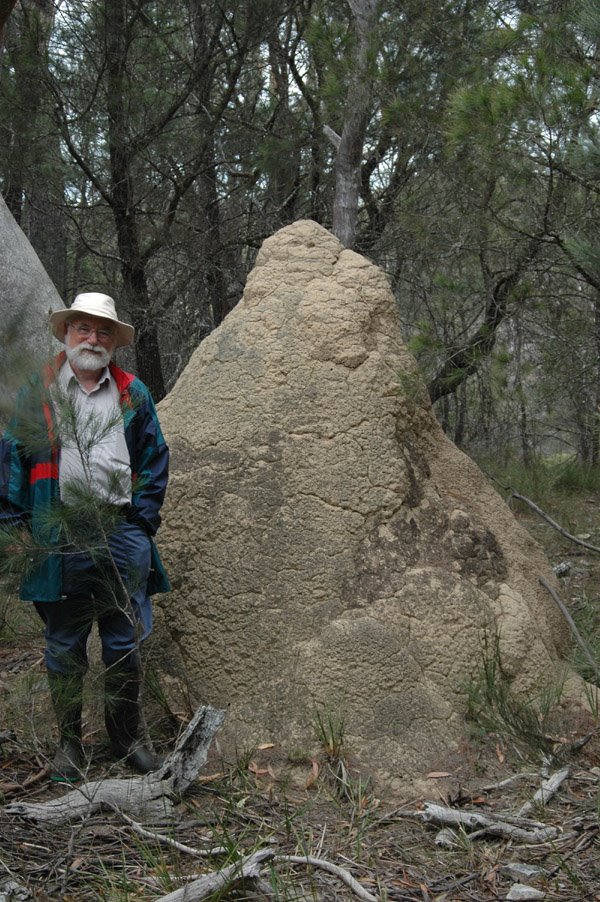
The sandstone plateau was covered in dense regrowth of Stringybark, Scribbly Gums and Grey Gums, for the property has been logged for firewood. As you can see from the attached photo, there were some very fine examples of termite mounds.


There was a very interesting gully, with a permanent stream, fed by springs coming out of rock ledges, about 20 metres below the top of the plateau. This gully had some caves with interesting eroded rock features.


The ledge below the cliff had exposed oil shale or perhaps very low grade coal, in shallow strata. There was a wet point, where rust-stained water oozed out from below a rock ledge. There were several Fungi growing in the red-brown mud there.


There were also several tiny, dark brown froglets there, little more than the size of a fingernail.


We had lunch at a point overlooking the Wingecarribee River (or a tributary). Although we were in sandstone country, the edges of this valley were steep, but not cliff-faced, unlike the more familiar escarpments of the local coastal escarpment, or the edges of the Kangaroo Valley.


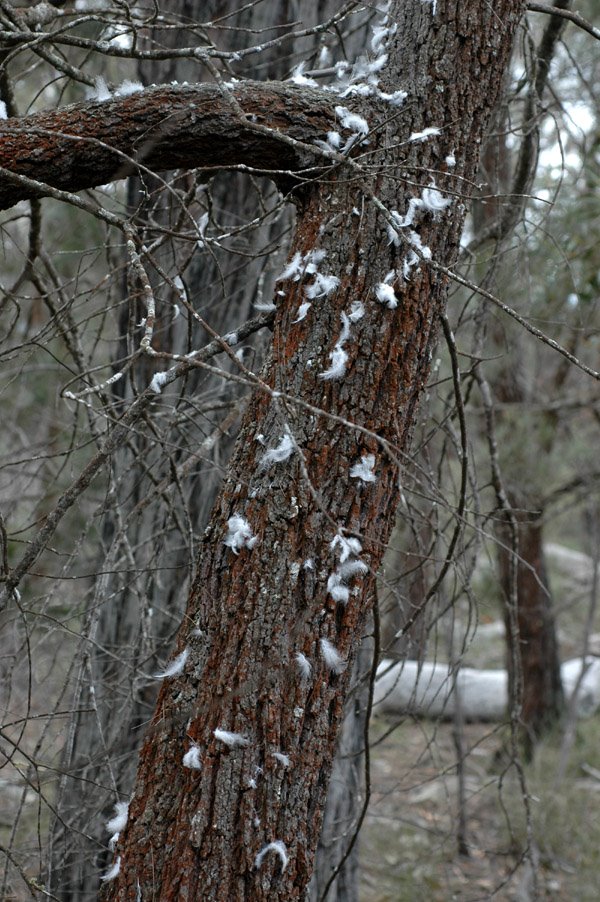
My favourite observation was a tree dotted with white fluffy feathers, (see above, left) which indicated that a Wonga Pigeon had been killed by a large bird of prey, most likely a large Owl, possibly even a Powerful Owl.


We also found several specimens of the Ground Orchid known as Parson's Bands (Eriochilus cucullatus). It is a tiny pink-white Orchid, which flowers in late summer and autumn, and has a preference for sandstone-based soils apparently.


There were also many other interesting plants in the "myrtle" family, which formed a low mat of heath growth, which were notable for their lemon scent. These plants might have been the Micromyrtus ciliata, but, as they were not in flower, I cannot be sure.