Christmas Bells

Christmas Bells
Christmas Bells - Blandfordia nobilis
Showing posts with label Berrima. Show all posts

Friday, January 28, 2011

Corunastylis sagittifera at Medway.

I have seen these plants previously, but their identity has been disputed somewhat. I had previously identified this species as "C. oligantha (probably)". These plants look a lot like some other Corunastylis species e.g., C. oligantha (the true species) from Mongarlowe (east from Braidwood); C. sp. aff oligantha - from Vincentia; and C. cornuta (from the ACT).


The problem with these Corunastylis species is that they look so alike - at least in photographs. No doubt if laid out side by side on a laboratory bench one could be satisfied that there are differences between them. Maybe.


Anyway, after consultation with Colin and Mischa Rowan, I have decided to stick with the name Corunastylis sagittifera - until someone can prove to me that they are NOT that species. C. sagittifera is reported to be found usually in the Blue Mountains (higher portions). These plants come from Medway, just west of Berrima, but it is an area which has many plants typical of Blue Mountains flora. Geographically, the "Lower Blue Mountains" is contiguous with the "Upper Blue Mountains". The soil in this area is a yellow clay, over sandstone - very similar to where I have also seen this plant, in a small section of Tourist Road, Kangaloon (also with Lower Blue Mountains flora). So I am satisfied that this record is legitimate (botanically).

These plants are significantly taller than the tiny little C. densa I showed two weeks ago.  Here is my hand, with my fingers touching the ground, and my thumb stuck out at right angles, just higher than the flower stem. That makes the stem 17 cm tall (seven inches) now that I have just measured my hand.


Corunastylis sagittifera flower spike.
Here are the flowers close-up.
You can see from the top flower why this plant is known as 
the "Horned Midge Orchid".
Corunastylis sagittifera
Another flower of the same species. Previously I have seen many of these plants in this site, but there has been a "burn-off" conducted here, and this year there are few Orchids visible. I am confident that they will re-appear in future seasons, as the plants would have been dormant when the burn-off was conducted.

This is a cropped image - from the photo above.
The image shows the dorsal sepal bent back against the stem.
The petal is lightly coloured, with some red stripes. 
It is pointing directly downwards.
The dark red, hairy organ is the "labellum".
It is flexible, being hinged. It flutters in the breeze.
The light green lateral sepals are the "horns". 
In this image, they are horizontal.
Click on the image to enlarge it, to see the details.
Cropped image of Corunastylis sagittifera.
This is an old image, from 2008. 
It shows the dorsal sepal of this same species of plant.
 The dorsal sepal has no significant hairs on its margins.
That fact separates this species from many other Corunastylis species.
The reddish hairs are, I believe part of the "column wings".
As such they are structurally separate from the Dorsal Sepal, but within it.
the red striped organs are the petals. One each side of the flower.
Taking photos at this level of detail, is hard work. Sorting through them all to get the best images to try to be able to show the diagnostic features of the species is even more time consuming. I hope you think it is worth while.

Thursday, November 18, 2010

A rare plant: Grevillea raybrownii

Several days ago I went to Medway and found myself in a sandstone gully over there. We are talking about a little township, west of Berrima. This site is close to a working coal mine, which apparently is about to be greatly expanded, with the introduction of longwall mining.

Medway includes one of my favourite places to visit - in search of Orchids and other unusual native plants. There is an old (overgrown) sports reserve - just a couple of acres, on the edge of the village. However, this patch of scrub which I normally visit has been burnt out. It was obviously a deliberate "burn-off" because the edges of the burn were very accurately controlled. Any spring Orchids are gone, but they will be back in future years, (hopefully). The autumn-flowering Orchids may be benefited by the burning. Some people maintain it is a chemical factor (the potash and smoke-water). Personally I think it is the lack of competition from shrubbery and grasses which mostly helps the Orchids. Anyway, it will be interesting to monitor the recovery.

I left the sports reserve and went to another favourite spot of mine. There is a steep gully, and I noticed a high sandstone rock shelf (across the gully) which I had never visited before. On my way across, I found just a few Donkey Orchids (Diuris sulphurea) but these are pretty common in the Southern Highlands. I did not photograph any of these Orchids.

I was hoping to find something unusual in the moss beds which I expected to find on the rocky outcrop. When I climbed up there, I saw a number of Calytrix tetragona plants (same species I had seen in Goulburn last weekend). But no Orchids, alas.

But what on earth is THAT?
As I worked my way back across the creek, I realised
I was looking at a large shrub which I had never seen before.
Prickly leaves, reddish new growth tips, and white flowers.
Within a moment I had worked out it was a Grevillea - a "Toothbrush Grevillea". That name comes from the shape of the inflorescence - the compound structure of many, many flowers.
The next thing I noticed was the compound divided shape of the leaves, and their sharp points. Technically this leaf shape is described as: "bipinnatisect with the secondary lobes often divaricate".
Finally I noticed the fat seed pods with purplish-red stripes along the basic grey-green colour of the outside of the ripe follicles.
These three characteristics immediately reminded me of the Carrington Falls Grevillea. Clearly it was a different species, but closely related. Both grow on sandstone, but this one was growing on an exposed rock shelf, whereas the other species grows close to rivers in wet forest.

So, similarities aside, what was it?

Eventually I tracked down a reference to Grevillea raybrownii in PlantNET. Two days later I found a photograph which helped me confirm the ID of this rare plant. I cannot find any photograph published on the Internet - before this. Is this really a world first? It might just be.

The only photo I have found is in the 3rd edition of Fairley and Moore "Native Plants of the Sydney Region" (which has just been published in September 2010).
It is reported that the pollinator is not known.
Well, there is a small to medium sized black ant here.

The plant was officially named (described) in the botanical journal "Telopea" Vol 5 (4) 1994 by Olde and Marriott.

This plant species is recorded here in "Flora of Australia Online".
NOTE: In case that link does not work for you (it didn't work for me, at first). But if you type in Grevillea raybrownii to this ANBG "Australian Plant Name Portal", then click "Flora of Australia online" - the second "radio button" from the bottom of the list, the desired entry should open for you. You may have to scroll the page sown to find this "Flora of Australia Online" button. But this system does work.

Habitat shot (for Mick).
Rock shelf, with Scribbly Gum and Calytrix scrub.
Gully beyond.
Looking towards far side of valley.

It is interesting to note the herbarium collection specimens examined by Olde and Marriott. The oldest is from 1901 from Berrima, close to where my plant is living. Those specimens would have been filed under Grevillea triternata, and then re-classified following Olde and Marriott's publication in 1994.

"SELECTED SPECIMENS (from 18 examined): NEW SOUTH WALES: Central Coast: Divide between the Nattai River and Allum River, Olsen 2183, 25 Jun 1974 (NSW); West Dapto, Cambage, May 1904 (NSW). Central Tablelands: Berrima, Maiden, Sep 1901 (NSW, MEL 595889); Mandemar Creek track, old road through to Joadja, Stead, 5 Apr 1975 (NSW 136247); Bullio tunnel, Mittagong-Wombeyan Caves Rd, Taylor 366, Goodwin, Bishop & Gunnell, 10 Dec 1984, (NSW, B, CBG, K, PERTH, RSA); 19.2 km NE of Robertson on No.1 fire trail in the catchment area of the Avon Dam, Coveny 848, 24 Feb 1969 (NSW)."

(DJW Note: That is one rare plant which the SCA Environmental Consultants missed in their surveys for the Kangaloon Aquifer. The area described is within the borefield area. Grevillea raybrownii is listed on the Rare or Threatened Plants list (ROTAP) for the Illawarra Region.)

Re the name: Olde and Marriott say: "ETYMOLOGY: The specific epithet honours Mr Raymond Brown (1947-), nurseryman of Bulli, New South Wales, for his contribution to the horticulture of Grevillea; he also first directed our attention to this species."

DJW notes: Ray Brown is credited with the idea to establish the famous Illawarra Grevillea Park, at Bulli (Wollongong Suburb).

Friday, October 29, 2010

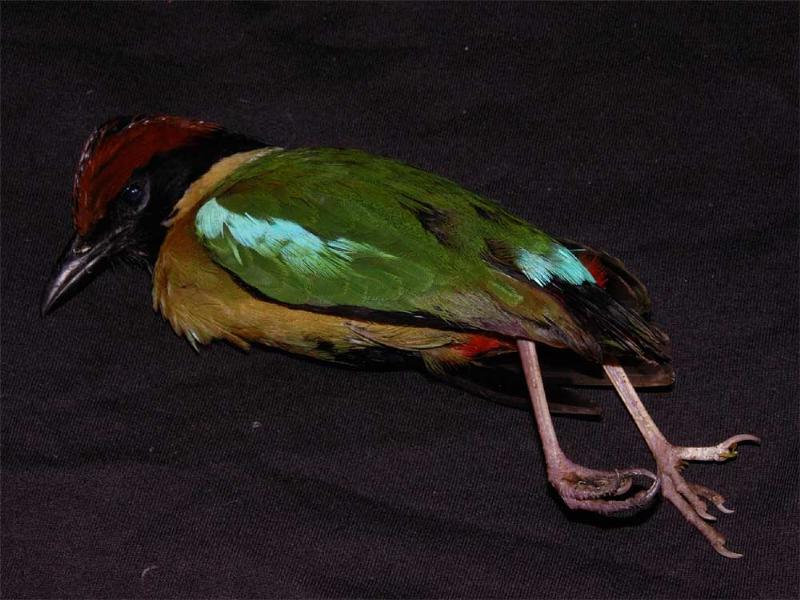
Noisy Pitta found near Berrima

Several days ago a Noisy Pitta (Pitta versicolor) was found near Berrima, in the Southern Highlands of NSW. This is a long way outside its normal range, and in a very unusual habitat for this species, which is a classical "rainforest bird".

Berrima is approximately 40 Kms west from Robertson (which itself is just above the Illawarra Escarpment, the closest true rainforest habitat to Berrima). The bird was presented by a "soft mouthed" Golden Retriever, to the dog's owner. Fortunately, the dog was very gentle, as befits a properly bred "retriever".

Unfortunately, the story does not have a happy ending, for although the bird was carefully handled (minimal handling), and was kept covered, and fed and watered appropriately, it was handed over to WIRES, but it died before it had fully recovered from its ordeal. Whether it was unwell to start with, is not known. After all, it was outside its normal range, and well away from its normal habitat, being a tropical rainforest bird.

Noisy Pittas normally live in dense tropical and sub-tropical rainforest. Their range is normally only as far south as the "Barrington Tops" (Hunter Valley Region). There are apparently some reports from the Mt Keira area, on the Illawarra Escarpment. (*** - see note below) The open farmland setting where the bird was found, is way outside its normal range and habitat preference.

IMAGE WARNING

IN KEEPING WITH THIS BLOG'S POLICY
OF PRESENTING INTERESTING AND UNUSUAL RECORDS
INCLUDING OCCASIONAL PHOTOS
OF DEAD ANIMALS AND BIRDS
I HAVE TAKEN SEVERAL IMAGES OF THE DECEASED BIRD.

I REGARD THIS AS AN EDUCATIONAL SERVICE.
HOW OFTEN DOES ONE GET THE CHANCE
TO SEE A NOISY PITTA IN SUCH DETAIL?

ANYWAY, IF YOU ARE LIKELY TO BE OFFENDED
BY PHOTOS OF A DEAD BIRD,
PLEASE GO NO FURTHER.

Kindly check back onto my blog again tomorrow.


*****

I have formally registered the "sighting"
(as such records are known).
There is no doubt as to the validity of the sighting
(photographic evidence).
The query was asked if this bird might have been
a caged bird "escapee"?
That seems unlikely, as few people would have the facilities
to keep a bird such as this in a private aviary.
They are certainly not "normal" caged birds.
Only the Taronga Park Zoo (Sydney) is likely to have a Noisy Pitta.

So there is no reason
to doubt the authenticity of the record as being
entirely a natural occurrence.

Location: The bird was found between Berrima and Moss Vale,
Southern Highlands, NSW.
Habitat: open pasture land, with residual mature Eucalypts
Date of finding: 26 October 2010

*****

Birdline NSW

Cumberland Bird Observers Club
Birding NSW

Report Receipt

Thank you for your report which has been recorded as follows:

Species: Noisy Pitta
Date: 28 Oct 2010
Site: Berrima, NSW
Notes: Bird retrieved by dog. Not obviously damaged by dog, however, it died, subsequent to it being handed over to local WIRES people. Bird was located in open farm land in Southern Highlands, between Berrima and Moss Vale. Cleared pasture, with large remnant Eucalypt trees. Nearest rainforest (Illawarra escarpment) is 55 Kms away, at Macquarie Pass. Mt Keira (apparently this species has been reported from there) is approx 90 Km away. Photo of bird taken after it died.
Observer: Denis Wilson
Photograph:


And here are the images:

Note the brilliant electric blue flashes on the wings and rump.
This colouring would really show up in low light conditions
when the bird is on the forest floor.
The back and wings are a brilliant emerald green,
The head is a rich brown.
The bird has large feet and strong legs
as befits its ground dwelling nature.
The beak is very powerful suiting its preference
for snails and ground dwelling arthropods (insect relatives)
This awkward looking image is shown to reveal
the brilliant patch of red feathers
in the ventral area and the under-tail coverts.
The dark patch on the belly is diagnostic of this species.
The throat is very dark, so it is almost invisible in this image.
This image shows the rich brown head
and the patches of white on the wing
(fully visible only when wings are fully extended)
Pittas have extremely short tail feathers.
The tail does not extend beyond the wings (or the legs).
Here you can get an idea of the white wing patches.
"Rigor Mortis" had set in by the time I collected the bird,
two hours after it had died.
So I was unable to open the wings properly,
for risk of damaging the specimen. I did not want that.

The rump is electric blue,
the tail feathers are black, but with emerald green tips.
The wings have traces of brown on the tips of the flight feathers.
The dominant colour is
bright emerald green on the back and wings.

The bird is stored safely (wrapped and frozen) and its body will be passed on to the CSIRO in Canberra, shortly, for inclusion in the Australian National Wildlife Collection.

I wish to express my appreciation to the lady who found the bird in the first place, and who looked after it appropriately. She tried to get it cared for by WIRES. Also, my friend Kim, who suggested that I be contacted to see if I could help.

Unfortunately, even with my local contacts, we were still not able to prevent the bird dying. However, at least the bird will not have died in vain, as it will go into the peak scientific collection of bird skins.

*** Postscript: I received the following comments from
Alan Morris, Moderator Birdline NSW.
Alan said that:
  • "Noisy Pittas are on the move south. There are three separate places on the Central Coast where you can hear them call (but not all the time) at the moment!
  • "While the southern normal breeding limit is the Barrington Tops/Gloucester area (not Coffs Harbour), they are being seen more regularly further south.
  • "There are regular reports for the Illawarra Region too although mostly in winter, but birds are now being reported all year round near Mt Keira I think!"
My response:
  • Thanks to Alan for the update on changing distribution of Noisy Pittas. With global warming seemingly occurring, that changed pattern makes sense. Many birds are extending their range from what we humans have regarded as "normal" (i.e., the distribution recorded since European settlement). Another which is recognised as moving "further south" is the Channel-billed Cuckoo.
  • I still regard this bird turning up near Berrima, in farmland, as an unusual record. The climate and altitude are the most significant differences from the areas on the Illawarra Coast mentioned by Alan.
  • Berrima district is approx 670 metres above sea level, and being away from the coast, is subject to much colder temperatures and is much drier, than even the highest places on the Illawarra escarpment which were mentioned by Alan as places where Noisy Pittas have been reported previously.

Monday, October 26, 2009

Lyperanthus - both brown and yellow forms

Several days ago I received a phone call from a friend of mine, Jenny, from the Australian Plant Society - Southern Highlands Branch. She said she had seen an unusual Orchid near the Berrima Weir, and wanted to know if I was interested.
Was I?

Jenny sent me a photo taken by a friend of hers, and I was able to identify the plant as a yellow form of Lyperanthus suaveolens, known generally as "Brown Beaks". The yellow form is well documented, but it is apparently not common, except on the NSW North Coast.

We arranged to meet on Saturday afternoon, and Jenny took me along a track, to find the plants she had seen several days before.

Yellow form of Lyperanthus suaveolens
As she had seen them growing near some Diuris sulphurea, that helped us locate these yellow Lyperanthus, as the Donkey Orchids are really obvious.
Here is a cropped image of a single flower.
Well, not quite, but as the flowers grow closely together on a stem,
it is hard to separate them.
Click to enlarge the image.
The strongly pointed dorsal sepal
and the prominent downward curved labellum
are clearly visible when seen in profile.
***** ***** *****
Having found these yellow flowered forms of Lyperanthus, we decided to look around (it was a nice afternoon for a walk). I was actually hoping to find some "Caladenias" in flower, but there were none to be seen.

Anyway, we had only gone about another 200 metres when I spotted a bunch of the classic brown form of Lyperanthus suaveolens.

You can see the strong leaves of these two plants (growing side by side)
We were both tickled pink to have "completed the set".

This shot shows the front view and the more distinctive side-on view.
Front-on view of the brown form.
Here is a cropped image of the column and the warty-looking labellum.
The technical description is "labellum covered in small, sessile calli".
Here is the flower view in profile.
The dorsal sepal is narrowly hooded,
and distinctly upward sweeping.
Click to enlarge the image.
It seems this species is not "common" in the Southern Highlands. I have seen one, once before, several years after I moved to Robbo, but before I had a proper camera. Jenny had not seen this species for many years, and that was in the Heathcote area, apparently. Neither of us had seen the yellow form before.

All together a pleasant afternoon walk. It is always fun to find a new species, or at least an uncommon variant thereof.

Friday, May 01, 2009

Vale Mrs Crowe, a remarkable woman.

Yesterday I was fortunate to join with the Crowe family, and friends to farewell Mrs Isobel Crowe, late of Berrima.
I first met Mr and Mrs Crowe, when, as a child, my family would call in to visit them at their Berrrima Bridge Nursery, down the end of a funny little road beyond the main Park in Berrima. At least that is how it always seemed to me, then.

My father was a plants man, and he and Claude Crowe were two of a kind. They both spoke "plant". Mrs Crowe was always the gentle and gracious hostess, on our visits, offering us cups of tea, with scones and jam. I remember the seasonal jams, especially the Blackberry Jam, Crabapple Jelly and my particular favourite, Fig Jam.

Many years later, after I moved to Robertson, I decided to call in on Mrs Crowe, one day when over near Berrima. I found the house, and knocked apprehensively on the door, not even knowing if Mr or Mrs Crowe were still alive, or living there. A little old lady came to the door, and I introduced myself - by name only. Straight away she opened the door, asked me in, and said "And how are Steve and Nonie?" (my parents). I was staggered. Here was I, an adult who had met this lady last when I was but a teenager, being welcomed as a long lost friend.

We talked about her family - Mr Crowe had died a few years before - and then we talked about my family, and plants and birds, and my child, Zoe, and my dog. We talked about where I was going to build my new house, in Robertson, and she advised me about the soil, and types of plants which would do well there. What a lovely welcome to the Southern Highlands!

We also did discussed rare Native Plants, for, over the years, she had collected many specimens of rare plants especially from East Berrima, and had sent them to the Herbarium in Sydney for identification, and to add to the Herbarium collection.

It was during such discussions I learnt that Mrs Crowe had been one of the first females to be trained as a Horticulturalist. Indeed while Mr Crowe had had great knowledge of plants, and particularly plant propagation, it was Mrs Crowe who had the formal training, and could identify plants from keys in the Botanical reference books, etc. She was proud to have been a ground-breaker, back in those days.

We talked of my interest in Tree Peonies, and she showed me some of these plants which Mr Crowe had collected and grown. Unfortunately, they were very old and weak plants now, growing in near total shade, under the enormous Cypress trees which had been planted so long ago as wind breaks, but which were now totally over-growing the house and garden. Still, it was great fun to potter around the yard, and ask about the plants. For example, the old varieties of Camellias which they grew are seldom available now, such as the old "Red Waratah" Camellia variety (Camellia japonica "Speciosissima"), which Mr Crowe had collected from the original Macarthur family's plants at Camden Park. A living piece of botanical history.

Every Autumn I would get a few phone calls from Mrs Crowe, asking me: "Are the Honeyeaters moving through yet?" It was in her capacity as an observer of birds that I mostly dealt with Mrs Crowe, in recent years.

Last week I received a call from Elizabeth Compston, from Canberra saying that she was coming up to visit Mrs Crowe, and then she would like to come over and meet me. We have exchanged many emails over the years, about Honeyeater migrations, as members of the Canberra Ornithologists Group. Anyway, arrangements were made for Elizabeth to visit Mrs Crowe in the morning and come over to Robertson at lunch time. She had known Mrs Crowe was not well, but then she heard that Mrs Crowe had been admitted to hospital. I got a call from Elizabeth at 10:00am that morning to say that Mrs Crowe had died during the night. She was distraught that she had missed out on seeing her friend, Mrs Crowe, by just a few hours. The family said yesterday that Mrs Crowe had been noting Honeyeater movements in her diary, right to the end, even over the Easter Weekend.

Noel Crowe, her son, gave the Eulogy at the service which was held in Leppington yesterday. I asked why it was being held there, despite Mrs Crowe having devotedly served as Verger and Warden at Holy Trinity Church, Berrima for half a lifetime. I learnt to my sadness, that the Holy Trinity Church had been closed in recent years, apparently against the wishes of the local community. This had apparently occurred since the appointment of a new Minister to the Parish. Archbishop Jensen had imposed his will on the parish, and appointed someone who the local community had previously rejected when considering candidates. The new Minister then went ahead and closed this historic church, thus alienating the local parish community.

Is this yet another success story for Archbishop Jensen's rule of the Sydney Diocese? I will let you decide.

I stress that the query is based upon my own understanding of the event. There may well be another perspective on these event. But I do know that the Berrima community has been damaged by these events.

***** ***** ***** *****

Anyway - let's move to happier thoughts. Noel's Eulogy included various other stories about Mrs Crowe, which are illustrated in the collage of images, below.
I especially liked the story of Mrs Crowe sitting at the wheel of the 1936 Singer"Bantam", drophead. It seems one of Mrs Crowe's first jobs was with a car company. She posed for the photo, but yet she never drove a car in her life. In discussions later in the day, it emerged later in the day that she was a very good driving "instructor", or at least a great source of advice to other persons doing the driving.

Isobel Florence Crowe (nee Tacon) as born at Cobram, Victoria. She was the daughter of a Minister, the Rev. Russell Tacon and Florence. The family moved around, eventually coming to NSW at Picton, where Isobel went to Picton High School. The family moved to Botany and then Bondi junction, and Isobel completed her schooling at Sydney Girls High School. She then went to the Metropolitan Business College.

Isobel was then accepted for training in horticulture at the "Sydney Tech", as one of the first women students. After graduating Isobel started work at Anderson Seeds Pty. Ltd., Summer Hill, N.S.W. It was there that she met a young technician working with that company, Claude Crowe.

During World War II the Crowes worked on strategic seed collection and storage - the "Mother Seeds" collection, which were important food crop seeds to be safely stored in event of possible invasion of Australia. It sounds a long way removed from the world of 2009, but it was obviously great training for a young couple who went on to run the pre-eminent Nursery in the Southern Highlands. Claude Crowe worked with the local resident and prominent businessman Sir Cecil Hoskins, who was responsible for granting the land along the old Hume Highway near Berrima which Claude Crowe planted as Memorial Driveway plantations. To this day, these Memorial plantations contain a superb collection of interesting trees, notably large fruited forms of Rowans and Crab Apples, and many unusual conifers. A Google Search under the name of Claude Crowe reveals many historic gardens in the Southern Highlands, the Monaro and the Blue Mountains planted by Mr Crowe. His name is well recorded by the Australian Garden History Society and the Historic Houses Trust.

One other photograph of note (in the collage set above) is the one of Mrs Crowe ringing the bell at Holy Trinity Anglican Church, Berrima. Note the hat, (which the Reverend Ian Vickery, a former minister at Holy Trinity) - who performed the Service - referred to as her "signature hat". This reinforces the contribution which Mrs Crowe made to the local Church community.

She was also remembered as a contributor to the Boy Scouts Association, and Red Cross, and the Berrima District Historical Society.