Christmas Bells

Christmas Bells
Christmas Bells - Blandfordia nobilis
Showing posts with label Grey_Days. Show all posts

Friday, September 07, 2007

Grey skies and Grey Goshawk

Today I was doing some work in the garden, with the help of Kim and her offsider, Damien. We were moving some plants around, and doing some clearing of trees and shrubs which had been damaged by wind.

While doing some of these chores, I suddenly realised there was a chorus of Magpies making those distinctive calls they make when chasing away an intruder. Magpies are such good "alarm" birds, and always tell me when a hawk or eagle is around. Listen to your local Magpies - they have many different calls, and some of them will lead you to an interesting sight, such as happened today.

High above, a Grey Goshawk was being chased round and round by three Magpies. Today's sky was grey and dull, unlike the clear blue sky from two weeks ago, when I walked along the track to Clover Hill Falls (half way down Macquarie Pass). I also saw a Grey Goshawk then, circling high. Not a good photo, but it is distinctive with the round tail, wide grey wings, and large white body. The Grey Goshawk is a classic bird of the rainforest, so Clover Hill Falls is absolutely classic habitat for this bird. Robertson, just a few kilometres away, is easily within foraging distance from this bird's main habitat.


The Goshawk looked at first glance, like a White Cockatoo, but Magpies would not bother to harass a Cocky. Not only are Cockies no threat to the Magpies, but also, a solitary Cockatoo is almost an oxymoron. They are a flock bird, and seldom fly by themselves.

The Grey Goshawk is a powerful flier, and soon outpaced the Magpies, and it flew off out of their territory. The Maggies lost interest and tailed away, heading back to the Pine Trees on the local ridge. Here is a photo of a Grey Goshawk, perched in the Redwoods in the "School Forest" here in Robertson. The yellow legs, the high stance, and the large size of this bird are all distinctive.
Here is the same bird doing what one mostly sees a Grey Goshawk doing - flying away from you. In this case it was landing, so the tail and wings are wide spread (to lose speed, as it comes in to land). But the shape of the wings and tail are diagnostic features of this bird.

The other "white" birds of prey (in the local district) are very different. The Black-shouldered Kite is a much smaller bird, with pointed wings, which either sits on power lines, or hovers (stationary in the sky) with a heavy flapping motion, while hunting for mice or large insects, like Grasshoppers. The other local grey and white bird of prey is also very different - the White-breasted Sea Eagle. It is huge, by comparison, and could not be confused with the Grey Goshawk.

Tuesday, August 14, 2007

A good day for the Shrike-thrushes.

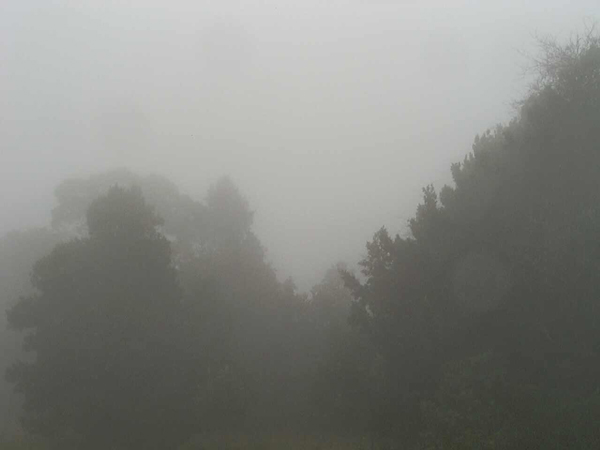
Today there was a "grey-out", in Robertson. Drizzle, changing to mist, intervened with light rain.

Of all the local birds, it is the Grey Shrike-Thrush (Colluricincla harmonica) which revels in this weather, most of all. It calls a lot on such days. There was one singing loudly from the Cherry Trees on the main street of Robbo, which is quite some distance from the natural heavy cover which it normally prefers. If you did not listen to the call yesterday, may I suggest that you check out this site, and listen to the MP3 file, which is shown far down on the right hand side bar, under the heading: "Calls". (Go to the "Birds in Backyards" site at that link)

I mentioned yesterday the distinctive posture of this bird, when you see it hopping around on the ground, listening for grubs and worms in the soil. Listening? Sure. See the head tilted on an angle here (below)? It is not looking at me - well, maybe it is keeping "an eye" on me, but really it is listening for insect sounds.

I have no idea what noises a worm makes, but they must make some noises, for Kookaburras and Magpies listen for them. And that's what this bird was doing yesterday. With some success, as you can see.

So, for a dull-looking bird, it is quite distinctive, for its habits and mannerisms, as well as its very distinctive calls. So, it is easily recognised. There are only two bird with similar habits in the local area.

The first is the similarly sized "European Blackbird", Turdus merula (a member of the true "Thrush" family of the Old World - Europe, Asia and North America), but that bird is much darker. The males are black, and the females are dark brown. Their call is a shrill whistle, or else a harsh repeated alarm call.The other "true thrush" in the local area is the "Bassian Thrush"( Zoothera lunulata ) (also known as the "Ground Thrush"). It makes a fine whistling call, at dawn and dusk. The call is similar to the Blackbird, and is often mistaken for the call of the Blackbird, which is more common in Robertson than the native species (unfortunately).

This bird is considerably heavier than the Grey Shrike-thrush. It has a very large eye, and distinctive spotted marking (little crescent shaped marks especially on the underside - which is the origin of its specific name - "lunulata") It is distinctively dark above, and light below. This bird is very happy on the ground, preferring to run through the undergrowth than to fly. If it does fly away from you, it has a pale cream stripe in its wings, which is very distinctive. This bird is very hard to photograph, because of its preference for dark shaded areas. It is also very well camouflaged.

Tuesday, January 24, 2006

A little moment of magic

Just before darkness fell, tonight, I noticed some movement in the shrubbery outside my window. Little birds were "working" through my planted garden, obviously searching for insects.

Often in winter one will observe what are called by birdwatchers "mixed feeding flocks" - birds of several species all together. That is what was happening today. It is supposedly "high summer" - a maximum of about 16 degrees C, with a thick wet fog all day. I can only assume that the birds had stayed put all day, hoping that the weather would lift, and then in the last half-hour, they decided thay had better "go shopping". Maybe?

Anyway, what were they? Brown Thornbill (Acanthiza pusilla); White-browed Scrubwren (Sericornis frontalis); Silvereye (Zosterops lateralis); Golden Whistler - female (Pachycephala pectoralis); Rufous Fantail (Rhipidura rufifrons).

For me, the best moment was when the Rufous Fantail arrived. It hopped across the ground (as the Scrubwrens were doing). I was looking down from above, so this gave me a perfect view of its fanned tail, with the lovely russet-coloured feathers on its back and tail. Normally this bird is a bit of a skulker, keeping to dense cover, and then bursting out to fly upwards to snatch some tiny insects (in flight). The most "colour" one usually sees is a flash of red-brown as the bird dives back into a Sassafras tree. Not tonight. There it was, with its tail fanned out fully, hopping across the tanbark, immediately below me.

A birdwatcher can only dream of moments like these, however brief they may be.

Monday, January 16, 2006

Funny moments in the fog

This morning, (late morning) a wondrous fog rolled in. I drove out along the Illawarra Hwy, past the Pie Shop on the corner of the Jamberoo Road. On the way, I saw a car pulled over to the side. Thinking that they might have been in trouble, I slowed, and saw a hand waving out the window. Then I realised the hand was holding up a mobile phone.


Strange, I thought, just here they should get good reception (the antenna is up on the hill, just above this position).


Then I realised that the driver was using the mobile phone's camera to photograph nothing! That was what she would have been able to record through the lens.


Welcome to Robertson.

Friday, January 13, 2006

green, in a grey world

Well, today the fog varied from a 30 metre fog, to a 200 metre fog - measured in terms of visibility range. I certainly could not see beyond the bottom paddock.

Sometimes it misted, sometimes it rained lightly, sometimes it was a dry fog - the kind one can easily walk around in without one's clothes getting wet. But the ground was wet all day, as evidenced by Lena's red-brown muddy feet. Ah, the joys of having a dog, in wet weather, in Robertson.


As I write (at 10:00 p.m.), the temperature readings in Bowral and Moss Vale, the nearest weather reporting stations to me, are showing 16 degrees C, and 96% humidity.


The rainfall figures for the last 7 days, and for today since 9:00 a.m. have been:
Last Friday, 5 mm; Saturday, 3mm; Sunday, zero; Monday, 2mm; Tuesday zero; Wednesday 14mm; Thursday 2mm, and today, since 9:00a.m., 7mm.
So there has not been much rain this week, but the humidity must surely have been averaging around 90%. As I said yesterday, one can almost hear the plants growing.


It is this kind of weather which makes Robertson the kind of place that it is - green, in a grey world.