My photos from this morning are visible on a Facebook Album.
https://www.facebook.com/media/set/?set=a.10153503966749829.1073742010.809229828&type=1&l=4d0e0eac00
This album is completely accessible to the public. You do not need to be a member, or to join anything to view it.
There is also a short video with lousy photos, but nice calls of the Grey Shrike-Thrush.
https://www.facebook.com/video.php?v=10153503700659829
Christmas Bells

Christmas Bells - Blandfordia nobilis
Wednesday, January 07, 2015


Thursday, January 01, 2015
Last Year, and New Year - on the cusp.
Firstly, just a few photos of a small party on New Year's Eve, at Vicki and Owen's place and a few photo of a beautiful rose flowering outside my bedroom window.
As usual these are found at a Facebook Album which is accessible to everyone freely.
No need to sign up for anything.
https://www.facebook.com/media/set/?set=a.10153465684089829.1073742007.809229828&type=1&l=64a7f57127
It behoves me to publish an annual figures for rainfall at my house for 2014.
 |
| Monthly totals - January through December, and Total for 2014. |
 |
| Lousy photo through glass just to show it is a real Blue Wren |
 |
| Going Up Male Superb Blue Wren chasing his own reflection |
 |
| Adult Crimson Rosella looking for yesterday's left over Watermelon |
 |
| A lovely photo of a lovely rose. Just Joey as it was on New Year's Day. |
Tuesday, December 09, 2014
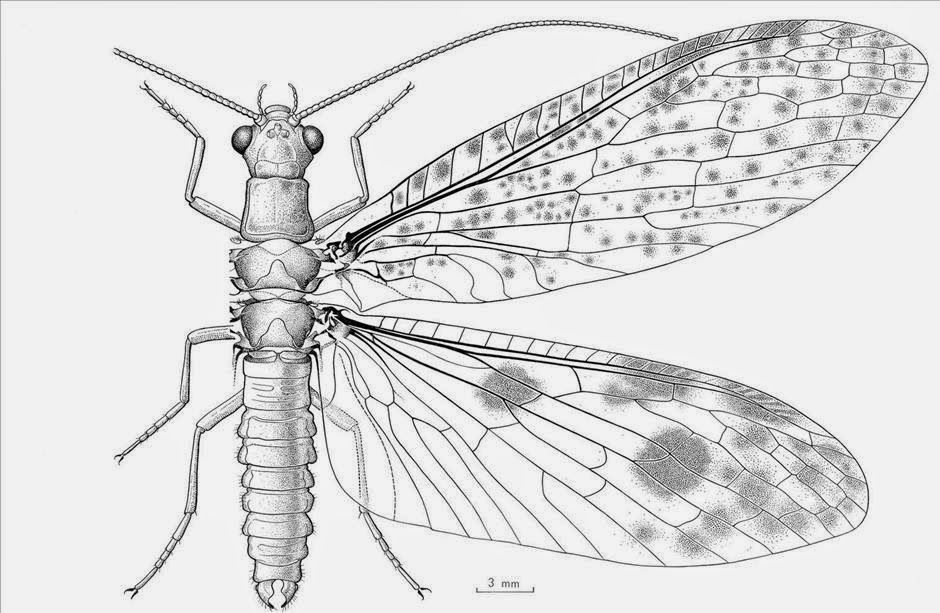
Dobsonfly - Archichauliodes species.
I always find Dobsonflies to be slightly strange insects.
They are as big as Dragonflies, but they fly with a weak, fluttering motion which immediately sets them apart from Dragonflies. They are partially aquatic. Eggs are laid on land (on rocks or vegetation). Then Larvae crawl to fresh water and become completely aquatic, until such time as they are ready to pupate.
From: http://www.ento.csiro.au/education/insects/megaloptera.html
DJW Notes:
They are not completely Aquatic in larval stage of their life-cycle (again, unlike Dragonflies).
Back to CSIRO site:
This was found on the edge of the Wingecarribee Swamp, in late November 2007. On a flowering Tea Tree (Leptospermum sp.) But that fits with its aquatic larval lifecycle. My insect, from yesterday, was also attracted to the flowers of relative of the Tea Tree (Astartea fascicularis).
Here is another page from CSIRO, to show some of the differences between Dobsonflies and Ant Lions and Lacewings.
http://www.ento.csiro.au/education/insects/neuroptera.html
Since publication, I have been contacted and provided with a working link to the "What Bug Is That?" site.
It is http://anic.ento.csiro.au/insectfamilies/index.aspx
Thanks to the ever alert members of the scientific community.
You know who you are :)
They are as big as Dragonflies, but they fly with a weak, fluttering motion which immediately sets them apart from Dragonflies. They are partially aquatic. Eggs are laid on land (on rocks or vegetation). Then Larvae crawl to fresh water and become completely aquatic, until such time as they are ready to pupate.
From: http://www.ento.csiro.au/education/insects/megaloptera.html
Megaloptera: dobsonflies and alderflies
CharacteristicsThis is a very small order of Australian insects commonly known as alderflies and dobsonflies. They are medium to large sized insects with a wingspan ranging from 20 to 100 millimetres. Alderflies and dobsonflies can be recognised by the following features:
|

- Long, soft, flexible bodies, usually dark coloured
- 2 pairs of membranous wings of similar size, often bearing dark patches.
- At rest the wings are held roof-like over the body
- Mandibulate mouthparts
- Long filiform antennae which taper towards the end
CORYDALIDAE is a widespread family of dobsonflies and well represented in Australia.
Archichauliodes species are inhabitants of cold-water streams and can be found from southern Australia to north Queensland. Adults of this species can usually be recognised as they have 4 or 5 large spots on their hind wings in addition to many smaller spots towards the edges of the wing.
Archichauliodes species are inhabitants of cold-water streams and can be found from southern Australia to north Queensland. Adults of this species can usually be recognised as they have 4 or 5 large spots on their hind wings in addition to many smaller spots towards the edges of the wing.
The larvae of alderflies and dobsonflies are aquatic, appear caterpillar-like and possess gills along the sides of their abdomens.
 Archichauliodes species (CORYDALIDAE) |
They are not completely Aquatic in larval stage of their life-cycle (again, unlike Dragonflies).
Back to CSIRO site:
"All species have aquatic larvae and mating occurs on the vegetation close to freshwater streams. Female alderflies and dobsonflies may lay up to 3000 eggs on rocks or debris close to the stream but not in the water. When the larvae hatch they enter the water and live a permanently aquatic life until they are ready to pupate. At this stage the larvae move out of the water into the adjacent leaf litter or soil where they pupate for several weeks. The complete life cycle may take only one year in warmer areas or up to 5 in colder climates."
Here was my first ever photo of a Dobsonfly.
It took me ages to get a proper ID on it, because, apart from specialist Entomologist site, there is not much readily available on them. At first I thought this was a Stonefly, but it is not. Nor is it a Giant Lacewing (with which it might be confused).
Here was my first ever photo of a Dobsonfly.
It took me ages to get a proper ID on it, because, apart from specialist Entomologist site, there is not much readily available on them. At first I thought this was a Stonefly, but it is not. Nor is it a Giant Lacewing (with which it might be confused).
 |
| Dobsonfly on Tea Tree. Wingecarribee Swamp, Nov 2007 |
 |
| Archichauliodes species (CORYDALIDAE) |

Great photo of a Dobsonfly
originally sourced from CSIRO "What Bug is That?"
Unfortunately that site appears to be
no longer being maintained.
Thanks Mr Abbott.

Dobsonfly on my front porch - attracted to the light
4 December 2013
Seems they like to fly at this time of year.
http://www.ento.csiro.au/education/insects/neuroptera.html
Since publication, I have been contacted and provided with a working link to the "What Bug Is That?" site.
It is http://anic.ento.csiro.au/insectfamilies/index.aspx
Thanks to the ever alert members of the scientific community.
You know who you are :)
Thursday, December 04, 2014
Wedge-tailed Eagle making "Lazy circles in the sky" over my house.
It is great to see one of a pair of Wedgies which flew over my house yesterday.
https://www.facebook.com/media/set/?set=a.10153381283594829.1073741993.809229828&type=1&l=12da12be84
One stayed to "make lazy circles in the sky" - a la "Oklahoma".
http://youtu.be/hpNeHMlJiD4

https://www.facebook.com/media/set/?set=a.10153381283594829.1073741993.809229828&type=1&l=12da12be84
One stayed to "make lazy circles in the sky" - a la "Oklahoma".
http://youtu.be/hpNeHMlJiD4
Monday, November 24, 2014
Privets and Hay Fever
This morning I woke with my house filled with the nauseating scent of Privet everywhere.
It is overpowering on humid nights (like last night) and mornings like this morning.
The culprits are the custodians of the Railway Line (who would probably be ARTC). But also the next offenders are the non-existent Committee in charge (nobody is actually in charge) of the School Forest.
Privet is the problem.
Privet is in the same family as the Olive - a fact which only comes obvious when the little black seeds develop in a couple of months. Small birds love them, So do bowerbirds unfortunately, and so also do White-headed Pigeons which last year swarmed all over these same trees and bushes, eating the fruit, and thus spreading the seeds. Damn.
Hay Fever is directly triggered by the sweet and overpowering scent of Privet. However, technically, it is classed as an allergy. Hence runny eyes as well as sneezes and difficulty in breathing. In fact, the scientists say that the problem with Privet is a direct irritation of the sensitive mucus membranes of the nose. I'll leave that for the experts to sort out.
It is overpowering on humid nights (like last night) and mornings like this morning.
The culprits are the custodians of the Railway Line (who would probably be ARTC). But also the next offenders are the non-existent Committee in charge (nobody is actually in charge) of the School Forest.
Privet is the problem.
Privet is in the same family as the Olive - a fact which only comes obvious when the little black seeds develop in a couple of months. Small birds love them, So do bowerbirds unfortunately, and so also do White-headed Pigeons which last year swarmed all over these same trees and bushes, eating the fruit, and thus spreading the seeds. Damn.
 |
| White flowers of Ligustrum sinense The Small-leaved Privet |
 |
| Flowers and small, slightly crinkled edged leaves of Privet Leaf margin referred to as wavy, which is good word. It helps people trying to weed out Privet seedlings. Because the leaf edges are distinctively wavy when plants are very small. http://www.iewf.org/weedid/Ligustrum_sinense.htm |
 |
| This is why I get cranky about the lack of responsibility for these plants. They are not on railway land, but have spread from the close-by Railway easement to the "School Forest". |
 |
| The Railway line is visible on far left of this image. The Laurence Langley Memorial Redwood Grove is visible in the background. |
 |
| An as-yet unknown (to me) Moths which was on my fly screen this morning. |
 |
| And my first Christmas Beetle of the season. Because Robertson does not have many Eucalypt trees we do not get many true Christmas Beetles like this one. Lots of annoying small Brown Beetles do occur here. |
Wednesday, November 05, 2014
Bearded Tylophora flowering inside my Study
As I write, my Study is being invaded by a branch of
Tylophora barbata, the “Bearded Tylophora”.
Ever since moving to Robertson in 2002, I have been aware of this small “climber” but have never known why it got its bearded reference. Just this last week, I realised that one of these small plants had made its way up from below my house, snuck in between the external cladding and then having entered the house structure, it has followed a tiny shaft of light, through a hole. Thus it has entered my Study.
I have ignored it for many months. My reward for doing that is that when I looked at the plant in late October, I realised that there were some flowering structures “Umbels” with small, dark flowers attached.
This surprised me. So I grabbed the camera.
And this is what I found. Flower of Tylophora barbata held against a 5 cent coin for scale.
 |
| Tylophora barbata held against a 5 cent coin - for scale purposes. |
The first thing which struck me was the extreme geometrical
construction of the flower. It also reminded me of a Hoya flower which my
mother used grow. Indeed they are in the same family.
Here is a closer image.
 |
| Tylophora barbata Note the 5 segments of the flower and the dark nodular glands and the 5 white segments in centre which are where the anthers are located. |
This shows the structure of the sexual organs of the plant:
“Calyx segments 5, sometimes with small
basal glands inside. Corona of 5 spreading fleshy obtuse knobs fully fused to
staminal column”. So the stamens are in the central white structure. The dark
knobs are glands, presumably to emit scent to attract tiny insects as
pollinators. My nose is not sensitive enough to detect any scent.
This next shot
(using a different lens and flash setup) shows that there are short, silvery
bristles all over the inner parts of the flower.
That takes me back to the name of the plant. The generic name is derived from the Ancient Greek tylos "knot", and phoros "bearing", from the swollen staminal coronal lobes. Barbata means "bearded" from Latin.
In “The Guide to the Yarrawa Brush” it says: “There are small hairs on the petals, hence the name Bearded Tylophora”.
 |
| Tylophora barbata - note the fibres on petals. |
So how does this plant get inside my house?
 |
| Paired leaves ("Opposite") of Tylophora barbata |
Here is the plant outside my hose, climbing up one of the
brick piers.
It likes to grow in dark, moist places, under trees, or in this case under a house.
It likes to grow in dark, moist places, under trees, or in this case under a house.

In fact, it has snuck up between the outer cladding of the house and found a small hole in the floor. The vine stems are so fine that it can enter just about anywhere it wishes to explore.
One it grew to the appropriate height, because it is in a dark area, it would then follow any shaft of light, to grow up towards the light, Thus it is easy to work out how it appears to have a "sense of direction". The light give it that direction to follow.
Subscribe to:
Posts (Atom)