Christmas Bells

Christmas Bells
Christmas Bells - Blandfordia nobilis
Showing posts with label Cold_Climate_Plants. Show all posts

Wednesday, May 21, 2008

Winter is about to descend on Robertson.

The frost are about to descend upon Robertson, I predict.

How do I know?
Simple - my Tree Dahlia has started to flower.Regular readers may recall two similar posts, from two years ago (OK only dedicated readers will remember these posts). I link to them, for more recently joined-up readers.
The first was entitled "The optimistic nature of Tree Dahlias", published on 7 June 2006.
The second was "The Nature of Frost (and an update on Tree Dahlias)" published on 13 June 2006.

The message is clear. Tree Dahlias take so long to grow to their full height, before they flower, that, inevitably, frosts are just around the corner. This year's flowers are about 2.5 metres above the ground. The plant grows this tall every year, before it flowers. Then the frost kills all the soft tissue material of the plant, leaving only the root stock. As with normal Dahlias, the plant has a set of tubers in the ground which are the perennial part of the plant. The difference for the Tree Dahlias is just how far they have to grow before the plant is mature enough to carry flowers.

In truth we have already had a very light touch of frost - but only once, and only very, very light. I do not know the temperature, but it was not enough to count as a real frost. Just a few signs of ice crystals glinting on the roof of the car.

But real frosts cannot be far away. Get your "Winter Woollies" out of the cupboard (if you have not done so already).
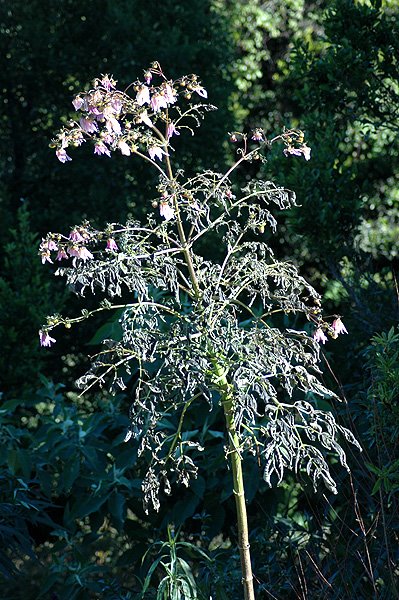
Tree Dahlia growing in front of native Sassafras and Pittosporum trees. The Sassafras (taller tree on right) is about 15 metres high. The low shrubs to the left of the Tree Dahlia are all well over head height.

Cultivation note: Tree Dahlias are easily cultivated by taking a stick of the stem with two growth points (nodes). (A stick about 15 inches long, usually). This will resemble a piece of fresh sugar cane, if you have ever seen that. Lie the stem down on a shallow angle, (bottom end first) so its head is just above the potting mix, in a Styrofoam box filled to the top with potting mix. Water it, and leave it alone for about 3 months in a protected position, and when you look at it (next spring), it will have formed roots on the bottom, and new shoots at the top. Plant it out and wait for a year. My plant came as "cuttings" from a friend in Canberra. I did exactly what I have described above, and my new plant has flowered every year since. Even though it is a silly plant to grow in a cold climate, I love it for its dogged determination to prove it can survive and flower each year.

Tuesday, June 13, 2006

The Nature of Frost, (and an update on the Tree Dahlia)

I moved to Robertson from Canberra, where, undoubtedly it is colder than Robertson. However, there is something different about the "cold" in Robertson. It is a wetter place, and so the cold seems to penetrate more.


Two days ago, we had a lot of rain during the day, then the clouds cleared off in the late afternoon. I know that always means trouble. For example, I was alert to the possibility of black ice on the road, the next morning.


What I had not anticipated was that the heater would run out of gas at 4:00am, and that Zoe, (the great softie that she is) would decline to go out and turn the switch from one gas bottle to the other - 30 seconds work. I was persuaded to go out and do the job myself, by Zoe thumping around the house, trying to get warm - a futile exercise, on such a cold night. Indeed it was the hot water running out when she tried to run a hot bath in order to warm up, which really triggered my decision to turn the gas tap over myself. Incidentally, I have an electric blanket, but until tomorrow's scheduled visit to Bowral, Zoe does not - she just has a cat to keep her warm. She has been promised an electric blanket, though. The cat will be ecstatic!


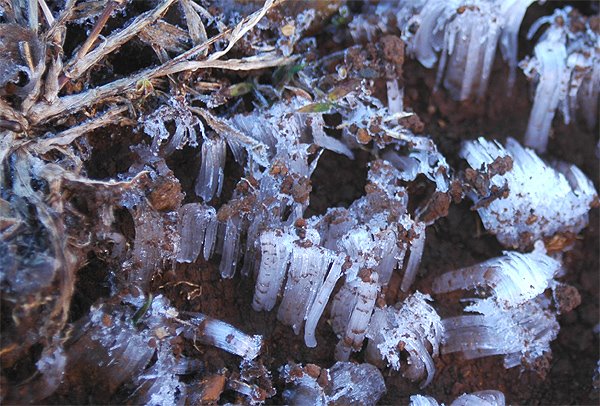
Anyway, I went outside, to find the switch for the gas tank, only to be surprised by hearing myself crunching over the grass (weeds, really). Odd, I thought - must be a heavy frost to do that. Next morning, I discovered that the source of the sound effects was that I had been crushing thousands of ice crystals, under the soil, as I walked just a few paces to the gas bottle.


Technically, these crystals which form in the soil are known as "permafrost", but my Northern Hemisphere friends will scoff at the application of that term to this little bit of ice formation, for it is not "permanent", or even semi-permanent. We aren't on the Arctic Tundra here. But what I was experiencing is quite different from a normal frost, where tiny particles of dew freeze on the surface of the grass, or soil. This was moisture in the soil freezing slowly, and, as a result, the crystals growing up out of the soil, and they lift the surface of the soil up to the height of the crystals, about 3 or 4 cms high. These crystals have great lifting power, and tiny pebbles, and small rocks will be lifted as the crystals beneath them form. Such crystals can, indeed crack large rocks, if they form within crevices in the rock, then expand.


Leo and Anni are entitled to tell me that I don't know anything about real cold. But it is cold enough for me, here in Robertson. It is also cold enough for Peonies, which was my primary criterion, when selecting a location when I moved from Canberra.


I mentioned last Wednesday the "Optimistic Nature of the Tree Dahlia". Great timing for that post. Have a look at it, on the morning of our big freeze. That was yesterday. Today it is showing even more damage, but you get the point - its growing season is over - for this year.


Oh well, it will have to start again next year to grow two metres tall, or more, before it will start to form its flowers, in late April or May. And, of course, it is destined never to set any seed, in Robertson. Poor thing. But I love the way it keeps on trying.

One could say that it is a metaphor for someone being treated for Lymphoma, really! No wonder I admire its stubborn hold on life.

Friday, December 30, 2005

My Peonies are wilting in the heat

The sunlight is powerful today. While the temperature is offically 33.6*C at Moss Vale (about 25 Km away), the humidity is a mere 20%, which is sucking the moisture out of the leaves of my Peonies.
*****

I had always known that growing cold climate plants in Robertson was a bit of an experiment. But Robertson is famous for its cooling sea breezes, which are said to roll in from about 2:00 pm. Not this week they aren't. The prevailing breezes are north-westerlies, bringing in pre-heated air from the hot dry parts of the country. And these are just breezes, not those dessicating hot dry winds, which can occur.
*****

I had been attempting to grow the Peonies without any supplementary watering, but today their leaves are just shrivelling up, before my eyes. They may have already incurred permanent damage. Bugger. I have waited too long, obviously.
*****

I was trying to be "water-wise", in this hot dry land in which we live. I have now weakened and resorted to some hand watering. But is it too late, already? Can I continue to grow these plant here?
*****

Prior to next summer, I shall experiment with a more cunning strategy of growing a hedge of
Kangaroo Apple (Solanum aviculare) in order to protect the Peonies from the strong sunlight (and dry winds). Failing that, the Peonies will all have to move to a "morning sun only" area, close to the rainforest. But I don't have much suitable land at present, until my shade trees (planted 18 months ago) grow taller. It is tough, balancing the conflicting demands of plants and the environment. Obviously one should grow endemic plants.
*****

Damn, we don't have any local Peony species.