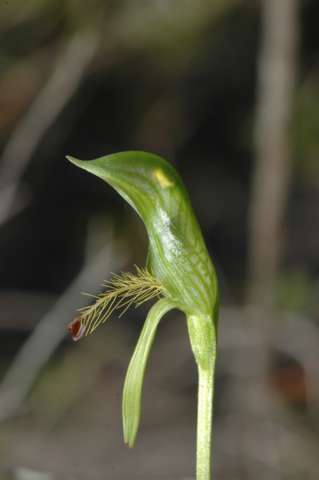
Christmas Bells

Christmas Bells
Christmas Bells - Blandfordia nobilis
Showing posts with label Alan_Stephenson. Show all posts

Saturday, August 24, 2013

Orchids from Nowra and Cambewarra Mountain

This morning I rang Alan Stephenson to check on the weather in Nowra.
We have had such cold, windy weather in Robbo that I was very uncertain that it was going to be worthwhile making the trip down to the Shoalhaven. But Alan assured me it was warm and sunny,

I am glad I went, for I found a number of interesting Orchids.


Hymenochilus bicolor
Formerly Pterostylis bicolor
Growing in Nowra Cemetery


Prasophyllum elatum
These plants on Leebold Hill
have green leaves and
black flower stems.
The buds are just visible,
They come out creamy colour.


Pterostylis erecta


Speculantha vernalis
This spring flowered species
of Speculantha

is distinct from the regular
summer and autumn flowered species.
Alan Stephenson has persuaded
the Federal Authorities

to list it as Critically Endangered
because it is so highly localised.


The epiphytic form of the
Sydney Rock Orchid
it grows so high in trees on
Cambewarra Mountain

that it is very hard
for me to photograph.

You can just make out
the long flower sprays.

Thelychiton epiphyticus


Dockrillia pugioniformis
Petalochilus alatus
Fairy Caladenia
This tiny Caladenia
is very sweet, but hard to find
and harder to photograph properly.

 An unusual magenta colour form of Glossodia minor

beside a regular colour form on right
Glossodia minor


Thursday, June 06, 2013

A Corunastylis has been named after Alan Stephenson

Regular readers will be aware that I frequently go into the bush around the Southern Highlands and the Shoalhaven region, photographing Orchids, with Alan Stephenson. He is a dedicated Orchid enthusiast, and serves as Conservation Officer with the Australasian Native Orchid Society and the Australian Orchid Council.

His dedication to the cause of wild Orchids has been recognised by David Jones having named a particular Midge Orchid, endemic to the Nowra region, as Corunastylis stephensonii, The paper in which the Orchid has been described and named is published in the Australian Orchid Review, June-July 2013.
"Corunastylis stephensonii: A New Orchid Species from the Shoalhaven Region of South-eastern New South Wales" - by David L. Jones.


Those of us who are familiar with these plants which we have seen numerous times at Vincentia, can be relieved that now we have a proper name for these plants, rather than Corunastylis sp. aff oligantha or the unofficial "Vincentia Midge Orchid". It is now officially Corunastylis stephensonii.

Congratulations to Alan.

Monday, April 08, 2013

Surprises where one least expects them

Alan Stephenson sent me a message that a friend of his had pulled their car off the road, on the way back form Moss Vale to Nowra and found some red Greenhood Orchids. Alan identified them as Diplodium coccinum. More to the point, he wanted to know where these plants were, exactly, as these plants are not often seen, and were not known to grow in that area.

I got a message (several actually) suggesting that they were along what is known locally as the Nowra Road, west from Fitzroy Falls. There was a distinctive letterbox nearby.

Armed with that information, it took no time at all to find the plants, once I had driven to the right place.

Scarlet Greenhood - Diplodium coccinum
What was startling to me was that once I started to look, there were literally hundreds of flowers and far more plants (leaf rosettes) than that amongst the grass. They were everywhere in just one hundred metre section of the road. Across the road they were not seen. Further down they were not seen either.

A good example of Orchids growing where they love to grow.

two flowers amongst the grass.

Another nice specimen
The point of my Blog title today is that this road is one which I drive along occasionally, going to look at Orchids elsewhere. Alan has driven this section of road hundreds of times over the years, as his daughter lived in the Highlands at one stage, I understand, and also, it is on his route to just about everywhere from Canberra or points west, as well as the Southern Highlands. It just goes to show that one cannot assume there is nothing to see, just because one doesn't stop to look. In this case, we owe this discovery to an observant traveller's unexpected need to adjust the load on a  trailer.
In deep shade under the pine trees
there were many plants of Acianthus exsertus
 One surprise for me was to find this small "Coastal Greenhood" Diplodium alveatum
Diplodium alveatum
is similar to Diplodium obtusum
The labellum is clearly visible and dark
it has a strongly rolled edge to the "sinus".

Habitat shot

Diplodium coccinum leaf rosettes amongst thistle weeds.
These rosettes had large leaves,
and were quite plastic-looking,
with a deep vein along the mid-line.

Saturday, March 30, 2013

Acianthella Orchids found at Gerroa.- update - Identity confirmed

A contact of Alan Stephenson's, Matthew, first discovered these plants last year, while working on "bush regen" work in the sand dunes in the Littoral Forest at Gerroa. Alan and I saw some of these plants last year, but the flowers had finished. I reported on the plants, with seed capsules present, on 15 June last year (much later than this year). That tells you something about the strange seasons we have been experiencing over the last few years.

Matthew contacted Alan yesterday to say that they were in flower again, (in fact mostly they had finished). But we went there today, met Matthew and took some photos of a few open flowers.


Front on view of Acianthella at Gerroa today.
Side on view of the Acianthella flower at Gerroa
The flower structure is clearly similar to
Acianthus exsertus
The whole plant is only about 2 inches high (about 50 mm) and the flower is less than 3mm across (slightly larger than a match-head). The front-on image when viewed at maximum pixels (as uploaded here) is about 50 times larger than the original flower.

That cropped image allows one to see the fine details of the flower, which is green except for the slightly rude looking pink cap of the anther (the male reproductive part of the flower). There is nothing subtle about Orchids!

These plants are presumably self-pollinating (at least David Jones's Big Book says so).


Plants growing in leaf litter on Littoral Sand Dunes
(2 plants circled in red)
Click to enlarge.


The shot of 2 plants growing amongst the leaf litter (circled in red) shows them at more or less real size (if viewed at full pixel size), if you are viewing this on a computer (smaller if seen on an I Pad).

The side-on view shows more clearly the structure of the flower which is clearly closely related to the more familiar Acianthus exsertus . The leaves are different though, much softer and not reddish underneath, and shaped almost like a "Club" (as in a pack of playing cards). The leaves are held above the ground (as is Acianthus). 
The tiny size of the flower is what surprised me most. At least Acianthus can be clearly examined with an un-aided eye. Not so these things. I had to use the camera, take a shot and then examine the image, to know if the flower was even properly open.


On the balance of probabilities, these plants are likely to be Acianthella amplexicaulis. I say this as, despite the difference in geographical range from what has previously been reported for that species, the photos I took look very similar to the ones Colin and Mischa Rowan have photographed. But their website does not show a location for their plants.

In that case this is still an important records, as a major extension of range - as previous records apparently are all north from the Hawkesbury estuary.
Thanks to Matthew and Alan for showing me these plants.

*************************


UPDATE 10 April 2013

Alan Stephenson has advised:

Have just spoken with Mark Clements and the orchid is definitely Acianthella amplexicaulis. This means it is not a new species but an extension of range of about 250 km and Mark was very pleased to get the samples. 
Thanks to Mathew for the find, as it is important.

Regards

Alan

That confirms my impression of the similarity of my images of these Orchids with those of Colin and Mischa, and of Bruce.

Good to have the ID confirmed, none-the-less, given the extension of range involved.

Once again, good work by Matthew in spotting these tiny things in the first place and in reporting them to Alan Stephenson. Thanks also to Mark Clements for the positive ID of the specimens.

Sunday, August 26, 2012

Botany Bay Bearded Greenhood

Last week I was shown where a group of 
rare Botany Bay Bearded Greenhoods were growing. 
Unfortunately, they were not yet open. 
Today I went back, with Alan Stephenson 
and we found them open. 
So we were able to photograph them successfully.
The extraordinary "bearded labellum" is clearly seen.
The lateral sepals are virtually joined together,
not parallel or flared apart.
In this case the pollinia are clearly visible
within the hood of the flower.
Botany Bay Bearded Greenhood
"Pterostylis sp. Botany Bay (A. Bishop J221/1-13) (Botany Bay Bearded Greenhood) is
a terrestrial orchid which grows to about 20 cm tall (Bishop, 1996). The current
distribution is extremely restricted and it is known from only one small disjunct population
on the Kurnell peninsula in Botany Bay National Park in southern Sydney."
And see also the Approved Recovery Plan for this species.

The person who showed me these plants last week was Tony Rodgers, who has an excellent FilckR site, with many, many Orchid photos and some other images as well. His site is http://www.flickr.com/people/xtraterrestial/  His excellent photos of these plants, from 2010 are located at this site.

Note the crowded leaf structure
around the base of the stem.
which is unusual for Greenhoods
which normally have rosettes, or stem leaves.
Botany Bay Bearded Greenhood


These plants are listed as Threatened Species under both the Federal EPBC Act and the NSW Threatened Species legislation.

The note on the NSW Threatened Species page says: "A terrestrial orchid with a slender flowering stem to 20 cm. Leaves are a narrow oval shape, 37 mm long, and 12 mm wide. Up to 12 leaves form a basal rosette that slightly ascends the stem. The flower is solitary and translucent green with dark green veins. 

This is probably my favourite photograph of this species of Greenhood, as it shows the very narrow "waist" in the hood. And the pollinia area clearly visible inside the flower (still awaiting the visit of the appropriate pollinator). 
Seen from very low angle
Botany Bay Bearded Greenhood
Another plant, seen from the side.
Botany Bay Bearded Greenhood
Another shot which reveals well the
"knob" at the end of the "feathered" labellum.
In fact ts know is not solid,
just tightly packed with short, brown fibres.
Botany Bay Bearded Greenhood
  
Yet another view of these
remarkable and rare Greenhoods
Botany Bay Bearded Greenhood

 And here is Alan Stephenson with me today, at the Kurnell heathlands.
You can see how Alan and I both had to get down and dirty, amongst the low heath scrub to photograph these plants.
Hard work, but worth it.
Alan photographing
Botany Bay Bearded Greenhood

Was it all worth it? I believe so.
The walking today was pleasantly warm, and not windy. I am less enthused about last year's effort. I didn't tell you about that, but you can imagine I am sure, seemingly endless walking between dense patches of twiggy heath scrub - where each new patch of heath looks exactly like the last patch you have just searched - in vain.

 ******************

Similar Species : Pterosylis plumosa (Plumatochilos plumosum)
The species is very similar to Pterostylis plumosa, however (in NSW) P. plumosa is found only on the tablelands and western slopes of NSW and has almost erect flowers which are larger and more robust that those of this species.
Tony Rodgers has comparison photographs of this species with the closely related species from the Little Desert, in Western Victoria.


Monday, March 19, 2012

Schools of Prawns - on top of the Shoalhaven Escarpment

I went bush with Alan Stephenson on Sunday.
He wanted to check on a Corunastylis he had seen in an earlier year, about which there was some confusion of identity. We did not find any of those particular plants, so that mystery remains. However, we did find lots of other plants of interest. Today I shall start a series of reports.

We went initially to the top of the Shoalhaven Escarpment (on Main Road 92) - above Sassafras, on the way towards Nerriga. We stopped at the highest point of this range, before the road descends to the Endrick River. That place is 780 metres above sea level - the highest point on that road.

We went there looking for the rare Corunastylis superba. Alan and I had examined this known site - looking for these Orchids - on 2 February 2012, and there was no sign of these plants - no leaves visible at all (and yes, we did know where to look). On Sunday, we found four plants - one had finished and set some seeds already, and one was just finishing flowering (see attached image).

Corunastylis superba
just finishing flowering


It is interesting that these plants had grown, and finished flowering in the six weeks between our visits. There were also several other plants with leaves recognisable as Corunastylis plants.

On the way to that site, we had called in to another area of exposed sandstone rock-shelves which is known to be good for Orchids.
As soon as we arrived at the rock-shelves, I spotted some "Little Dumpies" (Diplodium truncatum).
(Diplodium truncatum)
Almost immediately, we then found ourselves amongst some of the gorgeous little Greenhoods known as "Prawn Orchids" (Crangonorchis pedoglossa). This particular plant was a stand-out with the extremely fine point to the "dorsal sepal".
Such a long tip on
the Prawn Orchid
We later called in to another place where these Prawn Orchids are also known to occur, and much to our delight, they were obviously having a great season (the rainfall has been pretty remarkable, as you may well be aware). The moss beds over the rock shelves were totally soaked, and water was leaking out freely from these moss beds.

As these Prawn Orchids are small plants, photographed in a colony, from a distance (to allow me to get them all in the one photographic frame) you will need to click to enlarge the following images to make much sense of them.


I had never seen such a group of
Prawn Orchids.
A veritable "School of Prawns"
or a School of Prawn Orchids,
if you are pedantic.
And no sooner had we discovered
the first big colony,
than we found an even bigger and better colony.


These are tiny little plants, but such a great colony is remarkable.
There were over 30 plants in frame and even more close by.

And they were also growing out in the open (not under the low shrubbery as per normal).

Thursday, January 26, 2012

Corunastylis formosa (???)

Two days ago I published a post proclaiming that I had found a "new" Midge Orchid - new for me - that is.
Right and wrong.
Ah, the perils of Blogging, folks.

Yes I had found a "new species for me" 
but unfortunately I had given it the wrong name. 
Corunastylis formosa (not Corunastylis filiformis)
(Even that name requires confirmation.
It is possible that this is an as-yet unnamed species)
I had proclaimed that the species was Corunastylis filiformis. My Orchid-chasing colleague Colin Rowan (from RetiredAussies.com) emailed me to ask "are you sure?"
My answer was that NO, I was NOT SURE.
(I became less sure as I looked further and further into the original ID)

We swapped notes and I also communicated again with Alan Stephenson, who was able to provide a copy of the Orchadian description of another species, Corunastylis formosa, which, from P. 180 of David Jones's big Orchid book, looked a "better fit" with my plant.
  • The Orchadian, Vol 13, No 7 Published March 2001.
This is a copy of that illustration by David Jones, 
originally drawn on  4 December 1994.
Click to enlarge the image, 
to allow you to read the notes, 
and to see details of the illustration.

Note the text gives the name as Genoplesium formosum.
It has since been revised by Clements and Jones
in the Australian Orchid Name Index
as Corunastylis formosa.
Jones illustration from The Orchadian, from the original "description"

In order to resolve the true Identity of this plant, I decided I needed to collect a specimen, which will be forwarded to Mark Clements, at CSIRO, for verification of this ID, and to formally record the location of these plants at Butler's Swamp, Kangaloon, NSW.
So, why am I so sure that what is growing in Kangaloon
is Corunastylis formosa?
(I am no longer as sure.
But if it is not that species, what is it?
It has appeared early in the season,
in the same location for the last 3 years).
Corunastylis formosa (possibly) at Kangaloon.
The first point I wish to address is the habitat in which this plant grows. 
My flowers are growing on the edge of Butler's Swamp, Kangaloon
They are growing in the open, 
amongst grasses and some rushes
on black soil.
Some of them are found in deep moist peaty soil,
typical of an "upland swamp" over a sandstone rock substrate.
Altitude at Butler's Swamp is 640 metres. 

(Legal Note: these plants at Butler's Swamp are 
located immediately outside the "SCA's Special Areas")

Jones described his type specimen as 
"growing amongst shrubs on or close to the edges of montane swamps;
less commonly amongst grass bordering rivulets and other small streams.
Soils are  moist brown to blackish loams.
Altitude 750 - 800 m."

He also gives the etymology of the name "formosa"
as "from the Latin, formosus, finely formed, handsome,
in reference to the striking flowers and dense inflorescence."

Jones, D.L. The Orchadian, Vol 13, No 7 .... March 2001.

I wish to make the point about the similarity of habitat for Kangaloon
and the "type locality" as described by David Jones.
Altitude is high at Kangaloon (640 m), 
but not quite as high as Wadbilliga or Cathcart.
But compared to many other Corunastylis, 
both these groups of plants 
(Jones's "Type specimens" and my plants) 
must  be acknowledged as "growing at altitude".
  
Also the soil and habitat preferences appear similar for both sites.
Importantly, this is an unusual locality and habitat 

for other Corunastylis species I have located in this region
prefer locations, on dry soils or exposed rock shelves.


And now to the flower details:

The lateral sepals look like pointed "horns" poking out.
In situ, these lateral sepals tend to be held horizontally.
The dorsal sepal has no hairs along the edge
and the Labellum is coarsely hairy.
The labellum is also quite broad and "stiff" (i.e., it is not motile***)
as distinct from Corunastylis fimbriata, for example.


A single flower of  Corunastylis formosa (???) - isolated
To see the flower clearly, (isolated from others on the stem)
I severed the ovary and the flower from the stem.

Compare this image with the Figure "d" 
in the illustration above.
(Ignore the shadow lines)
Click to see the details.

Corunastylis formosa (???) petals and labellum visible, over the dorsal sepal.
Back to the Identification of this plant. 

This flower has the same "structure" as described by
David Jones within his  Corunastylis Group 2: "Dorsal Sepal hairless, petals hairless or with a few long hairs labellum broad with long coarse hairs." Jones. op cit P. 179

Compare this plant with the following related plants which I have previously reported and photographed. These are all grouped together by Jones in his "Group 2" (for Corunastylis).
  1. Corunastylis plumosa, the Tallong Midge Orchid - which grows on harsh, dry rock shelves, under dense low shrubbery.
  2. Corunastylis sagittifera, the "Horned Midge Orchid" which is a much paler flower, with a light-coloured labellum.
  3. Corunastylis formosa, the Cathcart Midge Orchid - this flower.
In order to study the flower's parts in detail
I dissected one flower.
Here is the Labellum.
You can see the coarse hairs on the labellum closely
and the two pale sections are the "callus" on the labellum
That callus is illustrated clearly in David Jones's illustration above
See figure "e" in the centre of that illustration.

Labellum of Corunastylis formosa (???), showing the "callus"
Here you can see the "dorsal sepal" (between my fingers)
with the column exposed (showing the pollinia)
Click to enlarge the image.


The dorsal sepal and column of Corunastylis formosa  (???)
This is a significant extension of range(???) for Corunastylis formosa
Kangaloon is a long way north from Wadbilliga National Park and also from Cathcart, NSW. Google Maps shows Cathcart is 380 Km south (by road). Wadbilliga NP is 280 Km south from Kangaloon (by road). So this locality record is a significant extension of range for this species.

My friend Martin Butterfield has provided a map to show the relative positions of  Cathcart, Wadbilliga and Kangaloon.


**************
Orchid chasing works best when it is done collaboratively, I find.
So I wish to thank Colin Rowan and Alan Stephenson for discussing the ins and outs of this ID with me, and Alan for providing the text from the Orchadian in which David Jones first described this species. That Journal is not available "on line" unfortunately. Martin Butterfield, who like me, is a plant chaser, and a fellow Blogger, and someone else who lives "in the bush" and so is familiar with the need to help people know where exactly we are talking about, has sent me a map with the three locations for this plant marked.
Thanks everybody.


**************

*** motile: actively moving; self-propelled. (PlantNET)
The labellum of Corunastylis fimbriata "flutters" in the slightest breeze, or if one blows on it. This species (and many others) have a stiff labellum, which does not move.