Christmas Bells

Christmas Bells
Christmas Bells - Blandfordia nobilis
Showing posts with label Ibis. Show all posts

Sunday, July 23, 2006

The Nature of birds in grazing lands

This winter has seen a lot of gentle rain falling over the Robertson area. One group of birds which have benefitted are the birds which hang out in the grazing lands around the district.

Ibises (mostly the Straw-necked Ibis) have been seen regularly, this year, on the dairy farming properties along the Belmore Falls Road, just down the valley from my house. They also have been seen on the Hindmarsh Dairy, past the Robertson Show Grounds, and in East Kangaloon, (also on dairy farming properties).

This closer shot was taken in Canberra, several months ago.

These birds have long curved beaks and they spend hours at a time searching for grubs (in particular) in grassed paddocks, especially where cattle are to be found.

They force their long beaks into the soft ground, in search of these grubs. Their hearing is apparently very sensitive allowing them to track the grubs.

Other species are seen here too. I have seen just a few White Ibis on these paddocks. There is a White Ibis in this flock, and a White-faced Heron, (the grey bird standing upright).
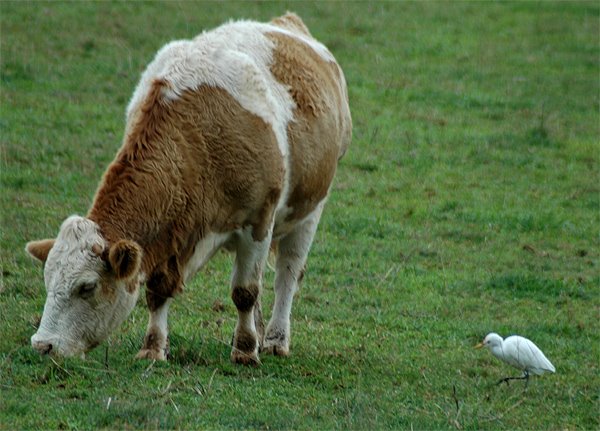
But last week there were 2 Cattle Egrets there. This is the first time I have seen Cattle Egrets in the Robertson area. I have seen them routinely in the much warmer Kangaroo Valley, just 10 Km away (directly), but an area with a "coastal climate", not a "mountain climate" as in Robertson. Unlike the Ibises, these particular Egrets hang out very closely with cattle, which disturb insects as they graze, and the Egrets pounce on the insects.

Last week I also saw a Pacific Heron (White-necked Heron) in the same paddock as the Straw-necked Ibis flock. I was interested to note that this bird is considerable taller than those Ibises.

I know it has a more upright stance than the Ibis, but it has a very large wing-span. It is close to twice the size of the White-faced Heron - (the regular heron of the area).
This bird is quite distinctive in flight, flapping very slowly, and with very dark wings, and a white chest and neck. But like most herons, it flies with its neck folded back into its body. Ibises fly with necks fully extended (plus their long beaks), so their flight profile is very different from this bird.

Thursday, June 01, 2006

The Nature of long curved beaks

Straw-necked Ibis
The colourful and attractive Straw-necked Ibis* is a "wader", really. That is, it is a swamp bird by nature, with a long pointed beak, designed for poking into the mud, in search of worms and grubs. However, Australia is a dry country, so this bird has adapted to living away from swamps and the water's edge, and is known as the farmer's friend.
* Incidentally, it gets its name from the long stiff feathers on its neck and chest, which are said to resemble straws.

These birds still breed in colonies (as do many swamp birds), but they now fly out to farmers paddocks, and clean up huge numbers of invasive pests, such as Grasshoppers ("Locusts") and curl grubs, which live under the soil and eat the roots of crops.

What are they doing in Canberra? Well, as you will see from the photo, this bird (one of a small flock) was on the lush green lawns which happen to be surrounding the Australian War Memorial, a place seemingly immune to the watering restrictions which are in place in the rest of Canberra (and most of the rest of the country). Lush green lawns are a sign of frequent watering, which means that the soil is soft enough to allow these birds to probe with their beaks, deep into the soil, in search of grubs.


When they are not promenading around on the lawns of our National Institutions, these birds are capable of flying vast distances, across the dry country, in search of the next occasional flood. They are beautiful fliers, as may be understood from the photo at left. Long straight wings transform this slightly ungainly bird (on land) into a true, long-distance flying machine. Their wing shape is similar to that of the totally unrelated Pelican, which is another bird which makes huge pilgrimages in search of the next flooded inland river system.

Both birds are capable of appearing, in the "desert", when the next flood is coming down along the inland river systems, from far north Queensland, such as in the periodic flooding of Lake Eyre. So flights of several thousand kilometers are well within the capability of this bird (and the Pelican). Quite how the Ibises of Canberra know that there might be a flood headed for Lake Eyre is one of those mysteries of meteorology which scientists have yet to unravel. But it is true, when Lake Eyre, or other inland river systems flood, Ibises, Pelicans and many other swamp birds ("waders") and waterbirds which normally reside on the East Coast of Australia, will suddenly appear in the previously totally dry landscape, in huge numbers, to take advantage of the bounty of Nature, when water arrives in the previously dry riverbeds of the red interior of Australia. So, it helps to have wings built like this, which are perfect for gliding on wind currents, to assist with huge, long distance flights.