THAT WAS DONE AT THE INSTIGATION OF THE LEGAL COUNSEL FOR PARSONS BRINCKERHOFF.
THEIR REASONS ARE STATED BELOW.

 THIS BLOG RESERVES THE RIGHT TO EXPLORE ISSUES OF PUBLIC ACCOUNTABILITY.
 THIS BLOG RESERVES THE RIGHT TO EXPLORE ISSUES OF PUBLIC ACCOUNTABILITY.
 The photographer in this picture told me I write a lot of crap in my blog. Interesting "review". I wonder which part she doesn't like?
 Today we were examining the pollution the SCA is causing to the local area with high concentrations of iron oxide sludge just collecting on the ground, in the retention ponds. The theory is that they are removing "iron" from the water, by "oxygenating" the water before it flows into the river. Trouble is, they are just dumping the iron sludge into these retention ponds, and they have no intention of improving their techniques, or cleaning the mess up. That is despite the fact that their own technical reports gave the SCA a plan of exactly how they could oxygenate the water, and remove the sludge. But no, it is easier and cheaper to dump it on the ground. The SCA are treating the Kangaloon Aquifer like an industrial waste dump.
 Anyway, today that woman's attitude was sufficiently aggressive as to provoke me to publish a photo of her taking photos of our peaceful group - causing no disruption, and doing no damage.
 Last week, the water being pumped from the Kangaloon Aquifer had turned brown, from iron. That there is a high iron content in the water is completely normal, and was expected by the Engineering Report commissioned by the SCA.
 Unfortunately, in their sloppiness (or indecent haste) the SCA have not bothered to install this proposed aeration tank, but just spill the water out over a metal tray, and allow it to spill onto the ground, then to run over the ground, through some Lomandra (rushes), and through another pipe, into the creek.
 I emailed Mr Graeme Head, Chief Executive of the SCA, last week, (15 March) about this issue, but have had no reply, as yet.
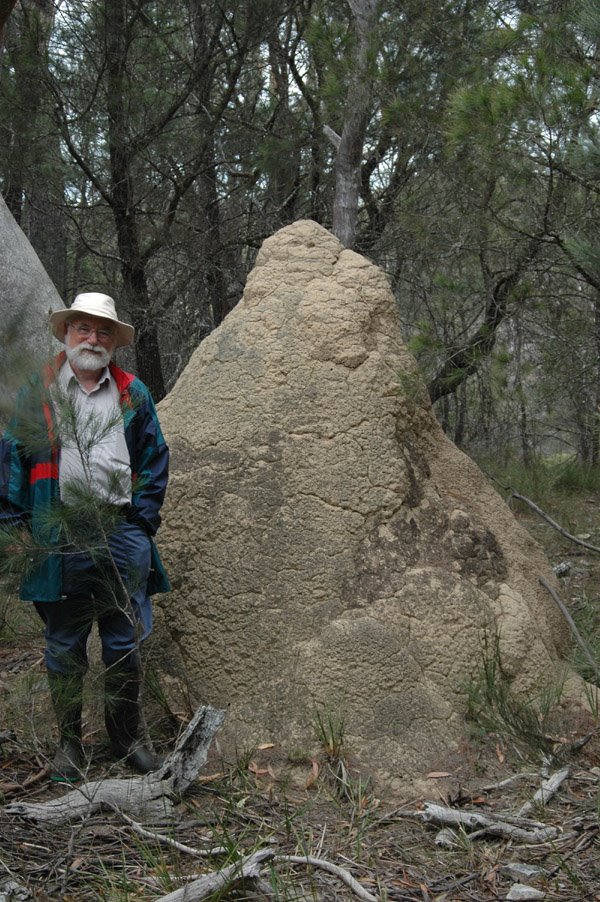 Today, Roy Freere and I visited a private property in the mixed Eucalypt forests of Canyonleigh. We went in search of rare and unusual species of plants, birds and fungi. We had a nice time in the bush, with our hosts.
The sandstone plateau was covered in dense regrowth of Stringybark, Scribbly Gums and Grey Gums, for the property has been logged for firewood. As you can see from the attached photo, there were some very fine examples of termite mounds.
There was a very interesting gully, with a permanent stream, fed by springs coming out of rock ledges, about 20 metres below the top of the plateau. This gully had some caves with interesting eroded rock features.
 The ledge below the cliff had exposed oil shale or perhaps very low grade coal, in shallow strata. There was a wet point, where rust-stained water oozed out from below a rock ledge. There were several Fungi growing in the red-brown mud there.
There were also several tiny, dark brown froglets there, little more than the size of a fingernail.
We had lunch at a point overlooking the Wingecarribee River (or a tributary). Although we were in sandstone country, the edges of this valley were steep, but not cliff-faced, unlike the more familiar escarpments of the local coastal escarpment, or the edges of the Kangaroo Valley.
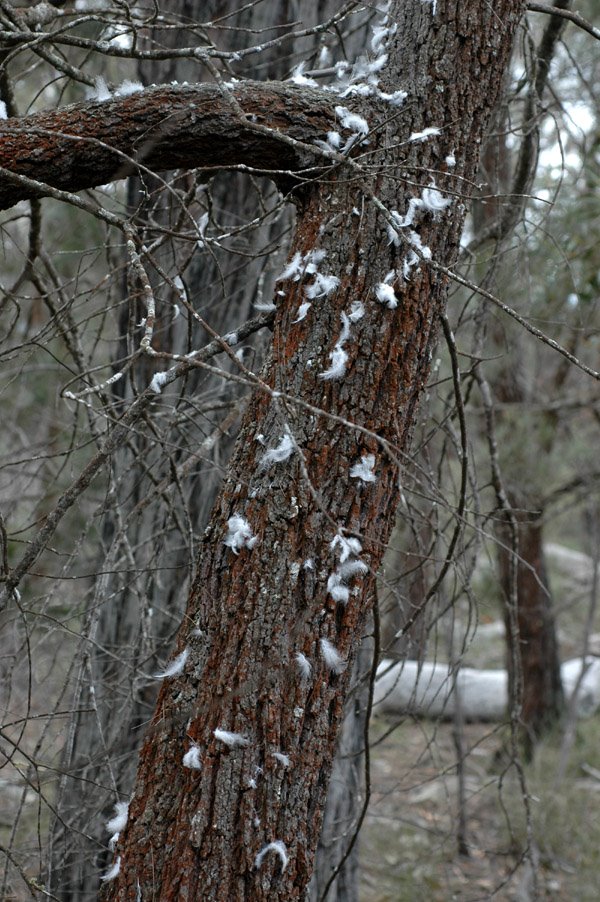
My favourite observation was a tree dotted with white fluffy feathers, (see above, left) which indicated that a Wonga Pigeon had been killed by a large bird of prey, most likely a large Owl, possibly even a Powerful Owl.
 We also found several specimens of the Ground Orchid known as Parson's Bands (Eriochilus cucullatus). It is a tiny pink-white Orchid, which flowers in late summer and autumn, and has a preference for sandstone-based soils apparently.
There were also many other interesting plants in the "myrtle" family, which formed a low mat of heath growth, which were notable for their lemon scent. These plants might have been the Micromyrtus ciliata, but, as they were not in flower, I cannot be sure.


