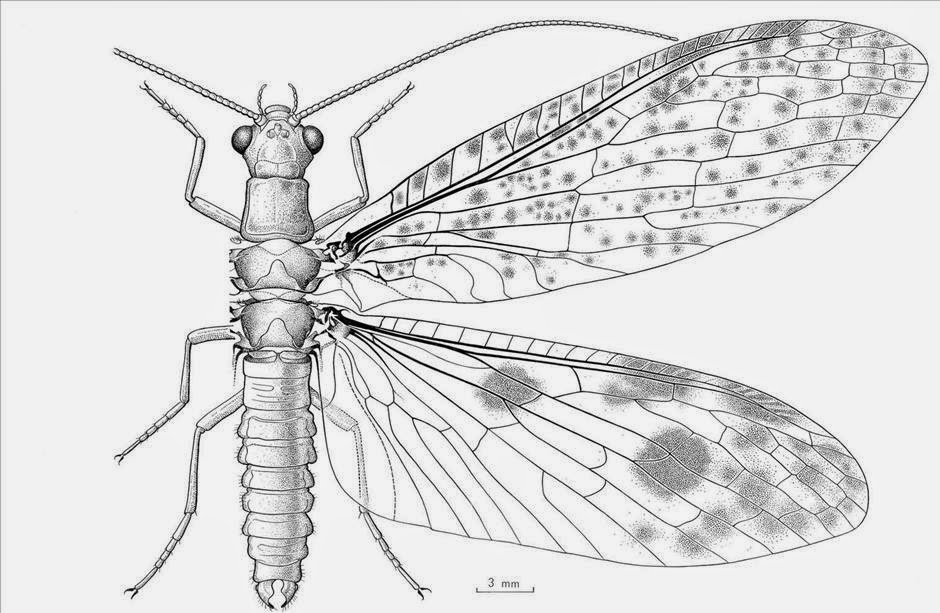
I always find Dobsonflies to be slightly strange insects.
They are as big as Dragonflies, but they fly with a weak, fluttering motion which immediately sets them apart from Dragonflies. They are partially aquatic. Eggs are laid on land (on rocks or vegetation). Then Larvae crawl to fresh water and become completely aquatic, until such time as they are ready to pupate.
From: http://www.ento.csiro.au/education/insects/megaloptera.html
Megaloptera: dobsonflies and alderflies
CharacteristicsThis is a very small order of Australian insects commonly known as alderflies and dobsonflies. They are medium to large sized insects with a wingspan ranging from 20 to 100 millimetres. Alderflies and dobsonflies can be recognised by the following features:
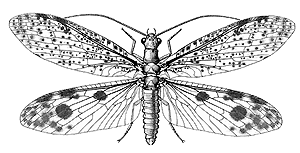 Archichauliodes species (CORYDALIDAE)
|
|
- Long, soft, flexible bodies, usually dark coloured
- 2 pairs of membranous wings of similar size, often bearing dark patches.
- At rest the wings are held roof-like over the body
- Mandibulate mouthparts
- Long filiform antennae which taper towards the end
CORYDALIDAE is a widespread family of dobsonflies and well represented in Australia.
Archichauliodes species are inhabitants of cold-water streams and can be found from southern Australia to north Queensland. Adults of this species can usually be recognised as they have 4 or 5 large spots on their hind wings in addition to many smaller spots towards the edges of the wing.
The larvae of alderflies and dobsonflies are aquatic, appear caterpillar-like and possess gills along the sides of their abdomens.
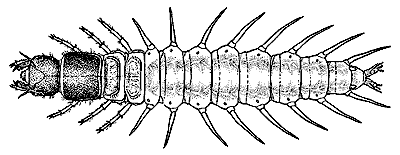
Archichauliodes species (CORYDALIDAE)
|
DJW Notes:
They are not completely Aquatic in larval stage of their life-cycle (again, unlike Dragonflies).
Back to CSIRO site:
"All species have aquatic larvae and mating occurs on the vegetation close to freshwater streams. Female alderflies and dobsonflies may lay up to 3000 eggs on rocks or debris close to the stream but not in the water. When the larvae hatch they enter the water and live a permanently aquatic life until they are ready to pupate. At this stage the larvae move out of the water into the adjacent leaf litter or soil where they pupate for several weeks. The complete life cycle may take only one year in warmer areas or up to 5 in colder climates."
Here was my first ever photo of a Dobsonfly.
It took me ages to get a proper ID on it, because, apart from specialist Entomologist site, there is not much readily available on them. At first I thought this was a Stonefly, but it is not. Nor is it a Giant Lacewing (with which it might be confused).
 |
Dobsonfly on Tea Tree.
Wingecarribee Swamp, Nov 2007 |
This was found on the edge of the Wingecarribee Swamp, in late November 2007. On a flowering Tea Tree (Leptospermum sp.) But that fits with its aquatic larval lifecycle. My insect, from yesterday, was also attracted to the flowers of relative of the Tea Tree (Astartea fascicularis).
 |
Great photo of a Dobsonfly
originally sourced from CSIRO "What Bug is That?"
Unfortunately that site appears to be
no longer being maintained.
Thanks Mr Abbott.
 |
Dobsonfly on my front porch - attracted to the light
4 December 2013
Seems they like to fly at this time of year. |
|
Here is another page from CSIRO, to show some of the differences between Dobsonflies and Ant Lions and Lacewings.
http://www.ento.csiro.au/education/insects/neuroptera.html
Since publication, I have been contacted and provided with a working link to the "What Bug Is That?" site.
It is http://anic.ento.csiro.au/insectfamilies/index.aspx
Thanks to the ever alert members of the scientific community.
You know who you are :)