Christmas Bells

Christmas Bells
Christmas Bells - Blandfordia nobilis
Showing posts with label Beetles. Show all posts

Friday, December 30, 2011

Orchid seed as fine as dust.

Today I was showing my friends Owen and Cathryn, and Helen some of the early summer Orchids of Kangaloon. We were accompanied by Cathryn's brother, David and his wife Merle, visitors from Canberra. We had a good fun time  looking for Orchids and other bits and pieces.

There is much of interest about in Kangaloon, (and not just Orchids, you will be pleased to hear). Some of the Orchids are just starting to flower, and some are still hanging around (from Springtime).

Seeds of Thelymitra (Sun Orchids) are as fine as dust
They are wind blown when the capsule is ready to shed.
In this case we experimented by flicking the ripe seed pod.
My photographic assistant counted down 3, 2,1, go.
I took the shot, with a flash, to illuminate the seeds.
Click to enlarge - to see the Orchid seeds better.

I found this Hairy Caterpillar (probably a "Wooly Bear" Caterpillar)
feeding on the leaves of a Hardenbergia violacea (False Sarsparilla)

Head-on view of the "Wooly Bear" caterpillar

Side-on view. Long hairs can cause skin irritation. Two red mites.
We found this Jewel Beetle feeding on 
a low-growing Leptospermum plant
on the edge of Butler's Swamp.
These Beetles love Leptospermum flowers.
As Beetles go this is quite large, flat, and very peaceful.
About 40mm long.
Stigmodera macularia Jewel Beetle
 I like this front on view..
Nice large eyes.
Its eyes look a bit "Possum-like", to me.
 
From the side.
Jewel Beetle - from the side. Stigmodera macularia
  • Corunastylis densa (a tiny Midge Orchid), cherry-red in colour - first found in Kangaloon, 16 January 2011.
Corunastylis densa (Kirsten Vine photo)
Cryptostylis leptochila - red velvety labellum with scent glands visible
The way the labellum curves back at the top is typical of this species.
Cryptostylis leptochila - side on view. Labellum reflexed at top.
  • Hyacinth Orchids - Dipodium punctata and/or roseum (Kirkland Road) - just starting (Shown yesterday)
  • Hyacinth Orchids - Dipodium roseum (definite) at Meryla Pass Rd (on plateau at top end of Griffin's Fire Trail, near Bundanoon Creek - accessed via Fitzroy Falls Rd (Nowra Rd). (Shown yesterday).
  • Microtis unifolia, tall Onion Orchids growing amongst Daviesia (Bitter Pea) shrubbery.
Microtis unifolia "Common Onion Orchid"
  • Caleana major (Flying Duck Orchid) (some still in flower at Butlers Swamp - dry part, near car park - not in the swampy bit).
  • It is one of my favourite Orchids. A good one, like this, always makes me giggle.
  •  Gastrodium sp. (Kirkland Road colony) have just a few flowers remaining. Huge seed setting has occurred.
Huge number of seeds set in this colony of Potato Orchids.
Close-up of swollen capsules on Gastrodium sp.
  • Prasophyllum flavum (one fresh flower) on Tourist Road, in dense cover, growing amongst the Hop Bitter Pea (Daviesia latifolia). I also found 4 more yesterday near Hindmarsh Lookout, (near Belmore Falls).


Prasophyllum flavum (Yellow Leek Orchid) 

HAPPY NEW YEAR 
AND A GREAT 2012 
TO ALL READERS.

Sunday, October 09, 2011

Carrion Beetle (Ptomaphila lacrymosa)

Nature invented what we humans call "recycling".
If it were not for things like Carrion Beetles, the world would be full of dead animal bodies.
These guys are an integral part of cleaning up the world.
Before I proceed, I must give you an image warning.
If you are inclined to be a bit squeamish, kindly come back tomorrow.

I have to say that Google Image Search is amazing.
Today I found some large beetles feeding on the carcase of a long-dead Kangaroo.
I assumed, at first, that they were cockroaches, so I immediately thought Dave Rentz will be happy.
But on close examination of the first few images I realised they had beetle antennae. Bad luck, Dave!
(He shall have to console himself  with memories of his recent "Ig Nobel Prize in Biology".)

However, back to these Beetles -  what on earth are they?

I started out looking at "Brisbane Insects and Spiders" - without luck.
I then tried Nick Monaghan's "Lifeunseen"
- which has excellent photos, and is always worth a visit when tracking down an ID of an unfamiliar insect or spider. But I drew a blank there, too.
I then Googled "Carnivorous Beetles", and that told me that many beetle larvae eat flesh, 
Charming! But not what I had seen - adult Beetles feeding on a carcase.
Then I saw mention of Carrion Beetles. 
Hello!
Refine the search to Carrion Beetles + Australia
Bingo!
First hit was Dave's Garden (a very wide-ranging website) with a picture of a Beetle which had been found feeding on a dead Wombat! 
How Aussie is that? 
It also gave me a name to search >>> Ptomaphila lacrymosa

Next step: Google Image search for that name.
Bullseye!

The Atlas of Living Australia came through with the necessary images and descriptions to confirm I had the right ID. 
  • "The Silphidae adults feed in a saprophagous manner, which means they feed on decaying matter. The beetles colonize the carrion during all four stages of decomposition which are fresh, bloated, decay, and dry. The main areas of decomposition for adults are during both the bloated and decaying stages. ... " (ALA)
The ALA had a further link to CSIRO's Entomology Division's "What Bug is That?"
  • "In Ptomaphila the elytra are provided with short, longitudinal ridges and tubercles and completely conceal the abdomen...."
  •  el·y·tron noun, plural -tra
  • one of the pair of hardened forewings of certain insects, as beetles, forming a protective covering for the posterior or flight wings.
  • Also called wing case, wing cover.
Here is the clearest (and cleanest) image.
The lumps (tubercules - as we now know to call them) are clearly obvious.
Carrion Beetle (Ptomaphila lacrymosa)
(Ptomaphila lacrymosa) - on the leg of a Kangaroo carcase
Two Beetles actively feeding (head down) (Ptomaphila lacrymosa)
(Ptomaphila lacrymosa) going for a walk along the bare bone
More Carrion Beetles actively feeding (Ptomaphila lacrymosa)
Close-up of a Carrion Beetle (Ptomaphila lacrymosa)
Nature is not always pretty, but it is all necessary, one way or the other.
Fungi break down trees into material plants can use as soil nutrients. 
Insects play their part in that decomposition process, too.

Monday, October 11, 2010

Orchid pollination - in progress.

Dear Reader.
What is my catch cry? - "Never leave home without your camera, Denis!"

What did I do today?
Yes, that's right - left home without my camera.
How stupid am I?
(Answers to that question may or may not be published, Dear reader).

I know you don't need an explanation, but my brother Brendan and I were intending to visit a friend, but he was not home, so we decided to take a quick drive to look at some Waratahs in the bush.

While out, we looked at the Waratahs and also some Orchids (of course).

Now I had photographed these Orchids on the weekend, and so (I thought) I did not need my camera anyway.

You know the rest, already, or can guess it, Dear Reader!

*****

Fortunately, my brother had his little "point and shoot" camera with him, so we have some images - but not as nice as I would have liked, but far better than the ones I could not take (with my camera sitting on my bed at home).

I went looking to show Brendan a case moth I had seen busy devouring an Orchid. Now for an Orchid fancier, there are few things more insulting than seeing a caterpillar devouring one's favourite flowers. This is one of the many Orchids in the group known as "Golden Moth" Orchids. It is Diuris chryseopsis - the "Snake Orchid"
A "Case Moth" devouring my beloved Orchid.
Technically, it is the caterpillar of the Case Moth
The Caterpillar uses silk to encases itself
with tiny bits of grass (in this example).
That shields the little bugger while it happily destroys the flower!
In this case it has webbed two flowers (on the one stem) together.
Next we found this European Honey Bee (Apis mellifera)
It was climbing all over a particular Orchid flower.
On close examination it had the Orchid's "pollinia" stuck on its "nose".
(Insects do not have "noses" for breathing, as we do.)
There is a "V-shaped" creamy yellow object on the front of its head.
David Jones says in his book that he pollen of Diuris Orchids is
a soft mealy substance.
Here it is again, a bit closer, this time.
The V-shaped object is clearly visible,
pointing away from the Bee's "nose".
Here you can see the Bee wandering around.
It is facing away from the camera.
The pollinia are still visible to the top-right of the Bee.
Underneath the Bee, in another flower on the same plant,
is a little brown beetle totally drunk on whatever chemicals
the Orchid produces to attract insects.
It did not move the whole time we watched the Bee,
including when the Bee climbed into the same flower.
And for good measure, in another flower, there was a native black Bee.
I cannot swear to this a being true, but it looks to me that this Bee has something white stuck on its rear end.
Could that be several pieces of Orchid pollinia?
The "jury is out" on that question.


*****
Q and A

  • Q. So, dear reader - what is the moral of today's story?
  • A. Never leave home without your damned Camera, Denis!
Oh, by the way, this is one of the wild Waratah plants
which we went out in the bush to see.
A perfect specimen of Telopea speciosissima
By the way, lest I appear ungrateful
I should thank my brother, Brendan
for supplying these photos.


Wednesday, December 09, 2009

Beetles love blossoms.

For the last week, several plants of Melaleuca linariifolia in my yard have been flowering prolifically. I decided yesterday that I ought take some photos to show you how these flowers are structured, for they are somewhat unusual.
This plant is one of those plants known as "Snow in Summer".
Such names are of course, very ambiguous, but poetic.
A little closer view.
Here is a shot of a head if flowers - seen end on.
The bristling petals interlock,
making it hard to see where one flower starts.
Here is the same group of flowers, seen from the side.
You can see the petals opened out like little cups.
They are clearly visible on the left hand flower -
the one closest to my fingers.
The long white structures are not petals they are stamens.
The botanists describe this structure as a "claw".
That's the bit I was referring to as unusual.
Click to enlarge the image to see the tiny dots of pollen.
Here is a set of buds, just starting to open.
Here is a spray of leaves, from which the plant takes its name
- the "Flax-leaved Melaleuca" (from "Linum" the Flax plant)
While I was taking those shots I realised that the old flowers were smothered with beetles.
Click to enlarge.
Small Brown Beetles and Soldier Beetles. I do not know why the fresh flowers were not attracting the beetles. The old flowers were literally crawling with beetles.

Saturday, December 06, 2008

A day at Sutton Forest

I have already mentioned that Liz and Wayne from Watermark Australia visited with Bernie, Kim and myself the other day. In fact we all met at Kim and Peter's property at Sutton Forest.

One of the advantages of that is that we could go out and stroll around the property, and inspect Kim's wonderful veggie garden, and her flower garden. This provided a very useful and relaxing interlude.
Asiatic Lilium (hybrid)
The same plant - single flower
One of Kim's David Austin Roses
This is a fine example of the "old-gold" coloured Graham Thomas
This image which I published before, is just to remind you that Kim really does grow vegetables amongst her Roses. Stunning red and green lettuces.
This is a favourite plant of mine, which my Mother absolutely adored. It makes a splendid cut flower. It is the Jacobean Lily, which is a bit of a misnomer. It is Sprekelia formosissima. These plants originate from Mexico, but are a popular garden flower, amongst discerning gardeners.

****************************************************************
Life and Death in the Garden, at Sutton Forest.

Lest you think I have gone all soft, amongst Kim's beautiful flowers, here are a couple of scenes which caught my eye while wandering around there.

A Bull Ant (Myrmecia sp) was attempting to drag a large wood grub into its nest (to feed its young). However, a group of very hostile smaller ants overpowered the much larger ant, and made it give up its prey. (Click to enlarge).
Quite remarkable when you think about the relative size and power of these two species of ants. The power of numbers won out. No wonder social anthropologists are fascinated by the workings of ant colonies.

Later on in our walk, over at the cattle yards, I found this dead small brown beetle. It had been caught in a spiders web, and it died with its wings still in flying position. This shows clearly the manner in which Beetles fly, by lifting their hard shelled wings (elytra) (the two brown wings which cover their back when not flying) so as to allow the lower wings to do the flapping. The soft membraneous wings are much longer than the brown elantra, so presumably those soft wings are folded in some manner, when not flying.

Saturday, October 18, 2008

Robertson Green Restaurant and Pub Beetle

This is a "Robertson Green Restaurant and Pub Beetle" . You might think it is an unusual name, but I have followed the tradition of naming it from where it was found. The first one landed on my daughter Zoe's black jumper, when she was sitting outside the Robbo Pub (in November, 2006). Last night’s specimen was found on the wire screen door of a local restaurant. My friend Ted kindly provided his sleeve as a neutral background to show the wonderful colour of the Beetle's shell.
As can be seen in the first image, it has series of pits or depressions on its wings, and those tiny pits are in a series of definite lines. From my memory, the common “Christmas Beetles” from around Canberra, which are bronze-coloured, do not have these lines on their wing shells. A brief look at the Australian Museum site this morning shows some of the Christmas Beetles (genus Anoplognathus) do have these ribbed lines on their wing shells. They also have similar spurs on the legs, which apparently are an adaptation for digging - presumably to lay eggs in soil, and to emerge from the soil, once they have completed their metamorphosis.
I was expecting to need assistance from my Aussie Nature Blogger colleagues to come up with a more scientific name for this creature, however, a Google Search for "Christmas Beetle + Green" gave me a perfect match: Anoplognathus prasinus Thanks are due to Nick Monoghan.
It is, in effect an apple-green coloured Christmas Beetle. It is distinctly hairy underneath.
Its also it has a series of short, sharp bristles between the head and the second segment of the carapace, and also above the wings.
This species seems to arrive earlier than the regular Christmas Beetles, as I saw it two years ago (just once) on 16 November, and last night, 17 October. Robertson does not have many Eucalypts, so it is likely to be a species which feeds on rainforest plants. This matches the information on the Australian Insects site linked above. I mention this, as the traditional Aussie "Christmas Beetles" are obligate Eucalypt feeders, and we get very few of them in Robertson.

I have only ever seen two specimens of this species of Beetle - so presumably it is not very common.

As can be seen in the first image, it has series of pits or depressions on its wings, and those tiny pits are in a series of definite lines. From my memory, the common “Christmas Beetles” from around Canberra, which are bronze-coloured, do not have these lines on their wing shells. A brief look at the Australian Museum site this morning shows some of the Christmas Beetles (genus Anoplognathus) do have these ribbed lines on their wing shells. They also have similar spurs on the legs, which apparently are an adaptation for digging - presumably to lay eggs in soil, and to emerge from the soil, once they have completed their metamorphosis. I have included two photos from 2006, which are not taken with the Macro lens. The first of those images, above, shows the intricate details of the spurs on the legs, and the arrangement of antennae and mouth parts around the head. I have also included one shot of the 2006 specimen just about to fly away – showing what I mean about the wing shells, for Beetles have thin, transparent wings under the cover of the hard wing shells***. As they are about to fly, they lift the hard shells up and out of the way, and then flap with the softer inner (lower) wings. You can see the split appearing between these hard wing shells, as the creature was preparing to take off.
*** The Australian Museum Beetles website tells me that Beetles "front wings (called elytra) are hard sheaths that protect the beetles' hind wings and cover the breathing pores."

Wednesday, January 10, 2007

Birds fall out of the skies - in Esperance, W.A.

Brush Wattlebird
You might recall that I wrote two stories last week about the super storm which buffetted West Australia last week.

Well, today Miss Eagle sent me a link to this story from news.com.au. Naturally I am always wary of Rupert's media network, but occasionally they do get good stories.

This story falls into the "incredible - but credible" category. (Ah, the joys of the English language). I read what I see in this story, and cannot pick holes in the reports. So, in that regard it is credible. But it is hard to believe that such a thing can happen - therefore we can describe it as "incredible".

The story says: "Thousands of birds have fallen from the skies over Esperance and no one knows why".

It seems that autopsies have been conducted on many of these birds, and no obvious reason can be found for the death of these birds. Poison and infection ("bird flu"?) appear to have been ruled out. Incidentally, bird flu seems to mostly be an issue with water birds, which tend to hang out in huge numbers, and in large flocks.

More significantly, this apparently started before the big storm hit last week. That was my original theory - exhaustion from trying to fly against the storm. Or even some massive electrical effects of the storm. But apparently not. Not if it started three weeks ago.

Singing Honeyeater
It is interesting that of the main species listed - Wattlebirds, Yellow-throated Miners, New Holland Honeyeaters, and Singing Honeyeaters - are all in the family of Honeyeaters. All are nectar feeders and insectivores. These birds are not normally represented in huge numbers, and they are not the obvious, colourful birds which people normally notice (not like Parrots, for example).

Some other species, such as Crows, Hawks and Pigeons are listed, but not in the same numbers as the others. Crows are carrion eaters - so they could get poisoned or diseased from eating other dead birds. Hawks are hunters, but could be poisoned or diseased form eating live birds, but that is less likely. But Pigeons are out of the frame completely. They are seed eaters, not at all likely to be eating the same foods as the other birds.

It is all very odd indeed.

"Acting chief veterinary officer Fiona Sunderman said toxins were the most likely cause but the deaths could be due to anything from toxic algae to chemicals and pesticides.

"Dr Sunderman said there were no leads yet on which of potentially hundreds of toxins might be responsible. Some birds were seen convulsing as they died."

My money is on some form of insecticide spray - but for all the Honeyeaters to have gone first, it requires their food sources (mainly native flowering trees such as Eucalypts and Banksias) to have been poisoned. Why? Has there been an outbreak of spraying of Christmas Beetles in WA? That my best guess.

Until more reports come to light, we should leave this report up in the air. I would not mind betting that it is some form of human "cock-up" but, those are the hardest cases to prove, because if it is something like that, then the humans responsible will be covering their tracks, and denying any knowledge.


Friday, June 23, 2006

The Nature of Gang-Gang Cockatoos

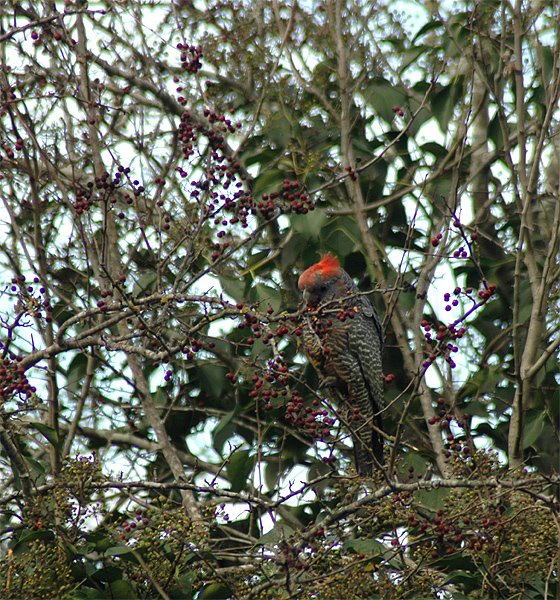
Over the last few days, I have had to drive to Bowral several times, and I have driven along Sheepwash Road and then, Kangaloon Road. Just past Sproule's Lane (on the left, as one is heading towards Bowral), there is a large stand of Hawthorn Trees, which are heavy with berries.

The Gang-Gang Cockatoos (
Callocephalon fimbriatum) have been hanging out there consistently, in the last few days. Look for them, as you go up a short, steep hill, just on the Bowral side of Sproule's Lane.


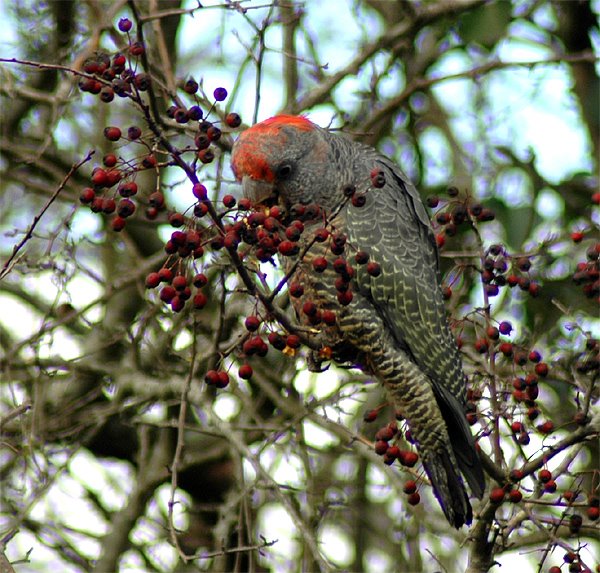
These birds LOVE Hawthorn berries (and other similar berries, such as "Washington Thorn", and other related plants). Let us not get hung up on the names of the plants, for they are confusing, at the best of times.

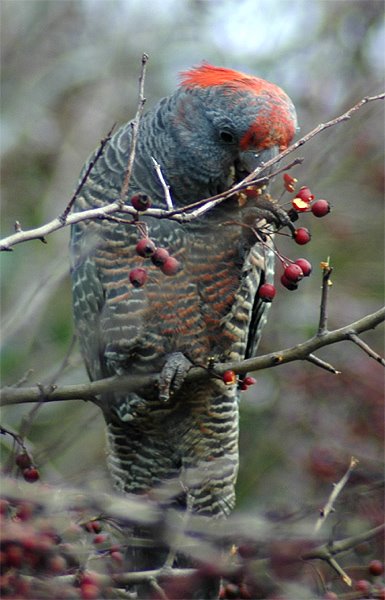
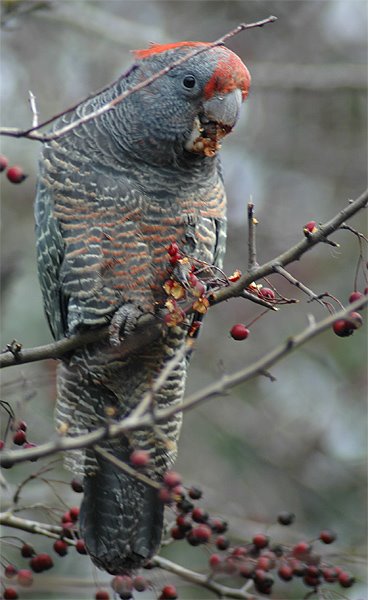
Many photos of the Gang-Gang show it chewing Hawthorn
berries. It is one of their favourite foods, in season. And this is the season.


A Google Search tonight revealed a recent declaration by the National Parks and Wildlife Service that lists the Gang-Gang Cockatoo as a "vulnerable species". It makes interesting reading, and it even mentions (in clause 7) a specific threat to the population in the Bowral area, from a contagious disease to which these birds are susceptible.

I was surprised to find, when I photographed these birds today, that they were all immature males. They are developing their red heads, but have not yet properly developed the full "Mr Curly" type of crest, for which these birds are famous. Why all these immature birds together, and no adults? I didn't know.

So, I was interested to note that in the background information on the species, in the NPWS declaration (linked to above) it says: "In winter..... the species may be observed in urban areas including parks and gardens (Morcombe 1986). The species in general, and creches of young birds in particular, undertake nomadic as well as seasonal movements ...." (Clause 3).
Source: NSW Scientific Committee listing advice

So, there is my answer - I had found a Kindergarten Class of young Gang-Gangs, learning the joys of eating Hawthorn berries.
*****

Interestingly, when Gang-Gangs are feeding intensively on berries like this, they will often allow the observer to approach very close indeed (as may be determined from my photographs). And they were sitting in these trees, right beside Kangaloon Road, with cars and trucks whizzing past, barely 3 metres away.

Gang-Gangs love their food, and when they are eating, they are remarkably calm, and placid. I love the Gang-Gang Cockatoo, but a male., with his full scarlet crest is even better than these youngsters.


Here is another link, which shows a pair, with a grey-headed female, and the scarlet crested male.