Christmas Bells

Christmas Bells
Christmas Bells - Blandfordia nobilis
Showing posts with label pollination. Show all posts

Sunday, January 08, 2012

Cryptostylis erecta (the Bonnet Orchid, or Tartan Orchid)

Cryptostylis erecta is a Tongue Orchid, but it is better known as the "Bonnet Orchid", or the "Tartan Orchid".
It tends to grow in coastal areas, but is known to occur in the Blue Mountains as well. But when I went out with Alan Stephenson the other day, to Leebold Hill (Cambewarra Range Nature Reserve) above Kangaroo Valley, I  said to Alan that I was hoping to find the Bonnet Orchid. It may occur in my immediate area of Robertson/Kangaloon/Fitzroy Falls, but I do not know of it growing there. Hence my interest in looking for it, on the wonderful high ridge above Cambewarra, and Kangaroo Valley. The habitat is similar to my local sandstone plateau areas, but it is warmer and wetter over there. The altitude is similar, but the Shoalhaven Valley region has a climate all of its own.

One can see why it earns both common names.
Bonnet Orchid, for the shape,
and Tartan Orchid for the colour and patterns.
Bonnet Orchid Cryptostylis erecta


Here it is, as I first found it.
It is growing in moist mossy soil, amongst grasses and rushes
over a shallow rock shelf (exposed rocks in background).
Bonnet Orchid Cryptostylis erecta

A closer view, to show the shape of the flowers.
Bonnet Orchid Cryptostylis erecta
Here is another close-up of the flower.
Add caption
It is appropriate to mention that this species is the main one featured in that Video I linked to last week, about "sexual deception" of Wasps by Orchids. Video by Macquarie University people (as named in the Video credits). That previous post was primarily about a related plant Cryptostylis subulata

And just for the record, the botanical illustration on the PlantNET site, for this species, Cryptostylis erecta actually illustrates the pollination process in detail.
Click on image to see in full size. 
Note the wasp pollinating the top-right flower, 
and the "reproductive organs" of the flower drawn in detail.

Botanical illustration for Cryptostylis erecta (courtesy of PlantNET)

Saturday, January 22, 2011

Golden Ray Lilies in their full splendour.

These Golden Ray Lilies (Lilium auratum) are wonderful. Their sweet perfume is quite powerful in the fresh garden air. It could possibly be overpowering if picked and brought inside. But I love to have these sweetly perfumed flowers, outside my front door, especially at night.
Lilium auratum - the Golden Ray Lily of Japan

 Here is the clump of Lilies (including the Pink Stargazer I showed last week) as seen from my front porch. I believe that perfumed flowers ought be planted where you cannot help but be surrounded by their sweet scent.
A clump of Lilies outside my front door
I spoke about the anthers of Liliums last week. Here I had a fresh flower (at 8:30AM) just opening, and I realised I could monitor the opening (dehiscing) of the pollen grains on the anthers.
Lilium anthers just opening (dehiscing) to release pollen
The fresh anthers are flat, as the flower opens. Then they themselves open to make their pollen grains available to insects (to achieve their purpose of pollinating a flower).


Top Anther is seen to be still flat;  Lower anther just popping open, along its side joint.
Here is the same flower seen at3:11PM on the same afternoon.
Anthers now fully matured.
Knowing how the dark orange stamens can stain clothing and fabric, florists usually snip off the anthers, to prevent clients complaining about the stains from the pollen.


On the third day of opening, the clump of Liliums looks much more impressive. The largest plant is carrying six opened flowers, and has a number yet to open. The pink Lilium in the background is the Pink Stargazer.
Lilium clump on 3rd day of flowering
 I mentioned the sweet perfume of this Lilium. It attracts lots of tiny insect (midge-like creatures). Of course, it also attracts some larger insects, such as this "Common Garden Katydid". (Caedicia simplex)


My Katydid appears to be a juvenile (a "nymph") as it has not yet developed wings. But what a fine set of antennae it has. (Click to enlarge image)
Common Garden Katydid on Lilium bud.


Monday, October 11, 2010

Orchid pollination - in progress.

Dear Reader.
What is my catch cry? - "Never leave home without your camera, Denis!"

What did I do today?
Yes, that's right - left home without my camera.
How stupid am I?
(Answers to that question may or may not be published, Dear reader).

I know you don't need an explanation, but my brother Brendan and I were intending to visit a friend, but he was not home, so we decided to take a quick drive to look at some Waratahs in the bush.

While out, we looked at the Waratahs and also some Orchids (of course).

Now I had photographed these Orchids on the weekend, and so (I thought) I did not need my camera anyway.

You know the rest, already, or can guess it, Dear Reader!

*****

Fortunately, my brother had his little "point and shoot" camera with him, so we have some images - but not as nice as I would have liked, but far better than the ones I could not take (with my camera sitting on my bed at home).

I went looking to show Brendan a case moth I had seen busy devouring an Orchid. Now for an Orchid fancier, there are few things more insulting than seeing a caterpillar devouring one's favourite flowers. This is one of the many Orchids in the group known as "Golden Moth" Orchids. It is Diuris chryseopsis - the "Snake Orchid"
A "Case Moth" devouring my beloved Orchid.
Technically, it is the caterpillar of the Case Moth
The Caterpillar uses silk to encases itself
with tiny bits of grass (in this example).
That shields the little bugger while it happily destroys the flower!
In this case it has webbed two flowers (on the one stem) together.
Next we found this European Honey Bee (Apis mellifera)
It was climbing all over a particular Orchid flower.
On close examination it had the Orchid's "pollinia" stuck on its "nose".
(Insects do not have "noses" for breathing, as we do.)
There is a "V-shaped" creamy yellow object on the front of its head.
David Jones says in his book that he pollen of Diuris Orchids is
a soft mealy substance.
Here it is again, a bit closer, this time.
The V-shaped object is clearly visible,
pointing away from the Bee's "nose".
Here you can see the Bee wandering around.
It is facing away from the camera.
The pollinia are still visible to the top-right of the Bee.
Underneath the Bee, in another flower on the same plant,
is a little brown beetle totally drunk on whatever chemicals
the Orchid produces to attract insects.
It did not move the whole time we watched the Bee,
including when the Bee climbed into the same flower.
And for good measure, in another flower, there was a native black Bee.
I cannot swear to this a being true, but it looks to me that this Bee has something white stuck on its rear end.
Could that be several pieces of Orchid pollinia?
The "jury is out" on that question.


*****
Q and A

  • Q. So, dear reader - what is the moral of today's story?
  • A. Never leave home without your damned Camera, Denis!
Oh, by the way, this is one of the wild Waratah plants
which we went out in the bush to see.
A perfect specimen of Telopea speciosissima
By the way, lest I appear ungrateful
I should thank my brother, Brendan
for supplying these photos.


Wednesday, July 22, 2009

Sassafras flowers - a detailed presentation

Sassafras flowers are blossoming all over Robertson at present. I mentioned them coming into flower, last week. I am still not able to bring you the sensation of their sweet perfume, unfortunately.At the time I wanted to go into some detail of the strange structure of the flower, but I could not find out enough information to enable me to explain them to you. Tonight I think I am ready to try.
Kindly bear with me, dear reader. I have never before seen any flower with the structure which you are about to see.

Sassafras flowers develop in threes.
One single flower in the centre,
and two buds which will develop as the first flower fades.
Here is a single flower - cropped.
It is about the size of a small thimble
just large enough to take my little finger.
Note the circle of thin stamens.
Each stamen has a pair of prominent white swellings at the base.
As I shall explain later, those swellings are the anthers,
but the pollen within them is not yet ripe - not ready to be dispersed.
Another flower - picked, and ready for dissection.
Here is how the flower (inflorescence) is described by botanists. This is sourced from "Forest Trees of Australia". Click to enlarge image so you can read the text.
The dissection commences. I have removed several petals ("perianth lobes") so you can see into the flower, from the side view. Note the fine needle-like structures which are the stamens of the flower.
Click to enlarge the image. Note the fine downy hairs on the petal surface and on the outside of the swollen base of the flower (ovary capsule). It is this part of the flower which swells into the seed capsule, and from my memory of the previous seeding explosion 3 years ago, those seed capsules are noticeably hairy as they develop. In fact their hairiness is significant, for the seeds are wind dispersed, and anything which helps catch the wind is important to successful seed dispersal.

This is the same image, having been worked over somewhat in Photoshop.
The point is to simplify and thus reveal the important features of the structure of the flower.
What you have left are two of the 6 stamens, each with the two prominent anthers, which are developing to maturity - preparing to shed pollen (dehiscing). There is a structure holding the anthers out to the side to the flower - at right angles (more or less) to the tall, upright pointed stamen. That structure is made more clear in a botanical illustration and a photo below. The pollen grains are held in the anthers. that is normal. But its location at the bottom of the stamen is far from "normal" amongst most "modern" plants. In fact, the botanists regard Sassafras as a primitive plant, (amongst dicotyledonous plants) largely based upon an analysis of the flower structure. That is, it is not regarded as "primitive" compared to ferns, etc. But compared to other flowering plants, it is so regarded.

This location of the anthers (and therefore the pollen) is very different from most plants with which we gardeners are familiar. For example Lilies, or my favourites, Peonies, which hold their pollen high within the flower, to maximize pollen collection by bees.
A pink trumpet Lilium
with pollen very prominently presented on the anthers.Here is one of my favourites, a Tree Peony.
Note the ring of anthers with heavy pollen.
Clearly the Sassafras plants have evolved a very different form of pollination. I recall reading that they are supposedly pollinated by Mosquitoes (perhaps small midges or gnats which I have noticed around in the last few days.) The pollen grains are close to the base of the flower, not at the tip of the stamen, which is the more familiar position.

Here is the "eye" of the flower, cropped close.
(Click to enlarge the image).
Note the ring of 6 stamens forming the outside ring of the central part of the flower. Some are pointing up towards the camera, so they disappear, somewhat. But you can clearly see the 6 bases of the stamens, each with two white bubbles of pollen on the anthers.
There are two dark spots on the base of each stamen.
Inside that ring of stamens are a series of small structures, which are the the "6 alternating shorter staminodes" referred to in the botanical text above. Staminodes are modified stamens, often infertile (having no pollen).
These structures are visible against the green base of the flower.
Right in the centre of the flower are the thin white, pointed carpels (the female parts of the flower).

Here is a botanical drawing of the structure of the stamen and anthers of the Sassafras.
And here is an image of a single stamen and the paired anthers at the base - the result of my "dissection". The green section is the remains of the base of the flower - acting as a handle for my fingers to hold the stamen - allowing its details to be clearly seen.
You can clearly see the pollen ready to be dispersed (a process known as "dehiscence"). If you glance back up the page to the third image, you see a photo of a very fresh flower. Examine the anthers in that flower, at that stage of development. They are hard and white and clearly are not mature - at that stage. The pollen had not yet started to dehisce in that image. Unlike the pollen in this image.

In due course, I shall show some seed capsules and then the actual seeds when they disperse.

Saturday, June 27, 2009

Protea flower parts - in detail.

Several weeks ago, I showed some lovely flowers of a popular hybrid Protea "Pink Ice". Here is the primary parent plant of that hybrid.

According to the Planzafrica.com website, Protea neriifolia was the first protea ever to be mentioned in botanical literature. It is a South African plant (of course). It was first discovered in 1597, and was apparently was first illustrated in 1605. It was described and named in 1810. The name refers to the similarity of the leaves to that of the European plant - the Oleander (Nerium sp)Today it is my intention to examine the details of these spectacular flowers. Of course, in Australia, we have many plants (Waratahs and Banksias and Grevilleas to name the most familiar) which the botanists recognised easily as related to the Proteas - hence they are referred to as members of the Proteaceae family. However, to the untrained eye, the differences are more apparent than the similarities. I wish to concentrate tonight on the similarity of flower structure (with some of our flowers).

When I started this investigation, the first thing I felt was "odd" was the tuft of little "feathered tips" in the centre of the Protea flower. Then I decided to pull out several of these flowers to examine them in detail. Two things happened. The flowers broke off half-way down, with a long thin tube still protruding down to the base of the "flower" (the entire head, I mean). Clearly that would have been the tube through which the pollen grains grow down to the ovary at the base of the flower. The second thing was that my fingers were suddenly covered with pollen, which surprised me, for I had been looking to see where the pollen grains originated, but had not seen them. At least I knew they were there somewhere. Time to look more closely.
Firstly you need to understand that what we see as a flower in in fact a composite flower structure - which is composed of many flowers grouped together inside a set of surrounding bracts. It is the bracts which we see as the main part of the flower - but in botanical terms, the bracts are mere "window dressing". They simply serve to protect the true flowers as they develop.

A Protea flower - an individual "true" flower I mean - does not have separate sepals and petals. Instead, there is one set of four perianth segments (called tepals). Initially these parts are fused. As the flower matures, it ruptures open.

Following up from my first experiment to pluck out a flower (which did not work), I realised I had to break open an entire flower head (removing some of the external bracts), to approach the many flowers from the side. That worked, and in the next image, you can see the "feathered tips" of the tepals, close up.

You can also see the lipstick pink tips of what are similar to our Australian proteaceae flowers - the "pollen presenters". Technically, this is the tip of the style. It is the female organ of the flower, but it acts as the male part of the flower temporarily. That will be familiar to readers of this blog - for it is the secret to their pollination.
This is one of the things which the Proteas have in common with our own Proteaceae flowers, although our plants tend to have a curved flower, and a style "pops out" to the side, under pressure.
This Protea style does not to have that curved shape - just a slight bend near the tip, visible here, just below the red coloured section.
The four tepals are fused into a long narrow tube with a closed cup at the top. (That is the bit which has that feathered external appearance). Inside the perianth, the four stamens are fused to the tepals, in such a way that the anthers are enclosed within the cup. The pistil initially passes along the inside of the perianth tube, so that the stigma too is enclosed within the cup. As the flower develops, the pistil grows rapidly. Since the stigma is trapped, the style must bend in order to elongate, and eventually it bends so far that it splits the perianth along one seam. The style continues to grow until anthesis, when the nectaries begin to produce nectar. Just before anthesis, the anthers release their pollen, depositing it onto the stigma. At this time, the perianth splits apart, and the pistil is released to spring more or less upright. Then the tip of the pistil (the "stigma") functions (for several days usually) as the "pollen presenter". Hopefully a suitable pollinator will visit the flower to get the nectar, and will be dusted with pollen. Once the pollen dries, it falls off the tip of the stigma, which then assumes its true female (receptive) function.
You can see the pollen on the Stigma in this image.
(Click to enlarge)
The male organs (anthers) of Proteas are also distinctive. The anthers do not have long stalks (filaments), but are joined directly to near the top of the tepals. Unlike most other plants, the anthers shed their pollen onto the topmost portion of the style just before the flowers open. Because the style presents the pollen in a position suitable for placing onto any visitor, the top-most portion of the style is called the pollen-presenter. The presence of a pollen-presenter is another diagnostic feature for Proteas. It allows the pollen to be "dusted" onto the natural pollinating vector, be it an insect, a bird or a South African mouse (or Honey Possum for Australian members of the Proteaceae).
Note the split in the perianth. That is where the pollen came from. In this regard it is functionally similar to the Waratah and Grevillea flowers. Click to enlarge the image above to see what I mean.

Four nectaries are apparently situated at the base of the ovary, between the ovary and the tepal bases. These secrete nectar to attract pollinators. Source: Protea Atlas Project

One thing which I have not managed to understand yet is why our Proteaceae flowers split into 4 separate perianth segments, but this Protea seems to keep its anthers closed within a single tube - even after the style has split out. From this reference document, it is obvious that many South African Proteaceae do behave in ways more similar to our Waratahs and Grevilleas (than this Protea does).
.

Tuesday, October 21, 2008

Waratah flowers - details

The Waratah flower is actually a complicated structure of paired flowers, joined into a head, which is classed as a "terminal conflorescence" (according to the Botanists). This means, as we can all see, that there is a large flower structure (composed of many individual flowers), at the end of a branch. There is a circle of bracts (modified leaves) which served to protect the flowers as they developed (follow this link to see a photo of the bracts curled up around the flower). The bracts also make the entire flower head more prominent, visually.

What these photos do not show is the bit about the flowers being held "in pairs". That is a botanical distinction which indicates (to botanists) that these flowers are related to members of the Grevillea genus. I shall show some Grevillea flowers in a few days, where that point will be more evident.

Today I wish to concentrate on the intricate flower structure which Waratahs have developed, and discuss the implications for the pollination process of Waratahs.

Where to start? Well, we know that Waratahs are attractive to birds and to bees. That is because they produce copious amounts of nectar. Their red colour also helps make them attractive to birds (for birds "see" red colours very clearly - because of their special optic nerves). In Australia, a whole tribe of birds has evolved along with these Australian members of the Proteaceae group of plants. These plants which are similarly shaped, (nearly all tubular flowers, with nectar). And so there is a mutual dependance arrangement going on, between the Honeyeater tribe of birds (from tiny Spinebills to large Wattlebirds) and this group of related plants. Gardeners and Birdwatchers know this, for they are always talking about planting out "bird-attracting" gardens.


How does it work? This shot shows three flowers from closed bud stage (lowest) to open, and then fully open (top). What it does not show is the "nectary" which is a tiny gland deep within the base of the flower. However, when you look closely at a waratah flower, when it is freshly opened (usually just the first few rows of flowers at the base) you will see tiny gleaming droplets of nectar, inside the curled parts of the opened flower. In some cases, the nectar will leak out, and collect on the red bracts at the base of the flower. In which case, expect ants to be attracted to these flowers.

As the individual flower matures, the style (the long pointed part of the flower) straightens out, and emerges backwards from a longitudinal split in the tubular part flower (which is known as the "perianth"). Then the perianth lobes curl arond on themselves, and shrink back down towards the base of the flower.

From the point of view of pollination, the trick is that the anthers in these flowers are held deep withing the tube (the perianth) and do not protrude at all. That means that unlike many familiar garden plants which present masses of pollen (on long anthers), which makes their pollen readily available to insects, the Waratah and other related plants, use what is known as a "pollen presenter". This is the most remarkable part of their trick, for the "pollen presenter" is in fact the female organ of the flower - the "stigma". But for the first few days after the flower opens, the stigma is not mature (as a female organ) and instead acts to carry the pollen which has been stuck onto it when it was curled up inside the (previously unopened) flower. In the image above, you can see there are four dark dots inside the curled perianth segment. Those are the male anthers, and while the flower was still unopened, and the style was still curled up inside the tube, the stigma (the pad on the inside edge of the style) was in a position to touch the anthers. So, the stigma collects the pollen from the anthers, and as it opens out, it takes the pollen with it.


In the next image, you can clearly see the dark brown coloured pollen on the stigma - the inside of the point of the style (curved rod).


The next stage is less visible. The pollen dries up, and then the face of the stigma (the "inside face" of the curled style then become mature as its female stage, and becomes sticky, ready to receive any pollen from another Waratah flower which might be brushed onto it by a passing Honeyeater, or bee.


The curved shape of these flowers is important, for Honeyeaters have long thin, curved beaks which they use to poke inside the tubular flowers of the Waratah, in search of the reward of some nectar. As they do so, they touch the pollen presenter, and receive a dusting of pollen on top of their forehead (or just around the beak). The bird then goes off to another flower. And if that flower is at the slightly later stage of development, when its female stigma is now mature (sticky), it till be able to receive pollen dusted onto it by the bird's feathers on its forehead.

You will often notice a Honeyeater (of some description) sitting on top of a Waratah flower. As it reaches down toward the base of the flower, to get the nectar, its head will come down from above the flower, making a perfect match between its forehead and the position of the stigma. That is why Waratah flowers are shaped they way they are - to suit the pollinators which have evolved with them.

I noticed today that my blogging colleague who writes "A Snail's Eye View" has written a report on pollination structures in Western Australian Banksias, which are related plants, despite some apparent differences. Their internal flower structure is very similar, and hence the pollination process is nearly identical, except that they rely more on insects, and tiny "Honey Possums" for pollination. Banksias develop a woody cone after pollination, whereas Waratahs develop a pod. Apart from that the pollination system is very similar indeed. You can also clearly see on Snail's Blog that Banksia flowers are also held in "pairs", even though the overall structure is also a "conflorescence" (as is the Waratah head).

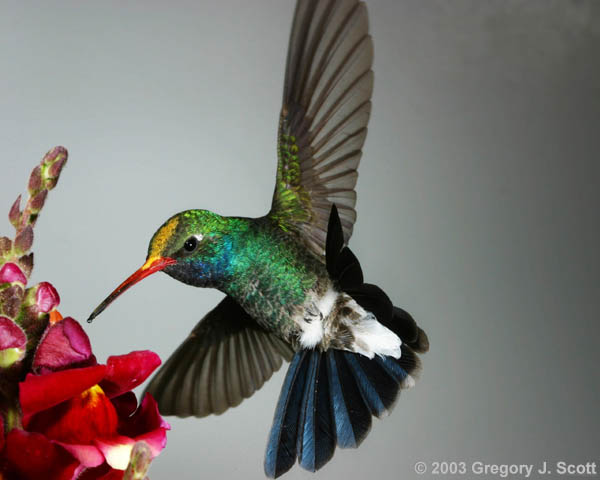
In an example of "parallel evolution" many red tubular flowers in Central and South America are pollinated by Hummingbirds, which are not particularly closely relate to our Honeyeaters, but which have adapted to feed on long tubular red flowers. As they do so, Hummingbirds receive dobs of pollen on their foreheads, from the plants, which they then take on to other plants. Sound familiar?

In my opinion, this is just an illustration of the fact that plants have shaped the world to suit their interests.

And we like to kid ourselves that we are the "masters of the universe"?

Sunday, July 06, 2008

Pterostylis hildae starting to flower

Pterostylis hildae (Rainforest Greenhood) is just starting to flower at Macquarie Pass. Colin will be pleased - he has asked me to keep a look out for them (which he knows I would have been doing anyway).

Here are two shots of the side of the flower. It is a small Greenhood, growing to less than 6 inches (most were smaller than that).Mature flowers have a brownish tinge on the "nose" of the hood.The labellum has an interesting shape, resembling a mini surfboard, complete with a nice brown stripe down the middle. Very cute detailing.I also saw the first of the winter/spring flowering "Ant Orchids" - which these days are classed as members of the genus Myrmechila. The more common "Ant Orchids" or "Wasp Orchids" in this district are the autumn flowered species, which are classed as Chiloglottis. All of these related plants are still classed as members of the genus Chiloglottis in the minds of the people who run the PlantNET website at the RBG Sydney - even though there are very good reasons to class these plants as separate genera, especially the much larger-flowered Bird Orchids (now called Simpliglottis). Related plants, yes. Same genus - I don't think so. I go with Jones and Clements.

This plant is Myrmechila (Chiloglottis) formicifera (the "Ant Orchid" - in English and Latin names).

From the front, the column is a clean green/yellow colour, whereas the basically similar Chiloglottis seminuda (an autumn flowerer) has strong lines of red across the flat front edge of the green "column". The "pseudo-insect" has a double-headed shape, by which I mean it is like a bug-eyed insect. You can make out clearly the protrusion at the far end of the "pseudo-insect's head". In fact it protrudes to the left and the right. Some of the autumn-flowered species have heart-shaped "glands". This one clearly is not like that.

The secondary set of glands, smaller little bobbles of "jelly" go right to the bottom of the labellum (that is the diamond-shaped blade which is protruding at the front of the flower). Also, the lateral sepals are held shallowly, and are widely divergent (like two narrow blades, on the left and right). They are reflecting the light from the flash, and so they stand out, in this image. That is a considerable difference from the autumn-flowered Chiloglottis species which I have photographed, where the lateral sepals are held very low under the labellum, either reflexed or bent forward under the labellum, but not spread wide, like in this flower.
Here you may observe the gap between the major gland (the "pseudo-insect") and the smaller glands which extend all the way down to the tip of the diamond-shaped labellum. The "pseudo-insect" not only resembles an Ant (in our eyes), but apparently it emits scents which mimic the scents of female wasps, and so, it attracts male wasps which attempt to copulate with the flower. Thus does the flower achieve its pollination. This is called "pseudo-copulation". All of this is now well documented, and it is not my imagination running away with me.I would have to say that I went looking in a place where I had previously been shown leaves of these Orchids, and found some leaves straight away. I stared and stared and it was only when I knelt down to get a really close look that I found the first flower. It was about 3 inches from my hand. What I am trying to say is these tiny, dark flowers are really hard to see, even when you know they are there - right in front of you.

Because these small flowers are so well camouflaged, it is no surprise, therefore, that they are famous for their reliance upon scent glands in order to attract pollinators. In fact, it is an interesting area of science which brings together entomologists (who identify the insects), botanists and molecular biologists, who identify the chemicals which the plants use to attract the pollinating insects.

Monday, January 14, 2008

More Wildflowers from the Sandstone Plateaux

These flowers are from East Kangaloon in the Southern Highlands (just north of Robertson).

This large Scaevola flower is very prominent amongst the ground-cover of plants, ferns, and leaf-litter on the forest floor. It is Scaevola ramosissima - the Purple Fan-flower. At present this plant is very commonly seen in most of the sandstone scrub (at least under Eucalypt trees). The flowers are quite large 3 to 4 cm long, with a very definite protruding 3 central petals. The two outer petals appear to be twisted back towards the rear. The botanists regard these "petals" as part of a corolla, deeply split, and spread out like a "fan" - hence the common name.
This genus was apparently named after a Roman Warrior Gaius Mucius Scaevola. The last name was a "nick-name" meaning "lefty" as he plunged his right hand into a fire - supposedly to show his lack of fear of fire (he had been sentenced to death by burning). He escaped execution - as a result of this display of bravery. Supposedly the shape of the flowers reminded the botanist (who named the genus) of a bony (burnt) right hand - hence he gave it the name Scaevola).

Hyacinth Orchids are still in flower (they started in early December). Here is a close-up image of the side of one flower.

(DJW Edit 2.1.2010) Although it is less than clear from this image, and the group shot below, this species is Dipodium punctatum. I had thought that these plants were D. roseum, but having gone back to the same clump in January 2010, I can now confirm that these plants are D. punctatum.)
You can see the twisted stem, which is how most Orchids end up with their flowers held upside-down, allowing the "labellum" (tongue) to serve as a landing platform for insects when wanting to pollinate the flower. In this case, the labellum is the dark pink protrusion at the front of the flower. The column of this orchid is inside the pale pink/white tube. The yellow blob is a cover, behind which the pollen grains are located. Insects attracted to the flower have to enter the tube, and as they do so, they brush the sticky pollinia, which they take (stuck to their wings or head) to the next flower, to effect pollination.

Below is a group of Hyacinth Orchids growing together in a way I have not ever seen before. In this location there were several clumps of Hyacinth Orchids growing in this manner. It makes a wonderful display. They are right beside a road - which is very convenient (for me). The local population appear not to notice them. How strange! Here is a better specimen of the Common Fringe-lily (Thysanotus tuberosus) than the one of which I published a photo a few days ago.I am slightly uncertain about this next identification. I know it is a Hibbertia, but I think it is Hibbertia diffusa (but I am not sure).
This is another plant which is very common on the sandstone forest floor. It is in flower commonly - for most of the spring and early summer seasons. It is probably the most common of the blue flowered plants in flower at present. It is Dampiera stricta.
This genus is named after William Dampier, the famous English "Privateer" (a more polite term than "pirate") who found plants of this genus at Shark Bay in 1688 to Western Australia. His notes of the flora and fauna survived Dampier being marooned (seemingly with his consent) on the Nicobar Islands. He built a new boat, and escaped to Sumatra. His journals survived these adventures, and were studied by Sir Joseph Banks, prior to his own voyage with Captain Cook in 1768 - 1771.

So, there you go, plants, and a bit of Roman and English history as well.