Christmas Bells

Christmas Bells
Christmas Bells - Blandfordia nobilis
Showing posts with label Birds _of _Prey. Show all posts

Tuesday, February 10, 2009

Grey Goshawk on a Grey Day

FIRE ACTIVITY IS CONTINUING IN THE VICTORIAN HILLS IN THE UPPER YARRA VALLEY, AND BEYOND, AS WELL IN THE NORTH-EAST OF VICTORIA. PLEASE GO TO THE PREVIOUS 3 DAYS POSTS, TO USE THE LINKS THERE, TO CHECK THE CURRENT FIRE SITUATION.

Today I heard a Lewin's Honeyeater calling excitedly outside. I went out to see if I could record it. (I have a little Digital Sound Recorder - a new "toy" - which I am still learning to use.)

By the time I got out on the back deck, the Honeyeater had ceased calling and it was eerily silent outside. The only noise was a dripping sound, coming off the roof, because there was a really thick fog around all day. Our fogs often produce "run-off" from the gutters.

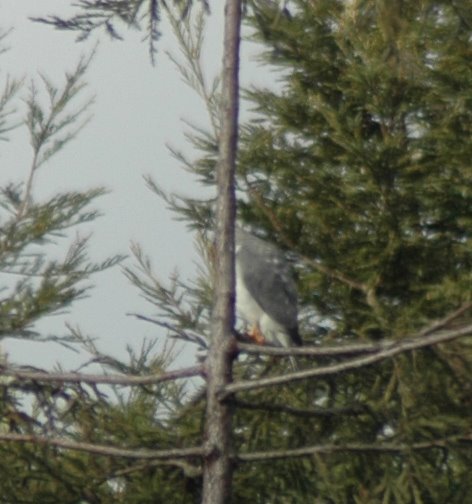
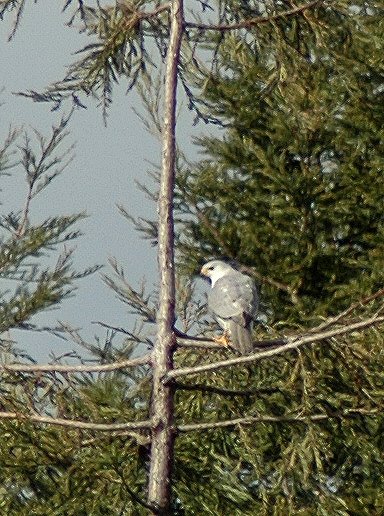
Anyway, I sensed that there was something odd about the "silence". So I peered through the fog and saw this. You can see from the trees how grey it was, and what poor visibility I was dealing with. These images are all greyed out, because of the fog, but the closer images (below this one) are all sufficiently detailed to make them worth-while clicking on to bring up the full-sized images).It was not much more than an "outline" to my poor old eyes. But from the "upright stance" I knew straight away what it was - a Grey Goshawk (Accipiter novaehollandiae***). This species is a resident bird, but seldom seen, because of its secretive manner of "stalking" birds and insects (and small mammals).

These birds are stealth hunters, and very secretive, normally. It is much more common for them to perch, hidden in trees, then to burst from cover, to give chase to birds. They hardly ever show themselves like this. But of course, it was camouflaged by the grey fog. And the resident Magpies were not on patrol. They didn't see it, or they would have hounded this wonderful bird out of the area straight away.

I ducked back inside the house, then rushed to get the camera, click off the Macro lens from last-night's moth shots, and click on the 70-300mm lens. I did a couple of practice shots to test my "light settings", before going back out onto the back deck. The reason I was so wary was that these birds have fantastic vision - probably 20 times better than mine, and they are usually very wary of cameras. Not this one, not today.
Having got that first image, I relaxed a little, and settled down, half-hidden behind a branch of a Wattle Tree, close to the deck. The Goshawk gave me a direct stare - straight back down the lens. But it held its nerve. It did not flinch.

To see the delicate patterned feathers around the top of the chest and neck,
click to enlarge.
Note the strong legs, clearly yellow. Also the yellow base of the beak, and the black curved tip (the black tip is clearly visible in the image 2 above). This is a big, powerful bird of prey. And it was serious about what it was doing. It was hungry. It was hunting, from a perch on the wire. Sitting on the powerline, but listening and moving its head around constantly - looking, listening and looking more.

Here it had turned its head right around. But it did not move its lower body position once.Note the immensely powerful feet - yellow legs, yellow feet, and powerful black claws.

This is the "Figure of Death" - staring down from the wires.
Now you know why the Lewin's Honeyeater had stopped calling.

See below, how it has lifted its pose, head held high, looking down to its left.
And again it looked over to the left, behind it's left shoulder.
The bird kept looking around, listening, raising its head, bobbing its head (it does that to simulate a 3D sensation - to help get a better sense of what it is looking at). Although the bird did not move its position for 16 minutes (which is an extremely long time to have the opportunity to observe this type of bird), it never ceased "hunting".

Then suddenly it had gone.
Silently.
How did it do that?
Had I blinked? I must have done.

Aaah, there it is - right down low, on an old triple fence post, at waist height. Amazing.

Please forgive the very grainy image. it was taken at about 80 metres distance, into a thick fog.
But I have posted it to show this rare event. The Sassafras trees in the background were shading the bird, which made it even more difficult to photograph in the heavy fog. It was only 2:40pm - but it seems like twilight conditions.

Note how powerful this bird is. Look at those massive shoulders.
It was still checking me out, over its shoulders, even from that distance.
For this bird to fly down so low, and to pose on the fence like this is most unusual. Clearly it was "after something" - possibly some of the Rabbit kittens which live down in the bottom paddock.

*** I was intrigued as to why this bird earned the name Accipiter novaehollandiae. That to me indicated it was the first species of this genus described from Australia (the genus is global). Sure enough, it was described by Gmelin (a German naturalist) in 1788. As the first fleet arrived in that year (and seemingly none of the ships returned to England before 1789) it was almost certainly described from a speciment collected by Banks or one of his associates, from Cook's voyage from 1770.

Wednesday, November 26, 2008

My Blogging 3rd Birthday.

Today is the 3rd birthday of my blogging life.
Perhaps it is not such a great achievement - there have been bloggers out there far longer than that - some were true poineers, whereas I was joining an established "bandwagon". However, I feel it has been a significant learning experience - at least for me. I hope some of you have enjoyed the ride too.

I have posted 807 posts over those 3 years. I set myself the goal of making daily updates, but clearly there are times when that is not possible. Still, I am batting at 73%, (three days out of four) which is not too bad (in light of my original objective).

As far as my readership is concerned, there have been 39, 793 visitors (excluding my own visits to the site). I hope you have enjoyed your visits, from time to time.

Although the site was entitled the Nature of Robertson - a deliberately ambiguous title - it has evolved, more and more into a "Nature Blog". It was always intended to be in part, a social record of the goings on in Robertson. And this is still in evidence. I maintain that policy on the basis that the "goings on" of the local people are part of the "Nature of Robertson" in a wide interpretation of the title.

But it has also developed as a Photo Blog, and in that regard, I will celebrate with several of my favourite photos.

This photograph of a White-breasted Sea Eagle was first published (in small format) in April 2006, after a visit to Narooma, on the far south coast of NSW. This is a larger file which should blow up to full screen size, if you click on the photo. The bird has blue eyes.Along with that, is my favourite Pelican image. This bird had literally tested the old adage:
"What a funny old bird is a Pelican? His beak can hold more than his belly can!" Quite literally, this bird had grabbed an off-cast poece of fish, left by a fisherman, who had simply chopped of the head of a large fish. The Pelican were squabbling over it and this fellow grabbed it, but was unable ot swallow it. Hence his manoeuvring of his beak and pouch, to try to line the fish head up, so that it could be swallowed. Eventually it gave up. But not before I managed to take this shot.The next photos are several interesting images of Ground Orchids.
The Small Tongue Orchid (Cryptostylis leptochila) has such a dramatic shape, it is always a favourite with photographers.Another favourite with photographers is the Flying Duck Orchid (Caleana major). Normally one takes their photo from the side, to show the classic shape with the "head" of the flying duck in profile. In this case, I realised there was a small "flower spider" inside the flower, and she had spun her web across the face of the flower, and was waiting inside the flower, looking out, waiting for an insect pollinator to come to the flower. Click to enlarge.Thanks to all my readers. And I should offer particular thanks to Anni, who first inspired me to commence blogging.

Wednesday, October 08, 2008

A fly-by Sea Eagle, chased by Magpies.

Duncan, down at Ben Cruachan has a lovely story today about a nest of the White-breasted Sea Eagle, in Gippsland, Victoria. Lucky him.
I was outside this morning when the local Magpie gang started up their distinctive calls they make when there is an eagle about. I looked, and the leading Magpie was flying straight towards a large bird flying fast, just over the local horizon of Pine Trees.
The bird flew straight towards, and then past, the Magpie(s) - for two more had arrived by now.
I though for a moment that it might be a Pelican, for I saw one of them over the village a week ago. But very soon it flew directly over me, and I could make out its head and beak, its very deep wings, and relatively short tail.
It was an immature bird, on the turn, being half-white underneath, but with dark blotches under the wings. It was not the clear grey and white of an adult Sea Eagle.
Its wings were much deeper than a Little Eagle (which is a relatively common visitor). Nor did the wing shape match an Osprey (which has thinner wings, and distinctive notches at the joints in the wings).
I had barely time to make my mind up as to its identity than it had passed out of view. Unlike the Little Eagle, which visits me when a southerly is blowing, and it will circle and then hover on the breeze, allowing plenty of chances for photography - this bird was on a mission.
The local Maggies gave up the chase (successful - in their minds, no doubt). But I could hear the next tribe take up the challenge.
Where I am, the coast is 25 Km east, (below an escarpment some 700 metres high) and the Wingecarribee Reservoir is 5 Km west. This bird was making a direct line for the Reservoir. But it still had 2 more valleys to cross over, then a further high hill, before it would sight the water. But it was flying very strongly, (even into a head wind) and would have made its likely destination within a few minutes.

Sunday, January 06, 2008

Birds of Prey - how to tell them apart.

The Museum of Australia (in Sydney) has an excellent "bird finder" system under the aegis of the "Birds in Backyards" project. You can fill out a simple on-line questionnaire, and it will direct you to various likely birds. I just go to their full list of species, and select the bird I am looking to check out.
Unfortunately the list is "sorted" in a most illogical way - sorted alphabetically by first name of the "common name". So to check various Thornbills, you have to jump from B for Brown Thornbill to S for Striated Thornbill. Apart from that, and several birds being listed by unfamiliar names, such as "Australian King Parrot", instead of the familiar "King Parrot", this is a very useful on-line bird reference. It would be much more sensible to list the birds by Thornbill, Brown; Thornbill, Striated, etc, so that related birds are close together, for ease of comparison. One of these days I hope they will take notice. Such a simple change would greatly improve the usability of this very fine resource.
Anyway, the Birds in Backyards people have recently opened up a "forum", a discussion line, where people can share their ideas (the pros and cons of bird feeders is always an issue). People can also seek help with bird identifications.
Recently someone on that forum asked how to identify a particular bird of prey - from a list of Whistling Kite, Little Eagle and Brown Goshawk. It seemed strange to me, as these birds are very different in habit, and shape - how could one not tell them apart?
Well, obviously people are learning about birds from different levels of experience, so I thought: why not try to help others learn the tell-tale signs, and what to look for?

Whistling Kite and little Eagle are the most commonly confused of the larger "hawks", so let us start with them, for today.

The Whistling Kite has a long, narrow wing, and relatively long tail. The wing is seldom held straight, but has a bit of a kink in its line. The wing tips (which can be varied in flight), are usually spread slightly open, with that is referred to as "fingers". The wings are usually drooped at the tip, not held high, as in some other large "hawks".In the case of this photo, the Kite had been dive-bombed by the Kestrel, which presumably felt its territory had been strayed into. The Kite, clearly surprised, turned and dived, to give chase. This photo is unusual in that it shows the upper side of the Kite (which one seldom sees).
From an identification point of view, it shows the wing formation perfectly. Bent wing, rather than the smooth leading edge of the wing (contrast with the Little Eagle photos). It also shows the "fingers" in a normal degree of "spread". The kestrel's wing shows how differently Falcons wings are shaped - with much pointier wing tips. Falcons are built for speed. But I shall return to Kestrels and Falcons on another occasion.
Little Eagle, circling against a stiff breeze.
Wing tips held pointed, tail spread, to give control.

Little Eagle, "frozen in mid-air".

This bird was balancing itself against the wind, nearly perfectly stationary. Wings spread to give maximum uplift and control, tail more-or less in "neutral". I was on the back deck, and the bird was checking me out, while presumably hunting for rabbits over my property.
This is an unusual image, as the bird was flapping hard to maintain a "hover", something normally associated with the smaller "hawks". These three photos show the variability of the Little Eagle's wings and tail. However, the wing tips, even when "spread" fully, are very different from the "fingers" shown by the Whistling Kite. And the tail is much shorter.

Generally the Whistling Kite is a bird of the open country, whereas the Little Eagle likes woodland, or moderately timbered country. Whistling Kites are extremely widespread, ranging from an off-shore island (where this photo was taken), to swamps, and dry open country. Further inland it tends to be replaced by the related Black Kite (or Forked-tailed Kite, as it used be known). It has a distinctive call, a shrill whistle which firstly descends, then rises again, often ending in a shriek. Unlike the Little Eagle, it calls frequently. Around swamps, the Swamp Harrier could be mistaken with it, but look for the white rump on the Harrier. It also holds its wings at a medium high angle ("upswept wings" is the standard description). This is a distinctive difference from the Whistling Kite, which tends to droop its wing tips.

Around Robertson, I would expect to see the Whistling Kite around the farming lands of Sheepwash Road, Glenquarry and Kangaloon. It is often seen near the Wingecarribee Reservoir, which also happens to be habitat for the Swamp Harrier, which is why I mentioned it above. The Little Eagle is an irregular visitor, which I see from my place, on average every 6 months, when the winds are right for it to circle above the steep valley below my house.

Friday, October 19, 2007

Manning Lookout and Kangaroo Valley

I went with Jim to inspect some "steps" which a mutual friend, Wayne had told Jim about, out near Fitzroy Falls. It turns out these steps appear to be part of a pathway leading from Manning Lookout, overlooking the Upper Kangaroo Valley. What surprised me is that while "Manning Lookout" is maintained by the National Parks and Wildlife Service, they only maintain the area around one main lookout point. There has been a very old track, complete with fitted sandstone steps in difficult areas, where steps are appropriate. The amount of work which went into forming these steps is impressive.

The steps lead down to a grotto and creek, with an interesting patch of damp rainforest (Coachwoods, Callicoma and Eucryphia).Further out along the narrow track, there is a spectacular clifftop, still with a railed off lookout point, even though one suspects that this track is no longer being maintained by NPWS. (Confirmed by notes below, from NPWS).

To my delight there was a group of the Yellow Rock Orchid Cestichis reflexa (formerly Liparis reflexa) growing there, in a small rock hole, right below the very top of the cliff. Unusually for this species, which favours damp rock crevices close to water, this position was quite dry, but it was at least south-facing, overlooking Kangaroo Valley, with rainforest immediately below the cliff, so it was protected from full exposure to sun and drying winds. These plants have no eyes, but if they did, they could appreciate the fantastic views available form their rocky perch (about which I wrote previously).
In this zoomed photo, you can just make out old flower sprays, with seed capsules formed. So, this plant has successfully flowered and set seed this recent Spring season. While we were walking close to these cliffs we saw a number of plants of another Rock Orchid, Dockrillia striolata, a very small plant, with single flowers. (Dockrillia striolata "in situ" and close-up of flower). Photos taken at Knight's Hill, in similar clifftop situations to Manning's Lookout.)
Dockrillia striolata - flower
While we were exploring these cliff-top locations we were "buzzed" by a Female Peregrine Falcon, (Falco peregrinus) clearly demonstrating proprietorial rights - so presumably she is nesting somewhere along the clifflines in the area. She zoomed past us, at eye height (on the cliff top edge), and then circled back through the forest behind us, calling excitedly, several times. These birds are cliff dwellers, and are totally at home here, being such skillful and powerful fliers, and lovers of updrafts.

Along the road into Manning Lookout there is a species of Prostanthera growing which I have only seen here (not elsewhere). From what I can work out it is likely to be P. incana, which is generally regarded as a coastal species, according to PlantNET. It is growing in a damp area (surrounded by Sword Grass) on black sandy soil, over sandstone, right beside the road. It is not growing in the more typical sandstone scrub at Manning Lookout, 500 metres further on, where the habitat is very dry. So, it appears to prefer the heavier, moister soil close to a "soak" which leads to a creek.That plant has very hairy leaves, which are "heavily crimped", with heavy veining, deeply incised. The flower colour is accurately reproduced in this photo, and it is more blue than many of the mauve-purple Prostanthera species. The plant was about 1.2 metres high, but wider than high.

Jim wanted to go down to Kangaroo Valley, to check out a potential landing strip, so we went down the Barrengarry mountain, into Kangaroo Valley and then along the Upper Kangaroo Valley Road. Along the bottom of the valley, there are tall stands of River Sheoaks (Casuarina cunninghamiana) growing. These plants had many really prominent clumps of Epiphytic Orchids flowering along their stems, some as low as 3 metres off the ground, others higher in the trees. I was amazed to see these flowers dotted all over the branches of trees right along this section of the Kangaroo River. Presumably they are regarded as common, but I had not ever seen them before. From the thick, ribbed leaves, it is clearly Dockrillia linguiformis - known as the Tongue Orchid. Some people refer to this plant as Dendrobium linguiforme, but apparently that name is regarded as obsolete by most Orchid authorities.
*****
Postscript:
The NPWS website includes the Plan of Management for Morton National Park (October 2001). In relation to Manning Lookout, this document states:

"Manning Lookout is a quiet area providing 3 lookouts into Kangaroo Valley and a long
walking track along the escarpment through attractive forest. The two northerly lookouts
and the associated walking track are not signposted and receive only low levels of use.

"The area is of historical interest as its use for recreation dates from the 19th century.
Old picnic facilities near the first lookout have been refurbished in recognition of their
cultural value. There are safety concerns with use of the area and investigation will be undertaken into the stability of the first lookout, and the feasibility of removing the two northern lookouts but retaining the track for experienced walkers. Upgrading is needed of the first lookout and track section." (My emphasis added.)

Source: http://www.nationalparks.nsw.gov.au/PDFs/pom_final_morton_budawang.pdf.

Friday, September 07, 2007

Grey skies and Grey Goshawk

Today I was doing some work in the garden, with the help of Kim and her offsider, Damien. We were moving some plants around, and doing some clearing of trees and shrubs which had been damaged by wind.

While doing some of these chores, I suddenly realised there was a chorus of Magpies making those distinctive calls they make when chasing away an intruder. Magpies are such good "alarm" birds, and always tell me when a hawk or eagle is around. Listen to your local Magpies - they have many different calls, and some of them will lead you to an interesting sight, such as happened today.

High above, a Grey Goshawk was being chased round and round by three Magpies. Today's sky was grey and dull, unlike the clear blue sky from two weeks ago, when I walked along the track to Clover Hill Falls (half way down Macquarie Pass). I also saw a Grey Goshawk then, circling high. Not a good photo, but it is distinctive with the round tail, wide grey wings, and large white body. The Grey Goshawk is a classic bird of the rainforest, so Clover Hill Falls is absolutely classic habitat for this bird. Robertson, just a few kilometres away, is easily within foraging distance from this bird's main habitat.


The Goshawk looked at first glance, like a White Cockatoo, but Magpies would not bother to harass a Cocky. Not only are Cockies no threat to the Magpies, but also, a solitary Cockatoo is almost an oxymoron. They are a flock bird, and seldom fly by themselves.

The Grey Goshawk is a powerful flier, and soon outpaced the Magpies, and it flew off out of their territory. The Maggies lost interest and tailed away, heading back to the Pine Trees on the local ridge. Here is a photo of a Grey Goshawk, perched in the Redwoods in the "School Forest" here in Robertson. The yellow legs, the high stance, and the large size of this bird are all distinctive.
Here is the same bird doing what one mostly sees a Grey Goshawk doing - flying away from you. In this case it was landing, so the tail and wings are wide spread (to lose speed, as it comes in to land). But the shape of the wings and tail are diagnostic features of this bird.

The other "white" birds of prey (in the local district) are very different. The Black-shouldered Kite is a much smaller bird, with pointed wings, which either sits on power lines, or hovers (stationary in the sky) with a heavy flapping motion, while hunting for mice or large insects, like Grasshoppers. The other local grey and white bird of prey is also very different - the White-breasted Sea Eagle. It is huge, by comparison, and could not be confused with the Grey Goshawk.

Tuesday, May 22, 2007

Sea Eagle over Butler's Swamp

White-breasted Sea Eagle
Late this afternoon, I was surprised to see a White-breasted Sea Eagle (Haliaeetus leucogaster) over Butler's Swamp. It did not stay there long (not surprisingly). But still, it makes an interesting observation record.
Of course, to a mighty bird like the Sea Eagle, Butler's Swamp is just a few minutes soaring time away from the edge of the escarpment.

Bird's Eye view
from Butler's Swamp
to the Ocean.
Check out these Google Earth images. The first is a "bird's eye view", angled to show Butler's Swamp in the immediate foreground, looking towards the ocean, on the horizon.


Butler's Swamp
(red marker at west)

to Lake Illawarra and Ocean
As you can see from this traditional view, (a Google Earth image), it would be only a few minutes flying time from Butler's Swamp (see red marker on west of the image) to Lake Illawarra, or the coast.


The Wingecarribee Reservoir is only a few minutes flying time, further to the west. While I have not seen the Sea Eagle there, I expect that it is at least an occasional visitor. It might even be a regular (I do not know). I shall ask Jane Lemann.

This afternoon, the bird was flying into a strong southerly wind, so it probably floated high over the escarpment, tacking into, and across the face of the wind. These birds are wonderful fliers, and are total masters of their aerial environment. This particular bird suffered the indignity of being challenged by several Magpies, which is what drew my attention to its presence. Anyway, having been harassed, it quickly departed the scene, by turning and flying strongly with the wind, rapidly outpacing its minor tormentors. It flew to the north-east, with the prevailing wind, and back towards the escarpment, and its more normal environment.

The particular bird here was photographed at Montague Island, in April last year. This is my favourite bird photo (of all that I have yet managed to take).

Tuesday, June 20, 2006

The Nature of the Grey Goshawk - a skulker in the tree tops.

There is a wonderful bird of prey (a "raptor" - that is the generic word) which lives in the rainforest country around Robertson. It is not a commonly seen bird, but every few months I will be lucky enough to record a "sighting". Yesterday, was such a day. The bird in question is a Grey Goshawk (Accipter novaehollandiae).

As I was driving across the Railway Crossing in Meryla Street, Robertson, there was one of these birds, sitting quietly in large, dead Blackwood tree - trying to pretend that it was camouflaged with the moss-covered branches of the dead tree. I drove home quickly to get the camera, and when I returned it was still there. By the time I had stopped the car, it had flown off. Damn.

Grey Goshawk -
disappearing through the tree tops


I looked around, and saw it hiding amongst the top branches of the neighbouring Californian Redwood Trees in the "School Forest". Great, I thought, I might get a middle-distance photo, at least.

Nope.

It was "off", as soon as it saw me get out of the car. (See photo at left - look closely - click on the photo to enlarge it - it is a large image, so be patient).

Look for the white wings (the under-wings) and even the yellow legs, as it is flying away.

Grey Goshawk playing "Peek a-Boo"

It did settle on another tree, at a safe distance of about 100 metres. But, it kept hiding its head. Like a young child, playing "Peek-a-Boo" it seemed to think if it could not see me, I could not see it. It was actively moving to stay hidden, as I tried to get a better line of sight. (I was at the railway crossing, with its brand new fence, so I could not freely walk in and try for a better view. Besides, I knew it would fly, if I came out in the open. I was staying close to the "Boom Gate" mechanisms, to make myself less obvious.)

I was amused, but frustrated by its sneakiness. With such birds, however, one tends to take whatever photos one can - for when will you get the chance for a perfect photo?

This skulkiness is typical behaviour for a Goshawk. Unlike many other raptors, which love to sit in prominent positions, to maximise their view of potential prey, these birds rely on a sneak attack, and the element of surprise. One could say they are engineered for exactly that.


Sir David Attenborough had a wonderful TV program episode on European Goshawks, years ago. He pointed out that they are strong birds, built for sprinting (short sharp burst of speed, not sustained flight). Eagles are soarers. Falcons are built for speed, with incredibly well streamlined bodies and wings. The Goshawk has wide wings - good for getting maximum power with control, when flying through trees - and being able to twist and turn to avoid obstacles at high speed. Even their tails are wide, again for the same reason. Falcons and Eagles are open air fliers. Goshawks are birds of the tree tops.

Grey Goshawk - landing.
Note the wide, powerful, wings and tail


Anyway, this bird, despite its obsession with avoiding my gaze (and my camera) did give me two classic (distant) views.


One is of the white sh
ape, disappearing through the dense foliage of the trees (photo 1 above). That is probably the most typical glimpse one gets of the Grey Goshawk.

The other is of it landing on a more distant tree - showing its wide, rounded wing shape, and its very wide tail - exactly the attributes which David Attenborough described as being the keys to its success as a hunter of birds within the forest canopy. Sorry about the poor quality of the image - still, the image is diagnostic.


Grey Goshawk, perching amongst the tree branches

The Grey Goshawk is a separate species, rather than an albino form of the more usual Brown Goshawk.


It is a beautiful bird, with a white body, grey wings, and prominent yellow legs, a yellow and black beak and a dark eye. It lives in the dense forests of the east coast of Australia and the Northern Territory. The hot link above takes you to the Australian Museum site, and gives a close-up photo of the head of this wonderful bird, and more on its life story.


Grey Goshawk allowed me a clear photo
- but only at a "safe distance"

A beautiful bird of prey. It is only a mid- sized bird of prey, not like a Whistling Eagle, or other large raptor. But it is well built and powerful. It is about 10% longer than a Pied Currawong, but it weighs nearly twice as much (according to the Australian Museum data files on both species).

This is almost certainly a female bird. Females are significantly larger than males of the species (a characteristic common to most raptors).


Thursday, January 19, 2006

"Wedgies" circling on a gentle easterly updraft

A pair of Wedge-tailed Eagles (Aquila audax) were circling very low today, just across the road from my house. (Go to this link to the Canberra Ornithologist's Group site, for a wonderful image by Stuart Harris, of a "Wedgie" in flight.) My pair were riding a gentle easterly updraft off the ridge along Missingham Parade, and so were circling immediately above my neighbours' houses, at about 100 metres, maybe less - about three times "tree height", which is pretty "low" for a Wedgie to circle, (especially around houses). They were demonstrating masterly control in light wind conditions. Anyway, that "vision" got me thinking about exactly what the weather pattern is which has brought this steady rain to us, in the last few days.


The ever-wonderful, (but oh so difficult to navigate around) Bureau of Meterology website tells me that we have had 26 mm of rain yesterday, 7 mm the day before that, and 25 mm on the previous day (i.e., Wednesday, Tuesday and Monday). I have changed the days, because the Bureau has this quaint habit of reading - as "today's rainfall" the water in the guage at 9:00 a.m. today (The 26 mm I referred as yesterday's rain is actually recorded as Thursday, 19 Jan). In my world, "today" has only just got started at 9:00 a.m. But that is the official standard.


I suggest, if you are interested in weather details for Robertson, go to the following "links" and then save them in your "favourites" or "bookmark" them for future reference.

This hotlink will take you to the permanent webpage for last 7 days rainfall for the South Coast region (although it is called the "daily rainfall bulletin"). Scroll down to "Central Shoalhaven" district, for Robertson's readings. We also appear in "Lower Shoalhaven" too. That is a permanent link, updated daily (after 9:00 a.m., and it also gets updated several times during the day for rainfall "after 9:00 a.m.")


Back to the rainfall. While it was good, soaking, steady rain, it is not the kind which makes Robertson stand out in the record books. But, heck, it was
good rain. Maybe the best kind. Not enough to cause floods, nor much erosion. But it was falling when the soil was warm - making perfect growing conditions for plants (and Fungi) and probably everything else, too.....

The Synoptic Chart for 1000 hrs, EST 19.1.06 from the Bureau's website. The following link will take you to the "latest" synoptic chart (regularly updated).

The Northern Rivers region of NSW is copping a bucketing, with flood warnings, etc.
In "Bureau speak": "A trough over northeastern NSW is directing a deep moist east to southeast onshore airstream" (from NSW Severe Weather Warning IDN28500, issued at 1:10 p.m., 19 Jan 06).


When a "high", (which in the Southern Hemisphere, has an anti-clockwise circulation of air) is sitting off Bass Strait, as seen in the Synoptic chart above, it is able to dump moist air from the Tasman Sea back onto the northern NSW coastal region. If there is a strong pressure difference between that high and a "low" somewhere near it, that increases the force of the wind and the likelihood of storms. There is an excellent "animation" of the circulation of air in, around and between high and low pressure systems on this page of the Bureau's site. Their "glossary" of weather terminology is also very useful.


Currently, in Robertson, we are getting some of the wash of that illustrated weather pattern.


But we can also get a bucketing, if a "low", with its clockwise air movement, is sitting somewhere off the northern NSW coast, directing moist air onto us, from the south coast. This is what happens when the "tail end" of a tropical cyclone comes down from Queensland, or the Coral Sea, and stalls, as a "deep low" (or a "depression", or a "trough"), off the northern NSW coast.

In general, that is why February and March are such high rainfall periods in Robertson.


And heck, the locals will tell you
that, in Robertson, it can also rain because it feels like it!