Christmas Bells

Christmas Bells
Christmas Bells - Blandfordia nobilis
Showing posts with label Dipodium. Show all posts

Friday, December 20, 2013

Rare Orchids at East Lynne - the very southern edge of Shoalhaven Shire


Yesterday, Alan Stephenson and I travelled to East Lynne, to check some Corunastylis vernalis which are known to exist near East Lynne. We found a small number of these plants still in flower. A number of pollinated plants were also seen, but not photographed.

They are fairly hard to see, (even if you know where they are said to be) as they are small, dark purplish-red flowers on stems a mere 150mm high (they grow taller once pollinated).

Corunastylis vernalis flowers
stem of flowering plant
and a young plant coming up.
Both show typical red base to the stem.
Corunastylis vernalis
 These plants are now thoroughly documented, courtesy of the Federal EPBC  listing and the associated detailed National Recovery Plan prepared by NSW NPWS.

After recording these plants, we drove up the track a bit further, and I found a single specimen of a Beard Orchid, which Alan identified as Calochilus gracillimus, the Slender Beard Orchid. It is also known as the "Late Beard Orchid" because of its delayed flowering season, compared to others in this genus.

Calochilus gracillimus
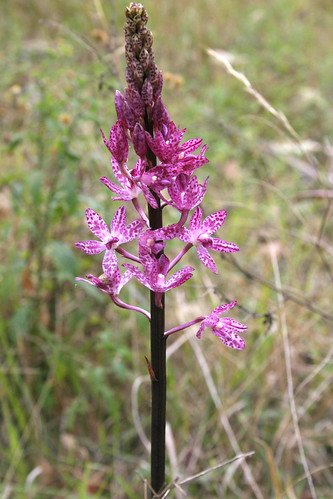
I cannot resist showing this lovely
Dipodium variegatum
If you are feeling peckish, after looking for these Orchids, you can take Tim, The Yowie Man's culinary advice and call in to the East Lynne Store (roadhouse, and cafe) just up the highway a little way, and have a coffee and one of their own genuine, home-baked pies which both Tim and I recommend.

Friday, December 13, 2013

Recent photos

Here  are some recent photos - from today, Friday 13, and several preceding days.

Lulu resting at Gordon's place
She had been doing
"Figure of 8" runs around his back yard.

My first photo of the "Little Wheels"
which I have had to purchase to replace the beloved 4WD
which has a terminal sickness in its motor.
This one runs well.
Hard for an old half-cripple like me to get in and out of.

Hyacinth Orchid which I showed to Cathryn and
her fellow botanical artist friends..
Dipodium roseum

He holding a single flower
Dipodium roseum

A full stem flower
Dipodium roseum
The local Helicias are ripening
These plants are right on their southern distribution
here in Robertson.
I am always intrigued as to whether they fruit colour
is related to the Bowerbirds
as potential dispersers of seed.

They have a low fertility rate, it seems.

Friday, December 30, 2011

Orchid seed as fine as dust.

Today I was showing my friends Owen and Cathryn, and Helen some of the early summer Orchids of Kangaloon. We were accompanied by Cathryn's brother, David and his wife Merle, visitors from Canberra. We had a good fun time  looking for Orchids and other bits and pieces.

There is much of interest about in Kangaloon, (and not just Orchids, you will be pleased to hear). Some of the Orchids are just starting to flower, and some are still hanging around (from Springtime).

Seeds of Thelymitra (Sun Orchids) are as fine as dust
They are wind blown when the capsule is ready to shed.
In this case we experimented by flicking the ripe seed pod.
My photographic assistant counted down 3, 2,1, go.
I took the shot, with a flash, to illuminate the seeds.
Click to enlarge - to see the Orchid seeds better.

I found this Hairy Caterpillar (probably a "Wooly Bear" Caterpillar)
feeding on the leaves of a Hardenbergia violacea (False Sarsparilla)

Head-on view of the "Wooly Bear" caterpillar

Side-on view. Long hairs can cause skin irritation. Two red mites.
We found this Jewel Beetle feeding on 
a low-growing Leptospermum plant
on the edge of Butler's Swamp.
These Beetles love Leptospermum flowers.
As Beetles go this is quite large, flat, and very peaceful.
About 40mm long.
Stigmodera macularia Jewel Beetle
 I like this front on view..
Nice large eyes.
Its eyes look a bit "Possum-like", to me.
 
From the side.
Jewel Beetle - from the side. Stigmodera macularia
  • Corunastylis densa (a tiny Midge Orchid), cherry-red in colour - first found in Kangaloon, 16 January 2011.
Corunastylis densa (Kirsten Vine photo)
Cryptostylis leptochila - red velvety labellum with scent glands visible
The way the labellum curves back at the top is typical of this species.
Cryptostylis leptochila - side on view. Labellum reflexed at top.
  • Hyacinth Orchids - Dipodium punctata and/or roseum (Kirkland Road) - just starting (Shown yesterday)
  • Hyacinth Orchids - Dipodium roseum (definite) at Meryla Pass Rd (on plateau at top end of Griffin's Fire Trail, near Bundanoon Creek - accessed via Fitzroy Falls Rd (Nowra Rd). (Shown yesterday).
  • Microtis unifolia, tall Onion Orchids growing amongst Daviesia (Bitter Pea) shrubbery.
Microtis unifolia "Common Onion Orchid"
  • Caleana major (Flying Duck Orchid) (some still in flower at Butlers Swamp - dry part, near car park - not in the swampy bit).
  • It is one of my favourite Orchids. A good one, like this, always makes me giggle.
  •  Gastrodium sp. (Kirkland Road colony) have just a few flowers remaining. Huge seed setting has occurred.
Huge number of seeds set in this colony of Potato Orchids.
Close-up of swollen capsules on Gastrodium sp.
  • Prasophyllum flavum (one fresh flower) on Tourist Road, in dense cover, growing amongst the Hop Bitter Pea (Daviesia latifolia). I also found 4 more yesterday near Hindmarsh Lookout, (near Belmore Falls).


Prasophyllum flavum (Yellow Leek Orchid) 

HAPPY NEW YEAR 
AND A GREAT 2012 
TO ALL READERS.

Thursday, December 29, 2011

Summer Orchids starting up - in Kangaloon.

The Orchid enthusiasts of the South Coast have been reporting Hyacinth Orchids and various Tongue Orchids to be on flower from several weeks now.
They are slower to start up here in the Southern Highlands.

a dark form of Hyacinth Orchid, possibly Dipodium punctatum

A paler Hyacinth Orchid - probably Dipodium roseum
Small Tongue Orchid - Cryptostylis leptochila

Close-up of column of Cryptostylis leptochila

Kirsten going for close-up shots

Lena asking "are you guys finished yet?"

Dragonfly - black and gold. Photo not good enough for ID purposes
 With my hip still in recovery stage, 
I am not going to get "down and dirty" just yet,
to photograph these tiny flowers up close.
The link below takes you to a post from last January,
when I was able to get close-up readily enough.
Tiny cherry-red Midge Orchid Corunastylis densa
Interestingly, the Corunastylis tribe (Midge Orchids) are generally late summer and autumn flowerers.
But I have this theory that that the "late flowering" Orchids need to flower earlier up here in the Highlands, in order to get their seeds ripe before the cold and/or wet season takes control.
On the Shoalhaven coast, these plants (as a group) generally flower much later than here - some as late as mid April.

Monday, January 04, 2010

Hyacinth Orchid (Dipodium roseum)

To put you out of your misery, Dearest Reader, here is an unambiguously pale pink Hyacinth Orchid - Dipodium roseum (with very few tiny dots of dark colour - and no large spots at all).

OK the "misery" has been mostly mine - trying to sort out these confusing plants. But I acknowledge the assistance of Alan Stephenson in sorting out these plants. I take comfort from the fact that this species was only named as a separate species in 1991 (Jones and Clements). Prior to that, everybody must have been confused by these "look alike" Hyacinth Orchids.

These images were taken on 2 January 2010, the same day as the other similar species, shown yesterday.

First thing to note is the habitat - on the side of a sandstone hill, overlooking Mittagong, NSW. These plants were growing in a small area of the hill which was "burnt off" last year. Many Orchids respond well to fire. There were many plants in flower in a small area of just a few hectares which had been burnt. I did not see any in flower in other areas of the same hillside which had not been burnt.

Second point - steep hillside on sandstone, therefore - perfect drainage.

Third point - Eucalypt forest, with typical "Sydney Sandstone" flora - Eucalypts, Proteaceae (many genera) and Acacias, as well as many "Pea flowers" ("Eggs and Bacon" plants).
A view of a rainbow over Mittagong
looking between Mt Alexandra and Mt Gibraltar (across the valley floor)
Taken ahead of a rain squall on 10 July 2007.
Note the Eucalypt forest canopy and steep valley below.
Here is a flower stem
Another stem of flowers showing two flower ovaries already pollinated.This is the full frontal view of the flower.
To my eyes, this is the most natural colour rendition of the flower.
It is definitely a clear mid pink.
Note the almost total absence of "spots".
Contrast this with yesterday's image of D. punctatum.

To show you the difficulty I have in presenting consistent colour-density in images of these flowers here is the same flower, photographed in slightly different light (in sun, not full shade), and probably closer to the flash - hence more over-exposed..

There, you don't often get more honesty in a photographer than that!
This shot does reveal the "mohawk" arrangement
of the fibres on the labellum.
Dark pink upright hairs in the centre,
and light pink flat hairs on either side of the callus ridge.
Click to enlarge, to see those details.
Explanation of light problems:
Because my Macro Lens is old and half broken
and the built-in flash unit has given up the ghost completely,
I use a cheap "add-on" flash with no controls.
Hence my problem of not being able to control the light consistently.
For a reference point, contrast the skin colour of my fingers.
Same fingers, obviously.
I did try to adjust it in Photoshop, but without success.
I decided to publish the honest photograph instead
for the sake of the flower details that the image did show you accurately.


Now to the diagnostic points of identification.
Note the recurved tips of the petals and sepals, especially the lower ones.
Here is a high-angle view of the labellum of the flower.
This is a rear view of the flower.
Note the recurved tips of the petals and sepals.
There is some very minor flecking visible.
It is insignificant compared to the flecking on D. punctatum.
Here is an underneath view , to show the shape of the labellum.
At the risk of provoking comment on my poor colour/light control,
here is a nice shot of the fine parallel lines on the keel of the labellum.
It is a pretty image and it shows very clearly what I wish to illustrate,
which is the parallel indented lines on the labellum,
reminiscent of rich corduroy fabric.
Click on the image to enlarge it, and see what I mean.
You just need to make an allowance for the artificial light.
The flower is paler than it appears here.
By contrast, here is a link to the same pose of yesterday's specimen
of Dipodium punctatum.

Sunday, January 03, 2010

Hyacinth Orchid - Dipodium punctatum

Sorry to go on and on about Hyacinth Orchids, but it is the season for them - they are popping up all over the sandstone plateaux of the Southern Highlands. And they are lovely, and showy, and best of all, highly visible. One can even spot these tall Orchids as one drives along a country road - that's pretty remarkable, compared with the normal difficulty in finding Orchids.

But, they have been causing me headaches, trying to sort out the various species, especially distinguishing this one from Dipodium roseum. (More about that tomorrow.)

I have gone back and "revised" and "re-revised" the names I have attributed to certain plants which I have published previously as Dipodium roseum. Wherever I have edited those earlier posts, that fact is made abundantly clear.

Ironically, today's post is about a most unusual form of Dipodium punctatum. These specimens (there were a few of them, not just one aberrant specimen) had green stems, instead of the normal dark red-brown stems.

But I have struggled to identify these plants positively - mostly because there are many much more strongly coloured forms which other people have published on their Flickr Sites and specialist Orchid Websites.Trouble is, many of the Flickr images are nice photos, but incorrectly identified.

My problem is that this what the local (NSW Southern Highlands) plants look like. But, none-the-less, although they are not as strongly marked as many plants are (from other areas) I have little doubt about their identity for several reasons - which shall become clear in the course of examining these images.

Here is a single flower - showing its heavy spotting.The first thing I noticed about these plants (there were two growing close together) was the pale buds at the top of the stems. And the stems were greenish yellow, not dark red-brown. I have never seen such a form before.
At first I thought it must be Dipodium variegatum, but that plant has spots on the pedicel and the ovary (the individual flower stem and the swollen base of the flower). These plants do not. (Click on the hot link here to see my previous post about D. variegatum.)
Here is a closer view of the pale buds.
There were many black ants on the flowers,
but they were a larger species than tiny house ants.
They were approx 8mm long.
Note how the top buds are yellow with dark spots
but as the flowers mature, they achieve a mid-pink colour,
but still with dark spots.
And closer still.
Note also there is one flower visible from the adjacent plant
(of the same variety).
Note its true pink colour, with dark pink spots.
Here is the full image of the two plants -
both with greenish yellow stems..
Here is a close-up of the base of the two greenish-yellow stems.
The rear view of the flower shows how heavily spotted it is,
especially on the lower parts of the flower.
In this side view, one can see that the petals and sepals of the flower are not recurved. That is one of the diagnostic points which David Jones stresses with regard to Dipodium punctatum.Here is the labellum of this flower - as seen looking down directly from above, to show the shape of the labellum, and the fine fibres on the central section of the labellum, and the grooved lines along the labellum.Alan Stephenson, the Conservation Officer of the Australasian Native Orchid Society, to whom I have sent these images, has now confirmed these plants as Dipodium punctatum. Many thanks, Alan.