Christmas Bells

Christmas Bells
Christmas Bells - Blandfordia nobilis
Showing posts with label Frost. Show all posts

Monday, June 28, 2010

Big Frost last night

Robertson does not have an automatic weather recording station (official one, anyway). So the closest is Moss Vale.
I know I was trying to do some important writing last night, but I could not keep going, as I was so cold.
Anyway, this morning I checked the Moss Vale Weather site, and it said -5.8* Celsius. That is about 25 Km west,a nd admiotedly is more likely to be colder than Robbo. But because our climate is so moist, we get really dense white frosts, once the temperature drops low enough.
I have a sloping site, below a line of tall hedging trees, so, in winter it is in total shade all day.
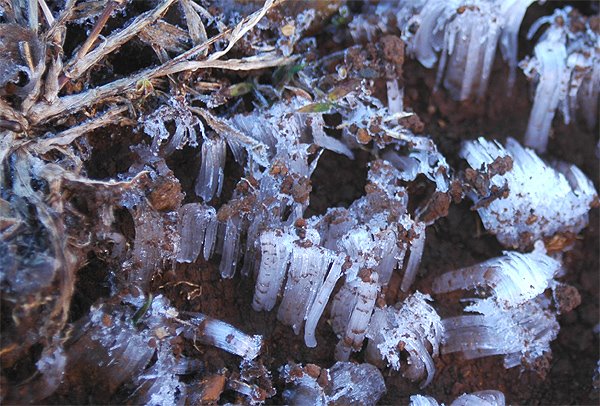
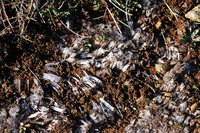
Late in the afternoon (4:40PM) there was still an unmelted frost on a sand pile. There was still a "permafrost" (little crystals of ice underneath the soil, lifting up small pebbles and rocks).
I forgot to look at the Tree Dahlia, but I am sure it will have been knocked back to the ground (as it has been in previous years). I shall check tomorrow.

Sunday, May 16, 2010

Autumn colour, and Sassafras seeds

This long balmy autumn is drawing to a close. But it has given us some remarkable sights.

Although not exactly spectacular, this is at least "impressive". I cannot begin to calculate the vast number of seeds of the Sassafras trees (Doryphora sassafras) which are lying on the ground here. As I have mentioned, in the context of house painting and wind, these seeds have been flying around my house for several weeks now. Some have simply dropped from the trees, and are lying here, awaiting a good rain storm to flatten them down to the ground. Without that soil contact they have close to zero chance of germination.
Now if Peter Garrett had seen these seeds lying here, he might have thought of using them as insulation in house roofs. They certainly look fluffy enough to do that job.
I just jammed my boot in amongst the seeds,
to show their depth.
To give you a better idea of the numbers of seeds involved in just those few images, here is a close up of a single intact Sassafras seed. It is on a blue woollen jumper, so the coarse knitting pattern will give you some idea of scale. The seed itself is about the size of a match-head, and the hairy appendages are somewhere between a 5 cent coin and a 10 cent coin in area (if flattened). The seed appendages are the method of dispersal, for the plant, when it seeds. The seeds catch the wind very successfully, when the seed capsules on the tree open, or when the entire seed capsule falls to the ground. Obviously they fly best when caught by the wind from high in a Sassafras tree. They have been floating around everywhere at my place for the last three weeks now. There is hardly anywhere which is free of these intrusive flying seeds.

Cool climate gardeners tend to associate autumn with coloured leaves. My Ornamental Pistachio, Pistacio sinensis, was just reaching its peak last week when the wind blew all its leaves away.

My neighbours tree has been looking great,
when glimpsed through evergreen trees.And my own Acer rubrum "October Glory" is looking fine, growing on the west side of the house, to show the sunlight through the leaves. It is one of Fleming's Nurseries "Lipstick range" of colourful autumn trees.
These are the brightest leaves I have at present. Not as colourful as plants I was familiar with in Canberra, but the trade-off is that biting cold weather which helps produce the bright colours. Frankly, I do not miss severe frosts.

Friday, May 14, 2010

Tree Dahlia makes it to flowering stage.

I love my Tree Dahlia plant. To me it symbolises the eternal struggle to succeed. In truth it might not be suitable for this climate, as it barely manages to flower, before the frosts cut it down.

Bare stems (canes) of the plant
and several arching branches carrying flowers.
In my experience, this plant needs other bushes near it
to support the heavy flowering heads.

My Blogging colleague, Martin, shares my interest in these flowers, and told me (in comments on his blog) that when he lived in Canberra, he grew them there, and they would last until the first moderate frost would arrive. It seems that where he now lives, he can no longer grow Tree Dahlias. My commiserations.

This year, my Tree Dahlia has flowered better than in previous years, as Robertson has had a long, dry and warm autumn season. In fact it started life badly as the first tall stem was knocked over by strong winds in late spring, and the plant had to start all over again.

But it has made it.
The pendant flowers always look like "Pixie's Caps" to me
(Well, as Pixie's Caps are traditionally illustrated).A close-up of the "eye" of the Tree Dahlia Flower.
Click to enlarge it, to see the details.
Just lovely, in my opinion.

Tuesday, August 19, 2008

A fairy tale morning in Robertson.

I told you it would be white! It was like a fairy tale morning in Robertson.
The freak weather conditions of snow, sleet and rain, followed closely by a hard frost, made for some gorgeous images of "snice" on leaves and flowers. It also serves to give me a new weather word - "Snice" A combination of snow and ice. It sounds better that the ugly word "snost".

It seems there was not just rain which fell, and froze, which is what I thought last night. People told me today that there was snow and sleet as well as some rain. This is evident in the granules visible on the lower levels of the windscreen of my little blue car. It obviously did fall as crystals, not drops of rain - which would not build up like that.
Here is Lena - looking cold - on the frozen driveway.
The ice on the water in a spare Rubbish Bin shows you it was pretty cold. Ice crystals always make for pretty images - no matter how mundane the container is.


"Snice" on Sasanqua Camellia leaves
- with the first rays of sunlight just touching the leaves.
"Snice" on Polyscias sambucifolia leaves."Snice" on Wattle leaves (Acacia fimbriata "dwarf")
"Snice" on Acacia flower stem
Close-up of "snice" on Acacia flowers.

Of course, such fairytale crystals do not last long in Robertson. I knew it would be worth looking out for, so I set my alarm for an early start. I then went back to bed to warm up, and to recover from a very long night on the computer. I have today posted an important submission on the Kangaloon Aquifer. More about that later.


Monday, August 18, 2008

Storm at sundown - leads to sharp frost at midnight.

Monday evening saw a very loud thunderstorm roll up from out of the Kangaroo Valley. I was sufficiently alarmed to turn off the Computer and TV.
Eventually the storm passed over, and I heard on the radio, about an hour later, that it had dumped a bucket of rain on Wollongong, and was heading into the southern suburbs of Sydney. It was a fast moving storm. We are exactly 100 Km from Sydney (directly - according to the Bureau's Radar Map - which has a neat distance measuring device on it).
Just after Midnight, Lena needed to go out for a wee. She was keen, at first, then stopped on the front verandah, and looked back in some alarm. I went out myself, and realised that the temperature had plummeted. I could hear the frost on the ground crunching under my feet. That is a sound I remember from my days in Canberra.

I grabbed the camera, and obtained this image of a sharp frost on the much cover over the soil - taken with flash, of course. You can see the pinkish red shoots of the herbaceous Peonies (hybrid varieties) at the top of the image.
I imagine there will be a very white frost in the morning. I know Lena will be reluctant to go out then. As we got some rain before the sky cleared off, we will probably have a bit of permafrost, with ice crystals lifting up small stones and the very friable soil here. Brrrrr! Chilly, but pretty.

Wednesday, May 21, 2008

Winter is about to descend on Robertson.

The frost are about to descend upon Robertson, I predict.

How do I know?
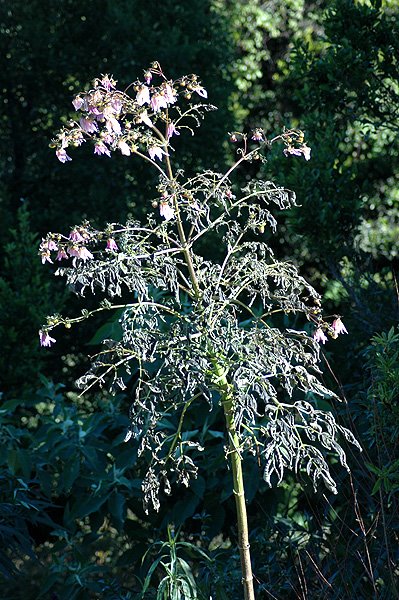
Simple - my Tree Dahlia has started to flower.Regular readers may recall two similar posts, from two years ago (OK only dedicated readers will remember these posts). I link to them, for more recently joined-up readers.
The first was entitled "The optimistic nature of Tree Dahlias", published on 7 June 2006.
The second was "The Nature of Frost (and an update on Tree Dahlias)" published on 13 June 2006.

The message is clear. Tree Dahlias take so long to grow to their full height, before they flower, that, inevitably, frosts are just around the corner. This year's flowers are about 2.5 metres above the ground. The plant grows this tall every year, before it flowers. Then the frost kills all the soft tissue material of the plant, leaving only the root stock. As with normal Dahlias, the plant has a set of tubers in the ground which are the perennial part of the plant. The difference for the Tree Dahlias is just how far they have to grow before the plant is mature enough to carry flowers.

In truth we have already had a very light touch of frost - but only once, and only very, very light. I do not know the temperature, but it was not enough to count as a real frost. Just a few signs of ice crystals glinting on the roof of the car.

But real frosts cannot be far away. Get your "Winter Woollies" out of the cupboard (if you have not done so already).
Tree Dahlia growing in front of native Sassafras and Pittosporum trees. The Sassafras (taller tree on right) is about 15 metres high. The low shrubs to the left of the Tree Dahlia are all well over head height.

Cultivation note: Tree Dahlias are easily cultivated by taking a stick of the stem with two growth points (nodes). (A stick about 15 inches long, usually). This will resemble a piece of fresh sugar cane, if you have ever seen that. Lie the stem down on a shallow angle, (bottom end first) so its head is just above the potting mix, in a Styrofoam box filled to the top with potting mix. Water it, and leave it alone for about 3 months in a protected position, and when you look at it (next spring), it will have formed roots on the bottom, and new shoots at the top. Plant it out and wait for a year. My plant came as "cuttings" from a friend in Canberra. I did exactly what I have described above, and my new plant has flowered every year since. Even though it is a silly plant to grow in a cold climate, I love it for its dogged determination to prove it can survive and flower each year.

Tuesday, October 02, 2007

Cherry Trees and Peonies in flower in Robertson

First blossoms opening on the Cherry Trees of Robertson.
Several weeks ago I received an inquiry about the Cherry Trees of Robertson, from a Japanese/Australian, apparently living in Sydney.
I promised to report when the Cherry Trees of Robertson were about to open their flowers.
Today is the day they have started to open.

By next weekend, the Cherry Trees along main street of Robertson ought be in full flower. This is one image of trees, taken on 1 October last year. Let us hope the strong winds of the last weekend drop, and allow the trees to make a good show, before their flowers fall.

The Tree Peonies in my garden have also been starting to open. This was the first flower to open, this season, on 22 September 2007. This is the classic Australian Tree Peony "Destiny". It is clearly a descendent of the famous Chinese Tree Peony "Rockii". If grown in isolation, "Destiny" comes true to type, from seed, but it has some subtle differences from the true species. I love this plant, even though it does not last all that well, especially not in hot winds. This flower is a late bloom, on a plant which has mostly finished flowering. Even so, this lovely flower is in good condition, and was about 7 inches (approx 16 cm) wide.
Here is a pale pink semi-double Japanese Tree Peony. I believe this to be "Fushakin". Owing to the extreme weather we have had this last weekend, I have yet to see the flower fully open, so I am not entirely sure, just yet. It has a lovely colour, but only 2 flowers on this young plant. The flower is about 4 inches (10 cm) in diameter (when still half-closed).
It is interesting that despite heavy rain in July, and some late frosts this year, the Tree Peonies have opened on exactly the same days as they first opened, two years ago (according to my Peony Diary from 2005).

Here is the first bud of Paeonia ostii - the blush pink buds open to a pure white flower, with a deep magenta-red carpel in the centre of the flower. But there are no purple-red flares on the petals, in contrast to Destiny.Here is a glimpse of the central carpel on P. ostii.
While the Peonies are exactly on schedule, it is interesting that the Cherry Trees in the main street of Robertson are one week later than last year.

Wednesday, June 13, 2007

Pressure - Frozen in Time.

Silvery dog in frost
Last night it was pretty cold at my place. Strangely, the village centre of Robertson (a mere 1 Km away), did not seem to get such a heavy frost. But I surely did. One of the things about a frost in Robbo is that the humidity is so high that when the moisture on the soil freezes, it looks dramatic. Lots of moisture, makes for dramatic ice crystals - even if the temperatures are not very extreme. My thermometer says it was only 0.4 degrees C just on the side of the house. Not a big "freeze", but plenty of frost and ice. Of course, true readings are taken out in the open, away from houses, and shrubbery.

I rang David Young to suggest that he might get some good shots on an open horse paddock opposite his house, but he said there was not much frost there.
Lena checks it out
David decided to punish me for the wake-up call, by publishing an "ironic" photo of me, from the Nature Reserve last week. I swear I was leaning back, while holding the stick forward. I was trying to get out of the range of the photo, while David was meant to be photographing the Weevil. I was holding the stick forward (you have to see the photo to understand this).

Anyway, David switched the focus from close-up to long range, and took a really awkward looking shot of me. I swear I am not this bad normally - well, nearly...

What can I say?
Silver frost on bench
A nice "pure" shot of the frost. Lena is wondering why I kept calling her from one place to the other, of course.
The trouble of being a silver dog, who colour-coordinates with frost scenes.
One of these days I shall download my "Snow" photos, and show you. Lena looked very cute in the snow!

Barrow full of ice
Last week's rain delivered about 6 inches of rain (140 mm over 3 days, in Robbo). Here what that much rain looks like in a large Builder's Barrow. Obviously it filled the barrow to overflowing, but you get the idea.
It ain't the Hunter River, but, it was good rain, none-the-less.


Patterns of Ice
I love this image. Click to enlarge it. The fine patterns form as parts of the water freeze, and the ice gets pressed one way and then another, as it grows across the water, then hits either more ice, or the edge of the barrow.
You are seeing pressure lines in the ice.

Pressure, Frozen in Time!

Wednesday, June 14, 2006

The Nature of Winter - frosts and birds

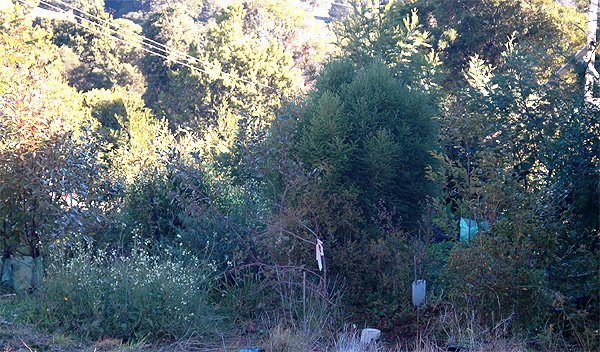
My "Side Garden" - full of weeds
Frost after frost. Crystal clear skies at night.

Oh for some pollution to wrap us in its comforting, and insulating blanket of smoke. (That's a joke, folks!)


We have had a series of heavy frosts, night after night, and they seem to be getting heavier. Today as I drove into Bowral, there was thick ice on all the puddles beside the road. I noticed other people's Tree Dahlias looking as burnt off as mine.


But when I came back home at lunchtime, there were flocks of small birds, (Brown Thornbills, Blue Wrens (Superb Fairy Wrens), White-browed Scrubwrens and Silvereyes flying around, having a lovely time, picking off the little insects amongst my young trees, in my "Side Garden" - see photo above. So, life goes on (and death too, if you follow my point) in the middle of a deep freeze.


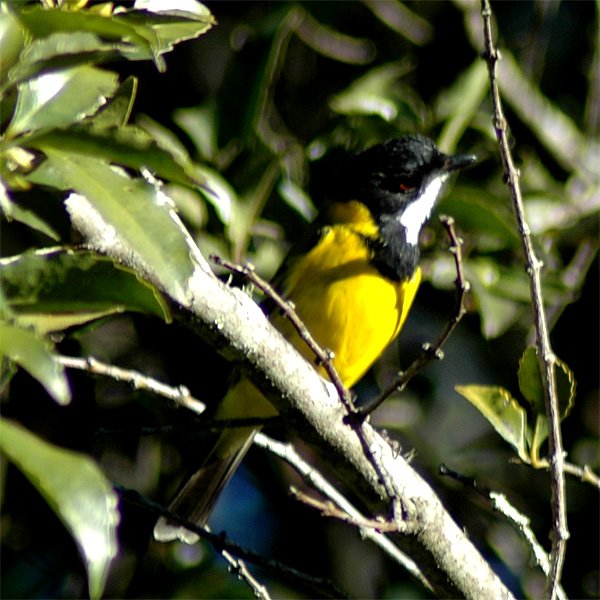
Here is a photo of a male Golden Whistler (Pachycephala pectoralis) which I snapped amongst the Sassafras Trees, down in the rainforest gully below my house. There were a lot of birds active there, today.


Incidentally, the Golden Whistler's Latin name means "Thick Head - with the chest". Thick Head was the old name for what we now call "Whistlers".

As I write, (1:45pm) there is still frost visible in the shady parts of my garden, and ice on water lying in the odd bucket or foam box around the property.


And this photo is of a Thornbill, showing what one normally sees in the tops of the trees - a dark shape, moving about.


This would generally be called a "Small Brown Bird". Such birds are best identified by call, but that requires some familiarity with them, unfortunately. Otherwise, patience, and quietness, and time spent standing in a suitable place, till you get a good look at the bird. You can listen to the call of the Brown Thornbill on the Lamington National Park site - go to Birds/Brown Thornbill. Click on the "ear" symbol to download the call, and listen to it. It is not very clear, but it is better than nothing.

Tuesday, June 13, 2006

The Nature of Frost, (and an update on the Tree Dahlia)

I moved to Robertson from Canberra, where, undoubtedly it is colder than Robertson. However, there is something different about the "cold" in Robertson. It is a wetter place, and so the cold seems to penetrate more.


Two days ago, we had a lot of rain during the day, then the clouds cleared off in the late afternoon. I know that always means trouble. For example, I was alert to the possibility of black ice on the road, the next morning.


What I had not anticipated was that the heater would run out of gas at 4:00am, and that Zoe, (the great softie that she is) would decline to go out and turn the switch from one gas bottle to the other - 30 seconds work. I was persuaded to go out and do the job myself, by Zoe thumping around the house, trying to get warm - a futile exercise, on such a cold night. Indeed it was the hot water running out when she tried to run a hot bath in order to warm up, which really triggered my decision to turn the gas tap over myself. Incidentally, I have an electric blanket, but until tomorrow's scheduled visit to Bowral, Zoe does not - she just has a cat to keep her warm. She has been promised an electric blanket, though. The cat will be ecstatic!


Anyway, I went outside, to find the switch for the gas tank, only to be surprised by hearing myself crunching over the grass (weeds, really). Odd, I thought - must be a heavy frost to do that. Next morning, I discovered that the source of the sound effects was that I had been crushing thousands of ice crystals, under the soil, as I walked just a few paces to the gas bottle.
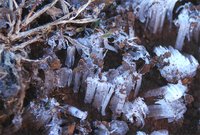

Technically, these crystals which form in the soil are known as "permafrost", but my Northern Hemisphere friends will scoff at the application of that term to this little bit of ice formation, for it is not "permanent", or even semi-permanent. We aren't on the Arctic Tundra here. But what I was experiencing is quite different from a normal frost, where tiny particles of dew freeze on the surface of the grass, or soil. This was moisture in the soil freezing slowly, and, as a result, the crystals growing up out of the soil, and they lift the surface of the soil up to the height of the crystals, about 3 or 4 cms high. These crystals have great lifting power, and tiny pebbles, and small rocks will be lifted as the crystals beneath them form. Such crystals can, indeed crack large rocks, if they form within crevices in the rock, then expand.


Leo and Anni are entitled to tell me that I don't know anything about real cold. But it is cold enough for me, here in Robertson. It is also cold enough for Peonies, which was my primary criterion, when selecting a location when I moved from Canberra.
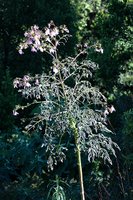

I mentioned last Wednesday the "Optimistic Nature of the Tree Dahlia". Great timing for that post. Have a look at it, on the morning of our big freeze. That was yesterday. Today it is showing even more damage, but you get the point - its growing season is over - for this year.


Oh well, it will have to start again next year to grow two metres tall, or more, before it will start to form its flowers, in late April or May. And, of course, it is destined never to set any seed, in Robertson. Poor thing. But I love the way it keeps on trying.

One could say that it is a metaphor for someone being treated for Lymphoma, really! No wonder I admire its stubborn hold on life.

Wednesday, June 07, 2006

The Optimistic Nature of Tree Dahlias

Tree Dahlias are the most optimistic of plants. They grow all season in order to produce their large pink "pixie-cap" flowers, just in time to be cut down by the first frosts of winter.


This is a remarkably futile exercise, in our climate. Perhaps where they live naturally, in Mexico, the seasons are longer, the frosts less damaging to plants.


But still I like them. They are well-named, for my young plant, only in its second year, has twice produced tall growths, well over 3 metres high, then thrown some sprays of flowers. And when walking down my street the other day, I saw some towering over a neighbours shed, probably arching some 5 metres into the air. And yet, like any normal Dahlia, they are a true perennial, the annual growth dying off, leaving only the tubers, from which new growth emerges in Spring.


Of course, in the case of the Tree Dahlia, the tubers are massive. The clump from which my plants came was a division, with long tubers 45 Cm or so in length, and a total root mass which was more than the previous owner could lift, without first dividing it with an axe.


It is interesting to think that this tall plant could, overnight, be reduced to a soft brown slimy mass of pulp, after our first serious frost. And yet, from that mess, will emerge next year, even more spires of these tall flowers, in an endless cycle of trying to outlast the season, to make enough growth to flower, before the inevitable result of being cut back to nothingness. As I said at the beginning,Tree Dahlias are the most optimistic of plants.