Christmas Bells

Christmas Bells
Christmas Bells - Blandfordia nobilis
Showing posts with label Sunsets. Show all posts

Monday, July 28, 2014

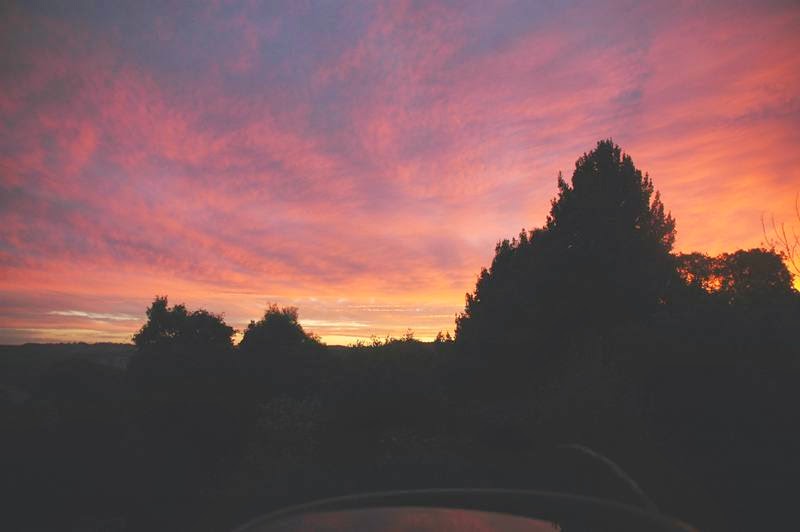
Great sunset colours this evening Monday 28 July 2014

While working on my computer, this afternoon,
I noticed an eerie pinkish glow in the western sky.
Of course, it was sunset.
But such rich colours, with a distinct purplish tinge.

Looking to the far-south-west.
Main patch of colour around to the right (west).

The tall conical tree is the Sassafras I regularly photograph.
The light changes, the range of visibility changes,
depending on conditions.

Similar angle, slight change in light as sun set changes colour.

Taken from the western side of my house.
Looking through deciduous trees.

Thursday, June 12, 2014

Soft sunset over Robertson

Soft Sunset reflected in Bird Bath

Looking west, first shot

Looking south to general glowing sky.

Light changes, and as it does, one adjusts the camera


Sunsets are beautiful, but transient.
My last shot of sunset tonight.

Wednesday, November 13, 2013

A week of strange weather in Robbo

This week started with the promise of rain, but little of nothing arrived.

Then we got a lot of drizzle, and on Monday night it arrived.
Heavy rain, then lashing rain, then hail, and thunder.
Poor little Lulu was very distressed and asked for "protection" so I picked her up on the bed. Strange how that works for kids and dogs. Maybe they are really just the same creatures, in different body shapes.

Then on Tuesday I saw that there was still a "drift" of the fine hail we had had about midnight.
A pleasant surprise to find this hail
still hanging on, in the early afternoon
on Tuesday,
Given that I got 60mm of heavy rain overnight, I was surprised that the hail had not melted in the rain.

My driveway coating washed down the hill, towards the peonies.


Peony "Sarah Bernhardt"
Peony "Bowl of Beauty"
Road base washed down the hill, towards my house.
It makes walking along my path to the front door a little less secure.


I went out to Carrington Falls to check the flow in the Upper Kangaroo River. It was flowing reasonably, but anything but in flood. But it had been nearly dry the weekend before.

Compare how it looked after heavy rain
in late June 2013


Stick Daisy Bush
Olearia elliptica subsp elliptica

Petrophile pedunculata"Conesticks"

Lambertia formosaMountain Devil looking very bright in the sun

Leptospermum morrisonii

Locals might note this proposed road closure
up to 45 minutes at a time.
The pedestrian access is surely a joke.
 I managed to collect a Leech out at Carrington Falls (I was hardly off the pathway - except perhaps to take  a couple of plant photos beside the path). Anyway, I found this leech crawling across my floor later in the afternoon.
Leech pretending to be a beached whale.
It had certainly had a good feed on my leg.
For grammatical pedants among you, is there a proper word for how Leeches progress across the ground - other then "leeching"?


Tonight, there was a lovely gentle sunset.
Sunset 13 November 2013
A nice way to conclude the cycle of weather we have experience this week.

Tuesday, July 30, 2013

Clouds at Sunset

After a long series of warm days, tonight we got a lovely sunset. It was followed by a mini-thunderstorm just after dark.
The evening sky to the south west,
colouring up as the sun prepared to set.

Sydney and Canberra are both reporting a record warm spell in July 2013. Hottest ever. Sydney had had (I believe) its hottest July ever.


A cumulo-nimbus cloud "head"
this is south from Robertson.
Therefore, at this likely distance, probably over Nowra.
We had some lightning and small amount of rain,
but I heard from Alan Stephenson later on,
that it is was "pissing down" at Nowra.
He rang to express doubts about a planned trip tomorrow.
Post-script:
The comments on the temperature "record" for July have been confirmed by some colleagues. Various "takes" on what it means, why politicians don't understand what it means, etc.
Most straightforward comment was: "160 year record for warmest July in White man's history".

Friday, October 05, 2012

Dirty skies, hot day, and Flying Termites

Today was one of the most unpleasant days (climatically) I can recall in ages.
Sure there have been much worse days, but we in Robertson need a bit of acclimatisation to these hot north-westerlies. 

OK it was only 27.1 C (max), but the humidity is the clincher. Close to 100% at present.
I can't get a retrospective reading on that, from the Fire Brigade Weather Station, unfortunately. But it was "sticky as...." (as the young people say).


This is what the sky looked like at Albion Park Airport, at lunchtime.

Normally one can see the Illawarra Escarpment
really clearly from here.

This is the view from the top of the Macquarie Pass
Under the dirty cloud
(which is not pollution, by the way)
one can normally see Lake Illawarra
and the Port Kembla Blast Furnaces.
This is simply a result of nasty atmospheric conditions.

The immediate effect of the burst of hot weather was an enormous swarming of Termites.
All the way up Macquarie Pass (through the rainforest)
I was driving through clouds of flying Termites.
If you look at this image closely, you will see little creamy "dots"
They are the wings (the only things clearly visible on these insects)
of hordes of flying Termites.
Termites swarming in the hot air.
There are probably 80 or so in that one frame.
and that was literally a single "snapshot"
of one place, at one time.
The drive up the Pass is about 6 Km long.
How many Termites hatched today?

Late in the day, the sky turned a dirty yellow
with the sun just about to disappear.
This was at 7:02PM
Strange colours. Not a classic sunset at all.
Lets hope tomorrow is a better day.

In writing this, I am aware that there have been bushfires in the Central Coast area, and I am not trying to compare our conditions to theirs. But the "dirty sky" is not smoke haze from burn-offs, and certainly not smoke drifting down from those fires. It was just a very strange day.

Thursday, August 16, 2012

Gentle sunset (when the wind had dropped)

Two nights ago, I caught this gentle sunset from the back deck.
Just lovely, especially after the tough weather we had had for most of the week before.

14 August 2012 at 5:31pm.

Wednesday, August 24, 2011

Sunset serenade


As the sun set slowly in the west, 
I went out onto the back deck to listen.
If you have birds around your home, 
try to listen to their calls as the sun rises or sets.
Sunset from my back deck tonight
Blackbirds were whistling beautifully (listen towards the end of this sound file), with the occasional clattering cluk, cluk, cluk alarm noise (unfortunately, that call is at the start of the attached sound file - which gives totally the wrong impression of their beautiful whistling call).

Pied Currawongs were carolling in the distance.

Magpies joined in with some of their piping calls.

And then a pair of Kookaburras joined in, to bid the day farewell with their wonderful call.

tonight's sunset from my back deck.

Friday, February 25, 2011

Sunset of a beautiful day

On Wednesday we were granted a beautiful sunset.

it was not a spectacular sunset, full of brilliant contrasts, etc.

It was simply one of the prettiest skies I have seen in a long time.
Tonight I can report that Brendan and I finished the re-cladding of my house. There are trim details to finish, and walls to be painted, but I can at least say we have got to the final corner, so the whole house is now re-clad, and insulated, and repaired as we went along.

Many thanks Brendan -  for your help.

I shall post a few "milestone" images from our journey through this long process - but not tonight.

Tuesday, April 27, 2010

Sunsets (after Turner)

Over the weekend, there was a delightful pink sunset forming over a nice set of cloud, over the ridge to the south-west from my house.For some reason, this set of clouds and the late afternoon sun combined to present some glorious views.I think Mr Turner, in grimy London, with his sunset skies brought to life by the volcanic eruptions in far away Dutch East Indies (Indonesia), would have liked to share my enjoyment of the more commonplace sunsets of Robertson.

Its all in the clarity of light we get here, I think.
No wonder the hills of Robertson are populated by artists.

Saturday, January 16, 2010

Grey skies and white flowers

Four nights ago we had a huge thunderstorm here in Robertson.
The morning after, as often happens, there was a thick fog - all day, and all day the next day and all day the next day.
The novelty of these thick summer fogs really wears off after three days.
This is the second "long fog" of the season - we had one which started at noon on Christmas Day, and lasted into the fourth day.

Anyway, here is an image of the fog at 7:28 PM on the third day of this fog - yesterday afternoon.
Sassafras trees in fog.
Far distant trees are just visible at 100 metres.
Today the weather was cloudy, but not foggy as such.
However, as the sun dropped low in the sky, the previously thick clouds thinned just enough to allow the sun to peer through as an orange globe. It was not the usual bright sunset - just a faint wash of rose colouring on the southern horizon, and the yellow globe.
Yesterday afternoon, one of the Oriental Liliums outside my front door decided to open. The flower is dotted with moisture from the fog.
But it is a lovely flower, with a sweet, but somewhat heavy perfume. The Moths love it, of course, as do I.As the flower is very fresh, the stamens have not yet started to open and release their pollen (a process common to most plants, but really easily observed on Liliums with their huge stamens, and red pollen).

I will photograph the open stamens tomorrow morning.

Friday, December 18, 2009

A season of plenty - plenty of squarking

The recent evenings have been soft and gentle - almost how one imagines English summer evenings are.

Butterflies have been mobbing the Buddleja bush. This is what these bushes are famous for, hence the popular name "Butterfly Bush".
This butterfly is the "Yellow Admiral" - Vanessa itea
Quite literally is is common to see something approaching 50 Butterflies around one bush, at any one time. This is the "Australian Painted Lady" Butterfly (Vanessa kershawi)
Another plant which is in full flower is a cultivar of the Tea Tree (Leptospermum spectabile). This plant produces copious nectar from the floral disc. And its flowers attracts bees, beetles and hover flies.
Here you can see the green floral disc to which I have just referred. The petals are red, and the sepals creamy white. The stamens are very prominent, still holding their pollen (as yet unripe). The little brown "bags" on the ends of the stamens will open to release the pollen, once it is ripe (at "dehiscence" - the shedding of the pollen).
In my yard, King Parrots (Alisterus scapularis) are uncommon. They are around, but I seldom see them feeding in my place. The people of Robertson do spoil them, by offering "bird seed" (which I do not do). I feel it makes them too dependent on supplied food. I prefer to wait and on occasions, find a King Parrot doing some more natural feeding. This handsome male is in a planted Acacia decurrens (not a local plant, but a garden specimen). But the King Parrot has observed that the wattle has set seed, which is as close as can be to "natural" food for the Parrot.The Acacia seed pods are visible above the Parrot's head - as straight, slightly brown pods, with nodules (bumps) visible. Each bump represents a seed (as in a classic "Pea Pod" structure).

Having boasted about not providing "bird seed" for the King Parrots, I do give the birds an occasional piece of fruit. I was hoping to attract a Bower Bird (which I did), but the top of the line birds at this season are the Pied Currawongs (Strepera graculina). Within a few minutes of me leaving two small pears out on the feed table, the Currawongs were into them. The Bowerbird sat quietly by - an unusual occurrence.
I always "fix " the fruit onto a spike (a screw). The theory is that it prevents the fruit from rolling off the table, when the birds are pecking at it.
This bird outsmarted me. It grabbed the Pear by the stem, and lifed the fruit in a single attempt. It seemed surprised, for an instant, then it flew off into the bush carrying the Pear, closely followed by two nagging, squarking fledglings.
Notice the enormously powerful feet of the Currawong.
Next time I will cut the long stem off the Pear. I don't want to be outsmarted again. I did not see, but it is very likely the Bowerbird scooped up the remaining piece of the Pear. I hope so.

Here is one of the young Currawongs. Note the grey plumage and the yellow gape (the joint of the upper and lower mandibles of the beak). That is a residual feature of young "passerines" which grow a very wide gape when very young, to facilitate feeding by the parents when in the nest. Once they fledge, the soft tissue shrinks to normal hard beak tissue. This youngster's eyes are grey, not bright yellow.And just to set the scene of the "soft evening" there was a pastel sunset on the little pile of clouds out over Fitzroy Falls..On evenings like this I like to use the very droll Aussie expression:
"Ya wouldn't be dead for Quids".

Sunday, June 14, 2009

Sunset and moths

Yesterday afternoon, while I was working on the computer, a friend rang me to say there was a terrific sunset outside.Normally I see the glow of such events in the late afternoon sky. But with the sun moving well around to the west (not south-west) and my study window facing east, I had not noticed the glow.I rushed out, and knowing how quickly sunsets fade, I grabbed the camera and took 3 quick shots. Thanks to Peter for letting me know.
Later on, there were several species of Moths around - just quietly sitting on the wall of my front porch. None of that crazy buzzing around, as other moths tend to do, in autumn. This is a mid-sized moth, (about an inch long), with shallow "tent" habit of folding its wings. The wings themselves are grey, camouflaged, and very finely fringed at the lower edge. It is not a heavy bodied moth, as, for example, "bogong moths" are. The legs are not hairy, and have some of those very long spikes along them. Contrast that with the very hairy Swift Moth below,

See the fine fringes on the lower edges of the wings.
This one looks to me to bew very similar to Donald Hobern's image of Heteromicta pachytera.
I have no information on this moth, other than that they are in the Pyralidae (or Crambidae) which group are said to be "concealed feeders" - i.e, they hide inside the substance on which they are feeding. As a group, they are referred to as "Webworms, Meal, Flour, & Frass Moths".
I have not seen Swift Moths for more than two weeks. I was starting to believe they only came out in the rain, but last night, there was no rain. There were three of these moths. Two different individuals here. Note the very finely haired legs, and the large antennae, and the thick coating of "fur" over the body (behind the head).
See from the side, you can recognise this moth as one of the Swift Moths which were around several weeks ago. Those Swift Moths were identified by Donald Hobern as Oxycanus dirempta. By local standards, these are very large moths. They sit with their wings in a very steep "tent" formation.

As one of the dominant local plants is the Blackwood Wattle, these moths would appear to have plenty of food for their caterpillars, which burrow into the ground, to feed on the roots of Acacia plants (trees). They are also likely to be the "host" species of caterpillar which gets invaded by Fungus spores, which develop in the "Cordyceps" fungus, which is quite common in this area. If you go to that linked post, you will see "mummified" caterpillars which have large fungi growing out of their now mummified bodies - once the caterpillar has been "consumed" by the invasive hyphae (roots) of the fungus. The caterpillars are typically longer than my fingers. The fungus then is about the size and shape of a cigar.
Another of the weird and wonderful aspects of the Nature of Robertson.