Christmas Bells

Christmas Bells
Christmas Bells - Blandfordia nobilis
Showing posts with label Fountaindale_Road. Show all posts

Wednesday, February 16, 2011

On your bike, Brown Pigeon!

Ok, there is no longer a bird called a Brown Pigeon on the official taxonomic bird lists in Australia.  It is a Brown Cuckoo-Dove, Macropygia phasianella 

To me it will always be a Brown Pigeon, because that's the name I grew up knowing it as, and because that's such a good name for it. Look at the head - it is 100% a "pigeon's" head. And what colour is it? Well, "brown" is almost an understatement. But it is brown, not green or blue or yellow, or anything else.

Brown Cuckoo-Dove - note head shape and soft feet
Pigeon or Dove? 
The bird we all know in the cities of Australia as a "pigeon" is officially the Rock Dove. That birds has a shorter tail, admittedly, and is a ground feeding bird, but both it and today's bird are undeniably pigeons. Similar head, and same soft feet (note image above). But in Australia we tend to use the name "dove" for the smaller, long-tailed varieties (of Pigeons), such as the Peaceful Dove. Some are ground feeders, others are not.


There are other Pigeons, larger birds, which feed on native fruits in the Illawarra rainforests. Those are exclusively birds of the tree tops. As they travel long distances between clumps of fruit-bearing trees, they are capable of flying very fast, for long distances. Just a few days ago by Bob McInnes,  reported to me a flock of 50 or so Topknot Pigeons at his place at Knights Hill. I have only ever seen just a few of these birds flying high and fast over Robertson, heading down to Kangaroo Valley. Occasionally I have seen them feeding in the tops of the rainforest below Lees Road Lookout. They are very partial to the fruit of Cabbage-tree Palms, which grow freely in the rainforests of the Illawarra and Shoalhaven districts.


Anyway, the taxonomists have a rule that any bird which is found in Australia, but is also found outside Australia, must be called by the accepted international name. There may be a question of "precedence" involved (which name was "first recognised" - by which they mean in the Scientific Literature). In the case of many Asian birds, they were known from there before they were known (in Europe obviously - because that's where the scientific naming authorities were). So the group of "pigeons" with long tails tended to be called "Cuckoo-Doves". Linnaeus named this one, and his Latinised name for it translates as "Pheasant Dove". This group of Doves (there are several closely related species) were first described from Ambon, in Indonesia. So, the name "Brown Cuckoo-Dove" is wrong in so many ways. But it is the official name, OK?


Now, what's this about the Bike?

Well, last Thursday a Brown Cuckoo-Dove had landed on the railing of my back deck, just outside the kitchen. Brendan was sitting out on the deck, and he whispered to me, as loudly and urgently as he could whisper (without disturbing the bird), "get your camera". I had no idea why, but I soon found out.
This is a male Brown Cuckoo-Dove.
It had landed on the hand-rail of my back deck.
You can note the subtle grey toning on the back of his neck.
Brown Cuckoo-Dove - male
By contrast, the female has a more bright reddish-brown (cinnamon) colouration on her head and neck.
Brown Cuckoo- Dove - female (note the reddish neck)
She was perched on top of my Barbeque hood, but it was quite safe.
That shot shows you the very long tail.
It also shows you how long-tailed birds can sit on the ground
(well, on a flat surface anyway)
without beiong troubled by their long tails. 
Rosellas does exactly the same thing. 
They both lean forward, and hold the tail flat.

Back to the discussion of what was going on last Thursday.

Both birds then moved around the side of my house, 
(still on the deck handrail).  
Then the male decided he quite liked my Bike's handlebars.
Brown Cuckoo-Dove - pair. Male on bike handlebar, female on post.
Both birds sat there quietly for some time, 
and then they spotted Lena (the dreaded "Attack-Schnauzer") 
who was going for a walk at the front of the house.
You could not find a more placid dog (and a more short-sighted one)
than Lena.
But the Brown Cuckoo-Doves didn't know that.
Hence the alert look on both of their "faces".
Lena wandered off on her walk, and the birds then relaxed.

This species is a regular bird around Robertson, but I have never had them perch around the house before. I hear them in the rainforest trees, and occasionally see them fly past. My friend George sometimes feeds grain to the wild birds at his place, and he gets them there as regular visitors. 

But George lives over on Fountaindale Road, and there is a subtle climatic and habitat difference between my street and his, on the next ridge east from here. Fountaindale Road is one ridge closer to the coast than my street. Therefore, they get slightly more fogs over there than I do, and probably 5 inches (125mm) more rain per year. Significantly, his road is lined with Lilly Pilly trees (Acmena smithii), which is a berry-producing tree. So the habitat suits these birds ever so slightly more than my place. 

My dominant trees are Blackwood Wattle and Sassafras. They are both dry seed producers, not berry producers. So my place is a better habitat for Wonga Pigeons than the Brown Cuckoo-Doves. 

Many people in Robertson do not realise that a difference of less than one kilometre can make a subtle, but significant difference in rainfall and climate - resulting in a habitat change. But the Pigeons of Robertson know the difference.

Friday, January 02, 2009

George's Peacock was feeling "romantic" today

Despite my "title" header, George does not have a Peacock - rather, one of the Peacocks which lives up the road, at the former "Ranelagh House" wanders up and down the top end of Fountaindale Road, and treats all the houses and gardens there as his own.

As an appreciator of English porcelain designs (particularly ones with peonies on them) I cannot resist this bird's pose - for it is a 'classic Bird on a Rock" pose.
Today, George's Peacock was feeling positively "romantic" and spend most of his time in display mode. I was impressed, but not that impressed, if you know what I mean. We joked that somebody must have fed him some Viagra tablets.All jokes aside, this bird was displaying in such spectacular manner that it deserves being shown on the Internet. He was slowly rotating, whilst still in full display.
The next image shows the full display - front on and "full on" if you know what I mean. Every now and then, he would shiver all over, and shake his tail feathers (while still in display). Click on the image to see the image of the bird's display feathers in full glorious detail.
Here he is "up close and personal".
Here is the bird's head and colourful neck in close-up view.

Such an "impossibly beautiful" bird - I just had to share it with you all.

.

Monday, August 04, 2008

Our New Doctor for Robertson

Ten days ago I reported that I had heard a rumour about a possible new Doctor for Robertson. Tonight I can confirm that it is true.

Tonight I met our new Doctor for Robertson, Dr Steve McGilvray, and his wife Helen, who is an RN, and is the Practice Manager. They are both very personable, and friendly, which is very nice. They are also both pet lovers, (well Helen might even be a bit of an enthusiast, but that's OK too). I feel they will fit in well in Robbo.
Dr Steve McGilvray (centre) and Helen (on right)
We were at the Fountaindale Grand Manor (the former Ranelagh House) for the Annual General Meeting of the Robertson Chamber of Commerce.
It was a good roll up, which is encouraging, for the Chamber has been only just surviving for some time. We even gained a volunteer as Treasurer of the Chamber, which will be a great relief to Dorothy, who has been doing everything for some months now.
Clr Paul Tuddenham came along, which was nice. This was the first time I have had the chance to speak privately with Paul, and I must say I was pleasantly surprised, and impressed by him. We have crossed swords, metaphorically at several public meetings, but there is always an element of role playing in public meetings. Tonight we spoke at some length about Council issues and, in particular, attempts by the State Government to assume control of the water and sewerage functions of Council. Apparently the Government is wanting to assume control of the revenue flow, and Council is trying to fight them off - partly to protect the revenue base, but also to support local employment. Makes sense to me.
Clr Paul Tuddenham,
Deputy Mayor of Wingecarribee Shire Council
Terry Oakes-Ash and his wife were at the meeting, representing the Southern Highlands Business Chamber. Terry made a brief speech supporting the Robertson Chamber of Commerce, and dare I say it, making it clear which groups within Council which he would like to see re-elected, and more importantly, other groups who he would rather not see elected, in the September elections. He also spoke in favour of the Leisure Centre proposal. Dorothy Baker, the President of the Robbo Chamber thanked Terry for his comments, but reminded everybody that the Robertson Chamber of Commerce is a non-partisan body, and is not aligned with any political party or electoral grouping.

Its all right, Dorothy. We expect Terry to speak his mind. Anybody who knows Terry Oakes-Ash understands that he is in favour of investment in the Southern Highlands - for the sake of the future of the highlands, and for job creation for the sake of the younger generation. I for one, would prefer a Council which was more sympathetic to the interests of the environment, and parks and open land, rather than more shopping centres and apartment buildings and endless housing estates. But at least Terry is always clear about what he stands for. So, I am sure nobody was upset by Terry's statements. And he has a droll sense of humour as well, which is good.

For the record, local Robertson resident Councillor, Clr Larry Whipper did not attend tonight's meeting, even though it was held in Robertson, hosted by the Robertson Chamber of Commerce. Enough said.

Robert Goldsack spoke about the forthcoming Springtime in Robertson program of events.Cate Hutchinson, who is now working for the Southern Highlands Business Chamber, but who is also a Robertson resident, spoke about the Horse Expo event which she is organising in conjunction with the Springtime in Robertson Festival. I had been a bit sceptical about the reports of the Horse event which I had heard previously, but now that I know Cate is running it, I am confident that it will all come together.
Cate was previously a Small Business Advisory Officer for the Southern Highlands region, employed by the Federal Government, but the program under which she was employed has folded, following the last election. So it is good to see that Cate is now working with the Business Chamber.
It was a very pleasant evening, and typically Robertsonian in its informality. But that's OK with me.

Friday, January 25, 2008

The Peacock's Eye

My friend George lives near Fountaindale Grand Manor (the pretentiously renamed former Ranelagh House). That guest house still has Peacocks roaming the grounds, and the neighbourhood.

George's photo of the Peacock on the bird feeder.

I wrote about the Peacock which visits George back in April last year. You need to understand that while Peacocks are very decorative, they are noisy birds (they were kept as security alarms in pre-electronic days, in the large British estates, and are both more decorative and safer to keep than a bunch of slavering attack dogs). However, they do not endear themselves to everybody in the district, when they crow (scream, almost) early in the morning. You can listen to a recording of a Peacock call (quietly) - here. In real life, the call is very penetrating, especially in the early morning. And did I mention that they defecate frequently, and voluminously?

My photo of the Peacock at George's place, last April.
Anyway, I like to see George's visiting Peacock (occasionally) - but while I like the Peacock for aesthetic reasons, I know he causes George and some of the other neighbours some grief.

Anyway, today the Peacock was visiting George (as I was too). I noticed when I arrived, that the Peacock was trailing one extremely long display feather. Unlike the native Lyrebird, these feathers actually grow on the back of the bird, not on its tail, but that is another story. This feather was hanging loosely behind the bird, but it refused to drop on the ground. However, after a bit of scouting around I found several discarded feathers - one in excellent condition. George gave me permission to keep these feathers. But before I left (with my treasures) George warned me that some people regard Peacock feathers as bad luck (inside the house). I had no idea.

Sure enough, when I checked the Internet I found no end of references to this superstition. In fact, apparently they are regarded as good luck - in Asia; but bad luck - in the Middle East and Europe. It seems this superstition is linked to the myth of Argus, and to the myth of the "Evil Eye". I shall not go into those vast subjects, (you can follow the links yourself). But I did learn that the Italians believe that phallic symbols, especially those little red horns that adorn millions of car windows in Italy, will ward off the effects of the "Evil Eye".

So that is one of my life-long puzzles solved. One down, 300 million still not explained!

Out of deference to George's sensibilities I have not brought the Peacock feathers into my house, lest something bad happen, and George might be forever able to say: "I told you so". That would be too hard for me to bear.
But I have ascertained (from George) that photographs are safe. I just love the magnificent sheen (caused by the way the feathers reflect light) on these display feathers, and the wonderful effectiveness of these iconic feathers as a display feature.

Whatever the human superstitions which have grown up around these feathers, clearly they serve their purpose for the Peacocks and their sombre Peahen partners.

Thursday, September 27, 2007

Spring Photo Competition - at the CTC@Robertson

Entries for the Robertson CTC's Spring Photo competition have closed (officially), but I guess we can squeeze in a few last minute entries if you feel inspired. But be quick!

I have entered one of the Gnome series shown a few days ago. And I have also entered a photo of a frond of a Soft Tree Fern (Dicksonia antarctica) unfurling. This photo was taken several days ago, at George's place. He has many Tree Ferns there, including both the two main local species - this one and the "Rough Tree Fern" (Cyathea australis).

The distinctive shape of the Tree Fern frond, as it grows, and unfurls progressively is really interesting. Historically they are called "crosiers" which is the name of a Bishop's symbolic staff - the so called "Shepherd's Crook" - named after the traditional staff used by shepherds, looking after their roaming flocks of sheep and/or goats. The hook in the top was supposed to help the Shepherd retrieve a lost sheep. All of that imagery has been borrowed by the Church as symbolic of Christ, the "Good Shepherd". And that is why the "crosier" is used for the symbol of power and authority of a Bishop.
But mathematicians and theoretical physicists have also focussed on the Fern Frond, as it unfurls, as a demonstration of "chaos theory" - for within each frond are smaller and smaller leaf sections, each of which as it grows, reveals the repetitive patterns which first prompted mathematicians to describe the seemingly endless repetitive sequences which are key to chaos theory. Obviously, in the Tree Ferns, these pattern repeats are not infinite, but the leaves are so large, and so complex in structure, that they are probably the supreme example in the plant world of complex leaf structures. The structure is described as multiple-pinnate, which literally means "feathered upon feathered" leaves.

There is an interesting description of this unfurling processes of Tree Fern branches in Wikipedia, where they describe it as "circinate vernation" - a term which is new to me.

I love these Tree Fern fronds, and I know that Crimson Rosellas also love them. They eat Tree Fern fronds, much as we humans eat Asparagus.
These photos were taken at the Australian National Botanic Gardens, Canberra, where they have a fantastic display of the Soft Tree Ferns growing in the rainforest gully. There is one point where the Tree Ferns are growing underneath a foot bridge, and one can often see Crimson Rosellas sitting in the Tree Ferns, chewing the young growth of the fern leaves, as in these photographs.

Saturday, September 15, 2007

Light is everything

Here are a few photos of the view from Owen's deck. As the caption says: light is everything.

This first shot was taken a few afternoons ago, when there was really clear, bright afternoon light shining on some of the paddocks down from Owen's place. This is a middle distance view.

The light was so bright, it almost hurt one's eyes.
Then, as the sun started to drop in the sky I took this shot, of the far distant views of Kangaroo Valley. Mt Scanzi is central in the frame. It rises from the bottom of Kangaroo Valley, but it stands free from the hills which appear immediately in front of it (there are layers and layers of sandstone ridges, which mask the distances involved). The very far distant horizon is the southern side of the Shoalhaven Valley, near the Buddawang Ranges.
Just a few minutes later, the same scene was transformed by a soft early sunset glow.
This morning, I went back to take advantage of the clear air to take a mid-morning shot of the same grand view. If you click on the image (above), to enlarge it, have a look at the plateau in the mid-distance, in the right hand side of the image. There is a large object visible, which is the "Surge Tower" which stands on the top of the ridge, above the Bendeela Power Station (in the Kangaroo Valley). This is part of the pipeline between the Kangaroo Valley and Fitzroy Falls, and the surge tower is used as a pressure relief system, when the hydro-electric power system is being used to generate electricity. They run water back down from Fitzroy Falls to Bendeela Pondage. However, with the Shoalhaven Transfer system operating more-or-less non stop, these days, to take water from the Shoalhaven to the Sydney water catchment dams, there is little or no chance to produce power from this hydro generation system.

Wednesday, August 01, 2007

Wingecarribee Shire Council and Robertson

Tree Ferns on a bend of Caalang Creek, in Hampden Park, Robertson.
I am on the Hampden Park Committee, in Robertson. Small beer, but it is enlightening to see how things do or do not work around the Wingecarribee Shire Council.

Recently we have had discussions about footpaths around the village. Then there was a thing called the PAMP study (apparently funded by the Roads and Traffic Authority (RTA)). The good burghers of Robertson rolled up and voted for their most important footpath requirements. Clearly the people of Robertson said we need the footpath built from Ranelagh House (on the corner of Fountaindale Road) to the Cheese Factory - along side the Illawarra Highway. It is a much used route; but there is just a grassy verge, with no clear walkway, and it is beside a very busy road, with heavy trucks thundering beside unprotected pedestrians. So, fair enough - it was agreed that it ought be built as an all-weather footpath, funded by the RTA.

Tonight we heard that, after all the promises that the footpath would be built, that there has been no funding allocated to the Fountaindale Road (Ranelagh House). Can this be true? After all the promises, and press statements, etc. Surely not!

What will I tell Greg, when I next see him? Greg walks that route, numerous times each week. In an orange safety vest, for high visibility, I am pleased to say.

Robertson need this footpath folks.

Tuesday, June 19, 2007

Owen's forest and waterfall

Down in the steep valley, beside Upper Fountaindale Road there is a little creek which flows permanently.


After rain it makes a very significant flow, complete with several small cascades. For artistic licence, let us call them waterfalls.


The rainforest in this deep gorge has wonderful large vines (lianas), which are covered with mosses, lichens and in many cases, fungi as well.


The waterfalls are over head-height, but they are not great leaps of water, of course. Still the sound of running water, the spray, the light, is all that one would want in your own back yard.

Blessed is he with this waterfall to call his own.
(As usual, click on the images, for a better look.)


Of course, this waterfall and forest comes with its own Forest Sprite, in a yellow rain jacket and trousers. You would be disappointed, if that was not the case, would you not?
Wikipedia assures me that I ought not refer to this character as a Leprechaun, as that would risk being an offensive stereotype. Perish the thought.
I am grateful to this cheery character for permission to visit his waterfalls, and forest.

Thursday, May 10, 2007

Creeks behind Fountaindale Road

Narrow creek cutting
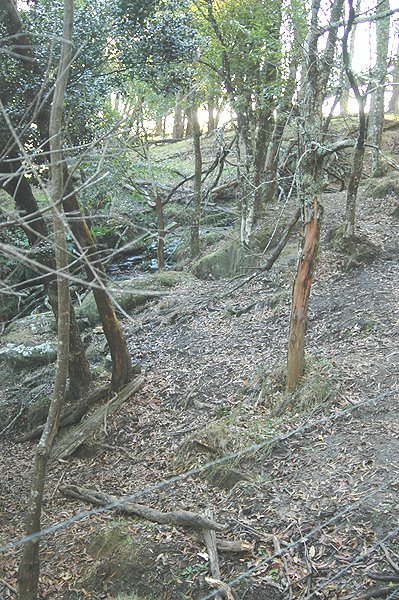
Down in the tall Eucalypt forest, below Fountaindale Road is a track which leads to a deep creek.

Today Jim showed me the way across the creek, via a steep, but passable, set of rock steps. Above this crossing point is a still pool called "Lorna Doone's Pool" - something straight out of my childhood reading.


Moss covered rocks
The creeks above this wonderful pool rush down through a series
of very narrow crevices, between moss-covered rock faces.

In some places, these cuttings were 15 metres deep, but they were too hard to photograph with any perspective.


Still pool, above the cascades
Further up the creek, the ground levels out and a still pool mirrors what little light was shining this afternoon.


Jim stepping across the creek
At a shallow point, we could easily step across the little creek.


A Moss Garden
Having crossed the creek, we went thougha patch of TeaTree Scrub, and found this wonderful little Moss Garden, in a small, open glade.

Friday, June 30, 2006

The Nature of what is underneath Bell's Hill

I asked the other day "what is underneath Robertson?". I gave the large scale answer, by showing medium distance photos of the district, showing both the plateau surrounding the Upper Kangaroo Valley, and Bell's Hill, rising above the plateau.

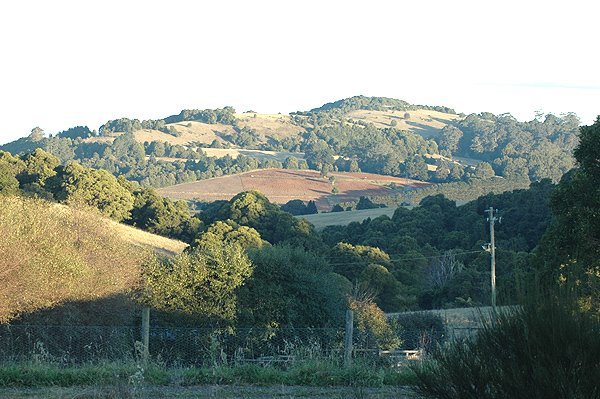
Here is what Bell's Hill looks like, from Robertson itself. This image was taken beside the Cheese Factory. You can clearly see the rich red basalt soil, having recently been ploughed, probably for next season's potato crop.

In my post of the other day, about the strata of stone under Robertson, I suggested one could draw a line across under Bell's Hill, at the level of the sandstone plateau - and deduce that the sandstone was continuous, right across, under Bell's Hill, and indeed the rest of Robertson. Today, I take the specific, or close up, approach.

If you drive to the bottom of Fountaindale Road (from Ranelagh House), you start on deep red basalt soil - the kind visible in the Bells Hill photo above. You are in a grove of rainforest trees.

As you start to flatten out onto the main area of farming land, you have dropped off the red soil, onto deep black soil. This soil is formed as the strata known as the Wianamatta Shale breaks down into soil - fine black soil.

This deep black soil makes good grazing country, and is mostly used these days for beef cattle production. Originally it was home to tall Eucalypt forest, and rainforest remnants.


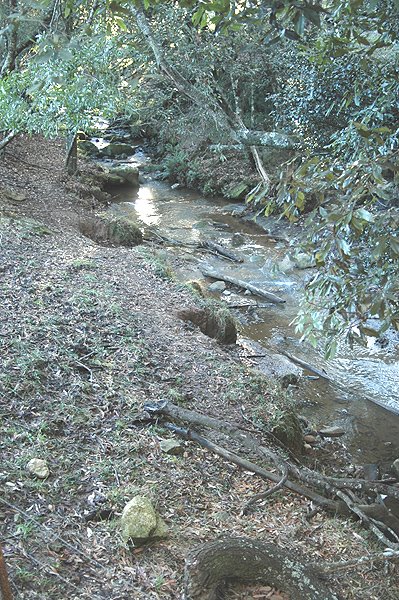
At the bottom end of Fountaindale Road, the road runs into the tall Eucalypt forest, and the soil changes to a sandy mixture. The depth of soil here is clearly visible in this creek side. It is probably about 30 metres deep.


This soil is a combination of black soil, washed down the hill, and the underlying sandy soils, derived from the sandstone base.


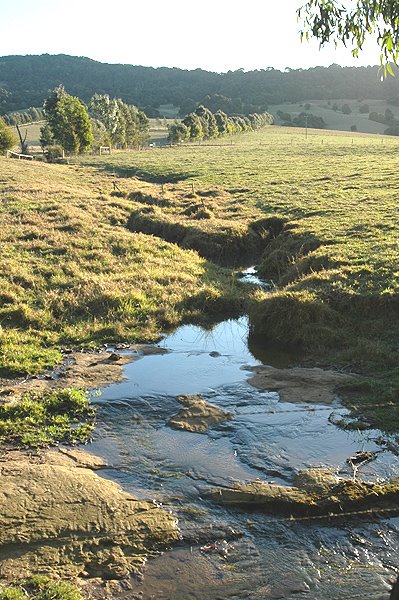
When you look closely at the bottom of the creek (it is a typical shallow stream, only a few inches deep) there is a flat base of exposed rock - a classic sandstone stream bed. And yet, this sandstone rock base is surrounded by the rich grazing country you see in the photos above and below.

Sandstone does not give you this rich farming country. You are looking at the lower strata of rock - the sandstone base. That underpins the more fertile black soil derived from the black shale, which is a separate deposit, in geological terms.


Out in the paddock, there is a small stream, just starting to erode through a much shallower layer of black soil, down to a sandstone rock shelf. Here the topsoil layer is less than 60cm (2 feet) thick. But the tell-tale flat shelf of sandstone rock is clearly visible.

The depth of the black soil is quite variable, obviously, if you compare this photo with the previous photos taken in the adjacent deep creekbed, just 50 metres away.

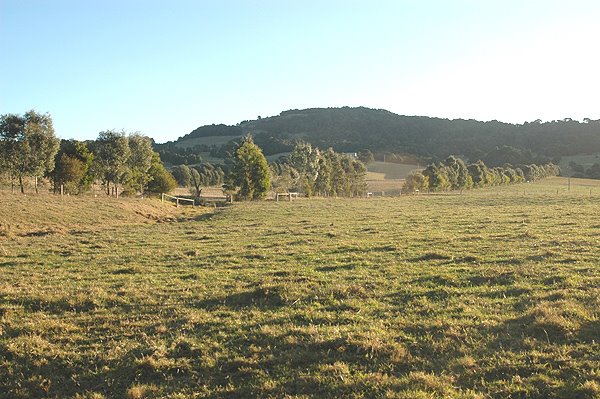
If you walk away from the deep creek and look up the hill, you see rolling paddocks, heading gradually up towards the mounded shape of Bell's Hill.

This image shows the complete picture - the exposed sandstone base, the black soil in the pasture land above, running back up the hill, to the slopes of Bell's Hill, less than 1 Km away.

So here it is: the sandstone strata, running directly under the basalt cap of Bell's Hill.


If you could get an equivalent picture elsewhere, under Robertson, it would be the same story. A continuous shelf of sandstone rock, underneath the basalt caps, and the rich red soil. And in between them, a layer of the Wianamatta Shale, which produces the black soil which is mostly is used for grazing country around Robertson.

The same pattern is repeated as you drive south, down Belmore Falls Road, or going north, you drive down Kangaloon Road, and along Kirkland Road, in East Kangaloon. In each case, you run into sandstone scrub country, as you reach the level of the sandstone plateau (at Belmore Falls, and the Tourist Road).

So, rainforest (on the red basalt soil) gives way to tall Eucalypts or cleared grazing country (on the deep black soil), which in turn, give way to Sandstone-based Eucalypt and scrub country. It is these latter pieces of habitat which are mostly now preserved as National Parks, or the SCA "Special Area" along Tourist Road. The red and black soil areas have long ago been appropriated for farming country, unless they are too steep to farm - that fact explains the patches of remnant rainforest around Robertson - mostly on rocky hilltops, and in creek gullies.

So, the sandstone underpins the Nature of Robertson, and dominates the surrounding countryside.

Thursday, January 12, 2006

Coffee, cats and wildlife in Robbo

Well it is high summer in Robbo, now.


High fog, high(er) cloud, followed by high humidity when the fog burns off and you get clear skies for a few hours. This is what has happened today. But you can almost hear the plants growing. It is a great feeling, and it is what makes Robertson the kind of place that it is. Well, at least the colour that it is - green.


I have just returned from a brief visit with G., in the deepest, darkest, shadiest glade of "Lower Ranelagh". He has Camellias which he has pruned which are nearing 8 metres high again. And a Mulberry on which the re-growth from a pruning "attack" is nearly 2 metres long. Meanwhile, swarms of little bronze-green Beetles are redressing the balance of nature, by stripping the leaves on his Cherry trees.

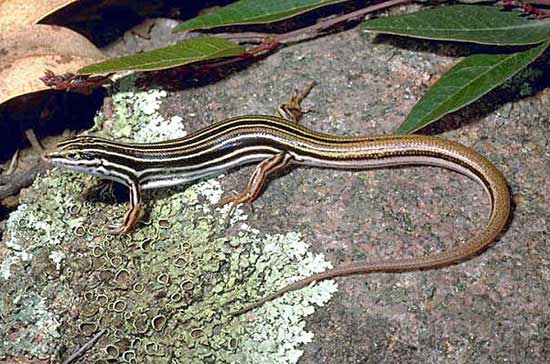
While we were having a cup of G's finest coffee, a "Copper-tailed Skink", Ctenotus taeniolatus was playing on the cobble stones around the pond. (Photo by Peter Robertson © Museum Victoria.)

*****

Meanwhile, a Wonga Pigeon (Leucosarcia melanoleuca) (Photo: Glen Threlfo) walked past his door, just a few metres away from us. (This link from the Lamington National Park has sound files, so you can listen to the Wonga Pigeon's call.) King Parrots were lining up in the trees, waiting for a feed. George is fond of complaining about the mess that the "bloody Lyrebirds" make. I just smile and say "we should all be so lucky, G.!"

G. is a cat lover, but he keeps his cats indoors, totally, which is to be greatly admired. Otherwise, these little native creatures would not be there for us to admire.

Breaking news: My Z. has just informed me that I am due to inherit a cat. Now that will be an interesting challenge. Z. will need to take advice from G. on training a cat to become an indoor cat.