Christmas Bells

Christmas Bells
Christmas Bells - Blandfordia nobilis
Showing posts with label Green.. Show all posts

Thursday, June 14, 2012

No Hunting in National Parks - I didn't go, but many of my friends were there

The NSW Parliament has been the scene of a series of protests recently.
The biggest one I know of was the "Our Land, our Water" rally opposed to mining and CSG versus farming and the despoiling of rivers and aquifers. That was back on May 1.

A few days ago, it was opposition to large-scale sackings and redundancies of NSW Public Servants and my mates, the NPWS officers.

And today, many of the same people were there again, to protest the NSW Shooters and Fishing Party's proposal for hunting in National Parks.

Skippy amuses this Boy in Blue.
Good humour is important
when running a Revolution.
Nice work, Skippy.
I didn't make the trip, but I did send off some briefing notes to Cate Faehrmann MLC and her staffers (in response to their requests).
 
In particular, I was fascinated by the honesty of the New Zealand Hunters.
  • HUNTING ACCIDENTS         INVESTIGATE: JUL 03 They act before they think, almost pre-programmed to shoot on reflex
  • HAMISH CARNACHAN investigates the campaign to stop hunters killing each other in the bush
  • An important factor, according to Green, is a little-known phenomenon he refers to as "buck fever", which he describes as "a psychological state whereby the hunter’s desire to shoot their quarry is so strong that it overrides all rational thinking".
    Speak to any hunter and they will invariably detail the concentration, often required for hours on end or even days, which goes into stalking a deer. Nerves are taut, the atmosphere intense, it’s all part of the primal thrill of the hunt. Green says when a hunter is "wound up" during the chase any unnatural distraction can draw a snapshot, in some cases with tragic consequences.
  • Source: http://www.investigatemagazine.com/jul03hunt.htm
And those are not my words, but the words of New Zealand hunters.

And then there is a very powerful article entitled: "How to avoid shooting your Mate".
  • In the Oct-Nov 2003 addition of “NZ Outdoor” Murray Dench wrote an excellent article titled “How to Avoid Shooting Your Mate”. If you read this article you would know that the hunter in my story acted questionably on at least two occasions. Finally, when considering the disturbing circumstance of the recent fatal shootings, I draw your attention to the title of this article. Title: "Shooting your mate"
  • NZ Hunting Information
    http://www.nzhuntinginfo.com/printPage.php?pageName=./articles/could
If you wish to sign the petition or write to the relevant politicians about Hunting in National Parks you can go to this site: http://nohunting.wildwalks.com/

If you are on Facebook, you can view many photos in Cate Faehrmann's Photo Gallery here.

Monday, July 07, 2008

Bits and Pieces

Kindly wish me happy 700th posting, please. Thanks for following along for the ride. If it were not for the feedback from the readers, this would not be worth doing.

Last week I took Lena for one of her occasional visits to Mr Darcy. In fact I was visiting my friends Lyndon and Maria, but don't tell Lena that.

The grass was almost unbelievably bright green in the morning light. But the colour is real. Lena loves a romp around on this field of neatly trimmed grass, and checking out the sniffs from the resident Goat, the local Wombats and Wallabies, and occasional Rabbits.
Mr Darcy is very ornamental, statuesque one could say. He is suitably handsome, as any Jane Austen fan would agree. Colin Firth fans - eat your hearts out!
The dogs, Lena and her friend Mr Darcy were not shy. They never are.

And from the sublime to the mundane, I noticed a small, dull, but beautifully shaped fungus growing from a dry piece of wood, at Lyndon and Maria's house. A perfect parasol shape.
Underneath this little brown parasol is a startlingly beautiful structure of widely spaced gills. These gills are interesting in that they alternate between complete gills (going from the stem to the cap), and short, incomplete gills. The gills are also relatively widely spaced, compared to the more familiar "field mushrooms" which many people consume regularly, purchased from Greengrocers (or supermarkets - if you have forgotten that "Greengrocers" still exist).

I have not been able to track down what this fungus is, but it bears some resemblances to this Mycena stipata (from an European website).
Any advice would be welcomed, folks.

And, as with everything I like to do in this Blog, there is a tiny surprise waiting for you. Yes a minute insect (or an "arthropod" if you prefer). I have no idea what class, or order of creature this tiny creature is. I wondered if it might be a "proturan". I do not know. I certainly would welcome any advice from fellow bloggers. If you scroll back up to the image two above, you may now notice this creature, wandering around inside the gills of the fungus, on the top left side.
All I can make out for sure is that it has several dark grey protrusions which I assume are antennae, (on the far right hand side) and what appears to be two pairs of legs towards the front of the body, and other tiny feet, or other structures, but I cannot count how many pairs of legs this little creature has. As often happens, I was not even aware that this creature was present, until I developed the photograph. I might have checked its fine details with a 10x magnifying glass, otherwise.

Distressingly, an extended search of the Internet tonight brought little joy in trying to work out what "insects" (for want of a better word) live within fungi. I have seen these creatures before (several times), but I cannot not track down what they are. The fungi people concentrate on the types of fungi, but it seems that they seldom stray into discussing whatever creatures live on and within fungi. Apart from "Springtails", (Collembola), I have found little mention of creatures which feed on fungi. But they appear not to have a larval stage, and adults have a different body shape to this, with 6 body segments. This creature seems to have more segments than that.

As I have indicated, any help would be welcomed in identifying (above), and also the type of fungus the tiny little creature for which this little fungus is its entire "world".

Thursday, June 19, 2008

Kangaloon Borefield to be "Shelved"

Well, it looks and sounds like Good News about the Kangaloon Aquifer, for a change. NSW Water Minister, Mr Nathan Rees announced on Wednesday 18 June that the Upper Nepean Borefield Proposal would be "put on the shelf". At least it is better than being told that the Borefield is to go ahead.

In Mr. Rees's Press Release, Mr. Matt Brown, the Member for Kiama acknowledged the strong community opposition to the project. Almost as an after-thought, Mr. Rees acknowledged that there was never much water to be gained from the project for Sydney, and that with the De-sal plant to come on line in 18 months, they simply do not need the Kangaloon Borefield.

Well, we should be gracious in welcoming the Minister's decision, but he does go to some pains to keep the door open for the project to be reactivated at some point in the future.

Over our dead bodies, Mr Rees!

The project is, was and always will be a total waste of taxpayers' money, and a dangerous experiment with one of the few "intact" parts of the Sydney Sandstone ecosystem. It is precious as an "environmental capsule", and must be maintained as such – not destroyed.

The Upper Nepean and Avon catchments should be immediately declared a National Park or Nature Reserve, and handed over to the National Parks and Wildlife Service for professional environmental management. Detailed plans were drawn up for exactly that to happen - a long time ago – by Helen Latham, on behalf of the NPA. The "Latham Report" is still available on the
NPA's website. If the NSW Government has forgotten that those plans ever existed I would be happy to provide them with fresh copies. They are more relevant today than ever.

Christmas Bells - at Butler's Swamp


--------------------------------------------------------------------------------

On behalf of the Save Water Alliance and the other groups which have opposed this plan all along, may I thank first of all, the generous members of the local Southern Highlands community who have supported us by coming to public meetings in Robertson and Bowral. I wish to mention those who put bumper stickers on their cars, and the landholders of Kangaloon whose "no
borefield" signs were torn down prior to the NSW Election by partisan political activists. Those incidents of politically motivated vandalism inspired us to greater endeavours.

So, in retrospect, we should thank Mr. Brown's (alleged) campaign assistants for their assistance in our Anti-Borefield campaign. Their mistake was in not recognizing that our campaign was not partisan (it never was), but was factually based. Along the way, we have had support from candidates from Labor Party (except in the Kiama electorate), the Greens (at State and local
level), the Liberal Party and from the Climate Change Coalition, as well as numerous independent candidates in both the State and Federal election campaigns.

I wish to thank specifically the dairy farmers and potato growers of Kangaloon, Robertson and Burrawang who gave us enough funds to commission a report from professional hydrologist, Mr. Ray Evans. Ray's report provided the necessary facts and figures which we needed to convince the Federal Government that the SCA had its computer modelling wrong. From that point
onwards, we were on our way to convincing the former Environment Minister, Mr. Malcolm Turnbull to declare the Upper Nepean Borefield project a "Controlled Action" under the Federal environment legislation. Mr. Turnbull was persuaded, partly by our submissions, but also, no doubt by the numerous private messages he received from influential Southern Highlands residents.

Mr. Turnbull signed the all–important order on 13 July 2007. It means that the borefield proposal cannot (even now) go ahead without Federal Government approval. The NSW Government appears to have conveniently forgotten that legal hurdle. We have not!

Rare, golden form of Christmas Bells
growing at Butler's Swamp, Kangaloon

Next I wish to thank the various peak Environmental Lobby groups, such as the Nature Conservation Council, the Total Environment Centre, the Wilderness Society, the National Parks Association (NPA), Rivers SOS, and the Colong Foundation, which have all assisted the groups working against the Upper Nepean (Kangaloon) Borefield. Special mention should be made of the long-suffering members of the Upper Nepean Borefield Community Reference Group, and Leon Hall, President of the Robertson Environment Protection Society, and Mr. Jonathan Bell of the NSW Farmers Association.

Subsequently, when preparing the response to the Environment Assessment, we were supported by the "Friends of the NSW Farmers", in commissioning a further report from Mr. Ray Evans. We thank them for their financial support for Mr. Evans' second report.

Naturally, I wish to thank Ray for his excellent research and sound technical advice in support of our "cause" – the future well-being of the Kangaloon Aquifer. I also wish to thank Prof. Gavan McDonell for his wise counsel and guidance as we have stumbled along the steep path of this
campaign.

The Member for Goulburn, Ms. Pru Goward has strongly supported the anti-borefield campaign, and we thank her for her support. We just need to convince the NSW Government to completely write off the borefield as a wasteful project and a dangerous environmental folly, not just play with words, like "putting it on the shelf". Abandon it now. Mr. Rees. Do not waste another cent on the Upper Nepean (Kangaloon) Borefield project.

I acknowledge Mr. Phil Herd, who initiated the Save Water Alliance. Without his energy and enthusiasm today's result might never have been achieved. I offer my thanks to Phil and the other members of our original Steering Committee, particularly Liz G, Liz H, Vicky, and Jonathan.

Finally, to the current members of our Committee, and our loyal volunteers, I wish to express my deepest gratitude for their on-going support, enthusiasm and efforts.

Denis Wilson

Chairman

Save Water Alliance

Friday, June 16, 2006

The Nature of different greens

Shortly after I moved to Robertson, I was inspired to write a brief poem called "Green Over Grey". Looking at this photo, it should have been called "Green over Blue".

I was writing about the way my view, locally, is dominated by bright or deep green colours - the colours of the Sassafras Trees and other "rainforest plants". However, the distant view, out over Kangaroo Valley and the Shoalhaven, is coloured the familiar bluish-grey tonings of Eucalypt forests. And, of course, on warm days the "Eucalypt haze" which gives the famous "blue" colour to the Blue Mountains, and most of our other distant hills in temperate Australia.

I have been experimenting at creating "panoramic shots", simply using basic cut and paste techniques, to portray the wider vista which my eyes see every morning. This is, of course, a much wider vista than one gets through a camera lens. I have not yet mastered the techniques involved, but hopefully you get the general idea.

Study the colours in the photograph above, and straight away, you will see the different intensity of the greens in the closer trees. Sassafras and Blackwoods have truer greens than gum trees. Of course, the pasture grass areas also have a different green, a lighter, yellower green. But not the blue-greys of the distant forests.<>


There are good "biological" reasons for the different tonings of the typical Australian bush, mostly to do with ultra-violet protection on the leaves, and coatings which minimise transpiration from the leaves. These are classic adaptations made by plants from hot, dry climates. Botanists describe these forests as "dry sclerophyll forest", a reference to the toughness of the leaves of most of the plants which live in such forests.That is how the Eucalypt forests have adapted. Hence their blue-grey colour, which typifies the Aussie bush.


Here is an early photograph showing the trees on my property (just after the paddock had been slashed). Look at the colour of the trees. These "cool temperate rainforest" plants grow in cooler, wetter areas, and often need to survive in low light conditions (as seedlings in a dense forest). Consequently, they are rich in chlorophyll, to maximise their uptake of light. Given that they typically grow in wet areas, they are less stressed by moisture loss, so they have not adapted as much to the UV protections the other native plants use. Put simply, their adaptations are more towards maximising the use of light (in dense forests) than towards adaptation to the typical Aussie dry climate conditions.


I should explain that there are major soil type differences between the Robertson area (deep, rich red basalt soils, high in fertility) and the distant Eucalypt forests, which are growing on Sandstone, (very old, leached out soils, low in fertility). Another difference is rainfall. Robertson is higher than the surrounding areas, and gets more rain, and much more fog. So, the rain which does fall can penetrate deeply into the fertile soil - where the tree roots can utilise it, to support vigorous plant growth.


Visitors to Robertson always remark on how "green" everything looks. It is not just the greenness of the paddocks, though in a wet season that can be pretty remarkable too (not this year). The real difference in "greenness" is from the different adaptation to "light absorbtion" made by the dominant forms of trees in the local area - rainforest trees, contrasted against the "light protecting" adaptation of the typical Eucalypt forest plants.


Friday, January 13, 2006

green, in a grey world

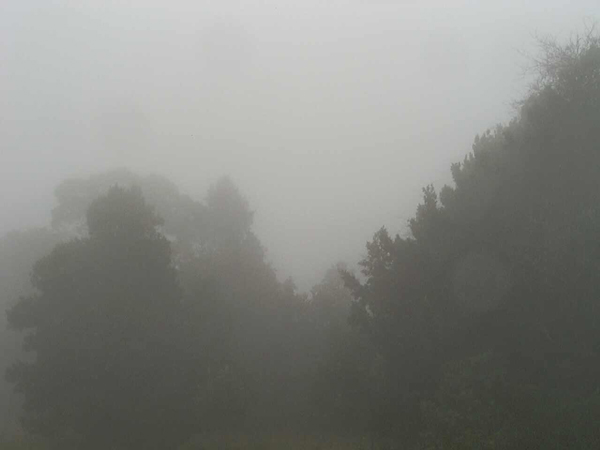
Well, today the fog varied from a 30 metre fog, to a 200 metre fog - measured in terms of visibility range. I certainly could not see beyond the bottom paddock.

Sometimes it misted, sometimes it rained lightly, sometimes it was a dry fog - the kind one can easily walk around in without one's clothes getting wet. But the ground was wet all day, as evidenced by Lena's red-brown muddy feet. Ah, the joys of having a dog, in wet weather, in Robertson.


As I write (at 10:00 p.m.), the temperature readings in Bowral and Moss Vale, the nearest weather reporting stations to me, are showing 16 degrees C, and 96% humidity.


The rainfall figures for the last 7 days, and for today since 9:00 a.m. have been:
Last Friday, 5 mm; Saturday, 3mm; Sunday, zero; Monday, 2mm; Tuesday zero; Wednesday 14mm; Thursday 2mm, and today, since 9:00a.m., 7mm.
So there has not been much rain this week, but the humidity must surely have been averaging around 90%. As I said yesterday, one can almost hear the plants growing.


It is this kind of weather which makes Robertson the kind of place that it is - green, in a grey world.