Christmas Bells

Christmas Bells
Christmas Bells - Blandfordia nobilis
Showing posts with label Penrose. Show all posts

Wednesday, October 31, 2012

Penrose and Tallong Cemeteries

Today I went with some local botanical artists to see some of the local Orchids which survive with little disturbance at Penrose Cemetery and Tallong Cemetery. This year was drier than in previous years, and so, many of the orchids had finished flowering already. And at Tallong the Goulburn-Mulwarree Council mowers had destroyed the famous collection of purple Diuris plants there. Alan Stephenson was less than impressed, as he had an arrangement with the Parks and Gardens supervisor; except that chap had moved jobs, and had not left a file note for the new incumbent.

But here are some of the Orchids we did find. And an unusual "flower Spider".

Thelymitra pauciflora

Side view of the column of
Thelymitra pauciflora
These flowers were heavily reflexed
in the warm, sunny weather


Purple Bearded Orchid
Calochilus platychilus
(formerly known as Cal. robertsonii)

two flowers of Calochilus platychilus

Thelymitra ixioides
Spotted Sun Orchid


Diuris sulphurea
Tiger Donkey Orchid

Two forms of Purple Diuris
Diuris punctata
from Tallong (left) and Penrose (right)

Spotted spider on Daviesia latifolia.

Pink form of Thelymitra pauciflora

Monday, November 21, 2011

Stingray Swamp - a vain search for the Giant Dragonfly

This is a report of our excursion to Stingray Swamp, near Penrose, on an educational excursion organised by Geoff O'Connor of the Moss Vale office of the HNCMA.
Despite the fat that we didn't find any Giant Dragonflies,
it was a very interesting and informative day..

 This is the Giant Dragonfly which we had hoped to find.
Petalura gigantea (The Giant Dragonfly) - Photo: HNCMA video
The Hawkesbury Nepean Catchment Management Authority has produced a video on Hanging Swamps. Ian Baird was one of the specialist speakers who talked with us yesterday.

The Video seems to be a bit slow to download, but let it load for a little while before you try to play it right through, and its OK. I have shown a "still image" from their video to show the Giant Dragonfly (Petalura gigantea). It is about 6 to 9 inches both in length and wing-span. Seriously large.

The assumption is that Swamps are mucky, but the peat was not at all "smelly", and the water which ran out from the swamps was reddish from the Button Grass vegetation, but that's the same kind of peaty water which the Scots use to flavour their Whisky (and Irish use for their Whiskey).
A core sample (after the top left layer of vegetation was removed).

The samples are analysed in 25 mm depth parcels. Typically such samples are aged to 16000 years.

Some of our group. Eucalyptus aquatica in the background is an endangered species.
This shows the depth of the Button Grass.

 The bright "Yellow Eye" or "False Flag"
It looks in general form like an Iris
but it is in fact related to the grasses (Poaceae)
"Yellow Eye" - Xyris sp. (possibly X. operculata)
Click to enlarge image to see flower structure in detail.
The length and shape of the "style" of the flower is diagnostic.
Xyris flower detail. Most likely Xyris operculata
We left the first open area of swamp and drove to another arm of the swamp.
This are was close to a rocky outcrop, 
which showed us something of the complex geology of the area.

Rock ledge showing different geological formations
Closer view of the same complex geology,
with coarse aggregates and quartz pebbles.
The lower level rock is evidently different 
from the much finer sandstone layers above.
Aggregate found in the lower level rock formation (under Sandstone).
In the stream bed below the rock ledge (shown above)
there was a line of Leptospermum shrubs and "Coral Fern".
Below these was a soft bed of Sphagnum Moss.
You can see the bright green moss below Ian's feet.
With Ian's metal spike he could demonstrate that 
the soft bed of organic matter was at least 1500 mm deep
and he speculated that it might be far deeper than that.
Ian standing on Sphagnum Moss in creek bed

We left without having collected any Leeches (for which I was greatly relieved).

Tuesday, November 01, 2011

Penrose. Tallong and Bungonia.

The ANOS Illawarra group normally does a "Southern Highlands Tour" on the last weekend in October. Several of us (me, Kirsten and Bruce from the Central Coast) did the Robertson and Kangaloon sections last weekend. Today I did the rest of the circuit by myself.

I had hoped to find masses of Sun Orchids at Penrose, but the weather was not in my favour. But there were many Beard Orchids out (Calochilus platychilus). The Purplish Beard Orchid (formerly known as Calochilus robertsonii)
 
Calochilus platychilus
At Penrose State Forest I saw many of the lovely lilac coloured Diuris punctata (the so-called Purple Donkey Orchid). Then, I went on to Tallong and found masses of en even taller, larger flowered form of this species. They were growing amongst masses of the large yellow-flowered Daisies, Podolepis hieracioides.
Lilac coloured Diuris punctata and Podolepsis daisies.
 In a closer shot you can see the masses of Diuris.
Diuris punctata amongst the Podolepsis daisies.
Here is one of the large-flowered Diuris punctata
Diuris punctata - lilac form.
Here you can see a Beetle which is busy eating the Diuris flower.
Beetle on the Diuris punctata flower
I then went further south to Bungonia State Conservation Area. I spoke with Audrey, the Ranger there, and showed her some of my photos of the Orchid I had gone to find. This plant is in the "rufa" group of plants formerly known as Greenhoods. These days it is known as Oligochaetochilus calceolus. It is endemic to the limestone country around Bungonia. Its specific name refers to its liking for limestone-based soils.
Oligochaetochilus calceolus - labellum has been triggered closed
 The Labellum of this plant has long fine "spikes" (trichomes).
The Labellum is movement sensitive, as part of its reproductive function
for the labellum senses if an insect comes to the flower, and
the labellum snaps shut (as in the previous image).
Oligochaetochilus calceolus

On the way back to Marulan, I found where there is another species of the "rufa" group, Oligochaetochilus aciculiformis. These plants were quite small, and very hard to find.
Oligochaetochilus aciculiformis
This flower has a different pattern of hairs on the labellum
to the previous species.
Tiny short hairs at the top and bottom of the labellum
and long hairs on the sides.
Oligochaetochilus aciculiformis. Note the short hairs as well as the long ones on the side.

Tiny details of difference reveal the hybrid origins. (Well, maybe not)

I referred yesterday to the "hybrid" forms of the Spotted Sun Orchid, Thelymitra ixioides. In this case the form is known as Thelymitra x irregularis.

EDIT: My friend Colin Rowan has persuaded me that these plants are in fact colour variants of Thelymitra ixioides, NOT hybrids. The "true hybrid form" is shown from last year, at the end of this post. It has the yellow "brushes", not just the yellow pappilose tips to the column. Colin says that is the only true hybrid form in this set.

Tonight I will show a few examples of the same group of plants which were growing in a tight cluster, around two adjacent trees, within 30 metres of eachother.

As a base-line point of reference, I will start with one "standard form" of Thelymitra ixioides

column details of Thelymitra ixioides - Nowra, 28/8/2011
 Here is the other reputed parent of the hybrid forms illustrate today.
Thelymitra carnea has the pink colour and 
the yellow top of the column - the "post-anther lobe".
Thelymitra carnea - the Pink Sun Orchid.

Here is the botanical illustration of what I have photographed 
of Thelymitra ixioides (first image above).

PlantNET botanical illustration - note the "papillose-toothed tips"
To make matters worse, here is the botanical description from PlantNET.
"Column to 5 mm long, erect, bluish. 
Midlobe with a dense rows of long, variable, colourful calli; 
accessory lobes columnar, erect with papillose-toothed tips. 
Lateral arms obliquely erect, 
with terminal tufts of white, pink or mauve hairs." 

"Papillose" literally refers to the "nipple-shaped" tips at the back of the column.
Don't blame me - its the botanists who invent and use these terms.


See the illustration for "pappilate" - middle level, 3rd from left.
Anyway, having established what we are looking at, lets move on.

************
This is yesterday's plant, which is closest to the lilac coloured form 
which is illustrated in David Jones's book (P. 256)
as "Thelymitra x irregularis".
The ring of pappilose nodes in the back of the column
are yellow in this one.
They are black in the "species" form.
Colin points out Jones shows a plant with yellow brushes
not white as in my plant.
See the two last images in this post for the true hybrid form
Column details for Thelymitra ixioides.
This is one is the clearest pink of the hybrid plants I photographed today. 
This one has a red collar 
underneath the golden pappilose nodes.
One of the pink forms of "Thelymitra ixioides".
And my personal favourite image of these column details.
This flower was in-between pink and lilac in colouration.
I like the way the 'arms" turn away from eachother.
Thelymitra ixioides
This next specimen looks as if something has interfered with the pollinia.
From the looks of it, there is a pollen sac stuck on top of the 
 "accessory lobe" the yellow protruding structure
on my left-hand side of this image.
Thelymitra ixioides
***********************

Last year, at Penrose cemetery I even photographed a pink hybrid form
with golden coloured lateral arms 
(instead of the normal white or bluish fluffy "brushes").
So, although it is outside today's "cluster" of hybrid plants,
it is worthwhile showing, for the full contrast it offers.
Pink hybrid Thel. x irregularis - note the golden column arms.
I have never photographed such a flower before.
 This image is a view of the column of the same flower,

photographed from the side view. 

It shows both the golden "pappilae" at the back of the column
and, more significantly, the yellow "arms".
All the other plants photographed have white column arms.

Colin agrees this is the true hybrid form
Thel. x irregularis note the yellow "brushes".
This is an even more extreme hybrid form than any I have seen this year. Interestingly, Colin and Mischa's images of this species, also taken in 2010, might well be of the same plant as I photographed last year on the ANOS Southern Highlands excursion.

Sunday, January 16, 2011

Yellow Leek Orchid - slow to flower this season

Yesterday, when commenting upon how "regular" in flowering time are the Liliums I grow, I made a rash promise to discuss the late flowering of some species of orchids. Already I have had my Orchid colleague, Colin Rowan teasing me about that promise. Well, for what it is worth, here it is.


I am going to discuss the Prasophyllum flavum - the Yellow Leek Orchid. As PlantNET says, it flowers from October to January.


Small plant of Prasophyllum flavum
I have seen this Orchid flower, in Penrose, here the Highlands, in the first week of November, over several years. Consequently I took that to be the "normal" flowering time at this altitude. 
Prasophyllum flavum - Yellow Leek Orchid
Several weeks ago I found a number of these plants flowering beside Tourist Road, in Kangaloon, along with Hyacinth Orchids, which are a normal summer-flowering species. This was the first time I have seen this species in that area - a fact I put down the the good rain we have had this year.
Prasophyllum flavum - the Yellow Leek Orchid
Then two weeks ago my friend Kirsten found the first of a number of Yellow Leek Orchids when we were looking for other plants along Belmore Falls Road. This area is a wet Eucalypt forest, with dense Proteaceous shrubbery as understorey growth. I was surprised to find these Orchids here, as I have often looked in this area, but never seen these Leek Orchids here, before. 

A tall flowering stem of Prasophyllum flavum
So, is this bold season of flowering of this Yellow Leek Orchid in the Robertson area related to the weather? And are these plants ones which would either not have flowered in drier years, or is it just that they have flowered so freely this year that they have become much more obvious than in previous years?


I cannot offer definitive answers, but I do know that there are closely related plants in the local area (other Prasophyllum species), which flower "like clockwork" in late October and the first two weeks of November. Why is this species suddenly flowering now? It is very tempting to say it is related to the rainfall. 


The best I can do is make the suggestion, and offer to monitor these plants over coming years.

Sunday, October 31, 2010

ANOS day out in the Southern Highlands

A great day was had by those who came along on the Australasian Native Orchid Society (Illawarra Branch) Field Trip to the Southern Highlands of NSW.
We started out from the Pie Shop in Robertson (a convenient meeting place) before heading to Penrose Flora Reserve to see the Diuris punctata there. We then went to the local cemetery (at Penrose) where we were pleasantly rewarded with masses of flowering Sun Orchids and some Bearded Orchids.
Not as many forms as last year, but a good display, none-the-less.
The list included a nice pink form of Thelymitra ixioides
Down the road to the Tallong Cemetery to see more of the purple Diuris.
Then back in the car to Bungonia State Conservation Area to get the endemic "rufa" Greenhood (a "Rustyhood"). Oligochaetochilus calceolus

On the way back Graeme showed us another spot beside the road where a different "rufa" was located. Oligochaetochilus aciculiformis Two new species for me, in a single day, is always fun.
Back in the car to head for Butler's Swamp, in Kangaloon, where we had SCA permission to enter the swamp to look for the endemic (and now formally listed as an "Endangered Species" on the Federal EPBC Act) Kangaloon Sun Orchid (Thelymitra kangaloonica).

As we left, we found several green forms of Prasophyllum brevilabre. These were growing in a wet area, and are flowering much later than the other members of this species which grow in dry land, further along Tourist Road. We thought at first that it might be a different species, but the "points" were fused, not divergent as in the other species. So alas, we had to settle for it being "likely to be" the green form of the regular "Praso. brevilabre".
The experts line up to take photos of the unusual Leek Orchid.
Walking back to the car, we found several small specimens of a Beard Orchid Calochilus campestris. I have seen this plant previously, in the Royal National Park, but I have now seen several specimens of it here, and in Kangaroo Valley, in the last few days. But today was the frst time I have seen it in Kangaloon.
Hanging out for a coffee, at 5:30 on Sunday afternoon in Robbo we discovered that Chats" cafe closes early on Sundays, so we ended up getting nice Pizzas at "Pizzas in the Mist" (on Sundays, it is take away only, so we ate them on the outside chairs). No coffee, but the pizzas were great, as usual, and very welcome after a huge day out.

Thursday, November 19, 2009

Yellow Leek Orchid at Penrose

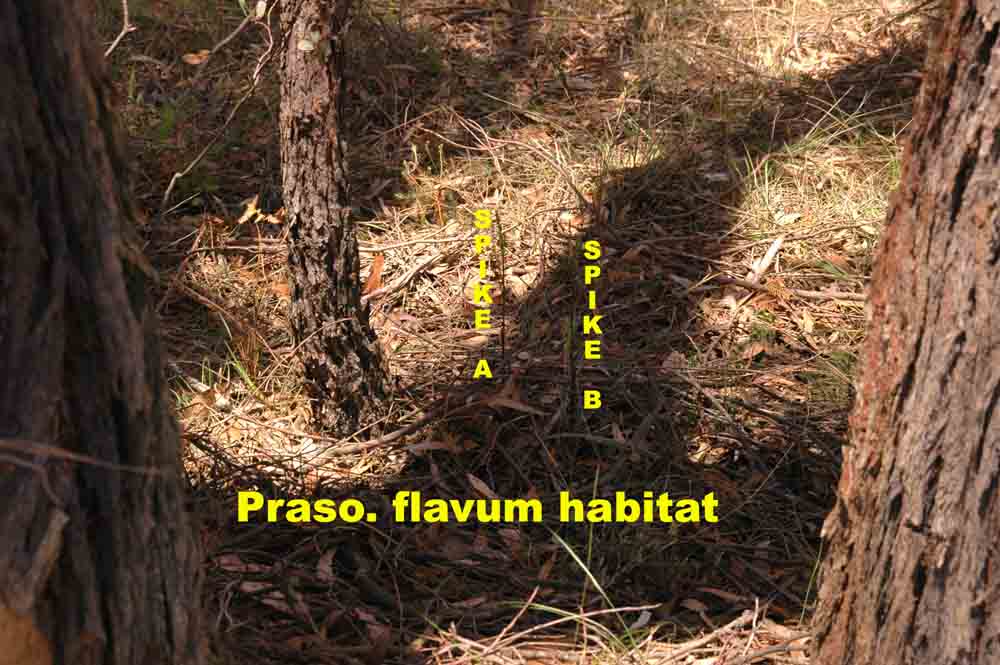
Two weeks ago, a sharp-eyed member of the Australasian Native Orchid Society spotted several spikes of a yellow Orchid growing amongst some Stringybark Eucalypts opposite the Penrose cemetery.
I went back two weeks later to confirm what we thought they probably were - namely Prasophyllum flavum - the Yellow Leek Orchid.
One of the diagnostic features of this plant is
the crinkled edges to the labellum
(which in Leek Orchids is above the column)
Click to enlarge the image, to see what I am referring to.
The books refer to this plant having a preference for deep forest litter. That's exactly right for the habitat shown in this photo. The only slightly odd thing is that the region is dry sandstone soil. Alan Stephenson has shown me this plant growing in the Nowra region, in deep sandy soil, on sandstone. Colin Rowan reports that this plant grows in wet forests in the mountains of Victoria.
This plant is regarded as widespread but not common.

As a matter of interest, the Sun Orchids we had seen here two weeks before had finished flowering.