Christmas Bells

Christmas Bells
Christmas Bells - Blandfordia nobilis
Showing posts with label Evolution. Show all posts

Tuesday, September 20, 2011

Footprints of Evolution

This is the foot of a White-throated Treecreeper. (Cormobates leucophaeus)
It is listed as being in the "family" Climacteridae (which name obviously refers to its climbing ability).

This bird is in the Order: Passeriformes. That puts them amongst a huge group of birds known as "perching birds", but the name itself derives from the European bird, the House Sparrow (Passer domesticus) which is familiar in many Australian cities and country towns.

The most obvious feature of this foot is the huge rear toe nail. The other toe nails are also strong, and over-all the foot is large, relative to the body of the bird.
Foot of the White-throated Treecreeper
These bird are noted for their habit of flying to the base of a tree, and climbing up the trunk, in a spiral manner, searching under loose bark, and in crevices, looking for spiders and insects. That's what they do. Having huge powerful feet, and especially elongated and powerful toenails is clearly an evolutionary advantage for them.

By contrast, this is the foot of a Painted Button-quail.(Turnix varius)
Foot of a Painted Button-quail - lacks a hind toe.
These birds (Button-quails) are more-or less universal in distribution. They inhabit warm grasslands in Asia, Africa, Europe, and Australia (not the Americas). They are a group of small terrestrial birds. The genus Turnix superficially resemble the true quails of the genus Coturnix, but differ from them, in lacking a hind toe.

The relationships of the Button-quails (Turnicidae) have long been unclear, having been placed variously in their own order, or with the Galliformes (birds related to "Chooks") or Gruiformes (birds related to Cranes). Recent studies have shown that the button-quails are actually related to the Gulls and Terns and their relatives (Charadriiformes). There are 16 species of button-quail, ranging through Africa, southern and south-eastern Asia and Australasia.
 
Whatever their real ancestral heritage (waders or gulls and terns), they have adapted to a life in dry country. They are apparently not at all related to the similar-looking quails and pheasants and the very familiar birds we know as "chooks". One only needs to recall the "so-called sport" of Cock-fighting (of which I do not approve) to realise they are selected for their spurs on the hind toe. That's my point in mentioning their rear toes - to distinguish them from this bird.

Wikipedia has some interesting notes about Button-quails.

There is an article in the Wires (Northern Rivers) website which discusses their unusual sex role reversal from the norm, namely the females are more brightly coloured than males, and they "hold and defend their territory" and after the female having laid the eggs, the male takes charge of raising the young. In that regard, they have many similarities to the huge ground-breeding birds, namely Emus and Cassowaries.

Anyway, the point about these photos is that the Button-quail's hind toe has been reduced to a mere "lump" on the foot, so entirely different from the Treecreeper's hind toe (which itself is an extreme adaptation). 

That's what happens when one's ancestors specialise in running around on the ground, in dry country habitats. Your hind toe becomes superfluous. Whereas, if one's ancestors specialise in picking insects from the bark of trees, you develop relatively huge feet and powerful toes. 


Both these birds were photographed last weekend, at Charcoal Tank, near West Wyalong.

Sunday, January 30, 2011

An Art Deco Moth?

This elegant moth came past my Front Porch light last night. This species of Moth is not rare, but I value them enormously, for their "elegant design". (I know, I am getting into trouble with that line of argument. I am loyal "evolutionist", NOT a supporter of "Intelligent Design".)


But let me go on further. It seems like an "Art Deco" moth to me.


Perhaps the Art Deco designers, especially transportation designers (who became obsessed with "streamlining") took their inspiration from Nature?

What better model to follow than the wonderfully streamlined Hawk Moth? So, it could simply be an example of Art echoing Nature. That makes more sense to me than "Intelligent Design" protagonists claiming that Nature acts according to our simplistic human understandings (of the enormously complex evolutionary processes). 
So there! 
Nature 1: Intelligent Design theorists 0.
Coprosma Hawk Moth - an inspiration for streamline design?
To me these Moths seem like something a car designer from the 1940s might have dreamed up, especially with its remarkably streamlined wings and body. (Check out the images on this "Streamlined Car" site. 

Consider also more superficial design aspects (the aesthetics) of this Moth. Consider the "eyebrow markings" and antennae, and the white legs. To me, these remind me of the "white wall tyres" and chrome finish so heavily favoured by Cadillac car designers in the "forties and fifties".
Coprosma Hawk Moth - an model for White-walled tyres and Chrome bumper-bars?
So lets get down to a bit of Moth biology.


This Moth is called Hippotion scrofa (Boisduval,*** 1832), It is known as the "Coprosma Hawk Moth".  There is an excellent photo by Donald Hobern on the Wikipedia site, plus a Museum Specimen displaying the forewings and hind wings in the traditional manner of pinned specimens.

Note the relatively plain forewings (just a hint of a dark patch). But there is a wonderfully rich red ochre colour, with a black trailing edge line, on the lower (hind) wings. The hind wings on Hawk Moths are much smaller than the forewings.
Coprosma Hawk Moth - Hippotion scrofa
According to the sources, the larvae (caterpillars) of this moth seems to feed on Dahlias, Fuchsias, and Epilobium, as well as the Looking Glass Bush (or Mirror Bush, Coprosma repens). That last plant is an introduced New Zealand plant which I remember well from my childhood in Melbourne, and which is a coastal plant, not found up here in the Southern Highlands. So, we can rule it out as a local food source for the caterpillars of this species. This Moth has a wide distribution, right across Australia and in Fiji and New Caledonia (according to Don Herbison-Evan's Moths website). Given that it was named in 1832, and is so widely distributed in Australia, one can only assume that it is a native species, and therefore must feed on a much wider range of plants than the garden varieties nominated. The genus Epilobium (Willow-herb), although universal in distribution is well represented in Australia.

*** I often note the influence of the early French explorers (La Perouse and d'Entrecasteaux and their scientists (e.g., Labillardière). In this case, the link is from Boisduval who named this Moth, from collections made either on the "Astrolabe" (under La Perouse) or the "Cocquille" (under Duperrey). Boisduval's original collection of Hawk Moths (the Sphingidae), including the "Type Specimen" of this species (presumably), is in the famous Carnegie Museum of Natural History, in Pittsburgh, Pennsylvania, USA.

Friday, November 19, 2010

Potato Orchids teach me about Gondwana

Several weeks ago, Colin and Mischa, from Victoria, came up here for the ANOS annual Spring tour of the Southern Highlands. During their visit Mischa reported seeing buds of Potato Orchids in a particular location. Then several days ago, Alan Stephenson sent me an email asking about Potato Orchids. So putting 2 and 2 together, I decided I had to go back and find Mischa's budding Potato Orchids. There is a hidden sub-plot to this, which I would rather not go into. Sorry Mick, but NO HABITAT photos this time. Suffice to say, here are some photos.
For those not familiar with Potato Orchids, they do not look much like conventional Orchids. That's a joke folks - as you would realise by now, "there ain't no such thing"!

These plants have dark brown stems and brownish flowers. Their leaves are reduced to small stem bracts. They lack chlorophyll and survive in a symbiotic relationship with a mycorrhizal fungus. They do not use photosynthesis for energy (food) production. That's why they do not bother to produce green leaves or stems. The name comes from a large rootless rhizome. Strange plants, but not alone in the weird and wonderful world of Orchids. Hyacinth Orchids are another local Orchid with a similar lifestyle.
There are a number of other tropical Orchids which are similarly leafless.

This genus of plants is found in India, Malesia, Australia, New Zealand. It is largely a Gondwanan distribution, but excluding Africa or South America. That's all for now, folks, but I will come back to this distribution.

Lets concentrate on the flowers, for now.
The narrow brown stem is 75 cm tall.
Here is a single flower.
You can actually see the pathetic little "leaf"
just below the lower flower, on the left.
A little shrivelled brown bract.
In terms of identification, this is an important image.
The flower "perianth" tube is about 17mm long.
According to PlantNET, the perianth tube
of Gastrodia procera is 15–20 mm long
whereas for G.sesamoides the perianth tube is only 9–12 mm.
Here is a close-up of the flower.
Gastrodia procera.
The specific epithet means "tall".
This plant was only 75 cm high,
which is within the range of both local species.
So that measurement is inconclusive.
Here is the opening of the flower. PlanNET explains this structure thus: Sepals and lateral petals
fused for most of their length to form a 5-lobed tube.
The yellowish tip is the tip of the labellum which is "free"
(attached only at the base).
The white "lump" (barely visible) is the end of the column.
To get that angle I lifted up one flower, to peer into the narrow opening.

In the interests of science I decided to collect one flower, to dissect it.
This is the "column" of the flower.
It is within the lower half of the flower.
In nature, as you have seen above
the "labellum" is above the column.
So, in nature, it lies "upside down"
You need to understand that the functional parts of the labellum
face the column.
So, this is the labellum turned over so you can see its "bits".
If you go back two images (above) you will realise that the yellow tip
you see is the end of this structure,
but in nature, it lies "face down",
so that the organs are facing the column.
Click to enlarge the image to see the details.
There are ridges, and the edges of the labellum are curled up.
There is a mass of yellow dust, which is referred to as "pseudo-pollen".

If your brain is hurting, just blame the "evolutionists"
Charles Darwin and more recently Richard Dawkins.
Dawkins is famous for his argument for the "Blind Watchmaker".
Prior to those guys we could simply "blame God"
for the existence for such confusing biology.
The good thing about that was
we felt no need to try to "understand" anything.

Sorry, but that does not work for me.
So, we struggle on, trying to make sense of it all.

Or else you can simply marvel at the complexity of Nature.
That works for me.

The reality is that we simply cannot get our heads around
the endless permutations and computations
possible over
some 150 million years
since
the break-up of the ancient proto-continent of Gondwana.

Source: Animation of Gondwanan break-up

It is generally acknowledged that Australia
has been an independent continent for about 80 million years.
So, with their current distribution, these plants,
or their progenitors

must have been around for much longer than that.

My mind cannot "contain" the evolutionary possibilities
over such vast eras of time.
But when I look at a Potato Orchid,
and ask how long it took for these weird plants to develop;
then, and only then, can I start to get my head around it all.

So, from little things we can learn something huge.

Thursday, February 12, 2009

A Dragonfly for Mr Darwin.

It is Charles Darwin's bicentenary today.

To celebrate, a wonderful Dragonfly decided to reveal itself in my garden (yard) today. From what I can track down, it is the Blue Skimmer Dragonfly (Orthetrum caledonicum). I think it is a female, but I am not sure (advice would be welcomed, please, Duncan). This species is normally found near ponds and dams. However, there are no dams or ponds within 500 metres of my place. However, the Dragonfly turned up. It was quiescent, resting on a stick. It allowed me to carry it around, on its chosen stick, without attempting to fly. The weather was cold and misty, today. I don't believe it was newly emerged (again - no ponds for the larvae to have lived in, here). Also, the tip of the front left wing is damaged slightly, so it has "done some work" already. Perhaps it is an old Dragonfly, tired and waiting to die?

Here is the full Insect, resting on a stick.
As with most of my images, click to enlarge the view.
Here is a borrowed image, with the distinctive parts of the wings labelled.
Here is a close-up of the face and eyes of my Blue Skimmer.
I particularly like the two short, sharp little "antennae"
Again, here is a borrowed image, naming the parts of the face.
Below is a close-up of the head and thorax of my Blue Skimmer.
Note the very powerful thorax structure and the strong grasping legs.
Both those "labelled" images (above) come from Martin Peterson's wonderful site on Swedish Dragonflies.

According to Martin's site, Dragonflies are creatures with an ancient lineage, having been around since before the time of the Dinosaurs, but have survived and thrived. Over those millions of years, they have evolved into some 5000 species, world wide. I mention this in honour of Mr Darwin's 200th birthday.

Saturday, July 07, 2007

The Nature of Orchids of Robertson.

I wish to acknowledge the inspiration and assistance of two Australian Orchid enthusiasts and inhabitants of the Internet. One is "Gaye from the Hunter", whose blog "Hunter Valley Backyard Nature" has featured a section on the biology of Orchids, which is well researched, with excellent "links" to other scientific papers.
The other is the owner of the excellent Website "banjorah.com"
That lady has excellent Orchid photos, plus a very useful section on her webpage, called "Orchid Facts" which has various illustrated photos of Orchids with their parts named. (That section works best if used with "Internet Explorer"). In several of my illustrations I have followed the lead set on her website.
Classic Orchid "parts"
illustrated (D. Jones ***)

Last Thursday I gave an illustrated talk to the Austalian Plants Society, Southern Highlands Branch, about Orchids of the Robertson area (Robertson and Kangaloon).

About 55 people braved the cold of Moss Vale to attend the talk, for which I was very grateful.


Stylised structure of
the symmetry of an
Orchid's flower.
I began the talk with some brief discussion (and illustrations) of the "parts" of an Orchid flower, as I know this is a bit of a block to most people. The strange names used by "Orchid people" confuse some plant enthusiasts.
I like to start my discussion from "first principles" of plant biology, where possible. In simplest terms, the sexual organs of the Orchid are combined within the central part of the flower. This is known as the "column". It includes the pollen-bearing organ (the male part) and the stigma (the female part) which most people never get to see, but which, of necessity, is of vital interest to insect pollinators. Usually the attraction comes from scent glands, although some Orchids (such as Potato Orchids) have evolved other attractions, (in that case "pseudo -pollen")
It is never that simple!
Here is a diagram of how the common "Ladies Fingers" Orchids have evolved differently from the classic structure. The red arrows indicate the variation of position from the "standard model" above.

I showed a collection of photos of 37 species of local Orchids. There were only two species of which I have photos, which I did not show.

I am hoping to add greatly to my "collection" of species over the coming winter and spring seasons.
Partly this is due to the fact that I now own David Jones's (***) wonderful Orchid book "Complete Guide to Native Orchids of Australia". This book is wonderfully detailed and is the best reference text which is currently available, for native Orchids of Australia.

Armed with this book, and a magnifying glass, I hope to make more sense of the Orchids which I will find. It has all the "new names" which the taxonomists have come up with, as they have reclassified the various types of Orchids. While I am not enamoured of "splitters" generally, some of the old Orchid genera, such as "Caladenia" which included the common "ladies fingers" types and also the elaborate "Spider Orchids" were desperately in need of revision. Similarly the Greenhoods and Sun Orchid groups.
Now for a real flower.
It is "Never That Simple"
Glossodia minor
(Click on photo to enlarge)
The "sepals" form the outer protective coating of the flower, when it is in "bud" stage. As the flower matures, and opens, they develop their characteristic shapes and colours, different for each species of Orchid.

This Glossodia flower differs from the sketched "Caladenia" type of flower (sketched above and photographed below) in that it does not have the Labellum as a dominant structure. It is there, just less dominant. It is in the classic position, underneath the "column".
The Labellum is a modified petal. Thus Orchids can be seen to have 3 sepals and 3 petals - one of which is usually, but not always, heavily modified. (Sun Orchids have almost exactly similar petals and sepals - without a characteristically shaped "labellum"). Thus they are more "regular" than most other Orchids.
The Glossodia flower is interesting in that it has two really obvious "calli" or glands (easily seen if you clicked on the photo).
Pale pink Petalochilus species.
If you click on this photo you will see that "Caladenia types" have rows of "calli" on their Labellum which act as something which David Attenborough (in his "Private Lives of Plants" TV documentary series) described as like "landing pads for insects".

This is a pale pink form of Petalochilus carnea (as far as I can work out).


It is "Never That Simple" (again).
Greenhood Orchid
seen from above.
They have
"special names" for
their parts too!
Greenhoods such as this Superb (or Cobra) Greenhood (Diplodium grandiflorum) have fused the two free Petals and the Dorsal Sepal into a "hood" structure. The "Labellum" (so dominant in "Slipper Orchids" for example) has become an internal structure, which is movement sensitive and motile. It senses an insect's presence, and snaps back into a closed position, to trap an insect pollinator, preventing its departure until it has been dobbed with the "Pollinia" - a sticky package of pollen which all Orchids produce.

Here is a side-on photo of the same species, which shows the erect "labellum" inside the flower. The shape of the Labellum, and whether or not it protrudes, is one of the diagnostic features of the Greenhood group of Orchids (many of which are not "green" by the way).

The front section of the flower is formed by the Lateral sepals, of which the lower sections are fused to form a structure called a "sinus", while the upper parts generally protrude to form the "points" (sometimes called "ears").


"Silhouette" of the Labellum
of the same Greenhood


Forgive me for one "art shot" - an almost accidental silhouette shot.
It happens to show well the raised Labellum of this Greenhood. I like the interesting visual effect, anyway.


Tall Greenhood with Labellum open
and then another shot when the labellum
has snapped closed.

The unfortunately named Bunochilus longifolium.
Perhaps I should not criticise this name, for the earlier name, Pterostylis longifolia never exactly tripped off the tongue.


This tall "Greenhood" does have quite long leaves along its stem, which make the plant quite readily identifiable, even when it is not in flower.

It is "Never That Simple"
- even less so, now!
This Small Tongue Orchid (Cryptostylis leptochila) is one of a group of Orchids which have reversed the "typical" structure, with the Labellum on top. In fact, according to the experts these Orchids are the "right way up". Apparently most "normal" Orchids actually twist as the flower matures, to put the Labellum underneath the Column. There are many genera of Orchids in Australia which are oriented in this way - "Leek Orchids", and "Duck Orchids" are two other groups amongst the local Orchids which are oriented that way.

Confused? Don't worry - we all are, a bit, at least. It takes time, but it is worth persevering with.
Chiloglottis reflexa
The complexity of Orchids always teases my sense of "wonder" - because of how complicated they have managed to become. I have only begun to scratch the surface of that discussion, here. For their evolutionary adaptation has taken them to great heights amongst plants - where some even have developed glandular modifications which physically resemble insects, as well as emitting appropriate odours to further complete the mimicry. This plant is in the group of Ant or Wasp Orchids. The structure resembles an ant or a female wingless wasp, but it is a structure of glands called "calli" on the Labellum of the Orchid. Calli is plural of "callus", meaning a swelling, or growth.

These Orchids then rely upon confusing male insects to such an extent that they attempt to mate with the flower, in the belief that it looks like, and apparently smells like, the appropriate female insect (mostly wasps). This process is called "pseudo-copulation", and is surely the ultimate in plant mimicry. How and why do they do it? Our imaginations can only guess at the answer.

I am not attracted to Richard Dawkins "Blind Watchmaker" model, but the main thing is our inability to imagine the possibilities which can arise over a length of time such as 65 million years, which is apparently the length of time since Australia apparently split from Gondwana. If we cannot "imagine" that time span, how can we imagine the possibilities of evolution which might have occurred within that time span?

Instead of finding it necessary to "understand" all of these issues, I prefer to enjoy the sense of "wonder" which is triggered by contemplating such tiny puzzles as these bizarre Orchid adaptations.

Sunday, November 26, 2006

Flying Duck Orchids - and my Blogger Birthday

Thanks to the regular readers who have bothered to follow the path of my steps across the last year. Little did I know quite where the journey would take me, when I started out on 26 November 2005. I wrote three blogs on that first day - because I had not then understood how the system worked, and I was experimenting with it.

I am delighted to see that my very first blog entry was entitled "Odd little things which grow around Robertson"


What is exciting is to see that the very first blog contains a picture of the "Flying Duck Orchid", (Caleana major) - which is still right up there amongst my favourite flowers. It is less satisfying to realise that I did not post a single word of text to go with the photograph. Oh well, I soon sorted out how that worked!

This little Orchid is a sensitive plant, with the "duck head" part of the flower sitting on a flexible hinge. Insects are attracted to enter the centre of the flower, in search of the mysterious scent which it apparently emits.

When the flower senses the movement of the insect, the "duck head" closes over, trapping the insect inside. This is an example of a highly evolved system for achieving pollination.

There is a tiny escape hole (which can actually be seen in the top photo - it is visible on the unopened bud on the right of the open flower). To escape through that little hole, the insect has to pass the pollen sacs of the flower, and it will inevitably get a dob of sticky pollen glued onto its back, as it seeks to exit the flower. Larger insects are liberated after about half an hour, when the flower re-sets itself to the open position.

Click on the photo to enlarge the view.

Interestingly, the second photograph shows a wonderful association of plants and insects. Flower Spiders are often found associated with Orchid flowers. Obviously the spiders know that the Orchid will attract insects to the flower, either by scent, or nectar, or pollen. In this case, there is a tiny spider sitting in her web, which is strung across the front of the flower. The body of the spider is only about the size of a match head, with the legs clearly much larger. (Click on the image for a larger view.)

She is facing outwards, and hanging upside down in her web - waiting for an insect to arrive. Clearly she avoids triggering the movement-sensing device on the flower, by remaining suspended across the front of the flower, on her web.

Two stories from one flower. This plant has given me double value for my sense of "Wonder" at the intricate designs of Nature. Each story is more weird and wonderful story than anything to do with this flower's uncanny cartoon-like resemblance to the head of "Daffy Duck"?
*****

As a matter of statistical record, since I linked the "Site Meter" statistical reporting system on my blog, there have been 4853 separate visits to this blog site, an average of 30 visitors per day. These statistics wildly exceeded any expectation I had at the beginning. And even better, these are not just accidental hits (which does happen on the internet), but there have been 11400 "page views", an average of 2.34 pages per visit, which means people have been actually looking through the blog entries.

Thanks to my loyal readers - you make it all worthwhile.

Sunday, June 25, 2006

The Nature of Fire - Part 2 - survival strategies of plants

I promised yesterday that I would talk about how different types of plants survive fires. In truth, it should be how different types of plants "deal with" fires.

This is regarded as an evolutionary issue, in that many of the plants with good fire survival strategies are "modern" plants which are understood to have evolved as Australia drifted further north, and progressively dried out, to become the fire-ravaged "sunburnt country" which it is today.
*****

I mentioned yesterday that the Eucalypts survived these cold burns, with little or no damage. That is due to their thick bark. But we all are familiar with the fact that even after a devastating fire, most Eucalypts can re-shoot from dormant buds hidden under their bark. So, even though the leaves get totally burnt, the stem is scorched, but not killed (usually). Within weeks of a fire, new shoots appear all over the plant. After a few years, the plant settles down to normal growth.

Acacias have very hard seeds which fall as their seed capsules ripen, every year. But the seeds can remain viable on the forest floor for years. After a fire, these seeds will germinate, as the hard coating on the seed will have been cracked by the heat of the fire, allowing the seed inside the coating to absorb water, and start to grow.

Some plants have thick bark on their trunks, which protect the living tissue of the plant from the heat of the fire, and, although the leaves may be burnt, they can regenerate quickly, after a fire. Surprisingly, the Rough Tree Fern, Cyathea australis, is such a plant. It is rainforest plant, primarily, yet it has a good fire survival strategy. That is an unusual combination, as many rainforest plants are notoriously weak at surviving fire.

Indeed that point is the flip side of my opening comments on modern plants having evolved to suit Australia's increasingly dry climate. That adaptation involved surviving fire. Many of the local rainforest plants are of ancient lineage, having evolved when Australia had a wetter, colder climate than it does today. That is why they are plants which tend to grow in remnant pockets of rainforest, in wet patches (such as Robertson), which is not very susceptible to bush fires.
*****

Within the Eucalypt forests of which I was talking yesterday, the most obvious fire survival strategies are: flaky bark, to protect the trunk; suckering from a root stock protected under the soil and storage of seeds, which open after the fire has passed.

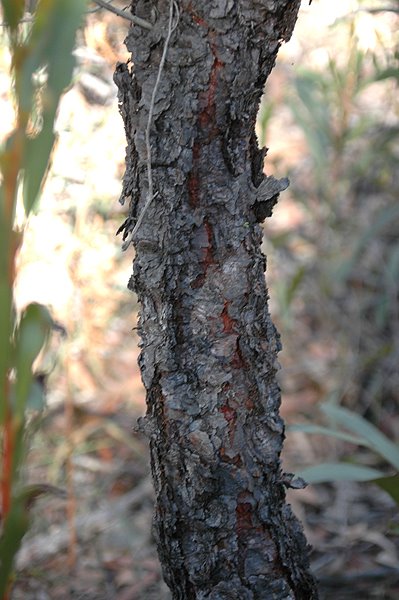
Persoonia linearis - flaky bark.


Several of the local Persoonias (Geebungs), Persoonia linearis and P. levis, both have thick flaky bark, which gets singed in a fire, but which protects the living layer of tissue in the trunk (the cambium).


Persoonia linearis - singed by fire.


This shrub has been singed by fire, but it will probably re-shoot successfully, because of its protective bark. The leaves will have been killed, but new growth will occur.


Persoonia linearis produces lots of fleshy fruit.
These plants also produce an excess of fruit, which are often seen lying all over the ground, under the shrub.

Persoonia seeds are notoriously hard to germinate in cultivation, but seedlings are commonly found in the bush. One explanation is that birds and animals eat the seeds, and in so doing "treat" the seeds in their digestive systems, in a way that favours germination.

However, there are also reports that some species of Persoonia are found to have good germination after fire. So, presumably some of these seeds, (which appear to have a very long germination period), might remain viable in the soil, and then germinate, in post-fire conditions.

Waratahs, Lomatias and at least one of the local Persoonias (P. laurina) all are obviously suckerers. A quick walk through this forest will show you that. Look at your local Waratah - if there is one plant growing, there will often be a series of smaller plants close by. Often you will find a taller dead plant (burnt) with regenerating plants around it, in a circle. The Lomatias and the little Persoonia are less obvious plants, but their strategy is the same.

Then there are the Banksias and Hakeas. These plants have a sacrifical strategy when it comes to fire. The adult plants have little or no resistance to fire, and simply die when a fire occurs.

But they have woody capsules in which their seeds remain viable for many, many years. Then, when the fire is raging, the seeds are protected inside these hard woody capsules. But within days of the fire passing, the old woody capsules slowly open (like oysters), and the seeds fall out, onto the ash layer on top of the soil. That ash contains chemicals from the burnt wood which has been found to promote germination of these seeds. Indeed, many native plant nurseries use "smoke treatment" for the same reason, to greatly promote the germination of native plant seedlings.


Old Native Plant books used recommend growers heat treat seed capsules of Hakeas and Banksias, in order to get the capsules to open and release their seeds. The usual method recommended was to put them in the oven, after someone had been cooking, and the oven was cooling down. That technique misses out on the "smoke" effect, but one can buy "smoke water" to soak seeds in, from many native plant specialists.

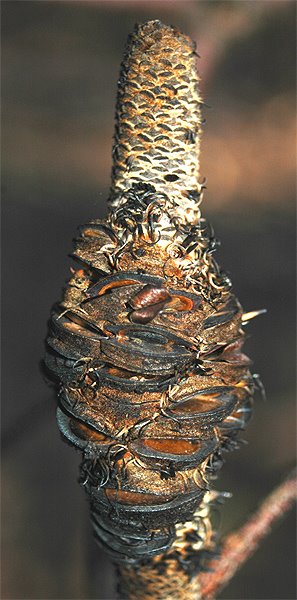
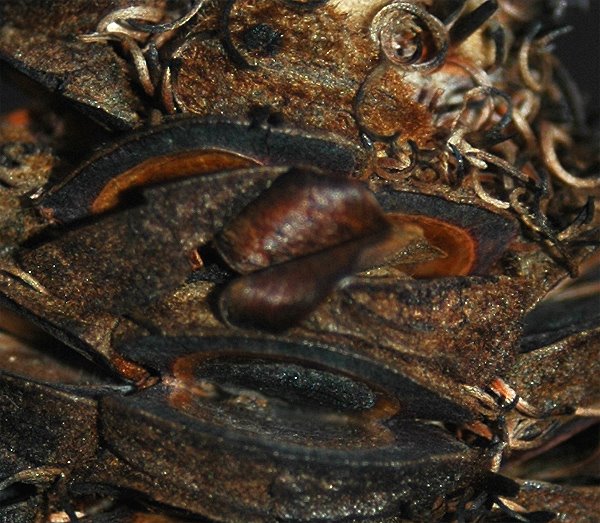
Pairs of curved seeds may be seen emerging from some of these woody capsules on the burnt seed cone of Banksia cunninghamiana.


These Banksia cones might be regarded as "time capsules", holding the seeds in virtual suspended animation, waiting for a fire to come and open the capsules with its heat, before the seeds can be safely released. In a few months time, there will be lots of young seedling growing near where the old plant died. That is why I refer to it as a "sacrificial strategy" - even though fire kills the main plant, the species will go on.

*****

I mentioned yesterday, how dangerous it is if fires occur too often.

Some species, such as the Banksias, and Acacias, rely on seed in order to survive a fire, as the plant itself is killed by fire. So, in order for the species to survive, it needs to have set seed.

Many plants take a number of years to reach maturity. They need to have reached flowering age, been pollinated, and then to have set seed, before they are able to survive a second fire. So, if, for example, this area was burnt off now, and then, in 3, 4 or 5 years, it was re-burnt, it is entirely possible that Banksias would be eliminated from that patch of forest. For some plants, this maturity cycle might be as long as 8 years.

So, repeated burning, as a forest management strategy can result in producing a "forest" with a live canopy of Eucalypts, but little of no understorey of shrubbery. That is not a real forest - it is a "treed desert" - with few species of plants, and even fewer birds and animals.

Unless the people who set fires like these ones, understand that, they risk permanently damaging the living forest, if they burn it too often.

Indeed, even if they do understand it, who is to say that any subsequent fire might not be a major bush fire which might occur naturally, in circumstances totally beyond the control of humans? If such a devastating fire occurs within that 8 year time period, the damage can be permanent.

Even if the subsequent fire is not lit by people, but is entirely natural, the result is the same.

Thursday, December 15, 2005

Triple Care Farm - Graduation Day

Triple Care Farm (TCF) is a "wildlife refuge" of a different kind.
It is a life-training camp for street kids, run by Mission Australia. It is a fabulous wilderness location on Knights Hill, about 10 Km from Robertson.

Yesterday they had a graduation ceremony for 35 young people. It was attended by many of the Mission Australia people from Head Office, as well as patrons and sponsors of TCF, and regular volunteers who assist the Manager, Warren Holt OAM and his staff, in running TCF. The Robertson Lions Club assisted today by doing the BBQ.

It is always uplifting to see young people preparing to leave TCF, full of optimism, and importantly, feeling good about themselves. These people have been cared for and respected, during their stay at TCF and shown that they can achieve to their own potential. They are going back out into the world from which they came, but now they are ready to face its challenges. I wish them all the very best for the future.

On the way back from Knights Hill, I stopped at the Carrington Falls Nature Reserve. This Reserve is home to the endangered species: the
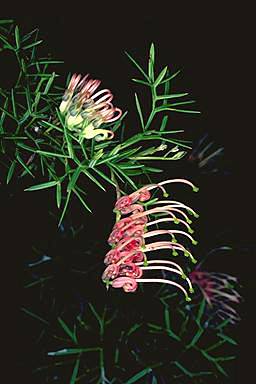
Carrington Falls Grevillea (Grevillea rivularis). This plant is not uncommon within the Reserve, but it is on the Endangered Species List because of its extremely restricted distribution (i.e., only found within this one Reserve). It is a large plant, but not obvious at first. It forms dense thickets overhanging the waters edge, along the Kangaroo River, above the Falls. It has unusual coloured flowers with a blend of green and purple. Unlike some Grevilleas, the flowers are not "showy". But they are very beautiful, when examined closely. Of course, it is a Protected Plant.

Tuesday, December 13, 2005

The Orchids and the Wasps (not the birds and the bees)

The summer-flowering Ground Orchids have started to flower, as I anticipated last week.

The Small Tongue-orchid (Cryptostylis leptochila) has just opened its first flowers. The "tongue" is reflexed upwards and backwards, over the top. The other sepals and petals are reduced to stiff, thin green arms. (Photo courtesy of Anni Heino)

This shape is quite different from the closely related "Cow Orchid" shown last week.

"Pseudo-copulation" is a great word for a bizarre process of pollination used by these Orchids. The flower emits a scent which mimics the pheromone emitted by female insects. In the Cryptostylis genus, male Ichneumonid Wasps are attracted, and seemingly, mistake the flower for a female wasp. They then copulate with the flowers, and in so doing, are dabbed with the pollen of the Orchid. Hopefully they then fly off to another Orchid flower, and complete the pollination cycle for the flower. Shame about the female wasps, though.

This process is not restricted to Australian Orchids, although they have perfected the system. The Cryptostylis genus is famous as the most common example of a plant which has developed "pollination by pseudo-copulation".

Another beautiful summer-flowering orchid is the tall Hyacinth Orchid (Dipodium roseum) Photo courtesy of Anni Heino) *** (DJW Edit 2 Jan 2010 - Actually Dipodium punctatum - a fact ascertained after double checking most known groups of Hyacinth Orchids shown on this Blog - including where Anni took this photo.

It can stand nearly a metre tall, but often less, in poor soil. It has a dark brownish stem, and lovely heads of spotted pink flowers, which, in this species have strongly reflexed petals.

Tricky thing - it has no leaves. It has no chlorophyll, so it cannot make its own food (as most plants do) through the effect of sunlight on the chlorophyll in their leaves and/or stems. It gets its food by forming a relationship with micro-fungi in the soil, which break down old Eucalyptus roots in the ground. Plants which get their food this way are called "saprophytes" - use this link to an article on a related species.

*****

Today I took young George for a flower-spotting walk near his home. In 200 metres we found 24 species of plants in flower. Mostly tiny flowers, but interesting.

George was intrigued by the lovely pink Trigger Plants, (Stylidium graminifolium) which have an elastic organ, shaped like a tiny "hammer". This strikes any insect which touches the sensitive centre of the flower. (They can be "triggered" by the inquisitive amateur botanist, with a fine twig).

For me, the find of the day was a Purplish Beard Orchid (Calochilus robertsonii). This was the first time I have seen this species.

This photo was taken under difficult, low light conditions (a thick Robertson fog), but it does show the "beard" and the characteristic shallow angle of the "hood" (the dorsal sepal). (Photo courtesy of Anni Heino)

This plant was growing on shallow black soil, over a sandstone rock shelf. I had seen the similar species: Red Beard Orchid (Calochilus paludosis) growing on poor sandstone soil, several kilometres away.
Have a look at that linked photo to see the differently structured flower, despite the similarities of both being Bearded Orchids.

Tuesday, November 29, 2005

Caper White Butterflies

White Butterflies have been "capering" around Robertson recently.
Have you noticed recently that Robertson has been invaded by whitish-yellow Butterflies? I first saw them come in a few weeks ago, when we were having a spell of warm weather, with warm north-westerly winds. (Anni - do you remember having had warm weather?)

I was down at my favourite meditation spot - the little lookout off Lees Road ( off Jamberoo Mountain Road), about 4 Km from the Pie Shop corner. This wonderful lookout overlooks the escarpment, and the valley of the Macquarie Rivulet. You face north-east, and look over Albion Park, to Wollongong. Immediately below you is a beautiful serpentine patch of lush green rainforest, and further out, the forest reverts to the more usual grey-green of the dominant Eucalypt forest.
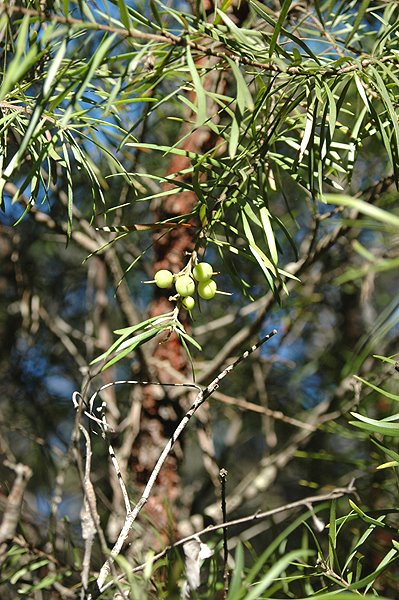
Anyway, as the warm winds were swirling around me, I noticed hundreds of these white butterflies, with yellowish coloured underwings. They are clearly different from the introduced pest the Cabbage White Butterfly. They are called the Caper White Butterfly (Belenois java).
As the "Fact sheet" from the Australian museum will tell you, they come from warmer places, where they feed on native Caper trees, members of the Capparis family. As that site tells you: "it regularly migrates to areas where there are no food plants for its caterpillars. It is not understood why this behaviour has evolved."

Another of life's little mysteries, or perhaps, (as with the Waratahs of yesterday's bulletin) another instance where the supposed "Intelligent Designer" went to sleep on the job?