After discussing yesterday
the Horned Orchids I saw at Canyonleigh I did not mention the other treasures which were to be seen at that same dam. I had enough photos just of the Orchids to be going on with. Besides, I knew I had hours (well, two sleepless nights actually) of photo processing to do before I could go on with this next subject. And what a huge topic it has turned out to be.
The living jewels of this swamp are the Dragonflies and Damselflies.

Gorgeous living jewels which zoom backwards and forwards through the air, just over the tops of the rushes which grow in the water. Occasionally they stop to rest on the muddy bank of the dam. No doubt, from the point of view of another insect, these brightly coloured creatures are the insect equivalents of armed forces patrolling in helicopters. These creatures which seem so beautiful, and so masterful in their control of flight - to us - must be terrifying to other smaller creatures. But such is the order of Nature.
I admire Peregrine Falcons, but they are the avian equivalents of Dragonflies and Damselflies. And I admire Swallows too. I have been known to make similar comments about Blue Wrens as well, which look so beautiful when perched on a lookout point in the garden, before pouncing on an Aphid or other tiny creature, about which we spare few thoughts. We think they are beautiful but they are ferocious hunters - of small things. Indeed, in January 2006, I wrote a tiny poem about just this topic - which you
can find here.*****
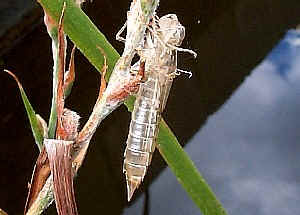
Before I go on with the "pretties" let's do something of the life-cycle of these creatures. Firstly, here is a shell of a
nymph of a Dragonfly.

The aquatic nymphs (of which this is just the empty shell) are a very popular bait, with fishermen - who refer to them as "Mud-eyes". To scientists they are the larval stages of Dragonflies and Damselflies. This photo shows the shell of the Dragonfly nymph (much as one often finds the cast-off shells of nymphs of Cicadas). This one has crawled out of the water where it had lived. It had then climbed to near the top of this swamp plant, and once there, the nymph has completed its last moult, and emerged as a Dragonfly adult. There is a split in the shell on the back, where the insect has emerged. You can clearly see where the large eyes of the "Mud-eye" had been. In the nymphal stage, these creatures are totally aquatic, and are said to be voracious predators of other aquatic insects and small tadpoles, and tiny fish hatchlings. What do these Mud-Eyes turn into? Well, in truth I cannot be sure of the species, but that one was much longer than some others I found. So, let us assume it was a nymph of a large Dragonfly. In fact it matches the image in the Chew Family website
of the nymph of the Australian Emperor Dragonfly (see also the images below, of the mating pair of Dragonflies).
This is the Black-headed Skimmer Dragonfly.
(Crocothemis nigrifrons). This species is noticeably heavy in the body. What appears to be a "double image" of the wings is caused by a brownish shadow being cast by the wings, in the strong sunlight. At first, when I processed the image (second image down) of the insect (taken from behind), I thought the insect must have been beating its wings too quickly for my lens. I thought I was getting a "double image". But when I then processed this image from the front view (image immediately below) I realised the brown mark passes under the head of the insect, so it cannot be a "double image" caused by movement of the wings. It has to be a shadow cast by the Dragonfly's semi-transparent wings.

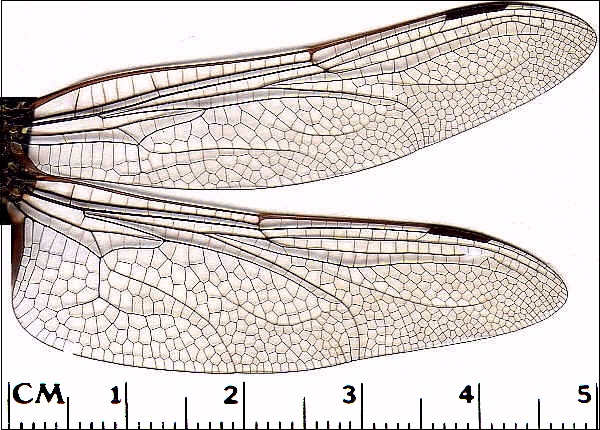
This next photos is larger than normal, but it will open up well (click on the image to open to large size) to show you wonderful details on the wings as seen from behind. You know by now to ignore what appears to be a "doubled" wing image - it is just the shadow. There are two wings on either side (of course). They are clearly visible,with strong patterns of veining. The
veins in Dragonfly and Damselfly wings are used by the experts to distinguish various species. Obviously that is done with insects in collections in Museums, etc. But sometimes one can be lucky enough to see details of the wing structures in photographs, as in this case (and in the pair of mating Dragonflies below).

Next is a closely cropped image to show the structures of the wing connection to the thorax of the insect. And to show the head of the Dragonfly. The Chew Family website has an illustration of the anatomy of the
head of a Dragonfly here. In my photo you can clearly see the very large compound eyes, which dominate the face (with the large reflected light patches from the sun). Below that, in the centre is a round structure known as the "vertex". It seems this is the upper part of the skull - presumably the brain casing. Below that is the larger organ known as the "frons" (that just means "front"). It has a central line in it, making it appear to be a double organ, but it is not. It is quite a large part of the head. Between the eyes and the frons there are apparently three
"ocelli" (primitive eyes - similar to the
"jewels" on the head of a Cicada). I cannot make them out in this image. Apparently there are also two tiny antennae (which I also cannot make out in this image) located just above the "frons". The mouth is not visible in this photo, as it is taken from above the insect, and the mouth is low down, below the frons. Dragonflies are aggressive hunters of other insects, and they have large, powerful mouths, although they do not tend to bite people.

The females of the Black-headed Skimmer are yellowish-brown, and I probably saw some, and assumed they were a different species (however, I did not get any good photos of the females). Perhaps I was attracted by the bright blue - "pretty ones". Aaah, subjectivity strikes me down again. Where is the scientist in me - recording
all the species, not just the showy ones?
Here is a delicate, and tiny olive-coloured Damselfly, with a brownish body. I have not yet been able to identify this species. It is very possibly a female, which makes it harder to identify, as the illustrations are mostly of the more brightly coloured males. It is possible it is even a freshly "emerged" adult (possibly just emerged from its larval stage), as it is recorded that some fresh specimens are green, but develop over a period of hours to brightly coloured specimens. Check out the
last photograph and the relevant text in this article on the Eastern Dart Damselfly.
I like the subtle colouring of this specimen. If you enlarge the photo (click on it) you can make out a lot of detail on the typical face of this Damselfly. Note especially the "bug eyes", which are separated on either side of the head - quite different to the Dragonfly head (shown in detail below). Also, she is holding her wings together, and parallel to the line of her body. They do not always do this, but Dragonflies seldom if ever rest in this position, whereas this is the classic pose for a Damselfly.

Now let us look at some of the more colourful specimens found at this dam in Canyonleigh. This is the Red and Blue Damselfly. No arguments from me about that name.

Once again, you can see the "bug eyes" and closed wings of a classic Damselfly.

The Common Glider Dragonfly
(Tramea loewii) spends a considerable amount of time resting on the moist ground adjacent to the dam, or on this dead reed stem (fortunately for me). Note the huge eyes, and the wings spread wide, while at rest.

I was lucky enough to get a couple of "in-flight" shots. The first shows a male with a typical dark tip to the abdomen (tail). The hind wings have a dark red patch on them, and the fore-wings are clear, but with light red-tinted veining.
For the technically minded, this image was taken on F10 at 1/400th of a second. Even then I did not quite "freeze" the wings in position. There is still some movement blur on the left fore-wing.

Here is another 1/400th second shot. It freezes the wings, and shows them to be beating in a "figure of 8" alternating movement. Insects do not fly by beating their wings straight up and down, but rather they "swim through the air", except these insects use 4 wings in perfectly synchronised movement. And you thought helicopters were "advanced"? This co-ordination leaves the movements of a helicopter blade for dead.

And now here is something scientific for you. The mating ritual of a pair of Dragonflies. Because they were resting well above my head, in an Acacia tree, I could not get good colour definition (against the sky), so all I know for sure is that the abdomen of the male is a strong yellow colour (although not very brightly coloured). The female is duller in colour. They might be
Australian Emperor Dragonflies - based upon colour and size. But I cannot be sure. The wings
certainly look right for that species.
Occasionally one sees Dragonflies and Damselflies paired up, when flying. That can be copulation, or pairing after copulation, a process whereby the male protects the female as she is preparing to lay eggs. When they are actually copulating, they form this "wheel position". Once again, I am indebted to the
Chew Family's website, for a full exposition of how and why
these various couplings take place.As can be seen in this photo the male Dragonfly (who would have been in the "leading" position when they were flying) has clasped the female by the top of her head, and she has bent her abdomen forward, under his, to receive his sperm package from his "secondary genitalia". Yes, folks the males produce the sperm in one set of reproductive organs located in their 9th abdominal segment (at the end of the abdomen, where one would expect it to be). Then, immediately prior to mating he moves his sperm package forward to a second set of genitalia (in the second abdominal segment). That is where the female attaches herself to the male's body, to receive the sperm from him. That is why she is adopting this curved posture, reaching her genitals underneath his belly, close up to his thorax. They do not join "end to end" (neither over the back, like Beetles do, or back to back, like Butterflies and Bugs do). There is a theory that this position reduces the risk of the male, having "served his purpose" being eaten by the female. Indeed males are known to clasp (couple) with many females over the several weeks of their life span as adult Dragonflies.
Although these mating Dragonflies were in Canyonleigh, they were away from the dam where the other photos were taken. In fact there was no large body of water close by. But, as you have seen already, Dragonflies and Damselflies, having an aquatic larval stage, need to lay their eggs in water, or on vegetation at the surface of water. So presumably this pair knew where the closest water body was. After the female lays her eggs, they will hatch out as tiny nymphs, and live underwater until they are mature. Then they climb out of the water (as we saw at the top of this article) , and begin their air-born lifestyle.
That completes their cycle of life.*****
Incomplete Metamorphosis
You will note that Dragonflies and Damselflies undertake a distinctive form of
"incomplete metamorphosis". They
do not undergo "complete metamorphosis" (with a pupal stage) as Butterflies and Moths do (egg; larva - e.g. caterpillar; pupa - e.g., chrysalis; and adult e.g., Butterfly or Moth). Even Beetles, Flies, Ants, Wasps and even Fleas all follow a similar developmental cycle.
Amongst insects which undergo "incomplete metamorphosis", some, such as Grasshoppers, Crickets, Mantises and Cockroaches, and some Bugs, have a particular form of "incomplete metamorphosis" where the young (nymphs) are similar in shape, but much smaller, and lack wings until their final moult. They develop through stages known as "instars" (1st instar, 2nd instar, 3rd instar, etc). These nymphs also live in the same terrestrial environment as the adults, and eat the same food as adults. Basically they are scaled down versions of the adult insects, except they do not have wings, and are not sexually mature. Insects which have that form of incomplete metamorphosis are known as "
paurometabolous insects".
Cicadas, Dragonflies and Damselflies and some other insects also do not pupate, but instead of going through the development stages of "instars" (small-scale models of the adults - except lacking wings), they have a larval stage which is totally dissimilar to their adult form. These used be classified as heterometabolous insects as they all undergo a
dual-elemental development stage. Cicada larvae live underground, but their adult stage is terrestrial (but above ground). They emerge, and after their final moult, the shells of the cicada nymphs are abandoned low down on trees, and the adults emerge as the
well-known flying insects.
There is a parallel development with Dragonflies and Damselflies, Stoneflies and Mayflies. They also do not pupate, (so they also are classed as undergoing "incomplete metamorphosis"). But unlike the Cicadas, they hatch from eggs into a larval stage as
aquatic insects. These
aquatic "nymphs" are known as "Naiads". (The name is borrowed from Greek mythology for
evil (but attractive) water sprites who supposedly lured men to their deaths.) Unlike insects such as Grasshoppers, etc, which have "instar" developmental stages, the larvae of these insects do not resemble the adults even remotely. Upon maturation of the "naiad" stage, the larvae leave the water (as we saw in photo 2 above). Then, just like the Cicadas, the adults emerge from the shells of the nymphs, and live their adult stage as the familiar terrestrial flying insects we know as Dragonflies and Damselflies. In aquatic entomology, the preferred terms for insects with these aquatic/terrestrial dual-elemental phases is
"hemimetabolous insects".