Christmas Bells

Christmas Bells
Christmas Bells - Blandfordia nobilis
Showing posts with label Cemetery. Show all posts

Friday, July 15, 2011

More on the winds of the last week, in Robbo

We have had a beating over the last 10 days or so, with the winds. (And it has been cold too).


However, it is the wind on which I wish to focus.


There has been a sad event in the cemetery, which I am confident is wind-related, not a result of mindless vandalism. I am recording this, in the hope that at some stage in the future, grieving relatives do not get the wrong idea about the damage to the Head Stone.


This perfectly lovely head stone has blown over, and in so doing has cracked and been chipped. You can see the fresh flakes and you can see how it hit one side of the grave edge and that caused it to split on the diagonal.


In the same windy week, half of one of the huge Sally Wattles (Blackwood Wattles) in the Cemetery grounds also came down. This tree was noted for the huge load of vines which were growing over the tree, and they acted like a spinnaker, trapping the wind and greatly increasing the loading on the tree. A neighbouring Blackwood Wattle, whch did not have so many vines, survived the winds just fine.


Fallen branches and vines from Blackwood Wattle in Cemetery
You can see the amount of foliage and extraneous vegetation which has come down. I have marked it with a yellow line on the image. I would guess that his tree (half of which is still there), is probably 100 years old. It has certainly seen many storms before.


It was noted for the massive growth of Pyrrosia (Rock Felt Fern) growing all over the branches of the tree. That only happens on really old Blackwood Wattles. The younger trees usually have clean branches.

Thursday, April 22, 2010

Hugh Waring - 16 July 1917 - 17 April 2010

I learnt today that Hugh Waring has died peacefully at his home in Canberra. There will be a graveside service in Robertson tomorrow.

Hugh and Adele (Del) Waring have lived at the end of the road to the Cemetery in Robertson for more than 50 years. They were famous for selling (growing) "Christmas Firs".

I first met Hugh in 1992 at a funeral for his good friend, and a mutual neighbour in Reid, ACT, the late Dr Wilf Crane. Hugh delivered a brief eulogy to Wilf, and supervised the planting of a tree in his honour, in Geerilong Gardens, Reid - in the park opposite where Wilf lived.

Shortly after I moved to Robertson I called in to visit Hugh and Del, who I had met, but hardly knew well. They were very hospitable and welcomed me warmly to Robertson.

Hugh then took it upon himself to encourage me to grow "interesting plants, especially trees". Hugh loved trees.

He showed me the huge timbers in the main room in their house, which he said modestly that he had grown and harvested to fulfill a promise he made to Del, that he would build her a proper house, (once the trees grew).
There towering above me, in the main room, was the evidence.
I love a Man with a Plan.
It may have taken nearly 45 years (at that stage) but he had completed his commitment to his lovely wife, Del.

Hugh had a particular fondness for Douglas-Fir (Pseudotsuga menziesii) the tree from which the timber known as Oregon is harvested. These trees were famously killed in their millions when Mt St Helens erupted in March 1980. They were the trees which looked like matchsticks strewn down the hillside in those famous photographs taken after the eruption.

Hugh had joined CSIRO, in Canberra, after the end of World War 2, and had become the Principal Research Scientist in the Division of Forest Research, at Yarralumla, ACT. Hugh had personally done much research on softwood trees suitable for growing in Australia.

In part, that was why he ended up living in Robertson, because Hugh was a great believer in soil chemistry influencing the outcome of attempts to grow trees, and he chose a south-east sloping hill, in a high rainfall area, with rich acidic soil as an ideal place to try to grow many of the northern hemisphere's most valuable timber trees, (including the Douglas-fir). The best place he could find which met those complex criteria was a little hill on the edge of Robertson, NSW. He and his brother, and their families jointly planted out their seedlings which now constitute a forest.

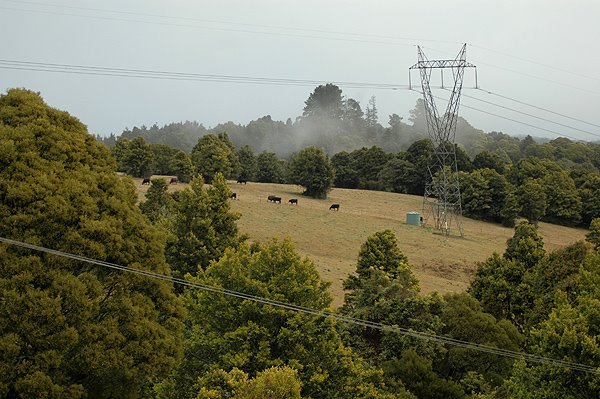
I look out over the Cemetery Hill, and Hugh's trees, every morning.


Incidentally, Hugh's trees created the backdrop to the main scenic shots in the movie "Babe", which was filmed on the adjacent property, Bell's Farm. But the movie would not have been made there without Hugh's trees creating a "non-typically Australian scene", for the producers of Babe did not want it to be identifiable as Australian scenery (there is scarcely a "Gum Tree" visible in the movie). They wanted an international "feeling" for the movie, and indeed Babe was an international success.

Hugh and Del featured in Andrew Ford's composition "Elegy in a country Graveyard", where they made several humorous contributions to the piece, including by referring to looking forward to being buried in their chosen plot, "next door". There must be something about living next door to a cemetery for 50 years which gives one a particular sense of humour when discussing death - certainly, in their case, there was a great sense of acceptance of death as part of life.

That, in essence, is what one would hope for in a man who devoted most of his life to the commercial growing of trees - and saw that they were harvested when ready.
*****
The Canberra Times has carried this fitting notice of the forthcoming Funeral Service:

HUGH DOUGLAS WARING
16 July 1917 16 April 2010 Late of Robertson (NSW) and Canberra.

Hugh was a very fine man, a philosopher, a scientist. A good brother, husband and father.He will be sadly missed by his extensive family and many friends. He lived each day as a bonus.

Friends and relatives of Hugh are invited to attend a Graveside Service to be held at the family property at 131 Missingham Parade, Robertson (next to Robertson Cemetery) on Friday, 23 April 2010, commencing at 11.30am.

In the Loving Care of G. Beavan Funerals 34 Station Street, Bowral 2576
Ph (02) 4861 2067.
*****
Post script.
The Service was huge, and very moving. People came from all over Australia, especially Canberra, where Hugh had spent most of his working life. I met up with some people I knew from my days in Reid.

Members of the family, and friends spoke lovingly of Hugh. Fond reminiscences, with just a few moments of sadness.

Everyone spoke about the importance of trees in Hugh's life. I am reminded that I ought have mentioned yesterday, the Chapter which Hugh wrote about the "Experiment" he conducted on a steep hillside at Robertson. This is included in a book called, appropriately, "Think Trees, Grow Trees".

Our farewell for Hugh was conducted within his beloved forest. A truly lovely spot, enjoyed by many on a lovely autumn day.

Farewell Hugh Waring.
You have inspired a great many people.

Saturday, October 20, 2007

Sublime to the extraordinary - in 200 metres

Most of the way down the road on which I live, there is a small Blackwood Wattle tree, which is covered in Rock Felt Ferns. Amongst the roots and leaves of this fern, there lives a single Orange Blossom Orchid. This lovely plant has been flowering valiantly for several weeks now - through good weather (like today) and bad (hot dry winds). This plant is relatively low, which gives me a chance to photograph it, unlike some, in the local rainforest, which are growing amongst the tree tops.
Seeing as I published a photo of Dockrillia linguiforme flowering on Sheoaks in Kangaroo Valley yesterday, it seems only fair that I should publish a photo of a local Epiphytic Orchid.
A little further along the road, at the Robertson Cemetery, the native Passionfruit, Passiflora herbertiana is in flower. This plant is not flowering well this year, and it is carrying some old fruit already, so it is a bit confused, I think. Perhaps it flowered a second time, late last season, and is now trying to flower again. Anyway, this bizarre flower is typical of this species.
It is very different from the introduced Banana Passionfruit, which is a weed in some places close to Robertson, such as along Jamberoo Road and Vandenberg Road. The fruit of this native Passionfruit are not palatable. Also, although I have tried to distribute a number of fruit around the cemetery, I have not seen any seedlings successfully established, as yet.

Back at my place, the latest Peony to start flowering is "Flame", an appropriately named brilliant red single Herbaceous Peony. Red Charm continues to work its magic, and Coral Charm is settling down and will produce some lovely blooms over the next week or two. Red Charm makes a spectacular cut flower, and Anni has a pair of them in a vase at her place, which look stunning. They were picked last Tuesday morning, and are holding well, as of Saturday afternoon. The flowers are huge.

Friday, July 28, 2006

The Nature of a skulker - the Bassian Thrush

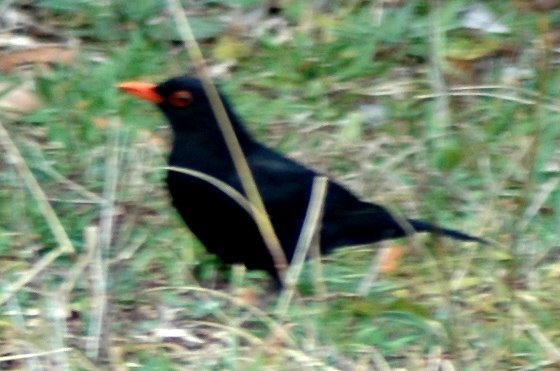
This bird was originally known as the Ground (or Mountain) Thrush. More recently it has been called White’s Thrush, and now it is known as the Bassian Thrush (Zoothera lunulata). I mention all of these names, in case you wish to refer to any older Bird Books which you might have.

I have seen this bird in the Robertson Nature Reserve, usually late in the afternoon, which is a time of day when it seems to be quite active. The first time I saw it, two years ago, it walked ahead of me, along one of the paths. It was difficult to see in detail, but its shape and behaviour is distinctively "thrush-like" - a bird which runs along the ground, stops, looks around, and then runs again (like the much more common "Blackbird").

Recently I observed two Bassian Thrushes at the Robertson Cemetery, in the heavy brush, just at the end of the road leading to the Cemetery. They are a bird of the heavy cover. They search for worms and ground-dwelling insects, under the leaves on the ground. Consequently, it is likely that, as with the Whipbird, you will hear the bird searching through the leaves on the ground, looking for food, before you will see it appear under some vines or other low growing plants.

To observe these birds, I found it necessary to sit perfectly still, underneath a bush. I tried to photograph them, but with little success, as they are quite shy, and they like to come out to play, late in the afternoon, when the light is poor. (Sorry about the poor quality image.)

They are extremely well camouflaged. It is for this reason that this bird is easily overlooked. It is not a common bird, but it is not regarded as rare. From my experience, you could expect to find this bird in any local patch of heavy rainforest around Robertson. I have also heard it calling, just on dusk, in the dense scrub along the Belmore Falls Road, but I have not actually seen it there.

In its behaviour the Bassian Thrush is very similar to the introduced "Common Blackbird" - to which it is related. The call of the Bassian Thrush is a thin whistle, not dissimilar to the Blackbird. It is known to call at night, and at "first light", and at dusk.


Saturday, July 22, 2006

The Nature of weather closing in

WEATHER COMING UP THE VALLEY

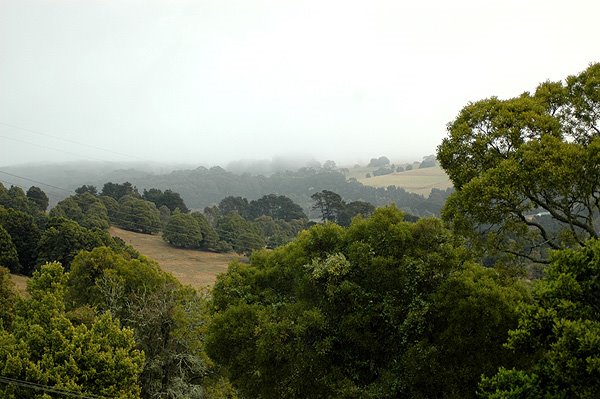
Last Thursday afternoon (and I'm writing on Saturday evening) I looked out the windows to the south and this is what I could see.

This is weather "closing in" on Robertson.


PEARSON'S LANE HAS DISAPPEARED

The sky was relatively bright (the sun being behind us, not yet masked by this wall of cloud).

The rain was sweeping up the hill, from the south, out of Kangaroo Valley.

The light was definitely unusual.

The fluffy grey clouds were masking the tops of the ridge opposite me (where Pearson's Lane runs). Giving it a flat topped appearance.


"END OF THE WORLD"
ROBERTSON'S CEMETERY HILL
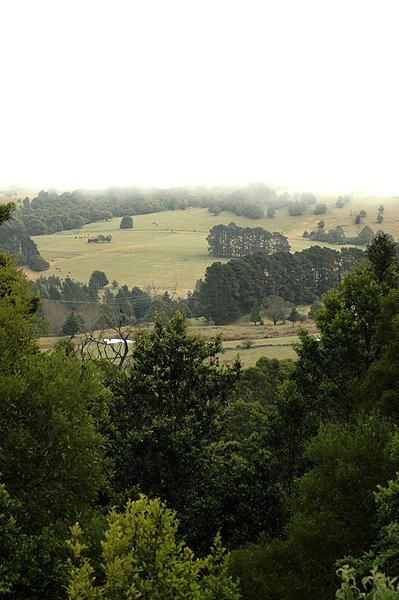
And looking down the valley, the world appears to stop beyond the cemetery (yes, I'm resisting those bad "dead end" jokes).

The tall trees on the "far hill" are at the cemetery - a mere 1 Km away.

They are clearly visible in my other distance shots, but with the wall of cloud beyond the hill, it suddenly stands out as the "end of the earth".


*****
I just love the way clouds change one's perspective on the view, from day to day, or even from hour to hour. That's why I keep posting new inages of the same view - because it is never the same.

******
As it turned out, this cloud hung over us for 48 hours, and dropped a reasonable amount of gentle soft rain on us. We got 24 mm of rain out of this. It was during this episode of soft rain that I photographed those Black Cockies - the ones eating Pine seeds in the rain.

*****
Today it cleared off, and Celeste, Ian, Jane and I planted a whole bunch of plants at the CTC. Jane donated the plants which she had raised herself, which is a great achievement (spoken as a some-time plant propagator).

There is nothing better than planting plants at the end of winter, after a week of rain (we also had 38 mm earlier in the week). These plants, (and some which I will plant tomorrow, of my own collection of seedlings) will positively jump out of the ground over the next 2 months, as the weather warms up.

Wednesday, July 19, 2006

The Nature of Children's Graves - bulletin 2

There is a lovely, elegant grave in the the Robertson Cemetery, where a child of 5 weeks and 2 days has been laid to rest. As with all children's graves, it is quite small.

This grave is moderately old (1925), and it is in a partially overgrown corner of the cemetery.

It is my favourite grave.


*****
Stairway to Heaven?
The grave is covered with a series of moss-covered stone slabs, each one rising over the one below. There are just 3 levels visible, but possibly another is now covered by soil.

To me, this appears to represent a series of steps - possibly the symbolic "Stairway to Heaven"
(see Genesis 28: 10 - 15). This refers to Jacob's dream in which he saw a stairway resting on the earth, with its top reaching to heaven, and the angels of God were ascending and descending on it.

It is otherwise known as "Jacob's Ladder".


These days, the symbolism of "Stairway to Heaven" is totally debased, owing to the over-riding influence of the Led Zeppelin song of the same name, with very un-religious connotations. (see the full lyrics here).

Not everybody agrees with my interpretation, indeed some people think the slabs have sunk, naturally, over time. But I am convinced that the grave was built this way.


*****

The text of the Headstone
In
loving memory of
Joseph Dixon
beloved infant son of
Thomas and Frieda
Dillinger
Died April 29, 1925
Aged 5 weeks & 2 days
Our little darling
has gone to
rest.


Tuesday, July 18, 2006

The Nature of Children's Graves - bulletin 1

The Robertson Cemetery is found at the end of Missingham Parade - the road on which I live.

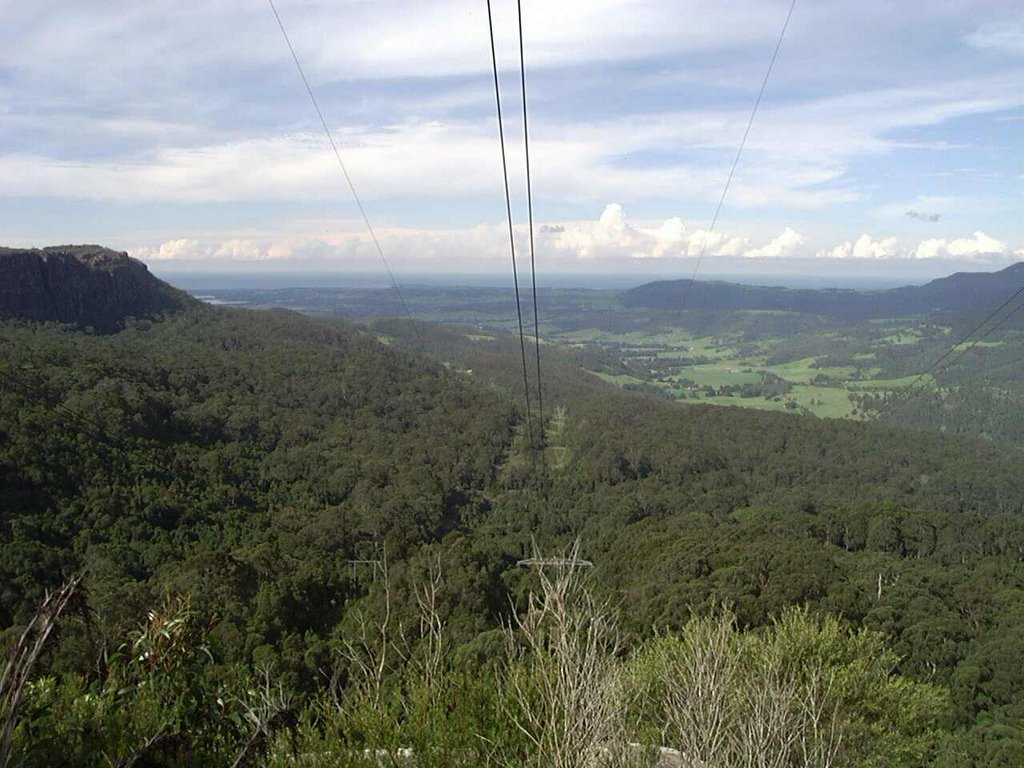
View south, over Kangaroo Valley

It is in a wonderful place. It has fantastic views out over Kangaroo Valley (see my photo at left). It is exposed to the south, so it is often windy, (but only on windy days!)

It also has great views across to the ridge where Pearson's Lane runs. That view is captured well on the photo gallery of the Robertson Chamber of Commerce.

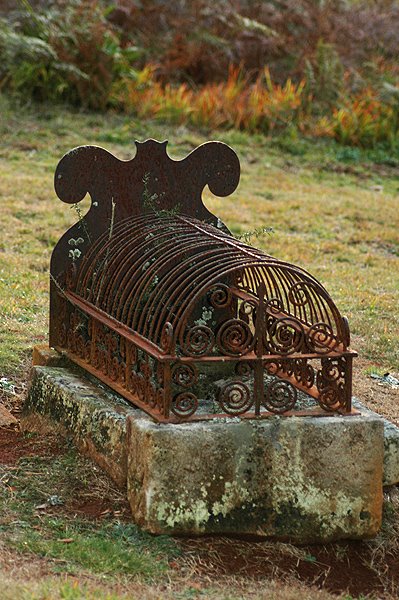
A child's grave, with steel cage and headplate

I am fascinated with the children's graves which may be found here. All old country town graveyards have many children's graves - a fact which all modern parents of young children ought realise, when debating the merits or demerits of vaccination.

In the "bad old days" young children died routinely of diphtheria, whooping cough and measles, as well as other diseases which we now readily control with antibiotics. But the communicable viral diseases were the real child killers. They still are, potentially.

All expectant parents ought visit a country graveyard, I think.


Some diseases of childhood, namely: Diphtheria, Tetanus and Whooping Cough are covered by the "Triple Antigen" vaccination for children. Hepatitus B, and oral (Sabin) Polio vaccinations are being encouraged to be given to all children. Pre-pubescent girls are routinely given the Rubella vaccination, to prevent the terribly damaging effects on the foetus, should a woman contract Rubella during pregnancy.

Anyway, grave stones seldom give the cause of death - it is just the fact of the death which is left with us, because of the grave.

Detail of Iron work on "cage"

This little grave intrigues me greatly.

The "cage" over the grave is in good condition, but the steel plate which acts as the "head stone" is heavily rusted, and sadly, no inscription is visible now.

The ironwork in the "cage" is very high quality work, and has lasted very well. It is rusted, superficially, but in Robertson Cemetery, that looks completely natural. To me the whole grave looks like a work of love - for the little child beneath.


The rear view of the steel"headstone"

The steel plate which acts as the "head stone" is heavily rusted, and sadly, no inscription is visible now. But what is the shape of the "cutout" symbolising?

Is it meant to be a guardian angel?

To me, it actually resembles a bat, but that is such an unlikely image. I hope that no-one regards my interpretation as disrespectful - no such thought is intended.

I would love to know the history of this grave.
*****
Tomorrow, I shall show you another Robertson grave - my personal favourite.

Wednesday, February 01, 2006

Enjoy the Nature of Robertson

I concluded yesterday's posting with with a little item about the call of the Lyrebird. I then added: "Enjoy! It is part of the Nature of Robertson". I think that point warrants being fleshed out.


There is so much about the nature of life in Robertson which is enjoyable. The people are decent, caring individuals, for a start. What - all of them, you ask? All the time?

Who knows? But most of them, most of the time, I will attest.


Unlike city dwellers (and I include local towns of Bowral and Moss Vale in that generalisation), the people of Robertson are very closely attuned to Nature. The farmers work the soil or their animals. In the Village, gardeners work the soil, but they know they have to compete with the Bowerbirds to harvest their crop of fruit, or berries, or even flowers like Roses.


As with Anni's recent trip away, when you get back, you have things to deal with in the garden, like overgrown lawns, and swollen Zucchinis. When I was away last year, for medical reasons, I was constantly aware of what might be happening in the garden - the weeds swamping the Peonies, or new flowers coming into bloom.


Very often we see Wombats standing, or walking slowly, beside the roads. Property-owners just on the edge of town live with them burrowing under fences, or even under houses. If you leave a shovel out in the garden a Wombat will poo on the blade over night - to mark it as his territory, not yours. How lucky are we to have the animals to remind us of that bold fact?

There are people who take their dogs for a walk down to the Cemetery, every day. In so doing they hear the Whipbirds (Psophodes olivaceus) "cracking" from the shrubbery, or hear the Black Cockatoos (Calyptorhynchus funereus) wailing like "Banshees" out from the trees overhead. I wake to the sounds of bird calls, every morning. How sweet is that?

Every time I look out the window, I see trees, greenery, flowers (and yes weeds, of course). But Nature is there - in my face, every day. If you live on a hill, as I do, you will have a view of distant mountains. Or, if you are lucky, out to the coast. How good must that be? (Take a bow, you McGuinness Drive residents, especially).


Alternatively, on foggy days, you are yearning for the fog to break, so you can see where your place is, in the world, again. You know you are "grounded". But without being able to see it, you know something is missing. It is such a lovely feeling to see the surrounding environment again, after a fog.


The weather in Robertson does not allow you to ignore it. It is such a dominant force. If you live here, you know you are part of Nature. That is what gives us all the "edge" - in being able to enjoy what is happening around us - the awareness that we are part of a system, something far greater than mere human endeavour.


We are part of the Nature of Robertson. And we enjoy it.