Christmas Bells

Christmas Bells
Christmas Bells - Blandfordia nobilis
Showing posts with label rainforest. Show all posts

Saturday, February 15, 2014

Sawfly guarding eggs on Rubus nebulosus

Bob McInnes, of REPS, brought me an interesting insect this morning. It is a female Sawfly Philomastix macleaii (apparently renamed Philomastix glabra) which was guarding a set of eggs she had laid on the underneath side of the leaf of the Green-leaved Bramble, Rubus nebulosus, a very sharply thorned Bramble with pinnate (5-foliolate) leaves. The specimen of leaves (and associated insect and eggs) came from Tony and Anna Williams's (not "Windsor" - apology for previous typo) property in Robertson. 

They have a very fine patch of "Cool Temperate Rainforest" on their hill. It differs somewhat from the rainforest in the Robertson Nature Reserve, as it is largely dominated by Lilly Pilly Syzygium smithii and Blackwood Wattle Acacia melanoxylon but their patch of Rainforest has some other uncommon trees, such as the Acronychia oblongifolia and the Black Olive berry (Elaeocarpus holopetalus) and their forest also has many large Birds Nest Ferns. (No doubt there are other differences which I have overlooked.)

The Sawfly is well reported to "guard" its eggs and larvae.
In the case of a closely related species, the guarding behaviour is described as follows.
"Females place their eggs in groups of 30-40 on the leaf underside on both sides of the midvein and later position themselves at the base of the leaf where the larvae feed on, with the head directed towards the stem."

Source: Pergidae of the World : An online catalogue of the sawfly family Pergidae (Symphyta)

That description matches exactly what this insect was doing - guarding her eggs.


Green-leaved Bramble, Rubus nebulosus
Philomastix macleaii female guarding eggs
Note how she is positioned at the 'base" (stem end) of the leaf.
This is to protect the eggs (and subsequently the larvae)
from crawling insects, such as ants.

Note similarities of this image with another image
guarding her eggs laid underside of
a Rubus moluccanus.
Similar posture, similar food plant.
Similar appearance, including long yellow antennae.
Philomastix macleaii 
female Bramble Sawfly

Eggs of the sawfly. Philomastix macleaii
Unlike eggs in earlier linked image, these are dark.
presumably well advanced towards hatching,
Check this image of similar purple eggs
of a Raspberry Sawfly.
Females of Philomastix spp. pierce the leaf from above and place the egg on the underside of the leaf (Macdonald & Ohmart 1993). All species of this genus exhibit maternal care. Females stand near their egg mass and young larvae or near the leaf petiole with the head directed to the stem and when disturbed they shake and create a buzzing sound with their wings (Macdonald & Ohmart 1993, Naumann & Groth 1998). This behaviour lasts until they die.
Source: http://www.pergidae.net/philomastix.htm


Click on image to enlarge.
There are tiny cuts in the upper surface of the leaf
presumably each cut relates to where the egg is underneath.
Does she protrude her "ovipositor" through the leaf?
That's the only thing which makes ergonomic sense
otherwise it would require the female to go to both sides of the leaf
and match up the cut with the egg.
Ockhams Razor would rule that out.

Saturday, May 04, 2013

Plants of Bells Hill, near Robertson.

There is an interesting patch of Cool Temperate Rainforest on Bells Hill, just south from Robertson. It is accessible by foot, from Yeola Road, but that's via private property, so permission would be required. But there is a road which goes up towards Bells Hill, from Fountaindale Road. It ends up as a "private road" but the first part, Maugers Road, is a public road. There are some great patches of rainforest just beside the road. No trespassing. My kind of road, for exploring along.

The interesting stuff is not always very obvious, as the forest patches are quite thick. and these plants are not necessarily Picture Post-card stuff. But they are interesting, if you check them out in detail.

Pimelea ligustrina
This plant grows to a large shrub,
and has creamy-white heads of flowers
followed shortly afterwards by seeds which readily disperse.
It has a reputation as being a bit "weedy" in places.
It is however, relatively uncommon in Robertson.
I would rate this plants as marginal on the Red Basalt soil.
It is more common in the forest below the basalt,
and half-way down Macquarie Pass.

Ripe fruits of Pittosporum undulatum
Under side of leaves of Pittosporum undulatum
There are a number of seedlings of a very large rainforest tree Stenocarpus salignus growing along this road. Presumably they are successful regenerations from trees which have been cleared from the original rainforest on Bells Hill. In any case, it is interesting to see them here, as seedlings.
Stenocarpus salignusThis is a tiny seedling,
less than 20 cm high.

The fresh leaf tips are reddish brown.

This is the upper side of a mature leaf of
Stenocarpus salignus
There is a prominent mid-vein and
Two other significant veins
which are roughly half-way between

the mid vein and the leaf margin.
Small veins run off
the mid-vein at an acute angle.

That leaf venation detail is shown quite well in the PlantNET botanical illustration.
Botanical illustration of
leaf and flowers of Stenocarpus salignus

Under side of the same leaves
(as above) of Stenocarpus salignusOnly the mid vein is prominently seen,
from below, in this example.

These leaves of Stenocarpus salignus
are really fresh
and light green,
with the characteristic reddish tips.
Old leaves go dull and leathery.

Stenocarpus salignusThis young plant is growing strongly now.Note how the leaf shape and colour make it stand out
from other vegetation in the background.
I have many more photos to show, but I will save them for another day.

Wednesday, May 01, 2013

Celastrus australis - Staff Climber (aka Staff Vine).

Celastrus australis - Staff Climber (aka Staff Vine).

This is an extremely common climber in the local rain forests. Currently it is very noticeable, because it is fruiting heavily, with orange berries visible in the tops of trees which themselves do not produce orange berries.

It grows right to the top of host trees, and then tries to catch hold of any neighbouring plants. If there is nothing higher, the stems bend over and keep going horizontally, till they find something else to climb on. I saw one recently which presented a solid wall of dense vegetation, approximately 20 metres wide, and more than 20 metres high - reaching to the top of the local Blackwood Wattles and Sassafras trees.


Fruit of Celastrus australis

Large numbers of fruit of Celastrus australis

Mature leaves of Celastrus australis

Lenticels are noticeble on the stems Celastrus australis
"One of the small, corky pores or narrow lines
on the surface of the stems
of woody plants that
allow the interchange of gases
between the interior tissue and the surrounding air."
In other words, these are "breathing holes" for the plant.


Juvenile stem and leaves of Celastrus australis
Once the capsule is opened
it clearly showing it is "three valved".
The seeds have a bright orange "aril"which is a
"membranous appendage, sometimes partially or wholly
covering the surface of the seed"
If one peers closely
one can make out patches of orange seeds
(just below the power lines).
These are Celastrus seeds.
Forgive the poor quality, please, but the distance
is more than 150 metres away.
The three lines are power lines passing between
my house and the trees.

Wednesday, September 12, 2012

Mysterious Ant Orchids

I cannot help myself saying this - I have done it before.

These plants are supposedly different species of Ant Orchids - of the Myrmechila genus.

But I have found these plants growing together, half way down Macquarie Pass
and they grow very closely together, yet somehow manage to keep their "differences".
It defies understanding (well, obviously, MY understanding).

Logic would dictate that the ancestors of one strain of these plants plants might well have found their way there.

But to postulate that two separate strains (or "species" if you like) have found their way to this isolated clearing within a rainforest (surrounded by unsuitable habitat for them); and that each species has established itself in this one little "opening" in the forest; yet they remain separate species, just seems so unlikely to me.

So, I fall back on the old Logical Saw of Occams Razor:
  • "It is a principle urging one to select from among competing hypotheses that which makes the fewest assumptions."
Basically, how could such an unlikely event occur?

Or, put more simply, I want to be an Orchid Heretic here, and suggest that these variations which are evident are merely individual variations between particular flowers, and NOT representatives of different species at all.

Shock horror. I may be expelled from the Australasian Native Orchid Society for saying that.

Having said all that, I note that these "species" have been recognised for a very long time. They were raised to species status by Robert FitzGerald Australia's first great Orchid specialist. "His extraordinary skills gave rise to a volume of work completed over seven years called Australian Orchids".
"The standard author abbreviation Fitzg. is used to indicate this individual as the author when citing a botanical name."
Source: http://en.wikipedia.org/wiki/Robert_D._FitzGerald#Australian_Orchids

So if FitzGerald was not troubled by my "doubts", I shall accept his species as valid and good.

Of course, the newer taxonomists have played with his original naming (which were then both classed as "Chiloglottis"). But I am following the "new names", because this name is used to separate the Spring-flowering species of this tribe. They also have their lateral sepals held out to the side of the flower, not recurved under the Labellum (as with the true Chiloglottis group).

This species (M. formicifera) has 
the labellum diamond-shaped, 
7–10 mm long, 6–7.5 mm wide, 
with a narrow, shiny, black, ant-like callus (gland)
extending from the base to the apex.
Myrmechila formicifera
This species (M. trapeziformis) has 
the labellum 
which is spade-shaped to diamond-shaped,
7–10 mm long, 6–8 mm wide, 
with a short, shiny, black, ant-like callus (gland)
occupying the basal quarter of the upper surface.
In other words, the lower labellum is clean
on the part furthest from the flower stem.

Myrmechila trapeziformis

Thursday, March 22, 2012

Some Butterflies and Moths of Robertson district.

Several nights ago I found this Moth on my front verandah - for the very first time.

I believe it is Eudocima materna, The abrupt rise in the line of the wings is quite distinctive. It matches the scalloped-out shape in the upper wings which becomes apparent (over the upper abdomen) when the wings are seen partly opened (second image).

Probably Eudocima materna

Probably Eudocima materna
If it is not that species, then I am pretty confident that it is in that genus. My problem is that the only other species in this Eudocima genus which is shown as entering NSW is Eudocima salaminia, which has quite distinctive (and dissimilar - from my specimen) markings on the upper wings. The other five species shown in Australia (according to Don Herbison-Evans' website) are all tropical moths.

This genus of moths is known as an agricultural pest, known as "fruit piercing moths". Mostly they attack Citrus but they also attack Lychees where those fruit are grown commercially. Their native "host plants" are mostly in the Menispermaceae family, best known in the Illawarra region for the Snake Vine and Pearl Vine.

Switching to the Butterfly tribe I was lucky enough to capture these images yesterday, at Clover Hill Falls track, half way down Macquarie Pass. These Butterflies were quite common along that track, amongst rainforest undergrowth underneath the Eucalypt upper-storey.

 
Wonder Brown Butterfly - female

What I did not realise at the time was that these dull brown Butterflies are the females of the species (only). They are Wonder Brown Butterflies (Heteronympha mirifica). Apparently the male of this species look like the more normally coloured forms of  "Brown Butterflies" (this term is used informally).
Wonder Brown Butterfly - female
Don Herbison-Evans shows both the males and the females. He says: "For many years it was thought the sexes were from different species, as the males also tend to congregate towards the tops of hills, and the females prefer the moist gullies below". That's why I didn't realise there were distinct males and females, as I was only seeing the females in the moist gullies.

One of the things I noticed about these Butterflies was their habit of sitting with the wings held totally flat.
Wonder Brown Butterfly - female
On the slow walk back along Clover Hill Falls track to the Illawarra Highway, I came across this stunning and dangerous-looking creature. At first I was suspicious that it might have been a Wasp. I have read about these Moths which resemble Wasps, but this was the first time I had seen one close up - close enough for meaningful photos.

The "experts" seem to be very cautious in naming species of these Wasp Moths. But with the small orange dots on the wings, (as distinct from large transparent patches on the wings) this seems the best "fit" in appearance and geographical range (as far as I can check). The Atlas of Living Australia seems to be having service difficulties tonight. 

If any reader can advise me if I am not correct, I would appreciate being set right.

Eressa angustipenna
Click to enlarge image.
You can see the coiled up mouth-parts
(known as a proboscis)
Eressa angustipenna
What an amazing-looking Moth. I think you can see why I was wary of it at first.

Friday, October 29, 2010

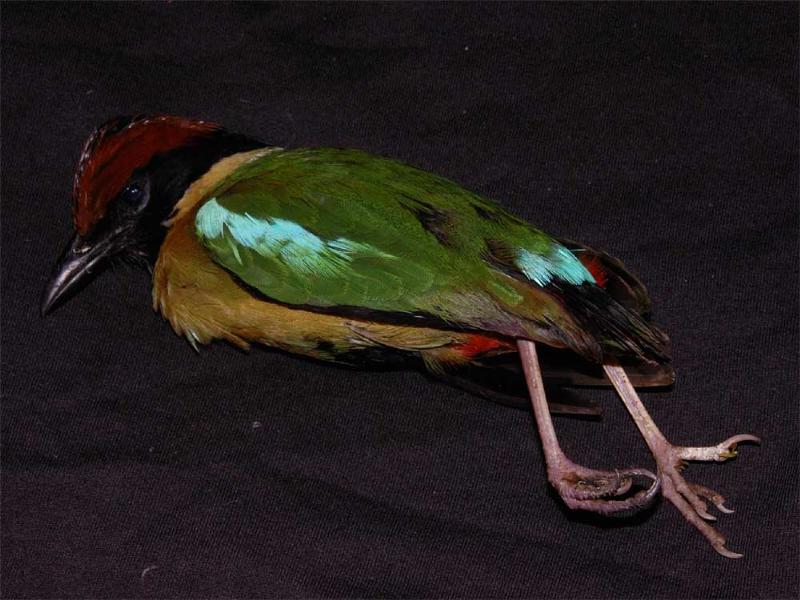
Noisy Pitta found near Berrima

Several days ago a Noisy Pitta (Pitta versicolor) was found near Berrima, in the Southern Highlands of NSW. This is a long way outside its normal range, and in a very unusual habitat for this species, which is a classical "rainforest bird".

Berrima is approximately 40 Kms west from Robertson (which itself is just above the Illawarra Escarpment, the closest true rainforest habitat to Berrima). The bird was presented by a "soft mouthed" Golden Retriever, to the dog's owner. Fortunately, the dog was very gentle, as befits a properly bred "retriever".

Unfortunately, the story does not have a happy ending, for although the bird was carefully handled (minimal handling), and was kept covered, and fed and watered appropriately, it was handed over to WIRES, but it died before it had fully recovered from its ordeal. Whether it was unwell to start with, is not known. After all, it was outside its normal range, and well away from its normal habitat, being a tropical rainforest bird.

Noisy Pittas normally live in dense tropical and sub-tropical rainforest. Their range is normally only as far south as the "Barrington Tops" (Hunter Valley Region). There are apparently some reports from the Mt Keira area, on the Illawarra Escarpment. (*** - see note below) The open farmland setting where the bird was found, is way outside its normal range and habitat preference.

IMAGE WARNING

IN KEEPING WITH THIS BLOG'S POLICY
OF PRESENTING INTERESTING AND UNUSUAL RECORDS
INCLUDING OCCASIONAL PHOTOS
OF DEAD ANIMALS AND BIRDS
I HAVE TAKEN SEVERAL IMAGES OF THE DECEASED BIRD.

I REGARD THIS AS AN EDUCATIONAL SERVICE.
HOW OFTEN DOES ONE GET THE CHANCE
TO SEE A NOISY PITTA IN SUCH DETAIL?

ANYWAY, IF YOU ARE LIKELY TO BE OFFENDED
BY PHOTOS OF A DEAD BIRD,
PLEASE GO NO FURTHER.

Kindly check back onto my blog again tomorrow.


*****

I have formally registered the "sighting"
(as such records are known).
There is no doubt as to the validity of the sighting
(photographic evidence).
The query was asked if this bird might have been
a caged bird "escapee"?
That seems unlikely, as few people would have the facilities
to keep a bird such as this in a private aviary.
They are certainly not "normal" caged birds.
Only the Taronga Park Zoo (Sydney) is likely to have a Noisy Pitta.

So there is no reason
to doubt the authenticity of the record as being
entirely a natural occurrence.

Location: The bird was found between Berrima and Moss Vale,
Southern Highlands, NSW.
Habitat: open pasture land, with residual mature Eucalypts
Date of finding: 26 October 2010

*****

Birdline NSW

Cumberland Bird Observers Club
Birding NSW

Report Receipt

Thank you for your report which has been recorded as follows:

Species: Noisy Pitta
Date: 28 Oct 2010
Site: Berrima, NSW
Notes: Bird retrieved by dog. Not obviously damaged by dog, however, it died, subsequent to it being handed over to local WIRES people. Bird was located in open farm land in Southern Highlands, between Berrima and Moss Vale. Cleared pasture, with large remnant Eucalypt trees. Nearest rainforest (Illawarra escarpment) is 55 Kms away, at Macquarie Pass. Mt Keira (apparently this species has been reported from there) is approx 90 Km away. Photo of bird taken after it died.
Observer: Denis Wilson
Photograph:


And here are the images:

Note the brilliant electric blue flashes on the wings and rump.
This colouring would really show up in low light conditions
when the bird is on the forest floor.
The back and wings are a brilliant emerald green,
The head is a rich brown.
The bird has large feet and strong legs
as befits its ground dwelling nature.
The beak is very powerful suiting its preference
for snails and ground dwelling arthropods (insect relatives)
This awkward looking image is shown to reveal
the brilliant patch of red feathers
in the ventral area and the under-tail coverts.
The dark patch on the belly is diagnostic of this species.
The throat is very dark, so it is almost invisible in this image.
This image shows the rich brown head
and the patches of white on the wing
(fully visible only when wings are fully extended)
Pittas have extremely short tail feathers.
The tail does not extend beyond the wings (or the legs).
Here you can get an idea of the white wing patches.
"Rigor Mortis" had set in by the time I collected the bird,
two hours after it had died.
So I was unable to open the wings properly,
for risk of damaging the specimen. I did not want that.

The rump is electric blue,
the tail feathers are black, but with emerald green tips.
The wings have traces of brown on the tips of the flight feathers.
The dominant colour is
bright emerald green on the back and wings.

The bird is stored safely (wrapped and frozen) and its body will be passed on to the CSIRO in Canberra, shortly, for inclusion in the Australian National Wildlife Collection.

I wish to express my appreciation to the lady who found the bird in the first place, and who looked after it appropriately. She tried to get it cared for by WIRES. Also, my friend Kim, who suggested that I be contacted to see if I could help.

Unfortunately, even with my local contacts, we were still not able to prevent the bird dying. However, at least the bird will not have died in vain, as it will go into the peak scientific collection of bird skins.

*** Postscript: I received the following comments from
Alan Morris, Moderator Birdline NSW.
Alan said that:
  • "Noisy Pittas are on the move south. There are three separate places on the Central Coast where you can hear them call (but not all the time) at the moment!
  • "While the southern normal breeding limit is the Barrington Tops/Gloucester area (not Coffs Harbour), they are being seen more regularly further south.
  • "There are regular reports for the Illawarra Region too although mostly in winter, but birds are now being reported all year round near Mt Keira I think!"
My response:
  • Thanks to Alan for the update on changing distribution of Noisy Pittas. With global warming seemingly occurring, that changed pattern makes sense. Many birds are extending their range from what we humans have regarded as "normal" (i.e., the distribution recorded since European settlement). Another which is recognised as moving "further south" is the Channel-billed Cuckoo.
  • I still regard this bird turning up near Berrima, in farmland, as an unusual record. The climate and altitude are the most significant differences from the areas on the Illawarra Coast mentioned by Alan.
  • Berrima district is approx 670 metres above sea level, and being away from the coast, is subject to much colder temperatures and is much drier, than even the highest places on the Illawarra escarpment which were mentioned by Alan as places where Noisy Pittas have been reported previously.

Saturday, June 19, 2010

The Moth and Me #12

I confess to having not even been aware of this particular Blogging Carnival "The Moth and Me", although I am aware of the fine work of some of the Nature Bloggers who are participating, especially Seabrooke Leckie who writes "The Marvelous in Nature".

Anyway, over at "The Skeptical Moth" Chris Grinter has just published "The Moth and Me #12".

I was totally taken by surprise when Chris asked me if he could include my "Moth Art" piece in this series.

It turns out Chris has a fascination for Hepalidae moths - what we generally call "Swift Moths" (for reasons which still elude me).

The particular moth from which I took the design for my "Moth Art"
is Oxycanus dirempta (thanks to Donald Hobern for the ID).
Here it is viewed more naturally,
hanging off the eaves of my deck awning.
I get many of these moths here, and so I regularly post about them, especially when they are beating their huge wings against my windows on cold, damp nights. The other reason they appear is because they are the main host species in the local rainforest to the truly bizarre Fungus Cordyceps gunni.

Thursday, May 06, 2010

Swift Moths and a large grey and orange moth

This last week has seen the arrival of many Swift Moths. I say arrival, but perhaps I should say emergence, as the larval stage of these moths is spent underground. Indeed, that is how they end up getting infected with the spores of the Cordyceps fungus, which kills a number of them each season (much to the interest of the Fungi experts).

Healthy, living moths have been battering at my windows for the last few nights. Heaps of them. Big Moths, with loud flapping wings.

This one has a large silver stripe along it wings.
It is also large, at least 7cm long.
This one has both stripes and spots.
It is smaller, at about 5 cm long.
This one has a very pale wing.
My favourite of these Swift Moths is this one, with what I describe
as hieroglyphic marks on the wings.
A very handsome creature, indeed.

Donald Hobern has advised me today:
"Just checked in ANIC. Based on the specimens there, Oxycanus australis is relatively consistent in appearance (like the image I forwarded earlier), whereas O. dirempta covers the diversity of all your photos - including some exceptionally close to the most highly patterned ones you show. I would therefore say that the likely identification is O. dirempta."

Don Herbison Evans' moths site shows another image, and also gives some life history for this species.

I have replied to Donald Hobern, tonight:
"I am happy to follow your suggestion and go with them all being forms of Oxycanus dirempta."

I was inclined to think that surely they had to be different species, as there is such great variation between individuals, (colour, size, details of markings, etc). But then I realised that clearly they are all responding to the same environmental signals (weather, moon, moisture, plants, or whatever).

So, deferring to Ockham's Razor, it is simpler to explain THAT shared behaviour as a standard reaction of individuals of the same species, to whatever trigger is bringing them out, now.

Plus their location is "common" to all, so clearly the simplest explanation is that they are all local, and all of the same Species.

My point is simply to illustrate that Swift Moths and Cordyceps both happily inhabit the forests here. The intensity of their appearance this week confirms that there are many healthy Swift Moths here, despite the presence of the Cordyceps fungi in the local environment.

***** ***** *****

I also found and photographed a beautiful moth which I had previously seen only once, last year, at Stroud, NSW, north of Newcastle.

Once again, Donald Hobern was able to tell me what I had found.
The mauve-grey moth is Ophiusa disjungens (Noctuidae: Catocalinae) It feeds on Eucalypts, Turpentine and (interestingly) Guava. None of those plants grows in Robertson, though Eucalypts and Turpentine are not so far away.
A lovely smooth Moth, with mauve-grey colouring.
The back of its head is covered with smooth grey hairs.
Its antennae are folded under the wings in this pose.
The spectacular coloured hind wings are only exposed when the moth flies, or opens its wings.
My favourite image, shows the head, the large eyes and also the antennae, now extended, once the moth is climbing around on my fingers.
My thanks to Donald Hobern, especially for his assistance with these confusing Swift Moths. Who would have thought that one species could be so different in their markings?