Christmas Bells

Christmas Bells
Christmas Bells - Blandfordia nobilis
Showing posts with label Pterostylis. Show all posts

Sunday, April 21, 2013

Having a feel for one's local area. Hunches can pay off.

Sometimes, one's instincts (or hunches) bear fruit.
This morning I set out to check an area opposite the Barren Grounds (approx 10 Km along the Jamberoo Mountain Road from Robertson). I had been in that area several years ago and found what I thought at the time were some Nodding Greenhoods (Pterostylis nutans).

I had a feeling that those plants warranted a good looking at, to double check the ID I had casually ascribed to those Orchids years before. And anyway, I hadn't been in that particular area for a few years.


Sure enough, I stopped opposite the Barren Grounds, walked back about 100 metres, to get past a thicket of native Stinging Nettles and some Native Raspberry prickles. I then walked off the road and quickly found a small colony of Greenhoods.

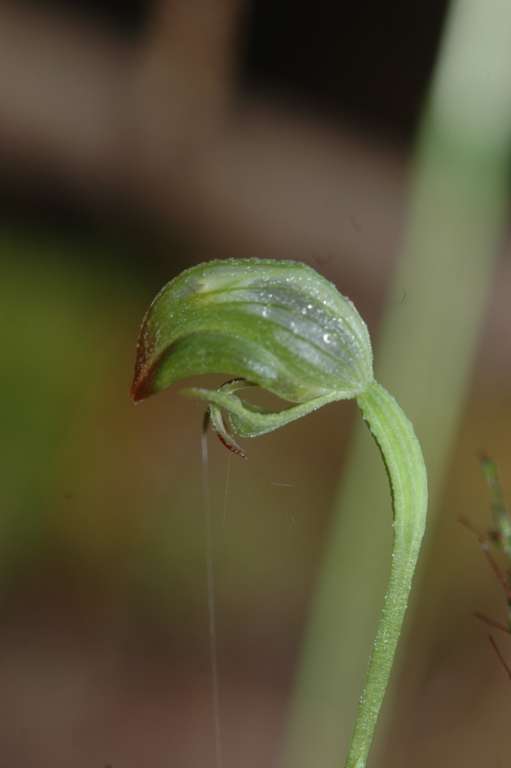
One look convinced me they were in fact not Pterostylis nutans, but the similar species Pterostylis hispidula (Small Nodding Greenhoods). 


Pterostylis hispidula
(Small Nodding Greehood).
The angle at which the Lateral Sepals
(otherwise known as "points" in most Greenhoods)
are held is distinctive.
Colony of Pterostylis hispidula
(Small Nodding Greehoods).

Pterostylis hispidula
(Small Nodding Greehood).
The bronze tinge on the tip of the "Hood" (Galea)
is also diagnostic.

Lateral view of Pterostylis hispidula
(Small Nodding Greehoods).
In this shot, the labellum is visible (with cobweb)

Pterostylis hispidula
(Small Nodding Greehoods).
The tip of the retracted labellum is just barely visible
These plants have sensitive labellums
which snap shut (inside the flower) if disturbed.
It is part of their pollination process.
I was also surprised to see a few flowers (nearly finished) of Spiranthes australis.
Spiranthes australis
amongst ferns in wet forest.
I am familiar with this species of Orchid, but I expect to see them in open swampy grasslands. But here they were growing in a wet grassy area, surrounded by Tree Ferns, Synoum and Lilly Pilly, and all were growing under tall wet sclerophyll Eucalypt forest.

Monday, June 25, 2012

A few Orchids from Comerong Island

Last weekend the Illawarra Branch of the Australasian Native Orchid Society went on an excursion to Comerong Island. See the introduction to this post, for location and geographic information about the Island. It was intended to be an Orchid trip, but we found more varieties of Fungi than Orchids (much to the frustration of my friend Colin Rowan).

We saw literally thousands of leaves of Pterostylis curta and some Pterostylis nutans. None were in flower, unfortunately.

However, Alan Stephenson was on a mission to re-locate a group of variegated Pterostylis curta plants which he had seen a few years previously. This required a  bit of walking along one section of track several times until Alan spotted what he was after.

There were a few, not many, of these unusually marked plants.
Such markings are uncommon, but not unknown. Possibly they were originally affected by a virus (as has famously happened with Tulips), but it seems that these plant markings are stable, not variable, nor likely to be an infection, which might otherwise kill these plants off, (or spread to others around them).

Variegated leaves of Pterostylis curta

Variegated leaves of Pterostylis curta
We then photographed some of the hundreds of Helmet Orchids
which were carpeting the ground
along the side of the track.
Corybas fimbriatus, the Fringed Helmet Orchid


Corybas fimbriatus, the Fringed Helmet Orchid

Corybas fimbriatus, the Fringed Helmet Orchid
A colony of them in the sand dunes, in the Littoral Rainforest
We drove along the single lane track which goes the full length of Comerong Island, out to the wharf at Crookhaven River (the redirected Shoalhaven River mouth). The last kilometer of the track had many deep puddles, but they were on solid bases, so, although a little scary (I had visions of cars getting stuck) Alan pressed through quite successfully. Definitely this last bit was 4WD only.
Acianthus fornicatus
This was one of very few in flower, but there
were literally hundreds of leaves of these plants growing
in certain patches of the forest, especially in disturbed areas
(e.g., where NPWS had bulldozed fallen logs
off the road, and into the forest).


Close to where the hundreds of Acianthus were,
we also found a few late blooming Cobra Greenhoods
Pterostylis grandiflora - the Cobra Greenhood
And finally we found a few very bedraggled,
but recognisable specimens of Bunochilus tunstallii
This Bunochilus tunstallii had collapsed,
and the flower had been triggered closed
but I was able to open the flower
to reveal the diagnostic brown labellum.
Bunochilus longifolia has a
cream labellum with a fine dark brown stripe up the middle.


Tuesday, May 24, 2011

Greenhoods at Jervis Bay site

These are yet more ground Orchid species found at the same Jervis Bay site. So just imagine how many plants are there, in total - the Caladenias, the Acianthus (two forms) and these Greenhoods. There were also a few other Orchid species here, but some, such as Corybas (Helmet Orchids)and Bunochilus (Tall Greenhoods) are not quite in flower yet. Speculanthas (Tiny Greenhoods) had finished.

It is an amazing area of plants. So many Orchids in one 200 metre stretch of road - surrounded by so much bush with relatively few Orchids. Why?


Taurantha concinna - the Trim Greenhood
(formerly Pterostylis concinna)
This flower is ever so slightly imperfect.
The "points" are not balanced or straight.
And the "hood" is slightly imperfectly formed.
The flower ought have a slightly more pointed dorsal sepal.
Taurantha concinna (with a particularly blunt hood).


Here is the botanical illustration from PlantNET to show what I mean
about the standard plant being slightly more pointed. 

Taurantha concinna - illustration from PlantNET
Here is the same flower - viewed from the front on.
This flower shows good colour on the front 
(more than I had remembered)
This image shows that the stem is quite rough (almost hairy).
As indicated above, you can see one point is bent over.
Click on the image to enlarge it.
You can see the labellum, which is in fact notched (V) at its top.
That is a diagnostic feature of this species.
(Other Greenhoods have V notches in the Labellum, 
but they look very different from this species.) 
The V shaped labellum is nicely illustrated above.
Taurantha concinnna
Here is the rear view of this flower.
It always seems very neat and "round bottomed"
Rear view of Taurantha concinna
Here is the rosette and the stem emerging from the centre of the rosette.
Note the sandy soil in which these plants are growing.
Rosette of Taurantha concinna

By way of contrast, here is Pterostylis acuminata.
I have shown this flower several times before, this season.
My reason to show it again is by way of contrast 
with the snub-nosed Taurantha concinna.
There were many specimens of Pt. acuminata 
growing along this same stretch of road.


Pterostylis acuminata - with a long pointed labellum 
It is the long labellum from which this plant gets its specific name.
This specimen has very nice balanced points (of the lateral sepals)
The hood is beautifully tapered, 
but not showing the extreme filiform pointed nose 
which some other species show (eg the Antelope Greenhood)
The show of light fawn colour is typical of this species.

As with so many other Greenhoods, 
this one is showing a fine cobweb underneath the flower. 
That indicates the likely presence of a tiny flower spider 
which is probably lurking inside the flower.

Saturday, April 09, 2011

Pharochilum daintreanum (Daintrey's Greenhood)

Pharochilum daintreanum - formerly Pterostylis daintreana.  

This plant was the reason for me going with Alan Stephenson, to Granite Falls, two weeks ago, and nearly busting my foot in the process. I hobbled for two weeks as a result of the difficult terrain there. Yet I went back again once my foot had recovered (to see this plant in flower). The bonus was getting the shot of the gills of the blue Entoloma Fungus, yesterday (which shot I ought have taken previously, but didn't because my foot was so sore). The Skink with the Flying Ant was a further bonus.


For once this awful name cannot be blamed on the Polish botanist, Dariusz Szlachetko, who has a love of giving our Orchids ugly names. This one has "Benth" in brackets after its name, but I think Mr George Bentham probably called it Pterostylis daintreana (certainly not Pharochilum daintreanum).

From what I can gather, this name is down to Jones and Clements.
Orchidaceae "Pharochilum" D.L.Jones & M.A.Clem. Austral. Orchid Res. 4: 80 (2002).


Mr Bentham was an eminent English chap. He worked initially as an amateur botanist, but his work was so well regarded by his associates, especially Sir Joseph Hooker (the younger Hooker), that he was invited to work at Kew Gardens as a botanical researcher. Eventually he published his Flora Australiensis, in seven volumes (1863–1878). Somewhere along the line he managed to be president of the Linnean Society for 14 years, and was awarded the Royal Medal of the Royal Society.


As for the "daintreana" part, it is a little unclear to me, But I assume it is named after Mr Edwin Daintrey, an "expert amateur botanist and a founder of the Linnean Society of NSW" rather than the Mr Richard Daintree, the Government Geologist for North Queensland (and amateur botanist while in Queensland). The latter man clearly got the river named after him. But David Jones in his book refers to it as "Daintree's Greenhood". I remain sceptical, but without access to the original text of Bentham's Flora Australiensis (in 7 volumes) I cannot check that fact. You can make up your own mind which of those fine amateur botanists was the more likely nominee. If indeed it is named after Mr Richard Daintree, then there must be a spelling mistake in the original Latin Botanical description, for the "form" is wrong. Note that Mr Daintree does have an Acacia named after him, but it has the "double e" in the plant name - Acacia daintreeana (F. Muell) That's why I have gone with Mr Edwin Daintrey as the more likely person after whom this plant was named (that and the fact that it is primarily a southern NSW Plant - but it does apparently stray into Queensland).


This story is a bit like "Great Expectations" (pity poor Martin, waiting, waiting, and wading through all this historical stuff, with just a little botanical terminology thrown in to annoy him further). 

Enough already. Here is the plant in question.
Pharochilum daintreanum in situ, growing out from under a rock.
 And a funny little thing it is too.
Clearly it is a Greenhood, and clearly related to the Bunochilus group and the Rustyhoods (Oligochaetochilus) with that high prominent "brow" on the "hood" (galea), and the very low-held ("deflexed") lateral sepals.

What I was not expecting was just how flimsy the plant is. The stem is very fine, not much thicker than a matchstick. This particular plant stands about 180mm high (approx 8 inches in the "old money").


But here at last one can see the flower structure.
Pharochilum daintreanum - a lateral view.
Note the fine pointed "lateral sepals" (the bits underneath the "hood")

In this next image, note the dark labellum and the two large side lobes.
Those side lobes remind me 
Pharochilum daintreanum - a surprise in the shape of the Labellum
One can clearly see the "side lobes" of the Labellum,
when it is in the closed position.
Pharochilum daintreanum - underneath view of the labellum when "closed"

This greenhood has leaf rosettes only when in the non-flowering (sterile) state. Flowering plants have "bract-like stem leaves" (but no rosette). Here are some non-flowering plants, in situ, in moist moss over a shallow rock bed.
Pharochilum daintreanum - leaf rosettes of non-flowering plants
So, does this plant warrant its own generic name (separate from the rest of the Pterostylis tribe)? 

Well, I think so, for it has very significant differences in flower structure, shape and growth habit from other related Greenhoods I have already mentioned, and it barely resembles other Greenhoods, like the Speculanthas, or Pterostylis acuminata, to name just two recent examples from that group.


So, despite their penchant for "clunky names" I am still a supporter of the revised names of Jones and Clements for Orchids, but most especially for their revision of the genus Pterostylis.

Peter Weston of the Royal Botanic Gardens in Sydney has this to say on the subject. (Note the arrogant use of the Royal Plural in this following quote which he has signed with his own name - not signed as part of any Editorial Committee for PlantNET):
"We  have chosen not to recognise the following genera segregated from, or resurrected from synonymy under Pterostylis by Jones & Clements (2002, Australian Orchid Research volume 4): Bunochilus, Crangonorchis, Diplodium, Eremorchis, Hymenochilus, Linguella, Oligochaetochilus, Petrorchis, Pharochilum, Plumatichilos, Ranorchis, Speculantha, Stamnorchis, Taurantha, Urochilus. Those authors justified recognition of these genera on the grounds that their phylogenetic analysis showed these taxa all to be monophyletic and that each was supported by some morphological characters. However, as these authors also noted, Pterostylis, as traditionally circumscribed, is also a monophyletic group that is strongly supported by both morphological and molecular data. The numerous name changes that they proposed for Pterostylis are simply unnecessary. (P.H. Weston March 2007)"

It is remarkably odd that Peter Weston, a recognised authority on Proteaceae is perfectly happy to go along with revisions of names (and "splitting" of species) within the Proteaceae tribe, but refuses to acknowledge the value of naming systems which separate out the blindingly obvious morphological differences in the Greenhood tribe. 

This is Plant Politics at its worst.  
  • Sydney RBG versus CSIRO in Canberra. 
  • Plant systematics (which few but the ruling "botanical elite" with access to DNA classifiying technology can deal with) - versus accessible, "field work" plant classifications. 
  • And it ignores clearly identifiable plant characteristics which are relied upon by people like me, who depend upon good names which distinctively identify a plant. 
  • After all, that is what plant names are good for, surely?

If I say a plant is a "Pterostylis" - it could mean just about anything:
  • spring, summer, autumn or winter flowering; 
  • short or tall; 
  • with leaf rosettes, or not (when flowering); 
  • with a simple labellum or, as in this plant, with a broad, prominent labellum capable of blocking off the entire "hood" (when triggered by a pollinating insect);
  • with "pointed ears" or deflexed lateral sepals, as in this plant.
Even if one went with the other synonym of Oligochateochilus daintreanum I would still know to look for the bold "brow" on the "hood", a wide labellum, and those deflexed sepals.
But if I use the name Pharochilum - it means only type of "Greenhood" - this one. 

The case for this generic name would be even clearer if there were several species within this genus. But this species cannot be held responsible for that fact. But if you were to follow this "naming" issue back to the Bunochilus group, it would be exactly the same argument, and perhaps even more easily justified.

Wednesday, June 02, 2010

More Orchids from Jervis Bay region

Well, having shown you the "Pretty as a Picture" Orchids yesterday (Petalochilus pictus), today I will show you some odds and sods.

Interesting little Orchids, but some are so small and so hard to figure out what side is up, that you might well wonder about them (or me). I find these crazy little plants totally fascinating.
***** ***** *****

Lets start with a Green form (technically classed as an "Alba" form) of Acianthus fornicatus. "Pixie Caps". Basically it lack the red pigment, leaving the plants green tissues as the only colour.
These plants were thick on the ground, in the same area as the "Pictus". There are about 25 flower spikes in this 'frame".
Their "heart shaped" leaves nearly cover the sandy soil.
There is a small fern, a few tufts of grass, and lots of dead leaves on the ground. The rest are these green Orchids.

OK - so this is an normal form of the same species.
You can see that the flowers are nearly transparent,
so they are not strongly pigmented at the best of times.
Their flowers are highly reflective.
The rounded hooded flowers give it the provocative Latin name,
which apparently in botanical Latin means "arched or bent over".
Next we come to the Corybas group of Orchids.
Corybas aconitiflorus is even more "hooded over" than the previous plant.
This is a dark red coloured specimen.
It is known in English as the "Spurred Helmet Orchid".
That name makes more sense if you see the flower as botanical artists do,
on a table, in a laboratory.
(Source: RBG PlantNET)
In the bush you only see the top of the flower.

Here is a more normal coloured plant,
with a greyish purple hooded flower.
These plants are quite small, leaves less than the size of a 20 cent coin
and the flower is the less than half size of a regular snail shell.
Here you can see one flower against my fingernail.
That might help you get the scale.
Another Corybas, and a rare one at that.
Corybas undulatus.
It has lightly toothed edges of the labellum.
Click on the image to see the fine details of the flower.
This plant is on the southern most limit of its distribution,
where we saw it, near Jervis Bay.
Its hood (dorsal sepal) is held more open than the previous species.
Both Corybas species here are ground-hugging plants.
From above you can see that the side of the flower is flared out.

These plants were not numerous. There are just three visible here.
They were growing in a muddy drainage line in typical sandstone scrub.
Eucalypt upper storey and many Proteaceous shrubs.
And now to more familiar Orchids, Greenhoods.
If you are a traditionalist you may refer to all these as Pterostylis.
Pterostylis acuminata
Here she is poking her long tongue out.
The rosettes of these plants nearly covered the ground,
but just for about one metre.
There were only a few flowering plants.

The next species is now known as Taurantha concinna
To my mind, this plant has an attractive "bum"
when viewed from the rear.
It is at its most striking when viewed up close - from the front.
Click the image to enlarge it to full viewing size.
Only then will you see the forked labellum.
The pollinia are just visible
in the back of the throat of the flower (behind the labellum).
This specimen is showing quite a lot of red in the front of the flower.

Friday, November 20, 2009

Two Greenhoods - a hybrid mystery solved

Two years ago, when the Illawarra Branch of the Australasian Native Orchid Society came up to Tourist Road, Graeme Bradburn spotted a Greenhood in a tiny drainage line. I was pleased and cranky at the same time - as I had regularly checked this drainage line looking for - you guessed it Greenhoods - and I had never found one!

Anyway, on the ANOS tour this year, Graeme struck again.
Pterostylis x ingens
Not only did he find the "supposed hybrid" Pterostylis x ingens, but there then followed some discussion about how this "hybrid" was here, when we had not seen either "supposed parents" (Pt. nutans and Pt. falcata) in the area.
Labellum of Pt. x ingens

***** ***** *****
Suddenly another member of the group called out: "Here is Falcata".
Indeed it was there - a mere 30 metres away from the hybrid plants.
I guess that solved part of the riddle.

The "Sickle Greenhood" Pterostylis falcata
(my first ever).
You can see the extremely long, pointed hood (galea).
The "hood" consists of 3 parts, the dorsal sepal and two petals.
The dorsal sepal far exceeds the petals
(which are bent down - on this specimen).
Here is the rear view of the plant.
One of the two plants in flower on that day
had a slightly damaged petal which was "drooping".
However, this image was taken to show the labellum.
It is nearly closed. Normally it should be protruding.
Here it is seen from very low down, to show the labellum.
By then, it was closed off (in the "triggered) position.
Note the very widely spaced dorsal sepals
and the deeply notched "sinus" (the "v" shaped part).
This is a "labelled" image,
as Greenhoods are very different from most other Orchids,
and the "experts" use specific words for the parts of the plant.

Thursday, October 29, 2009

Surprises at Tarlo, north of Goulburn.

Today I went with Alan Stephenson to hear a lecture by Mark Clements, a CSIRO expert Orchid researcher from the Centre for Plant Biodiversity Research. It was an interesting talk, about the challenges ahead in managing the CSIRO/ANBG Orchid Collection. One of the issues he raised was the possibility of having a self-sustaining commercial operation where they might grow and sell Orchids. That will scare the conservative management of the Dept of Environment which is the ultimate manager of the Botanic Gardens (ANBG). He also spoke about the work he has been doing for years, reclassifying Orchids (what is seen as simply re-naming Orchids), but it is obviously much more than that. There were several people in the audience who spoke critically of the "new names".

After the lunchtime lecture, Alan and I headed back up the Highway, to Goulburn and then on the Taralga Road to a district named Tarlo. We had been invited there by Lynette, a local property holder who had found some unusual Greenhood Orchids at her place.

From a photo which she had sent us, it was clearly one of the "rufa group" of Greenhoods, or "Rustyhoods" as they are known.
Indeed they are in the "rufa" group.

A quick look at the labellum revealed this.
The shape of the labellum and the lateral sepals
indicates it is Oligochaetochilus squamatus
This plant was previously known as Pterostylis squamata
Click to enlarge the photo and see the diagnostic bristles on the labellum.
Here is a flower with the labellum "triggered"
From directly in from, this is what the flower looks like
(with the labellum snapped closed - up inside the flower).
This is what the plants look like, in situ.
This plant was about 8 inches tall (approx 200 mm).
Here are two plants growing close together (amongst grass)
Here is the leaf rosette.
the leaves are dying off,
which Alan explained is normal once these plants start to flower.
This was very satisfying as it was a new species for all of us.
Lynette (who had found the plants, but didn't have a name for it)
and myself and Alan and also it was new for
Mark Selmes, from Mt Rae, had joined us to inspect these plants..
So it was a genuine thrill for all concerned.

For the record, these plants are 15 kms north-east of Goulburn, growing on sandstone and shale hillside, in dry stony conditions. This is well outside the previous recorded range for this species.

*****
*****

After studying these flowers, we went off to see a "dead bird" which Lynette had also found.
This was the thing which had interested Mark Selmes most of all.
All she knew was that it was a large grey and silver bird.
It had been suggested it might have been a Tawny Frogmouth.
A quick glance showed it was a very large Owl
Almost certainly a Powerful Owl.
The talons are immensely powerful.
I am convinced it is a Powerful Owl (Ninox strenua)
The bird had been dead for a long time, and was quite dried and "leathery".
I estimate it might have been dead for several months,
and had seemingly died in natural circumstances.
The body was more or less intact.

As it is an Endangered Species, Mark is very keen to get the remains positively identified and the record formally reported.

Too much excitement for one day!