![]() |
| Painting of Gang-gang Cockatoos by internationally renowned wildlife artist Humphrey Price-Jones donated by the artist to Landcare |
A BLOG ABOUT THE NATURE OF ROBERTSON, NSW, AUSTRALIA
ABOUT THINGS WHICH GROW HERE, NATURALLY; SOME OF MY SPECIAL INTERESTS - NATIVE PLANTS AND INSECTS, AND CULTIVARS OF PEONIES AND ROSES WHICH I GROW.
AND ABOUT LIFE IN ROBERTSON, TOO.
Christmas Bells
Christmas Bells - Blandfordia nobilis
Wednesday, February 13, 2013
GANG-GANG COCKATOOS PLACED AT RISK BY NSW ENVIRONMENT MINISTER
Tuesday, March 29, 2011
Gang-gang Cockatoo hit by car.
Image alert:
If you are distressed by seeing images of dead birds (no matter how interesting I may find these images) please look no further. Kindly come back tomorrow
.
.
.
The good news is that I also have images of live Gang Gangs further down the page (and a link to the sweetest "lovey-dovey" image of a pair of Gang-gangs you could ever hope to see). You can skip right to the end, if you wish (check the link in the very last paragraph).
.
.
This road-killed bird is a female Gang-gang Cockatoo. (Callocephalon fimbriatum)
![]() |
| Female Gang-gang Cockatoo (a road-killed bird) |
![]() |
| Female Gang-gang Cockatoo (a road-killed bird) |
![]() | |
| Toes of a Gang-gang Cockatoo. |
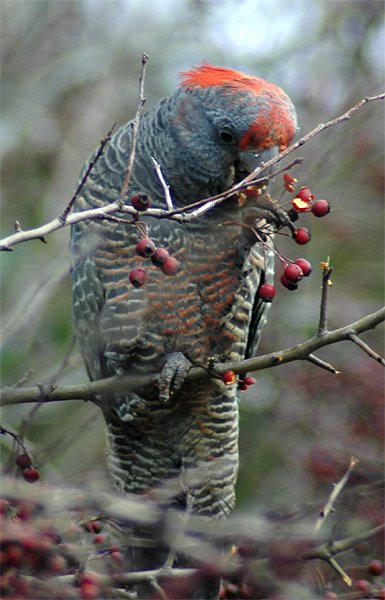
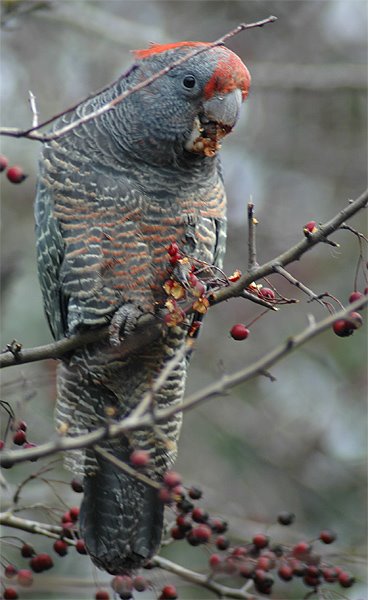
Note she is using the left foot to hold the food.
![]() | ||
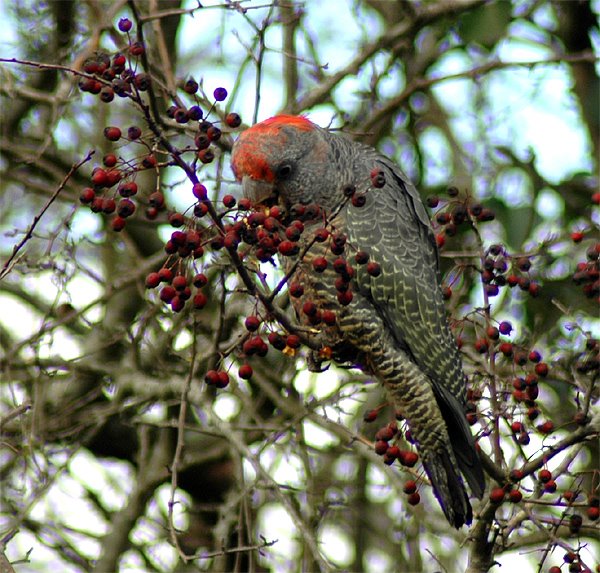
| Female Gang-gang Cockatoo eating Hawthorn Berries |
| This male is also holding his food in the left foot The tendency to use the left foot is noted in the Birds in Backyards information on this species. (See the box: "Did you know" below the map on that site) ![]() |
| Male Gang-gang Cockatoo also eating Hawthorn berries. |
![]() |
| A flock of Gang-gangs in a Hawthorn tree |
Tuesday, March 03, 2009
Some photos from the NPA walk to "The Grotto"
Here is an opening flower of the Lambertia formosa. These seven long tubular buds split open, and the four sides of the perianth tube roll backwards, to about one fifth of the length of the flower. That leaves a long style protruding from each flower. As you can see here, the "style" is still covered when the bud is still unopened. These flowers are the brightest flowers in the Sandstone bush around the Southern Highlands at present. The Honeyeaters and the Rosellas and Gang Gang Cockatoos love these flowers which are full of nectar.
This juvenile Eastern Spinebill, was sitting very quietly in a shrub beside the track. Unfortunately my photo was not very clear. But it was unusual enough that I felt it worthwhile showing at small size. The adults have very different markings, with a white throat, black "v" shaped mark on the chest. The white tail feathers (on the outside edge of the tail) are clearly visible. Spinebills (a type of Honeyeater) are very common in this patch of sandstone scrub.
Here is a photo of a single flower of Fieldia australis which was growing underneath the waterfall. It superficially resembles a correa flower, but it is not closely related to those plants. It is related to Gloxinias, and African Violets.
Here is a photo of a half-opened Banksia paludosa flower head (inflorescence). There are several points of interest. The most obvious thing is that the individual flowers open from the bottom upwards, sequentially. The brownish "match-heads" are the unopened tepals of the flowers. These flower buds are in pairs, arising from a common point on the stem. The fine points of the brush at the lower part of the flower are the "styles" in the opened flowers. They are all bright yellow, still being fresh with pollen. In this species these "stules" are straight, except for a slight bend near the point. By contrast, the commonest Banksia species in this area, Banksia cunninghamii, (generally referred to as B. spinulosa) has what are referred to as "hairpin" shaped styles. Note the Honey Bee enjoying the rich source of nectar.
This is a Red Spider Ant (Leptomyrmex rufipes) (or else a closely related species). There were several of these ants running around on the Banksia flower, which clearly was producing lots of nectar. You can see that the flower head was in the process of opening - and so the flowers were clearly very fresh. These Ants are distinctive in that they have very long legs, and they hold their black abdomen reversed, held high over their thorax. The red head is distinctive. These ants were moving very quickly, using their long legs to run over the top of the buds of the unopened flowers. Half a dozen of these ants had left the flower by the time I had changed lenses to get a close shot. This ant left the flower before I could get a second (clearer) shot. That is a fast moving ant.
While we had lunch down beside the river, below the waterfall, some members of our group found this leech, which climbed onto this piece of wire. The red and yellow markings become much more prominent, if the Leech manages to attach itself to a "victim" and engorges itself.
We had all prepared ourselves for Leech attacks, as my colleague Alan had taken home a Leech with him, just a few days previously. Nobody wants to be bitten by a Leech, except a recent shark attack victim.
Tuesday, June 03, 2008
Gang-gang Cockatoos in Glenquarry Hawthorns
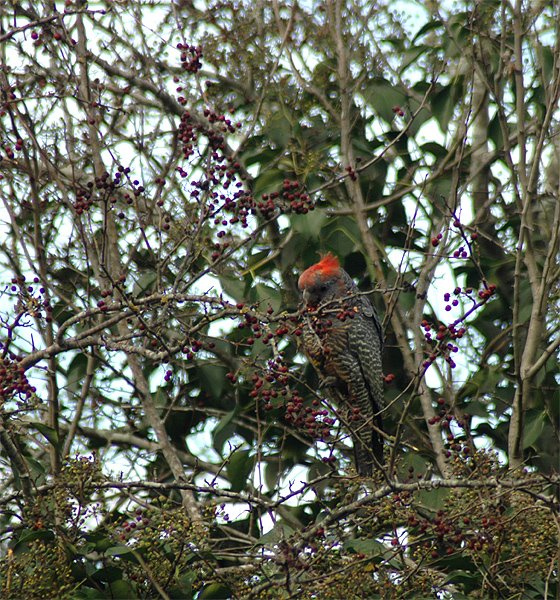
Last Sunday, Bernie and I were driving (Bernie was at the wheel) along Tourist Road and I spotted these birds. Bernie, (not being used to driving with a fanatical birdwatcher as passenger), was slow to react to my call, and by the time he realise I wanted to stop, we were well past these birds, and heading into a series of tight bends along Tourist Road. No place to stop there. Coming back about half-an-hour later, we slowed down, and sure enough this flock of Gang-gangs was still there, munching their way through an enormous feast of Hawthorn Berries. They are like that. When they find a good food source, they just sit there, happily feeding themselves.
There are 15 Gang-gangs in this one photograph, (some are hard to see in the small scale image
as they are at the back of the tree, facing away). 5 of these birds are mature males. I love the friendly female (low, at left) who was feeding on a seeding Hawthorn. She let me walk slowly to within about 3 metres, before she flew to the main tree.
It was at that point that I got out and walked across the road, to take these photos. Of course, I did not have my long lens with me (Why not?). So these are the best images I could produce. Yet another photo opportunity missed!Of course, from a weed control point of view, these Gang-gangs are contributing greatly to the spread of Hawthorns. But they do also provide very wonderful opportunities for birdwatchers to get a really good look at Gang-gangs, "up close and personal".
This flock of birds is almost certainly the same group as I saw several months ago, taking refuge in the large gum trees further down the road into Glenquarry, after the SCA's burn-off. I mentioned then that this species is classed as "vulnerable" under the NSW Threatened Species listing. That is an example of why I was so cranky at the SCA for the negligent manner in which they conducted that burn-off, not burning on a "mosaic pattern", (where they are supposed to leave unburnt sections of forest), as recommended by the Dept of Environment and Climate Change in its very thorough study of the "Terrestrial Vertebrate Fauna of the Greater Southern Sydney Region". At least these birds are safe, at present, but this food is not their natural diet (although they do love it). More importantly, they cannot nest in this open farmland habitat. They need tall Eucalypt forest for a year-round food source, and for nesting.
Thursday, March 27, 2008
More about Gang-gangs in Glenquarry
I still have not managed to get a really good photo of the males (I assume that this is because they are self-conscious, and know their red heads make them highly visible.)
However, a female and her two youngsters were more co-operative.
The female bent down from above, to feed the first of the youngsters. There is a strange "machine gun" sound as the female regurgitates the food to the juvenile. I am not sure which bird makes the noise. But the youngster holds out its wings, shaking them, as part of this begging/feeding process. Sorry about the poor image quality, but it is an event worth reporting.
Regarding the SCA's Special Area restricted access policy, here is what the local Wombats think! This poo was carefully placed (by a Wombat) on the SCA gate across the former Diamond Fields Road, (from Tourist Road) Kangaloon, as seen today.
As they say in the Theatre: "What a critic!"
Sunday, March 23, 2008
Gang-gang Cockatoos in Glenquarry
His brilliant red head is very distinctive.
Recently the SCA burnt off a large area of the bushland in the "catchment" area. This is the supposedly "protected area" (Special Area A) which is "supposedly" under their "protection". This area is known to include many Endangered and Threatened Species, including the Mittagong Geebung and the Gang-gang Cockatoo (Callocephalon fimbriatum), which is listed as "vulnerable" on the NSW Threatened Species listings. Plants such as the Mittagong Geebung are not able to fly away, in advance of a fire. Ninety percent of the known plants of that species in the area have been burnt. At least the Gang-gangs are better equipped to escape fire.Since the burn-off, a large group of Gang-gang Cockatoos, about 25 in all, have started hanging out in a deep gully along Tourist Road, in Glenquarry. There are numerous large Brown Barrel Eucalypts (Eucalyptus fastigata) and also some huge "Manna Gums" (Eucalyptus viminalis) here.
A magnificent specimen, in Glenquarry.

A female Gang-gang peering at me, from the safety of a tall Brown Barrel Tree. Females have a rose-coloured wash on their chest and abdomen. 
This post has been coming for a few days now. As Tourist Road is very narrow in Glenquarry, many people, such as James, saw me taking these photos. Other friends such as Lucy and Kim (for whom the Gang-gang is a very special bird) know that I was writing this blog post. And Joe in Florida likes reading about our Australian parrots.
Friday, June 23, 2006
The Nature of Gang-Gang Cockatoos
Over the last few days, I have had to drive to Bowral several times, and I have driven along Sheepwash Road and then, Kangaloon Road. Just past Sproule's Lane (on the left, as one is heading towards Bowral), there is a large stand of Hawthorn Trees, which are heavy with berries.The Gang-Gang Cockatoos (Callocephalon fimbriatum) have been hanging out there consistently, in the last few days. Look for them, as you go up a short, steep hill, just on the Bowral side of Sproule's Lane.
These birds LOVE Hawthorn berries (and other similar berries, such as "Washington Thorn", and other related plants). Let us not get hung up on the names of the plants, for they are confusing, at the best of times. Many photos of the Gang-Gang show it chewing Hawthorn berries. It is one of their favourite foods, in season. And this is the season.
A Google Search tonight revealed a recent declaration by the National Parks and Wildlife Service that lists the Gang-Gang Cockatoo as a "vulnerable species". It makes interesting reading, and it even mentions (in clause 7) a specific threat to the population in the Bowral area, from a contagious disease to which these birds are susceptible.
I was surprised to find, when I photographed these birds today, that they were all immature males. They are developing their red heads, but have not yet properly developed the full "Mr Curly" type of crest, for which these birds are famous. Why all these immature birds together, and no adults? I didn't know.So, I was interested to note that in the background information on the species, in the NPWS declaration (linked to above) it says: "In winter..... the species may be observed in urban areas including parks and gardens (Morcombe 1986). The species in general, and creches of young birds in particular, undertake nomadic as well as seasonal movements ...." (Clause 3).
Source: NSW Scientific Committee listing advice
So, there is my answer - I had found a Kindergarten Class of young Gang-Gangs, learning the joys of eating Hawthorn berries.
Interestingly, when Gang-Gangs are feeding intensively on berries like this, they will often allow the observer to approach very close indeed (as may be determined from my photographs). And they were sitting in these trees, right beside Kangaloon Road, with cars and trucks whizzing past, barely 3 metres away.Gang-Gangs love their food, and when they are eating, they are remarkably calm, and placid. I love the Gang-Gang Cockatoo, but a male., with his full scarlet crest is even better than these youngsters.
Here is another link, which shows a pair, with a grey-headed female, and the scarlet crested male.
Tuesday, January 17, 2006
Persoonias puzzle the "Geebungophiles"
However, the Persoonias are flowering now. They have tiny yellow flowers, but they are, for some reason, some of my favourite plants.
They are an odd bunch, within the Proteaceae Family. They have small, yellow flowers which are almost tubular in shape, which then open back with 4 symmetrical curled outer segments, leaving an inner tube which also curls back in 4 segments, leaving a "prominent style" protruding up the middle of the flower.
That "style" leads to the ovary. Like many of the Proteaceae, the "style" persists as a dried point protruding from the fruit or seed capsule. In the case of Persoonias, their fruit are small oval "drupes" - a fleshy fruit with a small hard stone inside it. Each has a small "point" which is the dried remains of that "style".
These fruits have a place in Australian literature, as they were called "Geebungs" by the early settlers (presumably derived from an Aboriginal word). They were, inadvertently, the source of the name of the "Geebung Polo Club", immortalised by A.B. "Banjo" Paterson.
In the sandstone country below Kangaloon, and Glen Quarry, one finds a number of species of Persoonia. The most obvious is P. levis, which has large flat leaves and a bright green colouration. Its colour makes it stand out amongst the grey-green colours of the Eucalypt forest. The next most obvious species is P. linearis, a tall shrub with soft, narrow leaves. It often has a weeping habit. Then, along the side of Tourist Road, where the original scrub has been slashed to create a fire break, one commonly finds re-growth of an interestingly "hairy" species, P. laurina, which has rusty-brown hairs all over it. Its new growth is tinged this rusty colour. Its leaves are soft, flat and oval shaped. A more unusual species is P. lanceolata which has elongated oval leaves. *(Edit) There is also a closely related species, with a distinct bluish tinge to them. That is in fact Persoonia glaucescens a Federally Listed Vulnerable Species. At first glance it could be mistaken for a small Eucalypt.
The next two are oddities. Persoonias are either great hybridisers, or else, the Botanists cannot really make up their minds about them. Some Persoonias have a distinctive rolled-under edge to their leaves. One such species is P. hirsuta. (Ed: See Erratum comment below - this reference should be to P. mollis DJW 28.2.06) It is said to be "variable". That is an understatement. One I saw today looked like a scaled down version of P. linearis, with narrow leaves, but with the tell-tale rolled edge to the leaf. Around Carrington Falls (10 Km south-east of Robertson) the local P. hirsuta (?) form there, (Ed: in fact, P. mollis. DJW 28.2.06) has oval or rounded leaves, half as long and twice as wide as this plant I was looking at today. Who is to know exactly what they are? I am far from confident of my identification of either of these forms of Persoonia.
Finally, there is a common prostrate Persoonia in the Kangaloon area. It forms bright green mats of foliage often more than a metre wide. Its leaf shape is almost diamond shaped, about 5 mm long, 3 mm wide. It does not meet the general descriptions of P. oxycoccoides, but that plant is the closest fit I can find. It is also described as "variable" in leaf form.
The fruit of the Persoonias are edible, but not very nice (to my taste). They have a sticky textured gummy flesh, with a hard stone, like a cherry pip, inside them. However, Gang Gang Cockatoos absolutely love these fruit. These birds will often sit quietly in a large Persoonia shrub, and will allow you to approach them, quietly, until they decide it is time to fly away, making their characteristic harsh creaking sound.