Christmas Bells

Christmas Bells
Christmas Bells - Blandfordia nobilis

Tuesday, December 04, 2007

Another Sun Orchid on Tourist Road

In the last few days, I have found a batch of tall Sun Orchids, growing down in the Kangaloon area. These plants are very strong growers. Some of which have been pollinated already (but the books refer to self-pollination occurring). But others are still in bud. However, like many Sun Orchids, they are shy to flower. The weather of the last few days has been sunny, and warm, but not really quite enough to persuade these flowers to open properly.
I managed to find one flower opening up (just). But, it was enough to see the distinctive column, and the so-called "post anther lobe", and the column arms.
This flower has a very short "post-anther lobe" (the structure behind the column), which is distinctively pinkish. The yellow column is clearly visible in the photo below. The "column arms" are very densely brush-like, and a clear yellow.
The plants are very tall - the tallest Sun Orchids I have seen, probably up to 800mm high. And they are growing in a wet peaty swamp (there is free water lying in patches). And the flowering time is later than any other Sun Orchids in the area.

This annotated photo shows the height of the plant, the large green leaf curving off to the right, from the base of the stem, and two so-called "sterile bracts" on the stem. All these details match the description of Thelymitra circumsepta, the so-called Naked Sun Orchid. I will keep monitoring these plants over the next week, and see if I get a nice hot, sunny day, which might prompt some more flowers to open.

Christmas Bells - early arrival - 2 December 2007

Yesterday, I found my first Christmas Bells of the season. It was much earlier than one I found last year, at Butler's Swamp. That was in late-January.OK, "one swallow does not a summer make" - but it is always a thrill for me, to see Christmas Bells (Blandfordia nobilis). Obviously they appeal to the child in me. I recall reading about them, first, in Vance Palmer's "The Passage". And they are so strongly associated with the Christmas event, even if their timing is a bit "flexible". As an old Canberran, I appreciate the fact that they do not grow in Canberra - except in the Botanic Gardens. Here, in the Southern Highlands of NSW, they grow wild in sedge grass and heathland.

Such wonderful vibrant flowers in a sea of otherwise dull-looking grassy foliage in an "Upland Swamp".The photo above was photographed from the car, for the plant is growing not far from the road, out at Budderoo. OK, I used a long lens, but still is is just a few metres off the road. Here is a close- up image of this wonderful flower.
Another plant of the wet sandstone areas is the spectacular red Bottlebrush, (Callistemon citrinus). This one was growing at Tourist Road, Kangaloon, in bushland, adjacent to a wet swampy area. It also grows at Budderoo.Here is a Grass Tree (Xanthorrhoea resinosa) growing at Butler's Swamp, Kangaloon. The habitat here is similar to, but not identical with, the area on the Budderoo Plateau. Both places are classed as "upland swamps on sandstone".
Here is a photo of the stem of another Grass Tree, which is just coming into flower. It is interesting to note that a single stem of the Grass Tree has many hundreds of flowers. And also, their positioning is not random, not radial, around the stem, but has the two diagonally intersecting spiral patterns.Those intersecting spiral patterns, although not obvious at first glance on this plant, are there if you look carefully. Look for a steeply angled line from bottom right to top left; than look in the opposite angle, for a shallower spiral line, going up from bottom left to top right.
That is typical of the arrangement of flowers on compound flower structures, such as the native Isopogon or the domesticated Sunflower. This pattern is defined by the ratios of "Fibonacci Numbers". Here is the Isopogon - for a classic Fibonacci numbers demonstration.Back to the Grass Tree, at mid-distance the stems are quite beautiful, with rich, waxy white flower buds bursting from the dense brown fibrous matting of the flower stem.And finally, two individual flowers, in close-up, bursting out like tiny crowns, much as the wonderful Michael Leunig might draw a king's crown - a little bit bent and twisted, but natural.

Monday, December 03, 2007

A spectacular Spider.

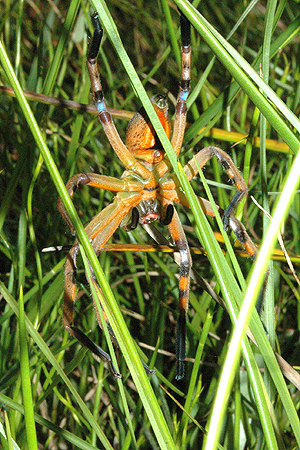
The surprise of the day, yesterday was to find a really colourful Huntsman Spider. Not only that, it had just shed its former "skin" (exoskeleton), so I had found it at a significant moment in its life as well. The colours were really bright, but very likely that was because it had just shed. My camera appears to have recorded a slight colour change, over just a few minutes. So, perhaps it was beginning to fade, slightly, as the fresh skin was exposed to sunlight for the first time.
I have never seen such a colourful large spider as this. Naturally I gave it some space, as I was not quite sure what kind of spider it was. But it appeared quite docile - probably as I had come across it at this critical moment of its life. It makes me think that spiders are presumably quite vulnerable at the moment when they shed their skins.In the range of colourful spiders, few exceed the "Jewelled Spider" - an old friend of mine from my time in Canberra, where it seems to be quite common. The web is quite well constructed, in a vertical angle, with a gentle sweep, like the sail of a yacht. Here is a close-up of the upper side of the spider. Black spurs at rear, and red legs in front. I was pleased to find this one yesterday, on its web which was spun between the tips of several Rushes, in a marshy area, in Kangaloon, along Tourist Road. This is the underside of the spider, which shows more yellow colour. The rear spurs are visible on the left, and red legs, and two small yellowish fangs at the far right. I am not sure what the large round yellow mark is in the centre. Presumably this is where the mouth is located.Here is another colourful creature, a fly with wonderful green eyes. I believe it is the "Flower-feeding March Fly". (Scaptia auriflua).And speaking of flies, I was being "buzzed" by these really loud flies. I mean the noise of their wings was really loud. They would zoom around, then pause, hovering, for a few seconds at a time, then disappear in a flash. I have never observed this behaviour previously. I tried a couple of photographs, with very little success. But the image of the body is clear enough to show several diagnostic features (which I could not see with the naked eye). The black abdomen, with white spots, and the way that the two rear legs trail out, in flight.I am indebted to the amazing Chew Family, in Brisbane for their web site which has a set of extraordinary photos of this Fly. From their excellent (amazing) photos I am confident that I was being buzzed by the Lygira Bee Fly (Lygira satyrus). Apparently it is a flower- feeding fly, so despite my concern at its aggressive buzzing, it is probably a pacifist by nature (unlike those nasty stinging March Flies).

These spiders and flies were all photographed within a distance of about 50 metres from each other, so, you could assume that nature is in balance in this area.

Saturday, December 01, 2007

Blue Wren and Lemon Migrant Butterfly

It was another confusing day in Robertson, today. It started clear. By early afternoon, it was drizzling, with a thick wall of fog hanging just outside of the village, out beyond the Pie Shop, and at Steve and Celeste's place, on top of Mount Murray. By this evening, it had cleared up completely, allowing an outside film show to go ahead at the CTC.
Meanwhile, late this afternoon, in the moist air, the little birds were having a field day in the shrubbery adjacent to my house.The male Superb Fairy-wren (Malurus cyaneus) (OK, OK, its a "Blue Wren") was inspecting the fine details of the shrubbery, looking for insects. But he missed this Lemon Migrant Butterfly (Catopsilia pomona) which was very quiet, just hanging from the bunch of flower buds on a Cassinia bush. His pale yellow colour, and lack of movement gave it sufficient camouflage to escape the attention of the Wren.

Friday, November 30, 2007

Snake, Dog Haircuts, and a big, big Fly

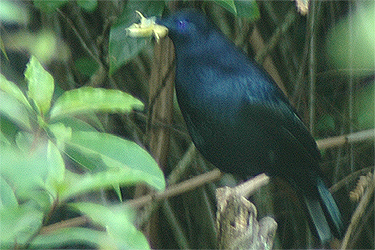
Thursday 29 November was a day of varied interests and activities. There was a male Satin Bowerbird calling actively, near its display "bower" in George's yard. It was carrying something in its beak, which I cannot identify. Presumably it is part of its "display" routine. Pardon the poor quality image, but it was photographed at long range, through a pane of glass. It is rare to get a chance to photograph a "blue bird" as they are pretty secretive. So this one, with some display material in its beak was definitely worth trying to record.
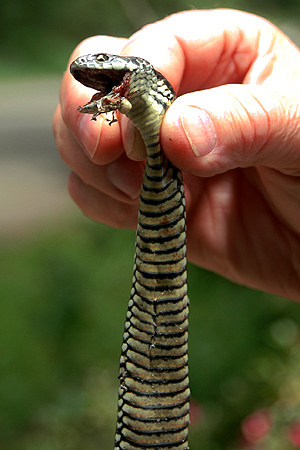
As you will know, I seldom publish photographs of "road kills". The following snake images are published not for "ghoulish" interest, but for educational purposes. It is to show that local Copperheads (a terrible misnomer, by the way) are distinguished by their small heads (relative to body size); the yellowish scales underneath, which can usually be glimpsed along the side of the snake, (i.e., when the snake is live, and normally lying flat on the ground). In the first image you can see the edges of the belly scales visible on the side, along the first one third of the body length. In the local Robertson Copperheads, the back (upper side of the snake) is usually a dark slatey grey, which is NOT SHINY. In the Southern Highlands, if you have a shiny "black" snake, it is likely to be a Red-bellied Black Snake.

Firstly, I discovered that a Copperhead Snake had managed to get itself run over in George's driveway. Seeing as the driveway is very short, and steep, (therefore it is a slow speed driveway) the Snake frankly must have been pretty careless in getting itself run over. I am sure my friend George is a careful driver (and unlike many locals, he respects Snakes), so the snake was probably killed by being backed over, at about 5kph, as George reversed out of his garage, and up the steep drive. As I said, probably a careless snake.


Then I went over to Steve and Celeste's place, to try and clip Lena, the Mini Schnauzer, and Edith, the Poodle Dog. We had some problems, as the clippers were not very sharp, and when we tried to change the blades, we could not get the new ones to "click into place" (as they are supposed to do). And the blades on my clippers are in need of sharpening, or replacing.
Anyway, Lena eventually got more or less "pruned". Edith got "Poodle Toes" (clipping around the feet, up to the ankles), and had her muzzle shaved. Suddenly she looked more like a"proper poodle". There had been some debate as to what her real breeding was, as she looks quite like a Bedlington Terrier, we think.
After the grooming session, both dogs went a bit crazy, dancing around, with Edie nipping at Lena's feet, or her bottom. Lena would then retaliate, and chase Edie, and so it would go on, round and round. Their "play" was quite good natured, despite appearances. Eventually we separated the dogs, just so Lena could rest in the car, free from hassles.Their chosen "playground" was an area of excavated Robertson red basalt soil, where Celeste and Steve are building a new studio. You can see why both dogs need the have their hairy feet trimmed, to minimise the amount of red dirt which they collect on their feet.

Earlier in the afternoon I took the opportunity to photograph a very large March Fly which was inside a window. From the look of this fly, it is what I would have called a March Fly. But the Museum Australia website indicates that this might be an Eastern Golden Haired Blowfly, Calliphora stygia (Family Calliphoridae).
From the underside you can see the huge mouth piece. True March Flies, (or Horse Flies) can inflict a painful bite with their mouths.
The Chew Family's website (from Brisbane) indicates it might in fact be a "Flower-feeding March Fly", not the blood sucker I had assumed. Either way, with the large mouthpiece, I would not trust this fly not to be a stinger. But, I am not an entomologist.

Incidentally, the silhouette photo shows remarkable detail of the legs and feet, the two antennae on the front of the head, and the wing pattern. (Click to enlarge).

Wednesday, November 28, 2007

Robertson Village Music Society

Today I attended a very pleasant Chamber Music concert, put on by the Robertson Village Music Society.
The concert started with performances by Bellatrix (a recorder quartet) The members of the group are Alana Blackburn, Laura Bell, Alicia Crossley, and Felicity Clark. They performed a range of pieces from the baroque to modern.
Here is an image of Laura, playing a Bass Recorder.
They were followed by a violin duo - April Kelson and Jamie Pollock.
After an interval we heard Gabriella Pusner who performed Beethoven's Sonata in A Major for violin and piano (Op. 23), in conjunction with Jamie Pollock (on Violin).
Then Gabriella combined with April Kelson to perform Brahms' Sonata in D Minor for Violin and Piano (Op. 108).I found the Beethoven familiar (at least in style), but I was quite taken by the Brahms piece with which I was not familiar.

Robert Goldsack is very pleased with the sound of the Kawai Grand Piano, which the Society has acquired.
The Robertson Village Music Society will host visiting concert performers four times a year, on the last Wednesday of February, May, August and November. Inquiries may be made to Robert Goldsack, of Meryla St.

Tuesday, November 27, 2007

Still, foggy days again, or still "still, foggy days".

Well, how should one describe this weather? It is still and foggy outside. It was yesterday, and on Sunday, and on Saturday (election day), and probably was before that too. So I think I am entitled to declare that it is still "still and foggy". Apparently Melbourne has had some bright sunny weather, and even a bit of hot weather last week. Not here.
Melba the mobile grass-cutter, who lives in my bottom paddock does not seem to mind the weather. Fair enough, it makes the grass grow for her. She is a white Welsh Mountain Pony, stained to a very fetching "Champagne" colour, by the red soil of Robertson.
The birds are perfectly happy in this level of wetness. They seem quite able to keep up their feeding, and the Blackbirds (Turdus merula) and the Grey Shrike-thrush (Colluricincla harmonica) absolutely love it, judging by their loud and seemingly cheerful calling.

The Crimson Rosellas (Platycercus elegans) get a bit bedraggled, in the wet, as they are seed eaters, and spend a fair part of their day on the ground, or close to it. And they have silly short legs, and a long tail, which means their tail-feathers drag on the wet grass and get damp. Here are 2 Crimson Rosellas sheltering from the rain. The photo was taken last January, but the reality is the same.Yesterday a male Superb Fairy-wren ("Blue Wren") (Malurus cyaneus) was out and about, flitting through the shrubs, looking for food. I think there is very likely to be a nest down in the long weeds below the house.