Christmas Bells

Christmas Bells
Christmas Bells - Blandfordia nobilis

Monday, January 16, 2012

A walk (climb) down to Fairy Bower

Regular readers will recall that I had a Hip Replacement Operation on 1 December 2011 (I am indebted to Greg for pointing out that I originally wrote 2012) Silly me - the Hip was not installed by Dr Who!

Yesterday I celebrated by walking 1.2 Km (horizontal distance) and 180 metres vertically (altitude) to go 600 metres from the Fairy Bower car park to the top of the Falls, and a further 600 metres, to negotiate the seriously steep access track to the bottom of the Fairy Bower falls. This is part of the Morton National Park, accessed via Bundanoon, NSW. 

Of course, I had to do this both down and up (the distances and height of the climb therefore has to be doubled). My hip came through fine (remarkably well, in fact) but my thigh muscles are sore from the unfamiliar exertion. But rest and good a soak in an Epsom Salts bath will help ease that.

There were two well placed chairs on the way up. I was not too proud to take a "Nanna rest". I needed it, and was glad that NPWS had bothered to position these seats in strategic rest points.

If you have "Google Earth", try opening this "Placemark" link to Fairy Bower Falls, Morton National Park, Bundanoon, NSW.

My trusty walking stick proved invaluable, especially on the old, steep and slippery old cut rock steps.
I am often amazed at the human effort which is evident in these tracks and steps being sometimes cut into the rock faces, and in other cases, cut rocks being positioned as steps sitting in place, often dug into sandy soil, or deep leaf litter, on 45 degree slopes. No photos of these were taken, as I was too tired and too busy hanging on, as I stepped carefully down or climbed back up.

The more modern style of pressed metal platforms, are wonderful, but presumably they are massively expensive, as sometimes they must be lifted into place by helicopters. All credit to the engineers of the NPWS and to the pilots, for that work.

While there is a track which take you to the bottom, there is no way I was going that far.
Bottom of the falls will do thanks.
View across the Bundanoon Creek valley (and a glimpse of the ravine at the bottom)

Looking up to Fairy Bower Falls - top section.
Fairy Bower Falls - lower section
On the way back up to the top I decided to take a few images (to give me a reason to rest), and to enjoy the beauty of the Fairy Bower walk.

One of the metal walkways below a sheer rock wall.
 From one of the steel walkways I was able to get this view up a wall of rock, covered with these amazing orange crustose lichens. I have seen them before, but never as fine a display as this. The site was a sheltered angle of the rock face, seldom in full sunlight. And obviously, it is in a moist gully, with high rainfall.
Wonderful red crustose lichens on sheltered side of sandstone rocks


Female Lyrebird seen track near the Fairy Bower car park

Cropped view of female Lyrebird.

A wonderful rock beside the Fairy Bower track back to the carpark
My friend and fellow Orchid enthusiast Alan Stephenson was with myself and some others on the trek to the bottom of the Fairy Bower Falls. Alan has shared with me several photos which I meant to take - but was too nervous (on the way down), and too tired on the way back up.

Above the Fairy Bower Falls, the track takes you over the tiny creek. Obviously there is a local tradition of making tiny little "water wheels" using sticks and stiff leaves. These have been positioned into little groves cut in the rock, in a "water race" which has apparently also been cut into the rock, to provide a steadily flowing stream of water, even at times of low flow in the creek. It works just fine.

I was really captured by the thought that this is a local tradition to manufacture these little "engines" (as "toys"). They are doing no "work", other than spinning round, to amuse us. But what a simple demonstration of how a water wheel can work.
Three natural "water wheels" made with sticks and leaves.

You can see the grooves where more of these "toys" have been placed before.
Alan, being Alan, also sent me a few images of Chiloglottis seminuda which he found on part of the walk which I bailed out from doing. A nice specimen too, although I am surprised that it was growing in such a wet forest.
Chiloglottis seminuda - photo courtesy of Alan Stephenson
I am hardly going to claim to be a "bushwalker", but I have been bragging about this walk all day. No only was the "achievement" very satisfying, the location was great, and a wonderful bit of wet forest under the falls, and nice sandstone forest above.

Thursday, January 12, 2012

More on the Elbow Orchid

Too late, too tired to write much more - I covered this Elbow Orchid discovery in some detail yesterday.
Here is the underside of the labellum - Elbow Orchid

Close-up of Elbow Orchid flower.
 Interestingly, one of the flowers was closed over, as in the "pollinating position".
But there was no insect involved.
The day was extremely windy, 
so that movement might have triggered the flower to snap closed.
Elbow Orchid in closed-over position. No insect involved.
 I took Alan Stephenson to see this tiny Orchid.
He agreed it was ridiculously hard to find, hard to see.

Alan Stephenson photographing the Elbow Orchid.

Tuesday, January 10, 2012

Elbow Orchid - a first for me.

This insignificant-looking Orchid (as in hard to see amongst the grass) was growing beside a track at Fitzroy Falls. NSW. That is part of the Morton National Park, so naturally I have taken steps to report it to the staff.
I have never seen this Orchid, before, but because it is so distinctive in its shape, I knew roughly what I was looking at, when I got down close to peer closely at it.

At first I thought it was a kind of Sundew with some dead insects hanging off the sticky bits.
But no, it is an Orchid.
As I first saw Thynninorchis huntianus - Elbow Orchid

"Common Elbow Orchid" Arthrochilus huntianus (re-named by Clements and Jones as Thynninorchis huntianus). "Thynninorchis D.L.Jones et M.A.Clem., Orchadian 13(10): 457 (Feb. 2002)". Originally it was in the genus Drakea, the related Hammer Orchids.

David Jones, in his Orchid book, says it is amongst the most specialised of all Orchids.
It is classed as a "leafless saprophyte", and as the new generic name suggests, it is pollinated by males of the Thynnine Wasp genus. The "elbow" structure allows the flower to move when a male wasp lands on it and tries to mate with the flower. That movement takes the wasp over to the pollen-housing, which is on the right hand side (of this flower), where the wasp would get a dob of sticky pollen on its head or back.
***** See note below, re the Tasmanian sister species.

You can see a video of this process in the related Hammer Orchids from West Australia. You can see how the hinged arm works, with the natural movement of the wasp. In this case (the Elbow Orchid), the Orchid flower is upside down, but that doesn't worry insects.

Thynninorchis huntianus - Elbow Orchid

Thynninorchis huntianus - Elbow Orchid

Full stem of flowers of Thynninorchis huntianus - Elbow Orchid

Another view of Thynninorchis huntianus - Elbow Orchid

Camera bag to give neutral background Thynninorchis huntianus - Elbow Orchid

My Orchid-chasing colleagues, Colin and Mischa have some wonderful photos of this species on their Retired Aussies site.

*****
Notes re the Tasmanian sister species explain the pollination process better than I can: 
"Male thynnine wasps (which give rise to the generic name), attracted to the flowers by a scent resembling that released by their flightless females, attempt to carry off the labellum (believing it to be a female wasp - DJW) for mating. In doing so, the labellum pivots on its hinged stalk, with the insect picking up or depositing pollen."
Source: Listing Statement for Thynninorchis nothofagicola (myrtle elbow orchid)

Sunday, January 08, 2012

Cryptostylis erecta (the Bonnet Orchid, or Tartan Orchid)

Cryptostylis erecta is a Tongue Orchid, but it is better known as the "Bonnet Orchid", or the "Tartan Orchid".
It tends to grow in coastal areas, but is known to occur in the Blue Mountains as well. But when I went out with Alan Stephenson the other day, to Leebold Hill (Cambewarra Range Nature Reserve) above Kangaroo Valley, I  said to Alan that I was hoping to find the Bonnet Orchid. It may occur in my immediate area of Robertson/Kangaloon/Fitzroy Falls, but I do not know of it growing there. Hence my interest in looking for it, on the wonderful high ridge above Cambewarra, and Kangaroo Valley. The habitat is similar to my local sandstone plateau areas, but it is warmer and wetter over there. The altitude is similar, but the Shoalhaven Valley region has a climate all of its own.

One can see why it earns both common names.
Bonnet Orchid, for the shape,
and Tartan Orchid for the colour and patterns.
Bonnet Orchid Cryptostylis erecta


Here it is, as I first found it.
It is growing in moist mossy soil, amongst grasses and rushes
over a shallow rock shelf (exposed rocks in background).
Bonnet Orchid Cryptostylis erecta

A closer view, to show the shape of the flowers.
Bonnet Orchid Cryptostylis erecta
Here is another close-up of the flower.
Add caption
It is appropriate to mention that this species is the main one featured in that Video I linked to last week, about "sexual deception" of Wasps by Orchids. Video by Macquarie University people (as named in the Video credits). That previous post was primarily about a related plant Cryptostylis subulata

And just for the record, the botanical illustration on the PlantNET site, for this species, Cryptostylis erecta actually illustrates the pollination process in detail.
Click on image to see in full size. 
Note the wasp pollinating the top-right flower, 
and the "reproductive organs" of the flower drawn in detail.

Botanical illustration for Cryptostylis erecta (courtesy of PlantNET)

Saturday, January 07, 2012

Albino Magpie in Kangaloon

Today, at Kangaloon (dairy-farming country near Robertson)  I was able to get a photo of an unusual bird which I have seen in the distance on several occasions over three months. I had though that perhaps it was a Corella with a deformed beak (I supposed it might have severe Beak and Feather Disease, if it was indeed a Corella.) It turned out not to be a Corella, but an Albino Magpie.

Albino Magpie at Kangaloon 7 Jan 2012
I had never been close enough 
to get a proper ID of the bird, until today.
 
It turned out to be a large specimen of a Magpie, 
and quite confident. 
It walked across the paddock into the shade, 
where it was relatively close to me.

It has pink beak, pink legs and white eyes.
A dead-set full albino.
It was successfully feeding on large insect larvae in the paddock.
Albino Magpie successfully feeding in the paddock.
I spoke with a woman who lives nearby, and she knows the bird, and said it had been around for about 6 years.
 
It is apparently very "bossy" when it comes to dealing with other Magpies.
(She had hand-raised several foundling juveniles about 3 years ago, and this bird had "come around" while her charges were still being fed).

So, from that, we know that it is surviving OK in the field.

It is at least 4 years old, possibly as much as 6, though that requires further consultation with another property-owner.

Here are two other photos which Jill Keft sent me in 2008. The photos are possible even older than that. You can see that, compared to a standard coloured male Magpie, it is a relatively large bird.

Jill Keft's photo circa 2008, Albino and natural colour forms.

Jill Keft's photo of Albino Magpie, circa 2008
So, this bird is surviving well in the wild, despite the stories one hears of albino birds and animals having low survival rates, owing to their high visibility, and being ostracised by other members of their species.

Friday, January 06, 2012

Borrowed images of Pigeons and Oystercatchers

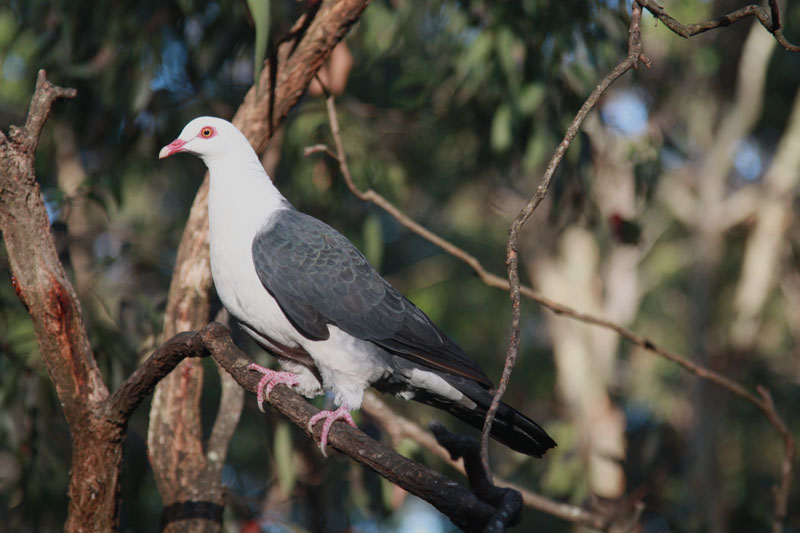
My brother Brendan has sent me some photos of some interesting birds he has seen recently. These were not taken in Robertson, although the White-headed Pigeon is a seasonal visitor here.

The first are some Sooty Oystercatchers, which Brendan photographed at Gerroa, NSW (south from Kiama, and north from the wonderful Seven Mile Beach) on 17 December 2011.

It is not hard to work out how these birds get their name.
They are dusky coloured,
and they pick their way around rocky shelves
looking for juicy inter-tidal snacks to eat (not necessarily oysters).
Sooty Oystercatchers (courtesy B. Wilson)

Sooty Oystercatchers (courtesy B. Wilson)

Sooty Oystercatchers (courtesy B. Wilson)
Here is the best image Brendan took, cropped a bit, to show its details.
Sooty Oystercatcher - a portrait (courtesy B. Wilson)

Lawrence Finn, Brendan's son-in-law, took some photos of White-headed Pigeons when visiting at Dalmeny recently. Here are the images he captured (reduced to make them web-friendly). As mentioned in the introduction, these Pigeons are seasonal visitors to Robertson, but these photos were taken on the Far South Coast of NSW.
White-headed Pigeon (courtesy L. Finn)
  This is a magnificent male bird, in fine condition.
White-headed Pigeon (courtesy L. Finn)
 Male White-headed Pigeon.
Females have a duller cap, 
and greyer (not shiny white) breast feathers.
White-headed Pigeon (courtesy L. Finn)
Thanks to Brendan and Lawrence for the use of these images.

Wednesday, January 04, 2012

A baby Stick Insect stuck to my head

Stick insects can "stick". Well, at least they can "grab hold" of one's head very successfully. 

Yesterday I was out at Medway, looking for signs of the Corunastylis sagittifera (Orchid) species which I have previously seen there. I found one small flower, severely deformed, because the stem had shrivelled at the base. This reminds me of  a fungal problem seen in many domestic "ornamental plants", including my beloved Peonies. But I know nothing more about it than that. I shall merely "report" the occurrence.
Corunastylis sagittifera, not fully open.
But while lying on the ground, to get the photographs, something quite large grabbed hold of my hair and my ear.

Now, I find such uninvited attention, from an unknown insect somewhat alarming.

I swept my hand across the side of my head, and watched to see what was knocked off (expecting a bloody great spider).

I found a harmless-looking green insect, which I assumed was a Katydid (simply because I guessed that it was not a Grasshopper). It has very small mouth parts, and small rounded eyes. (Have you ever noticed how Grasshoppers tend to have oval eyes, often set on a slight diagonal angle?)

So, I decided to take its photograph, and started by encouraging it to climb onto the base of my walking stick.
Podacanthus nymph (Stick Insect) on my walking stick.
It was remarkably cooperative with my endeavours to photograph it. No self-respecting Grasshopper would do that.

I had first wondered if it might have been a Katydid of the group of Katydids known as "Phasmodes" (even though they are reported only from Western Australia).

My fellow Blogger, and supposedly "retired" entomologist (they never do "retire" of course) Dave Rentz advised me: "It’s probably a nymph of a Podacanthus species. Of which there are a number in your area."

Thanks Dave, for setting me straight.

It still leaves me puzzling why it is that darned insects often look like other insects, even of different tribes (orders)? 

I placed the Podacanthus nymph on a Lomatia bush.
 
Podacanthus nymph got very excited, and waved at me.

Podacanthus nymph, with fine "tail end", and long legs.

Head of this Podacanthus nymph
We parted on good terms, and I waved it goodbye.

Thanks again to Dave Rentz for his willingness to share his knowledge.
Such assistance is greatly appreciated.