
Comerong Island is a long sand island, at the end of the Shoalhaven River.
It is in effect, the southern end of Seven Mile Beach.
The flow of the Shoalhaven River has been disturbed, historically, by the diversion of the River via a canal dug by the first European landowner, Alexander Berry. The Shoalhaven River's main flow now is permanently diverted via the Crookhaven River.
"Comerong Island has the largest remaining area of
littoral (coastal) rainforest on the south coast."
littoral (coastal) rainforest on the south coast."
 |
| Crookhaven River outlet of Shoalhaven River Comerong Island with sand beach visible front and centre |
The original opening was at "Shoalhaven Heads", but once the canal was
dug, the Shoalhaven River has ceased to bust open the sand dunes which
now block the original Shoalhaven Heads (some 5 Kms to the north).
 | |
| Shoalhaven Heads - as seldom seen these days. The beach is now continuous with Seven Mile Beach (which extends to the left as far as Gerroa). Comerong Island is just visible to the right. It goes for approx 5 Kms as seen in the image above. |
Here are some of the Fungi we found on Comerong Island last Sunday.
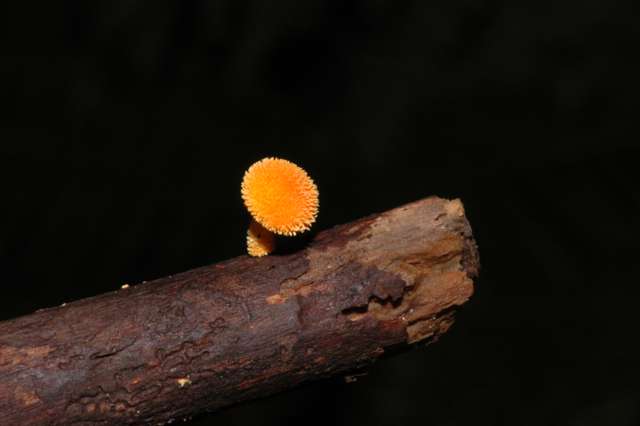 |
| A lovely small specimen of Cryptotrama aspratum |
 |
| unknown fungus Not sure if this was a severely decomposed Fungus, or a Slime Mould |
 |
| Lovely cluster of small kidney-shaped fungi with horizontal stems |
 |
| A small (4 cm tall) black fungus with no cap, but a solid fruiting body Possibly Geoglossum sp The leaves are of a Pterostylis, (Greenhood Orchid) |
 |
| A lump of soft, sticky yellow Jelly Fungus Tremella mesenterica It takes its name from abdominal tissues (mesentery) which separate key functional organs. In culinary terms, think of "tripe" (offal). |
 |
| Unknown gilled fungus with lovely chestnut colour Too pretty not to photograph even though I have no idea what it is. |
 |
| A young cap of Russula persanguinea These Russulas have distinctive stiff stems which snap like a piece of chalk. |
 |
| Possible Cortinarius sp. |
 |
| Stem of possible Cortinarius (as above) Note the prominent stem ring (annulus) |
 | |
| A wonderful moss-covered log with thousands of these small pale brown capped fungi Probably the best colony of fungi we saw. |
 |
| Interesting patterns in the upper cap of this little fungus. I love the "architecture" of fungi caps. |
 | |
| Possible Cortinarius perfoetens formerly Rozites foetens |
 |
| The underside of the same specimen above. |


