Christmas Bells

Christmas Bells
Christmas Bells - Blandfordia nobilis

Tuesday, July 25, 2006

The Nature of Anticipation

My friend and active Bloggista "Miss Eagle" has several blog posts she runs, on different themes. On one of her blogs, "The Trad Pad", is themed around: "Things that make life worth living: books and beautiful things, movies and music, furry things and gardens".

Several days ago "Miss Eagle" (over at "The Trad Pad") posted a blog around a poem by Catherine Helen Spence, a leading Suffragette and the face on the $5 note. The theme of the post was
a search for a suitable name for the in-between season, after the depth of the Australian winter, but long before Spring officially starts. The point is that Miss Eagle is seeing Wattles, Jonquils and early Fruit Trees in flower, in Melbourne - in July.


The issue Miss Eagle was addressing is the appearance of Spring,
without any cultural recognition of this reality (this in-between season lacking a name of its own). So, she set out to create a suitable name for this in-between season.

Anni has also posted about a similar seasonal confusion (under the heading: "As giddy as a baby on a swing" - a lovely poetic title).
*****
Anyway, to the issue at hand - the search for a name for this season. "Miss Eagle" suggested several possibilities: "The Harbinger" (which sounds nicely poetic) and "Newness" (which doesn't).

I suggested to Miss Eagle that a suitable word might be
"Risorgimento" an Italian word, which historically is used to refer to the re-building of the Italian nation. but the word itself means "resurgence". - which I think has the right "feel" to it for this season.

Anyway, I was teasing "Miss Eagle" (privately) about a phenomenon known only to Peony
growers (such as myself). But Miss Eagle has challenged me to publish what I told her. So, here goes.

Peonies are plants which are totally dominated by the seasonal change which occurs immediately after the Winter Solstice. As soon as the days start to get longer, the Peonies burst into invisible growth of their roots. Then, 4 weeks later (in Australia) they poke their shoots through the soil. There is an amazing sense of anticipation associated with this burst of growth.


"ANTICIPATION"
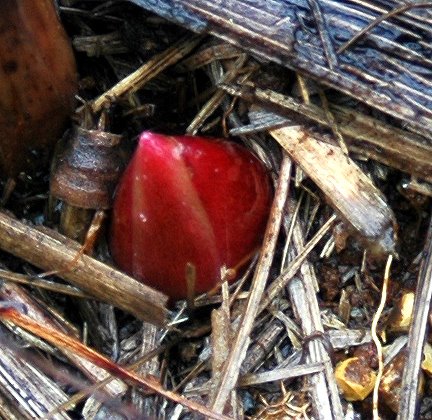
Every year, when this event occurs in America, the lady Peony growers, on email chat lines, etc, get very excited and refer to the Peonies "poking their little pink noses through the soil".

Noses???
Come on ladies, you can do better than that!!!

There is a certain shyness on my part about publicly giving this bud the most appropriate name, which would definitely be gynaecological.


Suffice to say that I am posting a somewhat "
clitoral" image to illustrate this story. I am being careful with my words, as I don't want to get "black listed" by "Net Nanny" (again).

I like the term
"Anticipation" for this season. If you wish to contribute your experience of this in-between season, or come up with a name for it, feel free to post a comment here, or better still, add your comment at The Trad Pad, where Miss Eagle originally raised the challenge.

*****
Here is the finished product - flowers of "Coral Charm". This is what the sense of "anticipation" is all about. (Photos from my "Peony Diary" which Anni kindly hosted for me last year, on her website.)

Monday, July 24, 2006

The Nature of Jim's Red Boxing-glove Lichens

When bushwalking with Jim, recently I found a clump of tiny lichens with brilliant red fruiting bodies. I nick-named these lichens as Jim's "Red Boxing-glove Lichens". These tiny Lichens are a maximum of 1 cm high.
(Click on the photos to enlarge them.)


Lichens are complex organisms. They are not plants, but are fungi,
living in a symbiotic relationship with either an alga or a cyanobacteria (depending on the type of lichen).

If you wish to see more photos of the world of Cryptogams (mosses, liverworts, hornworts and lichens) visit this link .

Some of the photography is stunning, and this is a world which few of us ever get to see in detail. This is part of the Australian National Botanic Gardens website - one of my favourite websites.


Quoting from the ANBG page on Cryptogams: "The non-fungal partner (or photobiont) contains chlorophyll and produces its own food. The fungus provides structural support and a fairly stable microenvironment for the non-fungal partner. Most lichens derive their shape from the fungal partner with the non-fungal cells often confined to a single layer just below the exposed surface of the lichen. The lichens also vary greatly in size, from tiny species to long, trailing species." (Cryptogams - panel 3)


My little red boxing glove Lichens, are seemingly close to the purple-topped species illustrated towards the bottom of page 9 of the Cryptogams site (scroll down the page).

So I (over-confidently) proclaim my specimens also to be in the "Metus" genus of lichens. (How would I really know?)

But I still think of them as Jim's Red Boxing-Glove Lichens.

*****

These are just some of the joys of going bushwalking in the local (Robertson) area. If you are interested to learn more about bushwalking - contact me, directly, (peonyden@bigpond.com) or check out the National Parks Association's Program of scheduled bushwalks for July and August 2006.
This Program covers bushwalks for all of NSW, but it includes walks in the Southern Highlands, and the Illawarra.

Sunday, July 23, 2006

The Nature of birds in grazing lands

This winter has seen a lot of gentle rain falling over the Robertson area. One group of birds which have benefitted are the birds which hang out in the grazing lands around the district.

Ibises (mostly the Straw-necked Ibis) have been seen regularly, this year, on the dairy farming properties along the Belmore Falls Road, just down the valley from my house. They also have been seen on the Hindmarsh Dairy, past the Robertson Show Grounds, and in East Kangaloon, (also on dairy farming properties).

This closer shot was taken in Canberra, several months ago.

These birds have long curved beaks and they spend hours at a time searching for grubs (in particular) in grassed paddocks, especially where cattle are to be found.

They force their long beaks into the soft ground, in search of these grubs. Their hearing is apparently very sensitive allowing them to track the grubs.

Other species are seen here too. I have seen just a few White Ibis on these paddocks. There is a White Ibis in this flock, and a White-faced Heron, (the grey bird standing upright).

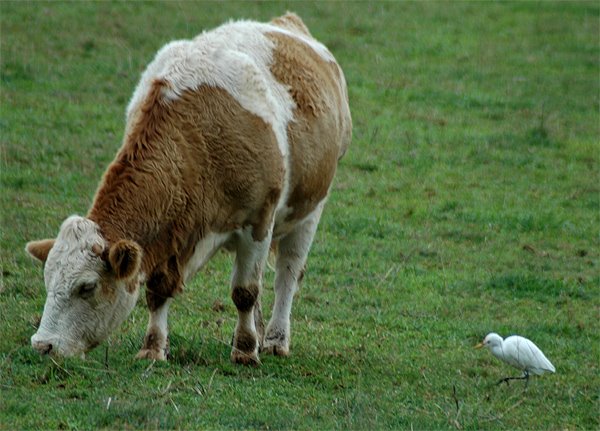
But last week there were 2 Cattle Egrets there. This is the first time I have seen Cattle Egrets in the Robertson area. I have seen them routinely in the much warmer Kangaroo Valley, just 10 Km away (directly), but an area with a "coastal climate", not a "mountain climate" as in Robertson. Unlike the Ibises, these particular Egrets hang out very closely with cattle, which disturb insects as they graze, and the Egrets pounce on the insects.

Last week I also saw a Pacific Heron (White-necked Heron) in the same paddock as the Straw-necked Ibis flock. I was interested to note that this bird is considerable taller than those Ibises.

I know it has a more upright stance than the Ibis, but it has a very large wing-span. It is close to twice the size of the White-faced Heron - (the regular heron of the area).
This bird is quite distinctive in flight, flapping very slowly, and with very dark wings, and a white chest and neck. But like most herons, it flies with its neck folded back into its body. Ibises fly with necks fully extended (plus their long beaks), so their flight profile is very different from this bird.

Saturday, July 22, 2006

The Nature of weather closing in

WEATHER COMING UP THE VALLEY

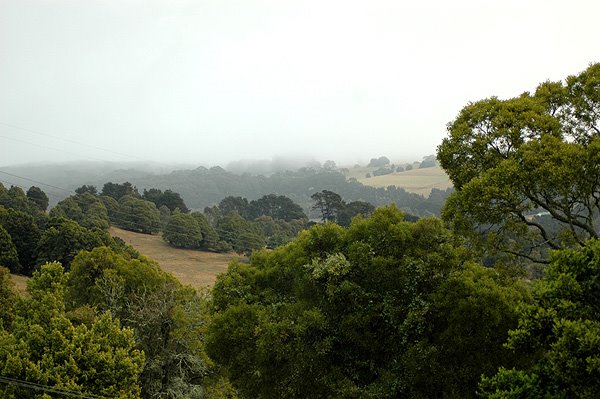
Last Thursday afternoon (and I'm writing on Saturday evening) I looked out the windows to the south and this is what I could see.

This is weather "closing in" on Robertson.


PEARSON'S LANE HAS DISAPPEARED

The sky was relatively bright (the sun being behind us, not yet masked by this wall of cloud).

The rain was sweeping up the hill, from the south, out of Kangaroo Valley.

The light was definitely unusual.

The fluffy grey clouds were masking the tops of the ridge opposite me (where Pearson's Lane runs). Giving it a flat topped appearance.


"END OF THE WORLD"
ROBERTSON'S CEMETERY HILL
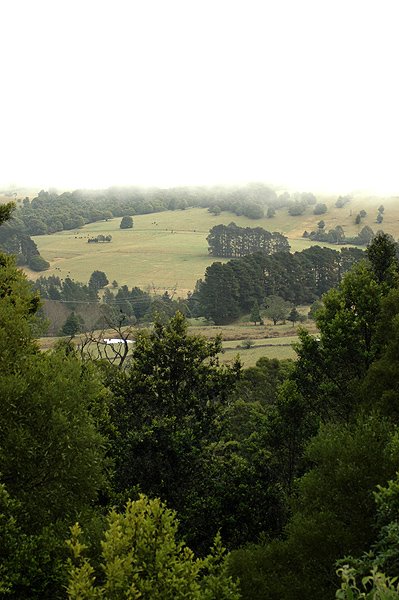
And looking down the valley, the world appears to stop beyond the cemetery (yes, I'm resisting those bad "dead end" jokes).

The tall trees on the "far hill" are at the cemetery - a mere 1 Km away.

They are clearly visible in my other distance shots, but with the wall of cloud beyond the hill, it suddenly stands out as the "end of the earth".


*****
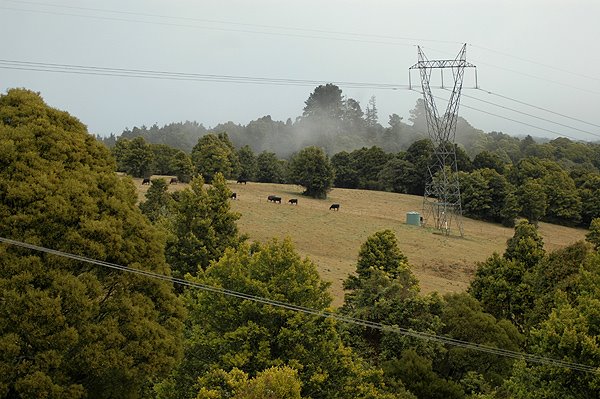
I just love the way clouds change one's perspective on the view, from day to day, or even from hour to hour. That's why I keep posting new inages of the same view - because it is never the same.

******
As it turned out, this cloud hung over us for 48 hours, and dropped a reasonable amount of gentle soft rain on us. We got 24 mm of rain out of this. It was during this episode of soft rain that I photographed those Black Cockies - the ones eating Pine seeds in the rain.

*****
Today it cleared off, and Celeste, Ian, Jane and I planted a whole bunch of plants at the CTC. Jane donated the plants which she had raised herself, which is a great achievement (spoken as a some-time plant propagator).

There is nothing better than planting plants at the end of winter, after a week of rain (we also had 38 mm earlier in the week). These plants, (and some which I will plant tomorrow, of my own collection of seedlings) will positively jump out of the ground over the next 2 months, as the weather warms up.

Friday, July 21, 2006

A Cockie has to eat - even on a wet day.

A "Black Cockie" settling in for lunch
Even on a damp wet day, a Yellow-tailed Black Cockatoo has to eat.

These birds (Calytorhynchus funereus) love to eat the seeds of the Monterey Pine (Pinus Radiata). Those trees were planted heavily around Robertson, by the early settlers here, and so, there are great food resources here for the Black Cockies.

In fact the Black Cockies spread the seeds of the Pine trees, so successfully that the pines are something of a weed around Robertson. The Cockies spread the seed not by ingesting the seeds and passing them through. When a Cockatoo eats a seed like that, it is chewed very badly and damaged.
Getting down to Lunch
No, what the Cockies do is steadily work on an entire pine cone, and then chew it off at the stalk, and often a bird will carry an entire cone away,
holding it in its beak. That is a fair achievement by a bird. It also makes them look very front-heavy when in flight - an odd sight indeed. Eventually, the Cockie gets fed up, literally, and will drop the cone, wherever it landed to eat it's "take-away" lunch. That is how such heavy cones get spread around Robertson, allowing seedling pine trees to sprout in new locations.

This bird is an adult female - with a pale brown beak.

"Can we go, now?"
The second bird in this pair, was sitting above the "busy" one, totally bored, and soaked.

If ever I saw a bird wanting to say "Can we go now?" it is this bird.

This bird is an adult male, with a dark brown-black beak, and a red eye ring.

The light was very poor, because of the rain. But the details of the bird's beak and eye ring are visible if you click on the photo to enlarge the image.


Thursday, July 20, 2006

HAVE YOUR SAY - AGAINST DRAINING THE KANGALOON AQUIFER.

HAVE YOUR SAY - AGAINST DRAINING THE KANGALOON AQUIFER.

Woodland near
Butler's Swamp, which
has endangered species
The Sydney Catchment Authority has now made available the electronic response forum, via their website. Now you can easily have your say on the proposal to drain the Kangaloon Aquifer, by clicking on this link: http://www.sca.nsw.gov.au/dams/GWHYS.html

It is easy to fill in the boxes required, to register your interest and submit your views.

I would recommend this, particularly if you have land in the Robertson area.

It appears that the persons with most to lose are residents of the lower parts of East Kangaloon, Kangaloon and Glenquarry, along Tourist Road.

If pumping is allowed to commence, the bores will pump water out, which causes an effect known as "drawdown", where a funnel-shaped area around the bore is drained of water. It is drained most deeply at the bore, and progressively the water draining effect spreads out wider and wider. Although the SCA is talking about areas of 500 metres diameter from each bore, they acknowledge some likely impact up to 2 Kms distant.

And that is only what they say, officially. Who knows what will really happen, if they are allowed to pump?

HAVE YOUR SAY - IT MIGHT BE THE ONLY CHANCE YOU HAVE TO STOP THIS !

The Upper Nepean Catchment Area
Tourist Road runs along the southern bounday
IT IS PLANNED TO BE FOCUS OF THE BOREFIELD


CLICK ON PHOTO TO SEE DETAILS - ROBERTSON, KANGALOON, TOURIST ROAD.

Wednesday, July 19, 2006

The Nature of Children's Graves - bulletin 2

There is a lovely, elegant grave in the the Robertson Cemetery, where a child of 5 weeks and 2 days has been laid to rest. As with all children's graves, it is quite small.

This grave is moderately old (1925), and it is in a partially overgrown corner of the cemetery.

It is my favourite grave.


*****
Stairway to Heaven?
The grave is covered with a series of moss-covered stone slabs, each one rising over the one below. There are just 3 levels visible, but possibly another is now covered by soil.

To me, this appears to represent a series of steps - possibly the symbolic "Stairway to Heaven"
(see Genesis 28: 10 - 15). This refers to Jacob's dream in which he saw a stairway resting on the earth, with its top reaching to heaven, and the angels of God were ascending and descending on it.

It is otherwise known as "Jacob's Ladder".


These days, the symbolism of "Stairway to Heaven" is totally debased, owing to the over-riding influence of the Led Zeppelin song of the same name, with very un-religious connotations. (see the full lyrics here).

Not everybody agrees with my interpretation, indeed some people think the slabs have sunk, naturally, over time. But I am convinced that the grave was built this way.


*****

The text of the Headstone
In
loving memory of
Joseph Dixon
beloved infant son of
Thomas and Frieda
Dillinger
Died April 29, 1925
Aged 5 weeks & 2 days
Our little darling
has gone to
rest.