Christmas Bells

Christmas Bells
Christmas Bells - Blandfordia nobilis

Wednesday, August 02, 2006

Let's talk about Aboriginal issues


The Presenters for the Morning Tea are:

Rollo Manning.
Rollo has been involved in community work for more than 40 years, as both a policy maker and at the grass-roots level. He is a pharmacist by profession.

He strongly believes a visionary approach is needed to avoid the total degradation of Aboriginal society, and is urging the support of mainstream Australia - to better understand the disaster which exists in Aboriginal communities across the north of Australia.
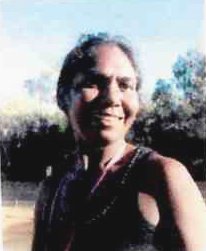

Maria Malay.
Maria was born in Western Australia in 1973, into the language group gija. Her mother died when she was two years old. She was then raised by her father, until his death in 1989.

She was doing it tough, in a world riddled with alcoholism, marijuana addiction, crime, sexual abuse and chronic unemployment.

With the help of a church community, she has been forging a new life for herself and her two children, in Darwin, since 2004, where she does her best to help people in need, with the inspiration which she herself received.

*****


This event has been co-ordinated by local resident Katherine Wood, who is the brother of Rollo Manning.

Katherine is asking the people of the Southern Highlands to welcome Rollo and Maria to this district.

Lets go along to the morning tea, meet Rollo and Maria and learn about real life conditions in the Aboriginal communities of the Top End.

*****

Get a different perspective on these issues from the pictures which the mainstream media deign to publish.

*****

See you there:

Burrawang Hall
Saturday 5 August 2006
9:30 am

Tuesday, August 01, 2006

Have Your Say - the Kangaloon Aquifer pumping proposal

HAVE YOUR SAY - AGAINST DRAINING THE KANGALOON AQUIFER.

The Sydney Catchment Authority has now made available the electronic response forum, via their website.

Now you can easily have your say on the proposal to drain the Kangaloon Aquifer, by clicking on this link: http://www.sca.nsw.gov.au/dams/GWHYS.html

It is easy to fill in the boxes required, to register your interest and submit your views.

I would recommend this, particularly if you have land in the Robertson area.

It appears that the persons with most to lose are residents of the lower parts of East Kangaloon, Kangaloon and Glenquarry, along Tourist Road.

If pumping is allowed to commence, the bores will pump water out, which causes an effect known as "drawdown", where a funnel-shaped area around the bore is drained of water. It is drained most deeply at the bore, and progressively the water draining effect spreads out wider and wider. Although the SCA is talking about areas of 500 metres diameter from each bore, they acknowledge some likely impact up to 2 Kms distant.

And that is only what they say, officially. Who knows what will really happen, if they are allowed to pump?

Monday, July 31, 2006

A day is along decade ..... in politics

Well, the Prime Minister has put some of us out of some of our misery - maybe, possibly, but I doubt it.

Confused? Well, so am I.

John Howard has announced that he will stay on to fight the next election. This is entirely predictable, because it is the one thing which John Howard really likes doing - beating Kim Beazley.

"Flubber" has completely managed to rub off even the "rusted on" traditional supporters of the Labor Party. First there was the shameful failure to stand on principle, regarding the Tampa refugees. And then, last week there was the double-backflip, when he decided to endorse Uranium mining. And so, he has destroyed the basic constituency of his support. How could Howard resist?

Besides, it is apparent that Howard has little concept of how to stabilise the economy, or the "mood of the nation" regarding Industrial Relations. And as for Foreign Affairs .......with troops in Iraq and Afghanistan, and who knows, Lebanon tomorrow, not to mention East Timor, and other places which I cannot now recall - our Defence and Foreign Policy is a complete basket case. Even the politics of water is now out of control.

However, if Howard now goes into Election Mode, then he can legitimately ignore all those issues, and just concentrate on criticising the Labor Party. How easy is that.

The fact that will create a giant distraction from the real issues of the state of rot of the country, will only be more attractive to Howard than having to do anything about those issues.

God Help us.

Sunday, July 30, 2006

The Nature of mountain springs.

The SCA keeps repeating the mantra that the basalt hills have springs at the lower levels, where the basalt caps meet the underlying (impermeable) shale layer. This is yet another of the SCA's half truths.

There are indeed springs at that level, but they are not the important springs. They are not the ones which create the mountain streams which dominate the Robertson environment. It is self-evident that they are not.
Take a look.

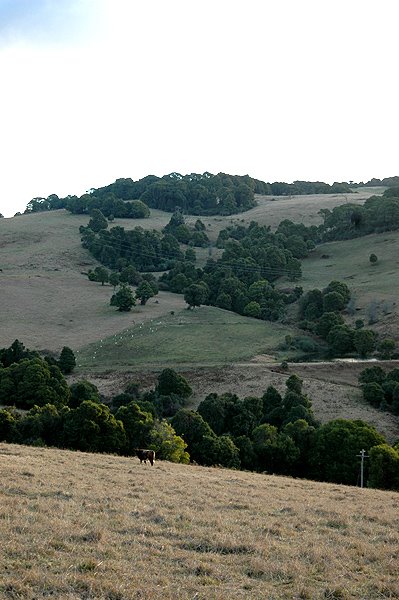
The line of trees - Sassafras and Blackwood, mostly - typical Robertson Rainforest trees, run down that hillside. They are following a stream.

A what? A stream - permanent water. How does it get there? From a spring close to the top of the mountain.

See how the trees turns at nearly a right angle, most of the way up the hillside. That is not just because of a property boundary - it is because they are following a creek line, running from one of several springs at the top of the hill.

This hill is entirely made of a basalt cap. The "basalt-shale interface" is hundreds of feet below this level, on the black soil level, where the land flattens out below the hills. This spring is not at the junction point between the basalt and the shale. It is way, way above it.

Halfway down the hill, there is a dam - the first dam in a series.

According to the SCA's simplistic geological model, this mountain stream ought not exist.

They refuse to acknowledge that there is a problem, because they say that all water runs downhill. That is why they keep talking about springs at the junction between the basalt and the shale. That is too simplistic.

I have seen springs on top of local hills, and many hills have springs very close to the top, as in this one.

Lower down the hill there is a second dam.


And then the stream runs out onto the much lower level of flat dairy-farming land a the bottom of the hillside. At that point it becomes the Nepean River - one of the legendary rivers of the Sydney Basin - the progenitor of the mighty Hawksbury River. It all starts here.

These photos were all taken from the one point, two thirds of the way up the hill from East Kangaloon. This is very close to being the highest point in the Nepean River catchment. The very start of the chain of waters which supply Sydney. The first shots were looking up to the ridge opposite. The last shot is looking down over the distant Nepean River catchment. Ground water responds to pressure. It is entirely possible that a spring on top of a mountain is forced upwards by the pressure of the entire body of water in the hillside, forcing water up through a mini fault line, or fracture in the rocks. How far below the point of the spring does this pressure find its way back up the hill? Could it come from the sandstone aquifer? The SCA says no. Time alone will tell.

According to the SCA theory, the springs start another kilometre (distance) away, further down the slope. This is a graphic illustration of the nonsense they want us to believe.

*****

If this permanent creek dries up, after the pumping starts - we will know the truth of their great lie, (or their incompetence).

*****
We are engaged in a great gamble - for the future of the natural environment in Robertson. I am not prepared to risk the future survival of entire ecosystems. They are. That's the basic difference in our approaches to this issue.

Saturday, July 29, 2006

The Kangaloon Aquifer - the false Nature of the SCA replies

Karen, over at the "Kangaloon Aquifer Issues" blog has been doing a valiant job of posting the questions which the local consultative committee have raised, regarding the Kangaloon Aquifer proposal. She has posted the SCA answers as well.

Butler's Swamp -
endangered, but supposedly protected
under Federal and NSW laws
I was fuming when I got to the answers relating to several questions which I had drafted.
"The “depth to water table” column in Table 5.1 (P. 29) at sites # 2, #3, #4, #5, #8, #9,
Stockyard Swamp and site #12 (East Kangaloon) all report water table depths of less than 20 metres. That puts the pre-pumping water table at all those sites within the reported range of Eucalyptus roots (Scoping Study, 5.2.3 p 24). Consequently, to commence pumping, and hence to knowingly draw-down water levels, in any of those areas, would threaten the survival of the key species within this environment. Many of these areas support Endangered Ecological Communities, protected under NSW and Federal legislation.
To draw-down the water table in any of these areas, with a time frame of up to 10 years, would be unconscionable.

Their answer was partially correct, but entirely misleading:-
"The Scoping Study was not an assertion that Eucalypts in this area have tap roots to 20m in solid sandstone. The scoping study suggested that this was a possibility (based on rooting depths in unconsolidated formations elsewhere) and that this should be looked at. It is generally agreed that these species are principally sustained by rainfall
and the groundwater component is much less important. Further information will be available in the upcoming SMEC study."

Who is talking about "tap roots"? Feeder roots are the key to plant survival. Tap roots are critical at seedling stage, and help physically stabilise the plant in the soil. But feeder roots do the work for which they are named. They can easily reach down to the water table, especially in sandstone, where the bedrock is so heavily cracked.

Also, may I ask "It is generally agreed" - by whom? Those words are meaningless - an argument to an unstated, unwritten authority. It is merely an assertion, without any evidence.
*****

In an earlier question I had asked:
The “supply” of water in the aquifer might be renewable, over up to seven years (Pp 33, & 40), but as water is integral to the environment, and as a number of ecosystems are acknowledged as being ground-water dependent, it is surely not “sustainable” to draw down water from the root zone of plants, for up to ten years (a 3 year pumping cycle, plus up to 7 years recovery to pre-pumping levels). This would surely threaten the survival of plants and, consequently other fauna types, within large portions of the study area.

The SCA answer is a nonsense:
Also water is NOT being drawn from the root zone of plants – the average depth to water table is around 15m and is in the sandstone bedrock well below the rooting depth of most species.

Butler's Swamp - woodland.
There is a "Threatened Species" of Persoonia here, growing beside a huge Eucalypt. The water table here is measured at 4 or 5 metres.
Where are the roots of this Eucalypt going?


To average the depth of the water table across the borefield is a statistical nonsense, when we are talking about survival of trees in specific habitats. Their own papers report water tables as shallow as 4-5 metres, in some testing bores. You cannot say to the plants living there - "Sorry, plant - the average depth is supposed to be 15 metres - you should not be drinking this nice shallow groundwater". Plants live where they live. It is called a micro-environment.

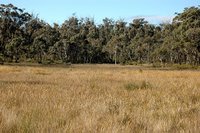
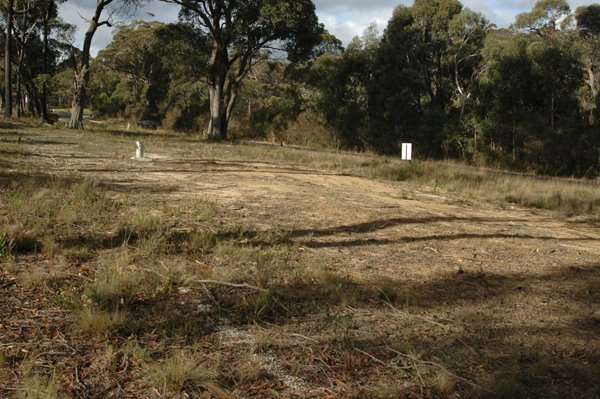
For example, the 2 photographed areas have totally different habitats. They are less than 100 metres apart. You simply cannot average them - for example, they have totally different plant forms, with different soil conditions, different everything.

Studies like this have to deal with reality, not statistical nonsenses, such as water table depth averages over a huge area of a borefield.

Lies, damned lies and statistics.


Also, their reply that "water is NOT being drawn from the root zones of plants" is absolutely contradicted by the studies themselves.

In one part of the report, they comment on microscopic crustaceans found in the aquifer, which feed on tree roots. OK - which tree roots, if there are no plants with their roots in the aquifer?

In another part of the studies, they acknowledge some loss of water from the aquifer, by transpiration. How else does that occur except from plants having their roots in the aquifer?

False statement after false statement. That is what the SCA produces.
*****

DO YOU TRUST THEM?

THIS IS THE SCA's IDEA OF REHABILITATION.


*****

Friday, July 28, 2006

The Nature of a skulker - the Bassian Thrush

This bird was originally known as the Ground (or Mountain) Thrush. More recently it has been called White’s Thrush, and now it is known as the Bassian Thrush (Zoothera lunulata). I mention all of these names, in case you wish to refer to any older Bird Books which you might have.

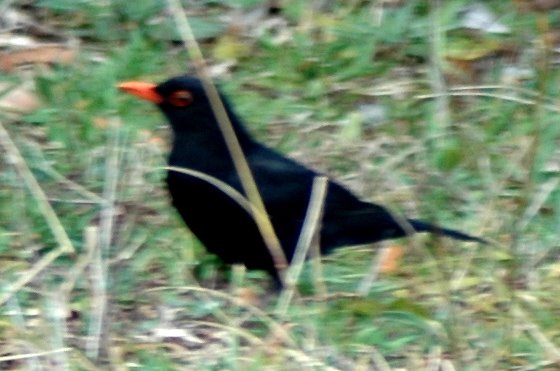
I have seen this bird in the Robertson Nature Reserve, usually late in the afternoon, which is a time of day when it seems to be quite active. The first time I saw it, two years ago, it walked ahead of me, along one of the paths. It was difficult to see in detail, but its shape and behaviour is distinctively "thrush-like" - a bird which runs along the ground, stops, looks around, and then runs again (like the much more common "Blackbird").

Recently I observed two Bassian Thrushes at the Robertson Cemetery, in the heavy brush, just at the end of the road leading to the Cemetery. They are a bird of the heavy cover. They search for worms and ground-dwelling insects, under the leaves on the ground. Consequently, it is likely that, as with the Whipbird, you will hear the bird searching through the leaves on the ground, looking for food, before you will see it appear under some vines or other low growing plants.

To observe these birds, I found it necessary to sit perfectly still, underneath a bush. I tried to photograph them, but with little success, as they are quite shy, and they like to come out to play, late in the afternoon, when the light is poor. (Sorry about the poor quality image.)

They are extremely well camouflaged. It is for this reason that this bird is easily overlooked. It is not a common bird, but it is not regarded as rare. From my experience, you could expect to find this bird in any local patch of heavy rainforest around Robertson. I have also heard it calling, just on dusk, in the dense scrub along the Belmore Falls Road, but I have not actually seen it there.

In its behaviour the Bassian Thrush is very similar to the introduced "Common Blackbird" - to which it is related. The call of the Bassian Thrush is a thin whistle, not dissimilar to the Blackbird. It is known to call at night, and at "first light", and at dusk.


Wednesday, July 26, 2006

Kim Beazley - a political obituary.

At the ripe old age of whatever I am, now, I can vividly remember participating in the 1972 Election which saw Gough Whitlam sweep into power. Indeed it was "Time"!

I remember a chap called Kim Beazley, Minister for Education in the Whitlam Government. He was swathed in an aura of decency. He was something of a committed Christian, which seemed slightly odd, even back then. But decent? There was never any doubt he was decent, respectable and a "True Believer" - in the Labor Party ethos.

Time passed by, and young Kim turned up in Parliament, and I was prepared to welcome him.

But I remember the "M.V. Tampa" affair. A boat load of 433 refugees, having been rescued by a Norwegian vessel, at sea, were then turned away by the Australian Government (29/8/2001). Kim Beazley Jnr capitulated to the pressure of the Government - frightened of being seen as "soft on border security". Dear me!

Kim went on to lose that election - not just a personal loss, but a loss for the Labor Party.
Why? He had compromised his social values, and disgusted the last of the Labor Party's "true believers". There have been many other things along the way, smaller ones, which I do not remember.

But this week, there has been another ground-breaking capitulation. Kim Beazley has announced this week that he will overturn the "3 mines policy". Oh good, I thought. No more Uranium mining - he's going to close them down. How wrong I was!


He has announced that he will allow (if he ever gets into office - which I now sincerely doubt) open slather on uranium mining in Australia. No artificial limits which the Labor Government (under Bob Hawke) had accepted, under a kind of "grandfather clause", whereby exisiting mines would be allowed, but no new ones. There is no logic to that position, but it is at least understandable - a typical Hawke compromise.

But, now all bets are off. The Uranium mining companies have all received a kick in their share prices. The gloves are off, boys - go for it. All down to Kim Beazley having opened his stupid mouth.

This at a stage when we are all being told that there is something of a problem
with international security. The Isrealis, (supposedly a nuclear power) are blowing up their near neighbours. The Americans have been blowing up their distant neighbours in Iraq. Pakistan and India, (both with nuclear capability) are still rattling sabres at each other. The last vestiges of the old Soviet establishment are said to be slowly pilfering off the remains of their nuclear facilities, and selling them on the black market.

Yet everyone is supposed to be worried that North Korea and Iran are developing nuclear weapons - to threaten the world! I do feel threatened - but by the rightwing nutters in Washington, and in Jerusalem - not by North Korea and Iran.

But do I want Australia to add to the mess? Certainly not.

The companies which will mine the Uranium are large multinationals and, in general I do not trust them. And I do not believe that selling lots more Uranium is a good thing, either for the global environment, or for international security.

And I refuse to vote for a pathetic politician who no longer believes in anything.
That's you, Kim Beazley.

You are drowning at sea, as certainly as those people were, who the Captain of the Tampa rescued - and who you rejected from Australia, by supporting Howard.

Where's the Tampa now, Kim?


*****

And to any other remaining Labor Party "True Believers" out there - Ben Chifley's "Light on the Hill" has just gone out!

"We have a great objective - the light on the hill - which we aim to reach by working for the betterment of mankind not only here but anywhere we may give a helping hand. If it were not for that, the Labour movement would not be worth fighting for."
J.B. (Ben) Chifley 12 June 1949

What has the Labor Party come to?

*****
I accept responsibility for any political comment in this blog. Denis Wilson