Christmas Bells

Christmas Bells
Christmas Bells - Blandfordia nobilis

Tuesday, November 28, 2006

The Community Reference Group Report

Regular readers will know that the Kangaloon Aquifer borefield proposal has been assessed (and rejected as unsatisfactorily researched) by the Upper Nepean Groundwater Community Reference Group.

It's an awful mouthful for a dedicated group of local people who have done a terrific amount of work reviewing all the papers produced by the Sydney Catchment Authority in justification of their proposal to pump the Kangaloon Aquifer.

The CRG (or UNGCRG to be precise) came to the conclusion that there should be a five year moratorium on the development of the borefield.

That is in stark contrast to the fact that the SCA is going ahead with developing the borefield as fast as they can (see photo at left, from 14 October 2006)

Anyway, their report is an important document, and it deserves to be more widely available than it currently is. It has been in the public domain at least since 1 November 2006, but it was actually submitted to the SCA in September 2006.
Butler's Swamp.
A wetland of
National Significance.
A vital part of the
Kangaloon Aquifer system.
Clearly the SCA is embarrassed by the fact that their own hand-picked group of people rejected the SCA's Kangaloon Borefield proposal. So the SCA have so far declined to publish the report.
It deserves wider distribution, so it has now been published - on a dedicated site.
"Upper Nepean Groundwater CRG Report"

I am not a member of this Community Reference Group. I am merely serving to publicise their findings - in the public interest.

Late Breaking News.
I have just spoken with Donna Sowry, Community Relations Manager, Metropolitan Water Plan, for the S.C.A. She assures me that the Report of the Upper Nepean Groundwater CRG will be up on the web later this afternoon.
http://www.sca.nsw.gov.au/dams/gwconsult2.html

The Report is not there yet, but Donna assures me it will be.
DJW 5:00pm, 28 November 2006

Monday, November 27, 2006

Nepean River water must not be wasted

The Nepean River is a tranquil stream as it leaves the green hills of the Southern Highlands.

Little does it know the battle which is being fought on its behalf.

The SCA is about to waste the precious drinking water which is found in the Kangaloon Aquifer, a mere 10 metres directly underneath this peaceful spot, just beside Tourist Road, in East Kangaloon - just a few kilometers from Robertson.

This environmental vandalism has to be stopped.

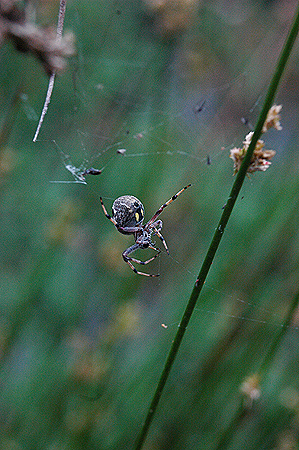
As a resident of this area, I feel we are trapped by the web of the Sydney Catchment Authority, like this pretty Damselfly. ***


Above left, is the Spider whose web had trapped the Damselfly.


Like the Damselfly, every turn we make seems to trap us more.
(Click on images to enlarge them)


Rumour has it that the report of the Community Reference Group is about to be watered down by the Chairman of that group, under pressure from the SCA. If that is true, it is a disgrace. So much for a supposedly independent representative body.

It is a move straight from the pages of "Yes, Minister".

Let us hope that the members of the CRG do not have to undergo the indignity of publicly fighting the SCA (or worse the Chairman) in order to demonstrate their genuine independence.

Hopefully, like this wonderful little Damselfly, they can extract themselves out of the web of the SCA "spiders".

The members of the CRG deserve our support.

*** Damselflies are closely related to Dragonflies, but they are distinguished by their "bug eyed" appearance - with widely spaced, protruding eyes. They also (usually) hold their wings closely folded along their bodies when resting. In this case, the wings have been caught in the Spider's web, and might have been damaged.
*****
"Latham's Snipe"
Photo: Harris. COG website.
While waiting for Bernard Eddy and Richard and Andrew Jones to finish filming a story about the Nepean River, I walked along the banks of the Nepean River and flushed a "Latham's Snipe" (Capella hardwickii) a summer migrant to Australia, which breeds in Japan and north Asia in the northern hemisphere summer (our winter).
Postscript: This bird is protected by a Treaty with Japan. As a result it is protected under the Federal environment legislation, the EPBC Act. DJW 5.11.07

Sunday, November 26, 2006

Flying Duck Orchids - and my Blogger Birthday

Thanks to the regular readers who have bothered to follow the path of my steps across the last year. Little did I know quite where the journey would take me, when I started out on 26 November 2005. I wrote three blogs on that first day - because I had not then understood how the system worked, and I was experimenting with it.

I am delighted to see that my very first blog entry was entitled "Odd little things which grow around Robertson"


What is exciting is to see that the very first blog contains a picture of the "Flying Duck Orchid", (Caleana major) - which is still right up there amongst my favourite flowers. It is less satisfying to realise that I did not post a single word of text to go with the photograph. Oh well, I soon sorted out how that worked!

This little Orchid is a sensitive plant, with the "duck head" part of the flower sitting on a flexible hinge. Insects are attracted to enter the centre of the flower, in search of the mysterious scent which it apparently emits.

When the flower senses the movement of the insect, the "duck head" closes over, trapping the insect inside. This is an example of a highly evolved system for achieving pollination.

There is a tiny escape hole (which can actually be seen in the top photo - it is visible on the unopened bud on the right of the open flower). To escape through that little hole, the insect has to pass the pollen sacs of the flower, and it will inevitably get a dob of sticky pollen glued onto its back, as it seeks to exit the flower. Larger insects are liberated after about half an hour, when the flower re-sets itself to the open position.

Click on the photo to enlarge the view.

Interestingly, the second photograph shows a wonderful association of plants and insects. Flower Spiders are often found associated with Orchid flowers. Obviously the spiders know that the Orchid will attract insects to the flower, either by scent, or nectar, or pollen. In this case, there is a tiny spider sitting in her web, which is strung across the front of the flower. The body of the spider is only about the size of a match head, with the legs clearly much larger. (Click on the image for a larger view.)

She is facing outwards, and hanging upside down in her web - waiting for an insect to arrive. Clearly she avoids triggering the movement-sensing device on the flower, by remaining suspended across the front of the flower, on her web.

Two stories from one flower. This plant has given me double value for my sense of "Wonder" at the intricate designs of Nature. Each story is more weird and wonderful story than anything to do with this flower's uncanny cartoon-like resemblance to the head of "Daffy Duck"?
*****

As a matter of statistical record, since I linked the "Site Meter" statistical reporting system on my blog, there have been 4853 separate visits to this blog site, an average of 30 visitors per day. These statistics wildly exceeded any expectation I had at the beginning. And even better, these are not just accidental hits (which does happen on the internet), but there have been 11400 "page views", an average of 2.34 pages per visit, which means people have been actually looking through the blog entries.

Thanks to my loyal readers - you make it all worthwhile.

Thursday, November 23, 2006

"Perfect Day"

Last evening, Boney rang to invite Zoe and myself around for a glass of something. When I got there, I discovered that Zoe and Boney had hatched a plot.

Today is my birthday. Last night was the eve of my birthday, and I was not anticipating any celebration then, so I was taken by surprise.

We had a glass, and went on to record Lou Reed's "Perfect Day" - a song which I fell in love with when in Glasgow. I used sing its heavily ironic lyrics when walking about in Glasgow, often with a throbbing headache (the kind one ought really describe as a "hangover"), while getting "Scotch Mist" sprinkles upon my jacket.

"Scotch Mist" is such a fine fog that it can bead up on one's clothes, without one getting wet. Of course, Robertson can produce similar effects on one's clothes.

But in Robbo, the irony of "Perfect Day" is lost, as one really can say:

"Oh It's such a Perfect Day,
I'm glad I spent it with you".....

Zoe sang the main lyrics and we doubled up on the chorus. Bones was on keyboard, Deb on Bass, and BJ helping out on backing vocals. Thanks to Zoe for thinking up the plan, and for keeping me in time (when singing).

I am now the proud owner of a CD of us all playing and singing "Perfect Day".

A nice surprise. A nice idea, Zoe. Thanks. And thanks to Bone for the technical know-how, and the keyboard playing and the encouragement to sing my favourite song - over the years we have known eachother, at the CTC's Music Nights.

Wednesday, November 22, 2006

The country (out there) is burning

The bush is burning.

The Upper Blue Mountains has the worst fires.
See this ABC news report.


And this updated story.


Sitting on my green hillside, where all the local countryside is green as green can be, it is hard to realise how dry the bush is. But look at the sky folks.

That pall of smoke hanging over the Southern Highlands is coming from fires in the rough, inaccessible countryside, beyond Canyonleigh, a mere 50 Km from us.


This fire is down in the Wollondilly River which is wild and inaccessible, and very very dry.


After all, Goulburn, on the Mulwaree River is in the headwaters of the Wollondilly River catchment. Goulburn is famously in drought, and has been so for 5 years at least.


The Pejar Dam (above) was apparently officially declared empty on 21 April this year (according to Wikipedia).

So, it is with some bemusement that I heard this morning that the NSW Premier, Morris ("Nero") Iemma is going to Goulburn tomorrow for a drought forum as requested by the local Mayor, Mr Paul Stephenson. (see photo at left).


One would almost swear there was an election in the wind.

Oh no, that's smoke, folks, in the wind. Real smoke.


The country is burning, while "Nero" fiddles about with NSW State Politics. Goulburn has been in drought for five years.
And now Iemma deigns to visit them?

Amazing!

Would that have anything to do with the Mayor of Goulburn/Mulwaree standing as an independent candidate against the high profile Liberal Party Candidate for Goulburn Pru Goward?

I wonder.


Monday, November 20, 2006

Perth introduces Desalination

Perth has introduced a desalination plant to produce 17% of its drinking water. It is powering the desal plant by wind power.
And all of this without any great fuss at all.

If little Perth can do this, why cannot Australia's leading State Capital city, Sydney?

Leadership has to be the answer. Western Australia clearly has that, but NSW is lacking it. What about it Mr Iemma?

Decide that this needs to be done, announce it, and get on with it.

I heard today that: "The New South Wales Government is promising to spend hundreds of millions of dollars reducing traffic jams in Sydney and improving public transport. It is part of the plan to help Sydney cope with an expected population of 5 million by 2020."

OK, I think to myself. Its all very well for them to plan roads for 5 million people, but what are those 5 million people going to drink? Surely that is more important than where they are going to drive?

What plans does the SCA have for this population, for which the Roads and Transport authorities appear to be planning? Is this covered in the NSW State Plan "A new direction for NSW", launched this week by Mr Iemma. I cannot find this population figure there, but maybe it is buried inside.

I shall keep on digging.

Sunday, November 19, 2006

The Nature of Nature - at the microscopic level

Yesterday, I had the great pleasure of watching 2 fully grown adults discover the beauty of the inner world of flowers.

My friends Jim and Songsri and I went into the Carrington Falls Nature Reserve, near the restored quarry (not close to the falls). This is an easy area to access, with a variety of habitats. You start near the road in open forest, with grass and herbs as undergrowth. Then you pass to an area of almost bare sandstone rock, with typical sandstone forest scrub, with dense undergrowth of Tea Trees (Leptospermum sp.) and the endemic Carrington Falls Grevillea, Grevillea rivularis. (Click to go to a good photo of the flower from Plantnet - the Royal Botanic Gardens plant identification website.)

This plant is one of Jim's favourites. It has long flowers, arranged in a "toothbrush" structure. The flowers are varied in colour, in part, white, then green, then purple (in parts). Also, the seed pods are fascinating. They are hairy, and when fresh, they are green with dark patches, almost resembling a caricature of an eye drawn on each side of the fruiting capsule.

Jim has bought himself a 10 power magnifying glass, and he was revelling in introducing Songsri to the inner world of flowers.

I was enjoying myself too, explaing the convoluted pollination system of the Grevilleas (and the related Waratah too). With the lens, one could see the pollen sacs inside the flower, and how the pollen is transferred onto the end of the "pollen presenter", which subsequently develops into its female stage. Some flowers had been successfully pollinated and we could see the ovary starting to swell. Other seed capsules were well developed - those hairy things described previously.

We also examined some Melaleuca squarrosa flowers, and noticed their sweet scent on the warm afternoon air.

The simplest structure of the flowers which we examined was the Leptospermum rotundifolium, which had large (3 cm wide) lilac flowers, with a very clear structure of a ring of 5 petals, an inner ring of stamens, around a prominent central disc with an obvious green colour. Have a look at the ANBG website photo on the preceding link, or this link for the Royal Botanic Gardens, Sydney, Plantnet site for this Tea Tree.

The best part for me was watching Jim explaining to his wife how to use the lens. Songsri clearly had not ever looked at a flower through a magnifying lens before. It was very satisfying listening to her squeals of delight, as she "got it right" with the lens.

And then she just fell in love with the inner delights of flowers. This is where a novice can develop her sense of wonder about Nature. All power to Jim, the educator.