Christmas Bells

Christmas Bells
Christmas Bells - Blandfordia nobilis

Tuesday, January 10, 2012

Elbow Orchid - a first for me.

This insignificant-looking Orchid (as in hard to see amongst the grass) was growing beside a track at Fitzroy Falls. NSW. That is part of the Morton National Park, so naturally I have taken steps to report it to the staff.
I have never seen this Orchid, before, but because it is so distinctive in its shape, I knew roughly what I was looking at, when I got down close to peer closely at it.

At first I thought it was a kind of Sundew with some dead insects hanging off the sticky bits.
But no, it is an Orchid.
As I first saw Thynninorchis huntianus - Elbow Orchid

"Common Elbow Orchid" Arthrochilus huntianus (re-named by Clements and Jones as Thynninorchis huntianus). "Thynninorchis D.L.Jones et M.A.Clem., Orchadian 13(10): 457 (Feb. 2002)". Originally it was in the genus Drakea, the related Hammer Orchids.

David Jones, in his Orchid book, says it is amongst the most specialised of all Orchids.
It is classed as a "leafless saprophyte", and as the new generic name suggests, it is pollinated by males of the Thynnine Wasp genus. The "elbow" structure allows the flower to move when a male wasp lands on it and tries to mate with the flower. That movement takes the wasp over to the pollen-housing, which is on the right hand side (of this flower), where the wasp would get a dob of sticky pollen on its head or back.
***** See note below, re the Tasmanian sister species.

You can see a video of this process in the related Hammer Orchids from West Australia. You can see how the hinged arm works, with the natural movement of the wasp. In this case (the Elbow Orchid), the Orchid flower is upside down, but that doesn't worry insects.

Thynninorchis huntianus - Elbow Orchid

Thynninorchis huntianus - Elbow Orchid

Full stem of flowers of Thynninorchis huntianus - Elbow Orchid

Another view of Thynninorchis huntianus - Elbow Orchid

Camera bag to give neutral background Thynninorchis huntianus - Elbow Orchid

My Orchid-chasing colleagues, Colin and Mischa have some wonderful photos of this species on their Retired Aussies site.

*****
Notes re the Tasmanian sister species explain the pollination process better than I can: 
"Male thynnine wasps (which give rise to the generic name), attracted to the flowers by a scent resembling that released by their flightless females, attempt to carry off the labellum (believing it to be a female wasp - DJW) for mating. In doing so, the labellum pivots on its hinged stalk, with the insect picking up or depositing pollen."
Source: Listing Statement for Thynninorchis nothofagicola (myrtle elbow orchid)

Sunday, January 08, 2012

Cryptostylis erecta (the Bonnet Orchid, or Tartan Orchid)

Cryptostylis erecta is a Tongue Orchid, but it is better known as the "Bonnet Orchid", or the "Tartan Orchid".
It tends to grow in coastal areas, but is known to occur in the Blue Mountains as well. But when I went out with Alan Stephenson the other day, to Leebold Hill (Cambewarra Range Nature Reserve) above Kangaroo Valley, I  said to Alan that I was hoping to find the Bonnet Orchid. It may occur in my immediate area of Robertson/Kangaloon/Fitzroy Falls, but I do not know of it growing there. Hence my interest in looking for it, on the wonderful high ridge above Cambewarra, and Kangaroo Valley. The habitat is similar to my local sandstone plateau areas, but it is warmer and wetter over there. The altitude is similar, but the Shoalhaven Valley region has a climate all of its own.

One can see why it earns both common names.
Bonnet Orchid, for the shape,
and Tartan Orchid for the colour and patterns.
Bonnet Orchid Cryptostylis erecta


Here it is, as I first found it.
It is growing in moist mossy soil, amongst grasses and rushes
over a shallow rock shelf (exposed rocks in background).
Bonnet Orchid Cryptostylis erecta

A closer view, to show the shape of the flowers.
Bonnet Orchid Cryptostylis erecta
Here is another close-up of the flower.
Add caption
It is appropriate to mention that this species is the main one featured in that Video I linked to last week, about "sexual deception" of Wasps by Orchids. Video by Macquarie University people (as named in the Video credits). That previous post was primarily about a related plant Cryptostylis subulata

And just for the record, the botanical illustration on the PlantNET site, for this species, Cryptostylis erecta actually illustrates the pollination process in detail.
Click on image to see in full size. 
Note the wasp pollinating the top-right flower, 
and the "reproductive organs" of the flower drawn in detail.

Botanical illustration for Cryptostylis erecta (courtesy of PlantNET)

Saturday, January 07, 2012

Albino Magpie in Kangaloon

Today, at Kangaloon (dairy-farming country near Robertson)  I was able to get a photo of an unusual bird which I have seen in the distance on several occasions over three months. I had though that perhaps it was a Corella with a deformed beak (I supposed it might have severe Beak and Feather Disease, if it was indeed a Corella.) It turned out not to be a Corella, but an Albino Magpie.

Albino Magpie at Kangaloon 7 Jan 2012
I had never been close enough 
to get a proper ID of the bird, until today.
 
It turned out to be a large specimen of a Magpie, 
and quite confident. 
It walked across the paddock into the shade, 
where it was relatively close to me.

It has pink beak, pink legs and white eyes.
A dead-set full albino.
It was successfully feeding on large insect larvae in the paddock.
Albino Magpie successfully feeding in the paddock.
I spoke with a woman who lives nearby, and she knows the bird, and said it had been around for about 6 years.
 
It is apparently very "bossy" when it comes to dealing with other Magpies.
(She had hand-raised several foundling juveniles about 3 years ago, and this bird had "come around" while her charges were still being fed).

So, from that, we know that it is surviving OK in the field.

It is at least 4 years old, possibly as much as 6, though that requires further consultation with another property-owner.

Here are two other photos which Jill Keft sent me in 2008. The photos are possible even older than that. You can see that, compared to a standard coloured male Magpie, it is a relatively large bird.

Jill Keft's photo circa 2008, Albino and natural colour forms.

Jill Keft's photo of Albino Magpie, circa 2008
So, this bird is surviving well in the wild, despite the stories one hears of albino birds and animals having low survival rates, owing to their high visibility, and being ostracised by other members of their species.

Friday, January 06, 2012

Borrowed images of Pigeons and Oystercatchers

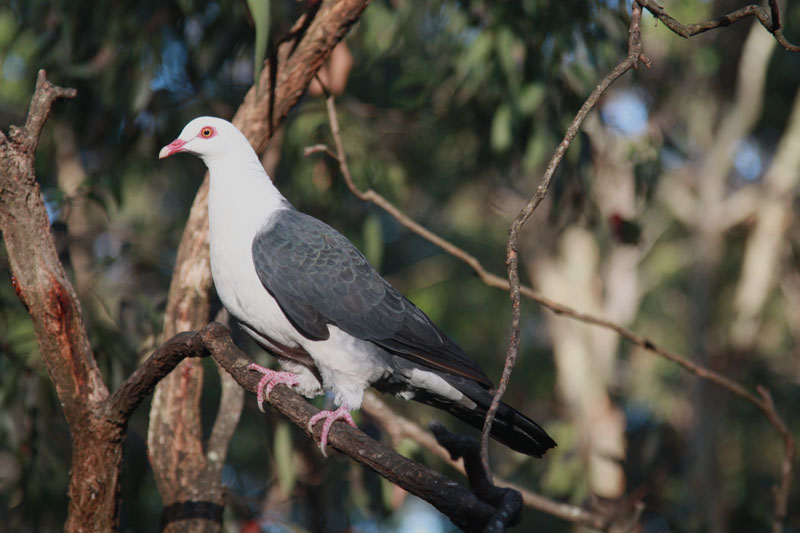
My brother Brendan has sent me some photos of some interesting birds he has seen recently. These were not taken in Robertson, although the White-headed Pigeon is a seasonal visitor here.

The first are some Sooty Oystercatchers, which Brendan photographed at Gerroa, NSW (south from Kiama, and north from the wonderful Seven Mile Beach) on 17 December 2011.

It is not hard to work out how these birds get their name.
They are dusky coloured,
and they pick their way around rocky shelves
looking for juicy inter-tidal snacks to eat (not necessarily oysters).
Sooty Oystercatchers (courtesy B. Wilson)

Sooty Oystercatchers (courtesy B. Wilson)

Sooty Oystercatchers (courtesy B. Wilson)
Here is the best image Brendan took, cropped a bit, to show its details.
Sooty Oystercatcher - a portrait (courtesy B. Wilson)

Lawrence Finn, Brendan's son-in-law, took some photos of White-headed Pigeons when visiting at Dalmeny recently. Here are the images he captured (reduced to make them web-friendly). As mentioned in the introduction, these Pigeons are seasonal visitors to Robertson, but these photos were taken on the Far South Coast of NSW.
White-headed Pigeon (courtesy L. Finn)
  This is a magnificent male bird, in fine condition.
White-headed Pigeon (courtesy L. Finn)
 Male White-headed Pigeon.
Females have a duller cap, 
and greyer (not shiny white) breast feathers.
White-headed Pigeon (courtesy L. Finn)
Thanks to Brendan and Lawrence for the use of these images.

Wednesday, January 04, 2012

A baby Stick Insect stuck to my head

Stick insects can "stick". Well, at least they can "grab hold" of one's head very successfully. 

Yesterday I was out at Medway, looking for signs of the Corunastylis sagittifera (Orchid) species which I have previously seen there. I found one small flower, severely deformed, because the stem had shrivelled at the base. This reminds me of  a fungal problem seen in many domestic "ornamental plants", including my beloved Peonies. But I know nothing more about it than that. I shall merely "report" the occurrence.
Corunastylis sagittifera, not fully open.
But while lying on the ground, to get the photographs, something quite large grabbed hold of my hair and my ear.

Now, I find such uninvited attention, from an unknown insect somewhat alarming.

I swept my hand across the side of my head, and watched to see what was knocked off (expecting a bloody great spider).

I found a harmless-looking green insect, which I assumed was a Katydid (simply because I guessed that it was not a Grasshopper). It has very small mouth parts, and small rounded eyes. (Have you ever noticed how Grasshoppers tend to have oval eyes, often set on a slight diagonal angle?)

So, I decided to take its photograph, and started by encouraging it to climb onto the base of my walking stick.
Podacanthus nymph (Stick Insect) on my walking stick.
It was remarkably cooperative with my endeavours to photograph it. No self-respecting Grasshopper would do that.

I had first wondered if it might have been a Katydid of the group of Katydids known as "Phasmodes" (even though they are reported only from Western Australia).

My fellow Blogger, and supposedly "retired" entomologist (they never do "retire" of course) Dave Rentz advised me: "It’s probably a nymph of a Podacanthus species. Of which there are a number in your area."

Thanks Dave, for setting me straight.

It still leaves me puzzling why it is that darned insects often look like other insects, even of different tribes (orders)? 

I placed the Podacanthus nymph on a Lomatia bush.
 
Podacanthus nymph got very excited, and waved at me.

Podacanthus nymph, with fine "tail end", and long legs.

Head of this Podacanthus nymph
We parted on good terms, and I waved it goodbye.

Thanks again to Dave Rentz for his willingness to share his knowledge.
Such assistance is greatly appreciated.

Tuesday, January 03, 2012

Little Orange Fungus at Macquarie Pass

My friend James showed me an unusual, small round fungus he had recently found at Macquarie Pass. He found it sufficiently unusual that he bothered to record it on his phone. Fortunately, it was a fairly distinctive fungus, easy enough to "track down".

 Small orange ball fungus, on wood, with spiky scales.
Cyptotrama aspratum. Image by James

I wrote back to James as follows:
"Your little yellow/orange fungus, with the scales or spikes on the cap seems to be Cyptotrama aspratum.
As with many Fungi, it has a wide (in this case "pan-tropical") distribution, which in this interpretation, can include us, (despite our recent cold start to summer). It is absent from Europe and Northwestern North America.

In Bruce Fuhrer's "Field Guide to Australian Fungi" he says:
"caps to 50mm across, covered with distinctive pointed fibrillose scales when young,
which fall off as the cap expands.
Found on decaying wood in tropical and subtropical forest"

And it is here on a NSW website
http://www.sydneyfungalstudies.org.au/images/commonFungi/cyptotramaaspratum01.jpg

Wikipedia records it too.
http://en.wikipedia.org/wiki/Cyptotrama_asprata

Monday, January 02, 2012

When is a Stonefly not a Stonefly? Ask Mr Dobson.

Well, the first problem is that nobody seems to know who Mr Dobson is or was.
  • "References to the names "dobson" and "hellgrammite" (both referring to the larvae) date back at least to the late 1800's, but to date there is only speculation as to the actual origin of these names" (Source: Wikipedia)
But according to convention I shall stick with the established name "Dobsonfly" for this insect.
CSIRO ILLUSTRATION OF A DOBSONFLY - Archichauliodes sp., adult

I did say that this "sighting" occurred at a New Year's Eve party, which accounts for the very fine shoes and stockings in the image. But trust me, they are incidental to the real story - the identification of the insect. No discussion nor comments will be entertained, except re the insect. Foot Fetishists are not welcome here.

In this image you can clearly see the long antennae raised up over the head.
Then there is the long neck, with two orange coloured sections.
Then the semi-transparent wings with grey spots on them.
A Dobsonfly - found at a party.

Dobsonfly showing the neck, with 3 legs visible.
In this next image kindly ignore the "masking off"
I had to engage in here.
It served to remove the underneath of a shoe
upon which the insect was crawling.
The image of the sole of the shoe 
was so bright (owing to the Flash used)
that everything else in the image was barely viewable.
With a little help from Photoshop 
I have been able to tone the image down somewhat.

You can at least see the Dobsonfly's lower abdomen
- the yellow, soft body -
(under its wings - the long grey objects above the body) 

This image is useful, if "weird". The abdomen clearly lacks any "filaments"
The point of that image is to demonstrate that 
this insect's "rear end" does not have any 
long "filaments" protruding out the back
So, it is not a Stonefly.

This next image was an attempt to check the mandibles.
Only partially successful.
But BugGuide shows me that males of at least some species of Dobsonflies
have large "pincer-like mandibles" held straight out in front.
This one clearly does not have those, 
So I conclude that this is probably a female.
You can also check this image from Wikipedia.
Female Dobsonfly, with small mandibles. My hand - for scale purposes.

Many thanks to James who had his Mobile Phone Camera at the ready.
He professes not to be an Entomological Photographer
But in truth, he did  a better job 
than I was able to do (without my camera).

What's that old adage, Denis?
Never leave home without your camera!
I chose not to take it to a New Years Eve Party 
(for good and sensible reasons)
But I should have at least had it safely stowed away in the car.
Never leave home without your camera, Denis!
Post-script:
Three years ago I wrote about Stonefly larvae I found on the local sandstone plateaux. I included in that post an image of what I then believed was an adult Stonefly.
Having seen this Dobsonfly (above) and photographed it from several angles, and compared those images with a host of other CSIRO and other Internet sources, I now conclude that my supposed Stonefly image, was in fact, almost certainly  a Dobsonfly.
Dobsonfly, not a Stonefly, as first thought.