Christmas Bells

Christmas Bells
Christmas Bells - Blandfordia nobilis

Friday, February 10, 2012

More Slip Sliding Away.

The title refers back to yesterday's post about some interesting Slugs, and of course Paul Simon's song.

Just one "slimy creature" today. This is the original photo sent to me by my friend Sam, on Facebook.
The Red Triangle Slug is on the side of their Water Tank. The reason for posting this shot is that the Slug is doing what they are famous for - eating algae off moist surfaces. Yum, Yum. 

It is like an outdoor Vacuum Cleaner. 
Every home should have one. 
And they will not attack your lettuce seedlings 
(unlike introduced Snails).
Sam's photo of the Red Triangle Slug
There will be no more slippery creatures, just a Sliding One (but there is an image alert, so it will not pop up to scare you). Plenty of warning is given.

****************

This is long post, but mostly just photos and captions, apart from my rambling preamble  below, about mining in the district.

This post will match part of Martin's Blog from two days ago. But hopefully not duplicate it.

The reason any of my photos match Martin's is that he invited me to join with the Canberra branch of the Australian Native Plants Society, to visit a private property at Nerriga, NSW. So inevitably we saw many of the same plants and animals. There is no intention to "compete" with Martin's report,  nor his photographs. Rather, I trust that our different Blog Reports complement each other.

Firstly a word about Nerriga.

This area is what I think of as "edge country", between the granite belt of the Braidwood area, and the rear (western edge) of the Sandstone escarpment.
That point, at Bulee Gap, west from Sassafras, is really the south-western edge of the entire Sydney Basin. 

But below Bulee Gap one crosses the Endrick River, which of course is following a Fault Line which lies west from the edge of the Sandstone plateau. That is in every sense a geographical and botanical "divide" between the Sandstone country, and the Granite belt, with a resultant mixture in between. That's why Gold was found in this area. It is also why it is interesting botanically.

The property owner, Joe, told us that the area was first opened up for Gold Mining, by the early European settlers (mostly Irish, it seems). That fits with the history of that line of country to the south, 
This area has all been subjected to huge geological disturbance, leading to the presence of deep "leads" (seams) with gold deposits along these fault lines. Indeed there are still people hoping to make their fortunes from the regional gold deposits. NSW DPI has even produced a paper on the Nerriga Gold Deposits - covering the area right where we were last Wednesday (Between the Endrick River and the Corang River). Both rivers flow roughly north, to the Shoalhaven River.

The village of Nerriga still maintains its old Pioneering style, in the quaintly optimistic belief that it will one day become a Tourist Attraction. It is more of a "red-neck" hang-out, where they sell Bumper Stickers proclaiming the Nerriga Pub. I refer to the type of sticker usually found on the back windows of old Holden Utes.

**********

But, on with the plants and animals.

EDIT: IT WAS REMISS OF ME NOT TO HAVE ACKNOWLEDGE THE ASSISTANCE OF ROS CORNISH, OF THE CANBERRA ANPS GROUP IN IDENTIFYING MANY OF THESE PLANTS.
Chiloglottis diphylla - the Common Wasp Orchid
  I found the purple colouring unusual, but it is noted
in the botanical texts as a variant.
Leptomeria acida

Most likely Persoonia lanceolata

Another plant I have not seen before - Boronia algida

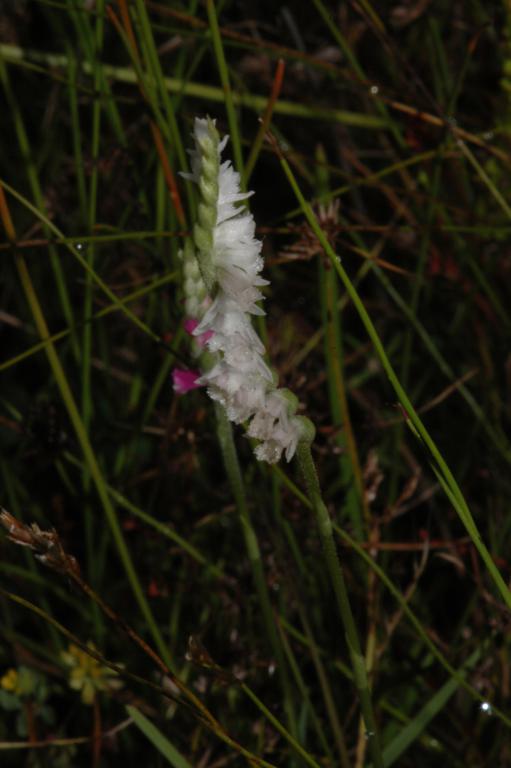
Spiranthes australis

A great big bunch of Spitfires on a Gum Tree trunk
A swampy meadow with Spiranthes and Epacris everywhere.

An unusual white form of Spiranthes australis

Spiranthes australis - white and not properly spiralled

Dipodium roseum - the Pink Hyacinth Orchid
I was not familiar with this species of Persoonia.
It is Persoonia microphylla, an endemic plant to the district.
Persoonia microphylla
 This next Beastie was a star attraction.
Everyone wanted to get a photo of it.
A Spider-hunting Wasp - a "Pompilid Wasp":
 Wombats and Wallabies are often partial to Orchid flowers.
A Bearded Orchid Calochilus sp. - flower has been eaten off.
Polyscias sambucifolia subsp. leptophylla

lovely fresh flowers on this Patersonia- Probably P. sericea

EDIT: Ros Cornish has suggested that 
this is more likely to be
Patersonia longifolia
 
 One image for the artists.
 Beautiful soft greys and pinks and creams on the bark
of this small Eucalypt tree.
Shedding Bark on the Eucalypt reveals soft colours.
Lomatia ilicifolia - The Holly Lomatia nicely in flower
This next plant is another endemic plant, 
with very restricted distribution
It is the "Narrow-leaved Sally")
It is one of the many Mallee forms of Eucalypt
which grow on the poor sandstone soils
along the Sandstone escarpments of the region.
Narrow-leaved Sally (Eucalyptus moorei)


Narrow-leaved Sally (Eucalyptus moorei) - flowers

Narrow-leaved Sally (Eucalyptus moorei) - buds
Narrow-leaved Sally (Eucalyptus moorei) - seed capsules
.
.
 .
 .
 .
Slithery Thing Alert 
.
.
.
.
.
.
.
.
.
.
.
If you do not wish to see a fine specimen of a
Red-bellied Black Snake
then please leave this page now, 
and kindly come back again tomorrow.
.
.
.
.
.
.
.
.
.
.
.
Red-belied Black Snake trying to do the Cobra thing, with its neck.
Red colour visible in 3 places on the belly. What a fine specimen!

For those of you brave enough to still be on this page - Congratulations.
You deserve a special prize, especially if you add comments, to claim your prize.


Thursday, February 09, 2012

Slip Sliding Away

It is raining hard in Robertson tonight. After 6 weeks of grey skies, but relatively little rain, that is good news for the bush, and its little slippery creatures. That's why I have called this post "Slip Sliding Away".***

My friend Wendy, from Ulladulla has just posted on Facebook that the Frogs are singing their praises for the rain there, too. Good for them.

Last night I returned from a trip to Nerriga (between Nowra and Braidwood) and collected an important parcel from Sam and Charlie. Sam had told me several weeks ago about a Slug with a red mark on its back. I had heard of this mysterious creature before, but I had never seen one before. 

I did know that it was called the "Red Triangle Slug" (Triboniophorus graeffei) How infrequently one finds an accurate descriptive common name! Judging by the comments and other images in the Gallery on that linked page, my Slug is in its "retracted" state. 
It seems to be saying "Go Away - Leave me alone". I took it outside, and released it into dense cover, while it was raining, last night. Slugs love the rain, as it means they can move easily across otherwise drying surfaces.

The image is too bright, but it shows the marking really well
Red Triangle Slug

Triboniophorus graeffei - Red Triangle Slug

Triboniophorus graeffei - Red Triangle Slug

After posting these images on Facebook this afternoon, I got a message from a fellow Blogger Margaret that she had also posted photos of them. In fact she posted what she called a Red Triangle Slug Orgy, for indeed there are 4 of these creatures in a huddle, two pairs of paired up slugs. And, as they are hermaphroditic (see below), it is an orgy in every sense of the word.
  • "a form of sexual reproduction in which both partners can act as the "female" or "male". For example, the great majority of pulmonate snails, opisthobranch snails and slugs are hermaphrodites"  (Wikipedia)
***********

Having been inspired by the rain to write more about "slippery, slimy things" I asked another fellow blogger Bronwen, who rejoices in the nom de plume "Snail", about this little slug I found late one afternoon, at Fitzroy Falls. 

To me, the surprising thing about this Slug was that I found it at about head-height in a prickly-leafed Tea-tree Bush (Leptospermum sp). That's not where I would ever expect to find a small Slug.

"Snail" responded: "Because it is not extended, I'm not 100% (sure) but it looks like a native cystopeltid. There are probably a whole bunch of species in the SE, but for the moment the S one is called Cystopelta astra".
A quick Google image search revealed a very close match indeed, from Mongarlowe, which is only about 120 Km south-west from here. Cystopelta astra - the "Snowy Mountains Humpback Slug" Thanks "Snail" (aren't experts great? Especially when they are generous with their information!)


The feature I noticed straight away with this Slug was the distinction between the thick body and the relatively fine, flat tail.
 That is quite clear in this next image.
Cystopelta astra - the "Snowy Mountains Humpback Slug"
This little slug seems to be widely distributed in south-eastern Australia, but not seemingly it has not often been photographed. 

The Morwell National Park website (as it often does) has a good page of information on a closely related species: It says: "This is a native species of slug that appears to be somewhere between a normal slug and a snail. The visceral mass, appears to be separated from the foot at the rear (this is the part permanently enclosed in the shell of a snail). The tail is flat......" (I have omitted comments which do not apply to my species.)

Cystopelta astra - the "Snowy Mountains Humpback Slug"

Cystopelta astra - the "Snowy Mountains Humpback Slug"
Well, as I conclude my blogging tonight, I note that the rain has now eased, and the Moths are starting to fly. The Moths of Robertson seem to love a good wet night.

I have has 41mm in the last 24 hours. That amount of rain is not high, by any means. It is simply worthy of comment as it is more rain than we have had in any day these last two months. So far this year, Robertson has "missed out" on the good rains which have fallen in Queensland and northern New South Wales (in Sydney even and certainly in points further north).

*** "Slip Sliding Away" Lyrics by Paul Simon - performed by Simon and Garfunkel "Concert in Central Park" 1981. 
Art had nearly lost his formerly pure, angelic singing voice at that stage, but it still was one of the all-time great live concerts. But, on that particular night, in Central Park,  he ought not have gone for the high notes in "Bridge over Troubled Water". Apart from that it was a great concert. And I merely saw it on TV (and had the tape, then the CD).

Tuesday, February 07, 2012

Genoplesium baueri also on Nowra - Braidwood Road.

Further to my most recent post about the lovely Turquoise Parrots, I can now report that in a quiet period on Saturday afternoon, when the "Turqs" were resting amongst the trees, and while I was resting my hip, Alan Stephenson went looking along the grassy verge of the Nowra-Braidwood Road, and found a few specimens of Genoplesium baueri - the "Brittle Midge Orchid".

Genoplesium baueri on Nowra Braidwood Road
This species is listed on the NSW Threatened Species list as "vulnerable". It has been nominated for EPBC Act listing, by Alan, but so far, it has not yet been "listed' in the Federal environmental protection system.
    Genoplesium baueri on Nowra Braidwood Road
The reason this lack of Federal environment protection is important is because of my last line comment on the previous blog post: 
  • Alan has just learnt that the local National Parks office is preparing to "slash" the roadside verge in this area, which would be bad news indeed for the Parrots which are feeding on the low grasses there which are happily seeding at present. Lets hope that move can be delayed for a few weeks at least.
Because I had not got around to mentioning the Orchids, I did not refer to the threat posed to the Orchids by roadside slashing. Of course, when the Orchids are in flower or when carrying any seed capsules, then slashing could well be "terminal" for a small colony of these Endangered Orchids.

Lets hope the Nowra office of NPWS can be persuaded to hold back on their plans for roadside verge slashing along the Nowra-Braidwood Road, for a few weeks, to allow these important "threatened species" to at least complete their reproductive phase.


There are so few of these Orchids known to exist that Australia does not have any "to spare". The biology of this species is such that it does not appear to recover well from disturbance. It has a habit of simply dying out if disturbed.

Decisions about such matters are probably less likely to be considered important for relatively drab little flowers like these.

Let us hope that the "pretty Turquoise Parrots" can help attract enough attention to get both these Endangered Species protected from such a simple threat as "routine roadside slashing". At the very least, surely the 600 metres where both these Orchids and Turquoise Parrots have been identified could be spared from slashing.


After all, it is the same Department (currently the "NSW Office of Environment and Heritage") which has "Listed" both these species as threatened species, which currently poses a threat to their survival - within the Parma Creek Nature Reserve.

The irony of this situation surely cannot be allowed to go without comment.

Monday, February 06, 2012

Turquoise Parrots on Nowra - Braidwood Road confirmed

Further to my preliminary report of 2 Feb, re possible sighting of Turquoise Parrots, I can now confirm the ID positively.
Only one male with blue face and red wing patch sighted, with a "spotting scope". But that was clear enough to put ID beyond doubt.

The location is identified on Google Earth as Yerriyong, NSW.
It is just past the Parma Fire Trail (if coming from the west).
On all occasions, we saw the birds within 600 metres of their preferred location - not further away.
Juvenile male Turquoise Parrot showing some wing colour

Turquoise Parrot - a juvenile
On Saturday afternoon (between 3 and 4 pm) the birds were present in the same place as previously, but they were skittish. They were "hiding" amongst Eucalypt regrowth saplings along the road, and seldom coming out to rest on the powerlines.

On Sunday morning we went back at 7:30 am. We saw a maximum number of 21 birds at any one time, along the powerlines. Small parties kept breaking away from the group, and new "new birds" flying in. They were very active this morning. It is impossible to know exactly how many birds might be in this flock, but we can say there were at least 21.

The birds were seen best in early morning light. They were not very approachable - flying in to nearby re-growth Eucalypt saplings for cover, then returning to the powerlines.

Turquoise Parrots - Small section of flock on powerlines

Occasionally they would double back to a location further down the powerlines, probably just to give us exercise - following them. We could see them well, and photograph them somewhat better than on Friday. But they would not allow me to approach within about 100 metres.

Turquoise Parrots - small section of the flock.
By 7:45 they were beginning to feed amongst the patches of seeding grasses along the road.

Better photographic equipment is called for, I am afraid.

As the Turquoise Parrot (Neophema pulchella) is listed as Vulnerable on the NSW Threatened Species List, I will report these birds, on the NSW Wildlife Atlas.

Alan has just learnt that the local National Parks office is preparing to "slash" the roadside verge in this area, which would be bad news indeed for the Parrots which are feeding on the low grasses there which are happily seeding at present. Lets hope that move can be delayed for a few weeks at least.

Thursday, February 02, 2012

Turquoise Parrots on Nowra - Braidwood Road

A complete surprise today - I saw a flock of 20+ Turquoise Parrots.
A "first " for me - a "lifer" as the "twitchers" say.
Alan Stephenson and I were driving back to Nowra from Bulee Gap (Between Sassafras and Nerriga) when I spotted a flock of birds on the power lines.
Mystery bird on powerlines

I had assumed they were Woodswallows, then as we zoomed past, I realised they had long tails. Could they be Parrots?
If so, what species?
They were parrots all right, but small, and NOT Lorikeets.
I asked Alan to stop and go back.

 Parrots on powerlines.
The light was terrible, so my  photos are very very very poor quality.
Bugger.
Grey skies are not helpful.
Click to enlarge, to see some details of the birds.
Turquoise Parrots on powerlines - Jerrawangala National Park

Turquoise Parrots were the obvious suspects, except I have NEVER seen them.
It was misting, and dark in the late afternoon - a photographer's nightmare.

It is definitely a "Neophema Parrot" (smaller than the Red-rumped Grass Parrots - which is in a different genus). The call of the Turquoise Parrot is a little thin rattling "tweeet" - very quiet (described as similar to a Thornbill's call). That explains why we didn't hear them calling at all. By contrast, Red-rumped Grass Parrots are relatively noisy birds (but nothing near as noisy as Lorikeets),


Turquoise Parrots - two-toned blue on wings, slight orange wash on belly.

The two-tone blue markings on the wings (turquoise blue and dark blue) are right for the Turquoise Parrot.
Some hint of orange on the belly had me confused at first - but Birds in Backyards has a  female which looks just like my birds.
It says that older birds of both sexes show some orange on the belly

I can see no red on the wings, but everything else is spot  on.
I have just found these images on the Internet.
Those images show that the red is not always visible, and there is no red on the wings of females or young birds. I have checked that with the Bird Books and it is correct. That explains a lot (especially given that a group like that could well be composed of 50 % young birds in early February).

This linked image is very clearly of a male bird, in clear light.
But the two-tone blue on the wing is right for my birds.
I get no strong colour on the birds faces in my photos, unfortunately. But the females look right.

In my mind, the Turquoise Parrot ID is strongly enough established, to "claim" a sighting.

Previous records in the area.
My old bird books report  records of "family groups south west of Nowra" of Turquoise Parrots, between January and February 1977, and also near Tomerong (same year).
Guess where we were today?
Now that I have learnt how to use the NSW Wildlife Atlas, I can now report that it shows 3 records along the Braidwood Road, and one at Tomerong. See Map details.
NSW Wildlife Atlas records for Turquoise Parrot in Nowra region
Nobody can quibble with this record.
The species is listed as "Vulnerable" in NSW.

The maximum number in any of my images is 13 birds - so that is a definite number. There were more birds when we first saw them. Small parties split up and then re-joined the main group.
I would "claim" 20+ birds. Not precise, but it gives a better idea than the "definite 13" in my first photo.

Will these birds be there when the weather clears?
If the weather clears on Saturday or Sunday, I will go back there and see if I can find them again, and try for a decent photo.

A good record - my first ever sighting of this species.
Even if this species has been previously reported from the area, I am still delighted to have seen them.
Shame about the photos, though.

Post Script:
Written Friday afternoon

The Canberra Ornithologists have come in on this issue.
Some suggest Blue-winged Parrots. Of course I had considered that, but I would require a much better "standard of proof" to claim that species (and many on the COG chatline  would have howled down my claim)
  • not only out of area
  • but out of season, as they mostly breed in Tasmania and stay there until March.
Anyway, my friend Geoffrey Dabb has communicated with Joe Forshaw, on the subject.
Joe is the author of "Australian Parrots"
Geoffrey's note is as follows:
  • Thanks Denis.  Better slightly imperfect images than none.  Joe Forshaw confirms turqs (within range, not Out Of Area), as below
  • Many thanks for the enhanced images. 
  • Really interesting because I cannot see an adult male, and most, if not all birds, appear to be juveniles. 
  • Joe
Alan and I will go back again, on the faint hope that we might be able to track down these birds again and get better views of them, and hopefully better images. 

We know exactly what to look for now, as diagnostic characteristics.

Alan has reported the sighting to the local National Parks people, who were interested to hear about these birds.

Denis.

Wednesday, February 01, 2012

Milkweeds and Monarchs

This afternoon, as I was leaving Carrington Falls Reserve (part of the Budderoo National Park) I noticed an unfamiliar white flower growing beside the road.
Gomphocarpus fruticosus Narrow-leaved Cotton Bush
Naturally I stopped to have a closer look. I realised from the shape of the flowers that it was probably in the Milkweed group. That was easily verified by tearing a single leaf. White sticky sap emerged immediately.

Gomphocarpus fruticosus Narrow-leaved Cotton Bush

I recognised that this plant, whatever it might be (and I did not know for sure, at this stage) was both a terrible weed and the preferred host plant for caterpillar of the the Monarch Butterfly. Sure enough, you can see a caterpillar of that species of Butterfly feeding on the plant, just underneath this head of white flowers. It has striking yellow and black bands across its body. It is just visible in the lower section of that image.

Gomphocarpus fruticosus Narrow-leaved Cotton Bush


Seed Capsule forming, It gives the plant its name of "Swan Plant"
I ought have recognised this plant immediately, for my Mother, having been a keen Floral Art enthusiast, often used the seed pods of the Swan Plant in her flower arrangements. But that was in Melbourne, when I was a child. When we lived in Canberra, that plant was not available, as the climate is too cold for it to grow there.
The seeds earn the plant the other name of Narrow-leaved Cotton Bush, for they have a structure attached to the hard seed which is made up of silky filaments, which allow the seed to be carried freely on the wind. And that is how it manages to be such a weedy plant. The plant is also toxic to stock, which makes it a pest for agriculturalists and livestock farmers.

The black and yellow colours of this caterpillar are distinctive.
Black and yellow seem to be universal warning colours in Nature.
Add to that the two pairs of dangerous looking (but harmless)
black "tentacles" which the caterpillar waves around
and I was persuaded not to interfere with it.
Those warning signals seem to keep birds away.
Caterpillar of Monarch Butterfly - Danaus plexippus
This caterpillar is the larval stage of what is arguably the most famous Butterfly in the world - the Monarch Butterfly. The Caterpillar feeds on various plants (including this one) that have a poisonous milky sap. The Caterpillar appears to retain the poisons in its body making it unpalatable to predators. The Monarch Butterfly's orange colour is a warning for predators to stay away, as the chemicals they got (as caterpillars) from feeding on milkweed plants makes the butterflies poisonous. Source Don Herbison-Evans website
This plant is in the family Apocynaceae, many of which produce strong chemicals, some of which are used medicinally, Many plants in this family are toxic to animals, including humans


The Butterfly of this caterpillar is famous for its migrations in North America. You can click to see a clip from a BBC documentary about that migration here.

The Caterpillar of the Monarch Butterfly "develops two pairs of black tentacles protruding from its back: a long pair on its mesothorax, and a shorter pair on its eighth abdominal segment. These tentacles are soft and in no way dangerous." Source Don Herbison-Evans website.

Caterpillar of Monarch Butterfly - Danaus plexippus

Caterpillar of Monarch Butterfly - Danaus plexippus
I met a friend while I was photographing the flowers and these Caterpillars, and I explained to her that I found myself with a moral dilemma. I wanted to destroy the plant because it is a Weed, (and particularly because it is growing within a National Park), but I did not want to kill the Caterpillars. We talked about this and we agreed to take off all flowers from the plant, and to destroy the several seed pods which were just developing, by crushing them on the road. The seeds were not nearly enough developed to be viable.

Monday, January 30, 2012

Huge colourful Swift Moth at Butler's Swamp.

On Friday I was at Butler's Swamp (just on the roadside verge, folks), in Kangaloon. I noticed this amazing moth sitting low down in the grass and rushes there.

I am familiar with the large Swift Moths which come to my porch light and windows on wet nights, especially. Usually Oxycanus dirempta.
But this one seemed different - larger, heavier, fatter and with deeper wings than any I had ever seen before.
Also, all my previous ones had some silver marks on the wings, but the patterns vary considerably.

All photos today are provided by 
my Orchid colleague, Alan Stephenson.

Ignore the dark lines on the wings
They are shadows from the grasses and rushes
in which this moth was hiding.
Its wings are plain fawn coloured.
No silver stripes.
Abantiades hyalinatus - a "Swift Moth" or "Ghost Moth"
Anyway, I sought advice from Dave Rentz, who said he thought it was an Hepialid Moth, but flicked the question on to Ted Edwards, from CSIRO's Australian National Insect Collection.

The answer came back that it is indeed a Hepialid moth, Abantiades hyalinatus
 
Indeed, my moth matches some shots from Donald Hobern's gallery.
But a quick look at the link below will show you why I did not recognise it at first. Look at the variability of this species of Swift Moth.
http://www.flickr.com/search/?w=25401497@N02&z=t&q=Australia+Abantiades+hyalinatus

It sure makes it hard for the amateur when they have wing pattern markings which are "optional".

I was not surprised when David originally suggested Hepialidae, but could not find matches in the Australian Moths on line page for this species.
http://www1.ala.org.au/gallery2/v/Hepialidae/Abantiadeshyalinatus/
Ted's comment about the colour fading (after the specimen dries out) explains that.
 

But I still think it very unsporting of these Moths to have optional patterned or plain wing markings.

Many thanks to both Dave Rentz and Ted Edwards.

**********************

Although we were out and about searching for Orchids (and we found some good ones), the Moth "find" tended to be the discovery of the day.

What happened was that when I spotted the moth 
we all gathered around to take photos.
Then I decided to try to pick up the moth, gently, 
as many large moths appear not to be too troubled by being handled.
Side on view of head, and neck of Abantiades hyalinatus
When I did pick it up, it immediately started flapping.
That revealed this amazing underneath colour.
Clear lilac hind wings.
Abantiades hyalinatus - hind wing colour
And not only were the wings this lilac colour
So was the body!
Amazing.
Abantiades hyalinatus with lilac body revealed
****************

Lest you think too badly of me, dear reader, 
for having disturbed this creature,
here she is, after I released her. 
She flew straight back down into the grasses and rushes
and grabbed hold of a stem, 
just as she had been doing when I first found her.

(I have assumed the sex to be female, mostly because of her size
and also her relatively fine antennae - but I am NO EXPERT.)

You can see the slight hint of lilac even there.
I am not sure what the large black dots are
on the abdomen.
Presumably some kind of gland or other organ.
If anyone can advise me, I would appreciate it.
Underneath view of Abantiades hyalinatus
Once again, I express my gratitude to Alan Stephenson for the photos.
I can now reveal that on the day I was busy 
hanging on to the Moth during the "flapping shots"
and afterwards, 
I was totally bewildered by my encounter with this wonderful moth
and so could barely hold my camera straight.

Post Script: Regular readers will have noted that when Blogging about Moths I frequently link back to Donald Hobern's Flickr Gallery of Australian Lepidoptera (as I have done today).

Well today, Donald advised that "Friday was my last day working at CSIRO as Director of the Atlas of Living Australia (http://www.ala.org.au/). I am moving for a few years with my family to become Director of the Global Biodiversity Information Facility (http://www.gbif.org/) in Copenhagen, Denmark. I'm already suffering withdrawal pains at the thought of leaving the Australian fauna for a few years, but I'll be back and I plan to keep working on the Australian plume moths in my spare time."
Donald Hobern.

It is appropriate therefore for me to thank Donald publicly for the excellent service he has provided via his personal Photo gallery, and also via his role as Director of the Atlas of Living Australia. 

I hope that he will continue to make his photo gallery available to us, as a reference service.
And I hope that the Atlas will continue to grow, and develop to its full potential. It is a service which has attracted the interest of many naturalists as well as professionals in the various fields of Natural History.