Christmas Bells

Christmas Bells
Christmas Bells - Blandfordia nobilis

Monday, February 18, 2008

The Australian Women's Cricket team does not exist.

Yes, shock horror - there is no such thing as the "Australian Women's Cricket Team".

This is despite the fact that the Southern Highland News correctly told us on Friday that there was to be the first-ever Ashes match played at the Bradman Oval.

The Opposition is clearly "the old enemy - England" That much is understood, OK?

Incidentally, the photos are of England's star player, and Player of the Match, Isa Guha. She was clearly the stand-out player, and deserves her place in these photographs.
But back to the main topic of this blog posting: who is "our team"?
Are you confused?

Well so am I , and hundreds of other spectators were too. Especially the many former Australian Women's Cricket team players who assembled under the trees at the picturesque Bradman Oval, over the last four days. There is no longer any such entity as the "Australian Women's Cricket Team". What we have is the "Commonwealth Bank Southern Stars".
Who or what are they?
If you asked the average member of the public what the "Southern Stars" were you would not get a sensible answer, well nothing to do with Cricket, anyway, let alone Women's Cricket, I am sure. Some kind of Jazz Band would be a more likely guess. This corporate branding, to the detriment of the Australian representative aspect of the team is disgusting (in my opinion).
Isa Guha in mid-air, about to deliver a ball.
If these women like to think of themselves as representing their country, sorry, they do not! As one of the former members of the Australian Women's Cricket Team (circa 1955) told me today: "They do not have the word "Australia" on their uniforms, no Aussie flag on their shirts or jackets".

These former players, for whom having represented their country is clearly important, (even after some 50 years), are particularly caustic about this failure of recognition of Australian representation.

When I asked about this, I was told in words of few syllables, that it is to do with "Cricket Australia" being a "boy's club"; and "money". The universal symbolism of thumb rubbing over the ends of the first and second fingers, and knowing looks was about all these senior Ladies would allow themselves.
Isa Guha on her follow-through.
If you Google "Australian Women's Cricket Team" you get historical references. Go to the Cricket Australia website, and you will find photos of male cricketers. You can click the last link on the top bar - the one that says "women". That will take you to the "Women's Cricket Homepage" (a single page, please note). If you link to "Southern Stars vs England" you will find out about the "Commonwealth Bank Southern Stars". Not a word there about them representing Australia. Not a single word.

If you click on the link that says "History of Women's Cricket" you find a single page link. It tells you that:
  • "In 1995 the AWCC changed its name to Women's Cricket Australia and in 2001 merged with the Australian Cricket Board (Cricket Australia from 2003) to streamline the administration of the game in Australia and to help cricket to realise its potential to attract women and girls to the game."
  • "Cricket Australia provides the framework and support for all state associations to develop cricket for women and girls at levels ranging from junior to through to national interstate competitions at Under 17, Under 19 and Open levels."
If you are foolish enough to go to the link on "Females in Cricket" you will find an appalling bunch of Marketing "Gobbledygook" with the following headings:
  1. "Be customer driven in growing female involvement"
  2. "improve female perception and image of Cricket"
  3. "commit resources to growing female involvement in cricket" (and finally)
  4. "leverage elite women's cricket to drive broader female involvement".
Did you get all that?
I do hope you are still following me:

Item 4.2 says:
  • "raise public awareness of the Australian Women's Cricket Team" (see perhaps it does exist, after all".
And how do they propose to do that?
  • Item 4.2 (a) says:
  • "associate the men's and women's team together at key events".

Hmmm interesting.
I would have thought that the only Ashes match to be played this year would class as a "key event", wouldn't you? (Rhetorical question).

There were no members of the male Australian cricket team present at the match yesterday or today to offer some moral support to the "Australian Women's Cricket Team". Not one. It is obvious that the male-oriented Cricket Australia hierarchy simply ignore their own "marketing strategy" for promoting women's cricket.

You would think it not too hard for someone at Cricket Australia to have asked Brett Lee, who lives just down the road, at Carrington Falls to stroll over to Bowral (after all he was "rested" from the match the boys played against India in Adelaide the previous day, so he was not engaged in a conflicting match.)

Clearly this weekend's "Ashes test" was just the Commonwealth Bank Southern Stars, not a real Australian team.

Clearly the women do not count as far as Cricket Australia, or the Australian male players, or the mainstream Media is concerned. The ABC had a "stringer" present on Saturday and Sunday, doing live voice crosses to "ABC Grandstand", but no TV coverage on the weekend; but we did get 30 seconds of footage on tonight's TV news. Big deal! Compare that with the coverage of the Men's test matches, and the media hype, before all "Real Ashes" series.

Where was Channel 9? Ritchie Benaud? Tony Greig? He is a former captain of England after all. Where was he?


Hawkesbury FM 89.9 MHz (at Windsor) were there today, doing live crosses and updates. At least that little radio station broadcasting to Penrith, Windsor and the Hawkesbury area, and even to Bathurst, thinks that there is still an Australian Women's Cricket team. God Bless them.

The old-fashioned Scoreboard at the Bradman Oval cannot cope with "corporate branding", by the way. It does not have enough space to show "Commonwealth Bank Southern Stars". So the attendants settled for showing it as a match between England and "Australia". If only that were the case!

Incidentally, Isa Guha ended the match with a nine-wicket haul. A wonderful effort by an outstanding sportsperson - of any sex, of any nation.

Tuesday, February 12, 2008

More treasures from the dam in Canyonleigh

After discussing yesterday the Horned Orchids I saw at Canyonleigh I did not mention the other treasures which were to be seen at that same dam. I had enough photos just of the Orchids to be going on with. Besides, I knew I had hours (well, two sleepless nights actually) of photo processing to do before I could go on with this next subject. And what a huge topic it has turned out to be.

The living jewels of this swamp are the Dragonflies and Damselflies. Gorgeous living jewels which zoom backwards and forwards through the air, just over the tops of the rushes which grow in the water. Occasionally they stop to rest on the muddy bank of the dam. No doubt, from the point of view of another insect, these brightly coloured creatures are the insect equivalents of armed forces patrolling in helicopters. These creatures which seem so beautiful, and so masterful in their control of flight - to us - must be terrifying to other smaller creatures. But such is the order of Nature.

I admire Peregrine Falcons, but they are the avian equivalents of Dragonflies and Damselflies. And I admire Swallows too. I have been known to make similar comments about Blue Wrens as well, which look so beautiful when perched on a lookout point in the garden, before pouncing on an Aphid or other tiny creature, about which we spare few thoughts. We think they are beautiful but they are ferocious hunters - of small things. Indeed, in January 2006, I wrote a tiny poem about just this topic - which you can find here.

*****

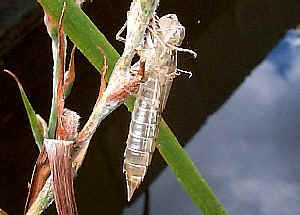
Before I go on with the "pretties" let's do something of the life-cycle of these creatures. Firstly, here is a shell of a nymph of a Dragonfly. The aquatic nymphs (of which this is just the empty shell) are a very popular bait, with fishermen - who refer to them as "Mud-eyes". To scientists they are the larval stages of Dragonflies and Damselflies. This photo shows the shell of the Dragonfly nymph (much as one often finds the cast-off shells of nymphs of Cicadas). This one has crawled out of the water where it had lived. It had then climbed to near the top of this swamp plant, and once there, the nymph has completed its last moult, and emerged as a Dragonfly adult. There is a split in the shell on the back, where the insect has emerged. You can clearly see where the large eyes of the "Mud-eye" had been. In the nymphal stage, these creatures are totally aquatic, and are said to be voracious predators of other aquatic insects and small tadpoles, and tiny fish hatchlings. What do these Mud-Eyes turn into? Well, in truth I cannot be sure of the species, but that one was much longer than some others I found. So, let us assume it was a nymph of a large Dragonfly. In fact it matches the image in the Chew Family website of the nymph of the Australian Emperor Dragonfly (see also the images below, of the mating pair of Dragonflies).

This is the Black-headed Skimmer Dragonfly. (Crocothemis nigrifrons). This species is noticeably heavy in the body. What appears to be a "double image" of the wings is caused by a brownish shadow being cast by the wings, in the strong sunlight. At first, when I processed the image (second image down) of the insect (taken from behind), I thought the insect must have been beating its wings too quickly for my lens. I thought I was getting a "double image". But when I then processed this image from the front view (image immediately below) I realised the brown mark passes under the head of the insect, so it cannot be a "double image" caused by movement of the wings. It has to be a shadow cast by the Dragonfly's semi-transparent wings. This next photos is larger than normal, but it will open up well (click on the image to open to large size) to show you wonderful details on the wings as seen from behind. You know by now to ignore what appears to be a "doubled" wing image - it is just the shadow. There are two wings on either side (of course). They are clearly visible,with strong patterns of veining. The veins in Dragonfly and Damselfly wings are used by the experts to distinguish various species. Obviously that is done with insects in collections in Museums, etc. But sometimes one can be lucky enough to see details of the wing structures in photographs, as in this case (and in the pair of mating Dragonflies below).
Next is a closely cropped image to show the structures of the wing connection to the thorax of the insect. And to show the head of the Dragonfly. The Chew Family website has an illustration of the anatomy of the head of a Dragonfly here. In my photo you can clearly see the very large compound eyes, which dominate the face (with the large reflected light patches from the sun). Below that, in the centre is a round structure known as the "vertex". It seems this is the upper part of the skull - presumably the brain casing. Below that is the larger organ known as the "frons" (that just means "front"). It has a central line in it, making it appear to be a double organ, but it is not. It is quite a large part of the head. Between the eyes and the frons there are apparently three "ocelli" (primitive eyes - similar to the "jewels" on the head of a Cicada). I cannot make them out in this image. Apparently there are also two tiny antennae (which I also cannot make out in this image) located just above the "frons". The mouth is not visible in this photo, as it is taken from above the insect, and the mouth is low down, below the frons. Dragonflies are aggressive hunters of other insects, and they have large, powerful mouths, although they do not tend to bite people.
The females of the Black-headed Skimmer are yellowish-brown, and I probably saw some, and assumed they were a different species (however, I did not get any good photos of the females). Perhaps I was attracted by the bright blue - "pretty ones". Aaah, subjectivity strikes me down again. Where is the scientist in me - recording all the species, not just the showy ones?

Here is a delicate, and tiny olive-coloured Damselfly, with a brownish body. I have not yet been able to identify this species. It is very possibly a female, which makes it harder to identify, as the illustrations are mostly of the more brightly coloured males. It is possible it is even a freshly "emerged" adult (possibly just emerged from its larval stage), as it is recorded that some fresh specimens are green, but develop over a period of hours to brightly coloured specimens. Check out the last photograph and the relevant text in this article on the Eastern Dart Damselfly.

I like the subtle colouring of this specimen. If you enlarge the photo (click on it) you can make out a lot of detail on the typical face of this Damselfly. Note especially the "bug eyes", which are separated on either side of the head - quite different to the Dragonfly head (shown in detail below). Also, she is holding her wings together, and parallel to the line of her body. They do not always do this, but Dragonflies seldom if ever rest in this position, whereas this is the classic pose for a Damselfly.
Now let us look at some of the more colourful specimens found at this dam in Canyonleigh. This is the Red and Blue Damselfly. No arguments from me about that name. Once again, you can see the "bug eyes" and closed wings of a classic Damselfly.The Common Glider Dragonfly (Tramea loewii) spends a considerable amount of time resting on the moist ground adjacent to the dam, or on this dead reed stem (fortunately for me). Note the huge eyes, and the wings spread wide, while at rest. I was lucky enough to get a couple of "in-flight" shots. The first shows a male with a typical dark tip to the abdomen (tail). The hind wings have a dark red patch on them, and the fore-wings are clear, but with light red-tinted veining.

For the technically minded, this image was taken on F10 at 1/400th of a second. Even then I did not quite "freeze" the wings in position. There is still some movement blur on the left fore-wing.Here is another 1/400th second shot. It freezes the wings, and shows them to be beating in a "figure of 8" alternating movement. Insects do not fly by beating their wings straight up and down, but rather they "swim through the air", except these insects use 4 wings in perfectly synchronised movement. And you thought helicopters were "advanced"? This co-ordination leaves the movements of a helicopter blade for dead.And now here is something scientific for you. The mating ritual of a pair of Dragonflies. Because they were resting well above my head, in an Acacia tree, I could not get good colour definition (against the sky), so all I know for sure is that the abdomen of the male is a strong yellow colour (although not very brightly coloured). The female is duller in colour. They might be Australian Emperor Dragonflies - based upon colour and size. But I cannot be sure. The wings certainly look right for that species.Occasionally one sees Dragonflies and Damselflies paired up, when flying. That can be copulation, or pairing after copulation, a process whereby the male protects the female as she is preparing to lay eggs. When they are actually copulating, they form this "wheel position". Once again, I am indebted to the Chew Family's website, for a full exposition of how and why these various couplings take place.

As can be seen in this photo the male Dragonfly (who would have been in the "leading" position when they were flying) has clasped the female by the top of her head, and she has bent her abdomen forward, under his, to receive his sperm package from his "secondary genitalia". Yes, folks the males produce the sperm in one set of reproductive organs located in their 9th abdominal segment (at the end of the abdomen, where one would expect it to be). Then, immediately prior to mating he moves his sperm package forward to a second set of genitalia (in the second abdominal segment). That is where the female attaches herself to the male's body, to receive the sperm from him. That is why she is adopting this curved posture, reaching her genitals underneath his belly, close up to his thorax. They do not join "end to end" (neither over the back, like Beetles do, or back to back, like Butterflies and Bugs do). There is a theory that this position reduces the risk of the male, having "served his purpose" being eaten by the female. Indeed males are known to clasp (couple) with many females over the several weeks of their life span as adult Dragonflies.

Although these mating Dragonflies were in Canyonleigh, they were away from the dam where the other photos were taken. In fact there was no large body of water close by. But, as you have seen already, Dragonflies and Damselflies, having an aquatic larval stage, need to lay their eggs in water, or on vegetation at the surface of water. So presumably this pair knew where the closest water body was. After the female lays her eggs, they will hatch out as tiny nymphs, and live underwater until they are mature. Then they climb out of the water (as we saw at the top of this article) , and begin their air-born lifestyle. That completes their cycle of life.

*****
Incomplete Metamorphosis

You will note that Dragonflies and Damselflies undertake a distinctive form of "incomplete metamorphosis". They do not undergo "complete metamorphosis" (with a pupal stage) as Butterflies and Moths do (egg; larva - e.g. caterpillar; pupa - e.g., chrysalis; and adult e.g., Butterfly or Moth). Even Beetles, Flies, Ants, Wasps and even Fleas all follow a similar developmental cycle.

Amongst insects which undergo "incomplete metamorphosis", some, such as Grasshoppers, Crickets, Mantises and Cockroaches, and some Bugs, have a particular form of "incomplete metamorphosis" where the young (nymphs) are similar in shape, but much smaller, and lack wings until their final moult. They develop through stages known as "instars" (1st instar, 2nd instar, 3rd instar, etc). These nymphs also live in the same terrestrial environment as the adults, and eat the same food as adults. Basically they are scaled down versions of the adult insects, except they do not have wings, and are not sexually mature. Insects which have that form of incomplete metamorphosis are known as "paurometabolous insects".

Cicadas, Dragonflies and Damselflies and some other insects also do not pupate, but instead of going through the development stages of "instars" (small-scale models of the adults - except lacking wings), they have a larval stage which is totally dissimilar to their adult form. These used be classified as heterometabolous insects as they all undergo a dual-elemental development stage. Cicada larvae live underground, but their adult stage is terrestrial (but above ground). They emerge, and after their final moult, the shells of the cicada nymphs are abandoned low down on trees, and the adults emerge as the well-known flying insects.

There is a parallel development with Dragonflies and Damselflies, Stoneflies and Mayflies. They also do not pupate, (so they also are classed as undergoing "incomplete metamorphosis"). But unlike the Cicadas, they hatch from eggs into a larval stage as aquatic insects. These aquatic "nymphs" are known as "Naiads". (The name is borrowed from Greek mythology for evil (but attractive) water sprites who supposedly lured men to their deaths.) Unlike insects such as Grasshoppers, etc, which have "instar" developmental stages, the larvae of these insects do not resemble the adults even remotely. Upon maturation of the "naiad" stage, the larvae leave the water (as we saw in photo 2 above). Then, just like the Cicadas, the adults emerge from the shells of the nymphs, and live their adult stage as the familiar terrestrial flying insects we know as Dragonflies and Damselflies. In aquatic entomology, the preferred terms for insects with these aquatic/terrestrial dual-elemental phases is "hemimetabolous insects".

Monday, February 11, 2008

A new Orchid for me - the Horned Orchid

Several weeks ago I was contacted by a reader from Canyonleigh, approx 70 Km west from Robertson, but still in the Southern Highlands of NSW. This lady asked me to identify an Orchid she had seen at a neighbouring property. I managed to identify the plant for her, from a photograph, as likely to be the Horned Orchid (Orthoceras strictum). But I suggested she contact Alan Stephenson of the Illawarra Branch of the Australasian Native Orchid Society. Alan confirmed my suggested identification, but came up with some more information.I was invited to go over to see these plants, but since then, we have had rain, rain and more rain. Today I managed to go over there and was shown around by the property-holders Ian and Margaret. These plants are growing around the edge of their dam.

Horned Orchid - Orthoceras strictum
They are relatively tall Orchids - about 600 mm. They grow amongst sedges and rushes around the edge of the dam - on moist ground, mostly (but not in water), but there are some growing further afield from the dam, on the higher and drier sides of the dam. The soil in this local area district is gravelly, not a sandstone base, nor basalt, although both those soil types occur in the Canyonleigh area. It is an area of complex geology, with soil-type changes every few kilometres along the away into this district.As you can see these Orchids produce long stems, with a series of individual flowers in a loose spiral around the stem. The green ovaries at the base of each flower are very prominent, although they are partially shrouded by a colourful purplish bract.This group photograph shows how these plants grow in clusters amongst clumps of strong-growing rushes and sedges. I was very pleased to be able to see these plants, which I have never seen before. Thanks to Ian and Margaret for their hospitality.

In return, I was also able to show Ian and Margaret the seedpods of some Onion Orchids (Microtis sp) and Sun Orchids (Thelymitra sp) also growing in the same habitat. Obviously those plants flower earlier, but I have tipped the owners off to look in the same area for these other Orchids from October onwards - on warm sunny days in the case of the Sun Orchids. If you live near a dam with a naturally vegetated edge, like this, check out what is growing there.

Sunday, February 10, 2008

Carrington Falls after heavy rain

The beauty of Carrington Falls is that it provides so many different views and points of interest. I went out there today with David to take some photos, and his girls came along to play, and spot interesting creatures. Aaah, that reminds me of when I had terrific eyes. You can see some of David's photographs over at today's post on his site.

Yesterday (after a morning of heavy rain, the light was very difficult, as there was heavy cloud, and the waterfall spray was creating mist everywhere below the falls. But there was a huge amount of water of going over the Falls (well, the Kangaroo River is a very small river, with only 6 km of catchment length above these falls - so you cannot expect too much).
These are the main falls - once again seen from the main lookout point, opposite the falls. This shot was taken today, on the second day after heavy rain. So the levels had dropped considerably from the day before.This is a detail shot of the water crashing over the rocks half-way down the falls.
It is a very compact waterfall, dropping into a narrow gorge, which is the absolute top end of the Upper Kangaroo Valley.
Above the Falls, the river is still known as the Kangaroo River, but there is no longer a valley (in the sense it is normally understood). So this is the very beginning of Kangaroo Valley. You can see a bright reflection of light from a pool about 600 metres away, down in the bottom of the Gorge. Here is a shot of the top of the falls, taken from the same lookout as where the gorge was viewed from (immediately above).Above the top of Carrington Falls, the Kangaroo River is transformed into a typical creek (or River, if you must) flowing over shallow sandstone bedrock. It also provides rock crevices for these Lizard Lovers to enjoy their view of the River - in safety. They must have been marvelling at the difference between the torrent of yesterday and the "heavy flow" of today.

A pair of "Wall Skinks" (Cryptoblepharus virgatus)
enjoying their view of the Kangaroo River,
just above the Carrington Falls.
Above the Falls, there are riffles, alternating with smooth flowing streams, small cascades, and pools for kids to safely swim in. Because of the recent high flows, and the cool weather, few people were swimming, but Rhiannon and Aeron could not resist the temptation to paddle their feet in the water, at least.Across the river, a small stream flows into the Kangaroo River. It drops over a sandstone rock wall, a ledge, forming what is known as Nellies Glen (forgive the ungrammatical title - it is a name steeped in local history. Apparently there is another place with the same name in the Blue Mountains as well). I know of several such formations in the district, but this is the most popular, and most accessible to the public.Adjacent to Nellies Glen, there is a long rock shelf which drips fresh water constantly into a carved our depression, a cave of sorts, with a small pool in its bottom. The rock shelf is not particularly high, or deep, but it is probably 50 metres in length. Underneath is an area which is constantly moist and shaded. Naturally it has a wonderful natural moss garden growing there.Just outside the rock ledge, there was a pool of rainwater, which today was occupied by a few Tadpoles and some small insects, and this very fine "Fishing Spider" (Dolomedes sp.)
I love the way these creatures create dimples in the water, showing that their feet actually spread over the surface of the water, supported by the "surface tension" of the water. Presumably their feet are coated in very fine hairs to spread their weight over as much surface as possible, and to prevent the feet puncturing the surface of the water. They are related to the Wolf Spider, and behave similarly, running after their prey, or waiting to pounce on it. They apparently eat water insects, but sometimes move away from water as well. This group of Spiders is distributed around the world.

Saturday, February 09, 2008

Rain and hail drown the Giant Earthworms

Robertson was hit by heavy rain again today. Indeed, just outside of Robertson, on the top of the Jamberoo Road, there was a heavy hail storm. To read Greg's first-hand report on the hail at his place, click here. I heard about this in the morning, and was surprised to find patches of iced-up hail still lying beside the road, 5 hours later. As this photo was taken a few hundred metres from the "Robertson Pie Shop" (which is the Bureau of Meteorology's official weather station for Robertson), it is likely that the 23 mm of rain reported so far today is an understatement, as the hail would almost certainly have blocked the rain gauge. I shall ask around tomorrow for other local rainfall records. This ice had not melted despite 2 hours of heavy rain after the hailstorm.

During the heavy rain, I rang David and he invited me around to his place to check out the Orchard Swallow-tailed Butterfly Caterpillars we had seen previously. When the rain eased, briefly, we went out to check on their growth. When seen previously (on 19 January) these guys were half-grown and brown and white coloured. The bird-dropping disguise. They have now grown to nearly full size. Now, as you can see this is one fat caterpillar, and it is armed with spiky protuberances.
Indeed, when alarmed it can do this!
That is a stunning display, and, if you check back to the top photo, you will see that those glands were not present, or not visible. The red glands appeared suddenly, when I lifted the leaf on which the caterpillar was feeding to take a close-up photo. Bingo, this is what I was presented with. I was impressed, and I am sure a "predator" would also have been "warned off". In fact those glands can produce a strong-smelling liquid (although it did not squirt me).

The front-on view of a caterpillar is not often seen as clearly as this. So lets have a close look. You can see a really clear, but accurate diagram of the body parts of a caterpillar, at the Chew Family's website on the Insects of Brisbane. That illustration is based upon a caterpillar of this species. That illustration will help you locate some of the named parts I am about to mention.

The creamy coloured "face" has an inverted V shape. Either side of the lower end of the V marks are small brown points, which are the eyes of the caterpillar (called "Stemmata") . There are apparently 6 tiny eyes, located together, on each side (I could not see that detail - that's where biologists come in handy, to explain things in fine detail for us). I can see where these eyes are, however.

The mouth is the "raison d'etre" for a Caterpillar, so it is very highly developed. Indeed if you have ever read to children, the wonderful book by Eric Carle, called the Very Hungry Caterpillar, you will know that all they do is eat!

Check this article in Wikipedia, on the mouth parts of chewing insects. The caterpillar's mouth parts consist of "mandibles" (jaws, used for cutting and chewing food) and maxillae (the hairy organs below the jaws, used for directing the chewed food into the mouth) and "palps" (which according to the Macquarie dictionary, are sense organs), so that the Caterpillar can feel what it is eating. Just as well, as it probably cannot see so close in front of its face.

Incidentally, "Osmeterium" (well, "osmeteria" probably) is the name for the pair of glands on the forehead. These are specific to caterpillars of the Swallowtail group of Butterflies (which includes the Orchard Butterfly). These glands can be "everted" (the word for when an internal organ is turned outwards, as required), when the animal is threatened.
In this subsequent photograph, this second caterpillar was apparently happily walking along the Lemon Tree leaf, but with these glands fully extended. So, he was still saying "beware of me".

And now to a Giant Earthworm (possibly Notoscolex grandis) I found today, at the wonderful lookout at Lee's Road, on the very edge of the Illawarra Escarpment. The worm was flooded out of its burrow. It had come out, and was lying in a puddle, so I rescued it (hopefully) by putting it back into some soil, and covered it over with leaves, to give it some chance of surviving. This one is at least 200 mm long (about 8 inches long). My camera lens cap covers a 62mm lens, and is therefore slightly larger than that. Of course, this worm when fit and healthy can stretch itself much longer than it is in this situation, when it was nearly drowned, and (to use an ugly word) quite "flaccid". It is the largest Earthworm I have found, since my time in Robertson. Greg found one at his place a few days ago - probably in the same situation as this one, nearly drowned.
The article by R J Blakemore linked above is published originally in Eucryphia (the magazine of the Robertson Environment Protection Society). It is apparent that there are many species of giant earthworms in the Robertson area.

Friday, February 08, 2008

Belmore Falls - after more rain

We got a heap of rain yesterday afternoon. In fact, according to the Bureau's Rainfall records for the last 5 days, we have received 15mm, 98mm, 40mm, 36mm and 45mm (a total of 234 mm in 5 days). That is over 10 inches in the "old money". The "official" records for Robertson are taken at the Robertson Pie Shop, and show some variation from those figures, but those figures above are for Caalang St, which is closest to my house, and also, closest to the headwaters of Wallangunda Creek, the main tributary of Barrengarry Creek, which flows over Belmore Falls.

So I decided to check to Belmore Falls at lunchtime today. It was certainly running harder, faster and louder today than the other day. So, at the risk of duplicating myself, let me take you there again, today.

This is a panoramic photo (2 merged images), but it is my best so effort so far at performing this trick of blending 2 images. Click on the image to open it to the fullest size which I can safely upload to Blogger.

Please be patient as the image is large, and takes a few moments to download fully. Then you can scroll up and down the entire image, to get the full effect. It is about 2.5 times the height of your screen at full size, but you can really get the impression of how good the Belmore Falls are, at present. It is worth waiting for, I think. The splash from the pool at the foot of this first fall is momentous. And the sound is proportionately loud.

Thursday, February 07, 2008

Happy Chinese New Year, Hands off Hampden Park!

So, allow me to give you the traditional greeting: "Kung Hei Fat Choi" which apparently is Cantonese for "Congratulations and Be Prosperous" (well, that's what Wikipedia tells me).

Auspicious things were meant to happen in the heavens, today. There was "supposedly" a partial eclipse of the sun this afternoon. In Robertson there was rain - heavy rain. So how can we tell what was happening up there in the sky? The light was dull, but that could have been from the heavy rain.

Meanwhile, down here on earth, the Council convened a public meeting in Robertson to authorise the "stealing" of public land in Hampden Park, to sell off two blocks in order to fund the creation of an Indoor Leisure Centre in Bowral.

Great! In these days of global warming concern we are supposedly planning to build an indoor heated pool (which is not designed to be "carbon neutral", not even solar heated). And it is a fifty kilometre round trip from Robertson. What is the sense in that, when we are all trying to plan to reduce our travel, because of fuel costs and also because of the use of energy?

This idea is a hang-over from the 1960s when we would gladly have piled the kids into the back of the Holden station wagon, to go for a swim.
The EH Holden Station Wagon
Ah, the good old days.
Today we have to think about such excessive use of fuel. And if it is bad today, how will it seem in 10 years time?

The Indoor Leisure Centre is a dinosaur - in planning and environmental terms. The people of Robertson (every local resident who spoke tonight) told the Council's "facilitator" that they do not want to sell this land, for a Leisure Centre to be built in Bowral.

The only person to speak in favour of the proposal is the wife of the Councillor who has proposed the construction of the Leisure Centre. Her argument is that as a school teacher for 30 years she has taught many (too many) kids to swim in cold water. I can understand her point, but is that a justification for building an environmentally unsound building?

Time to re-think the idea, everybody.

Think Globally, Act Locally.
Hands off Hampden Park!