Christmas Bells

Christmas Bells
Christmas Bells - Blandfordia nobilis

Friday, December 03, 2010

"Blue Ant" is not an "Ant"

When I was a kid, in Melbourne (a long time ago) these insects were known as "Blue Bottles". When I moved to Canberra and subsequently visited beaches in NSW, I discovered that "Blue Bottles" were a kind of Jellyfish, or "stingers". Now I learn that "Bluebottles" (as they are known on the NSW coast), also known as "Portuguese Man o' War" are not "Jellyfish" at all, but are "not a single animal but a colony of four kinds of highly modified individuals (polyps)." Apparently they are related to Corals and Sea Anemones, (unlikely as that may seem - to a non-marine-biologist like me).

This "Blue Bottle" is also called a "Blue Ant", but once again, it is not an Ant. In fact is a female Flower Wasp, Diamma bicolor.

My female Wasp was climbing around amongst the flowers of a mauve-flowered Hebe shrub (formerly known as a "Veronica") .

I was first attracted to this shrub because of masses of insects
swarming around its flowers.
Most were either "Hover Flies" or tiny native Bees.
But then I realised I was looking at
this scary and dangerous-looking insect
amongst the mauve Hebe flowers.
Look closely.
Here it is - cropped.
Note the long curved antenna on the right of the head.
Ants have bent antennae, not curved segmented antennae.
This is another close-up shot.
This time the left antenna is visible.
You can clearly see the segments in the antenna.
(Click to see full size)
Eventually the Insect came right out in the open for me.
The stiff sparse hairs on the body are clearly visible.
Normally these Insects are found wandering around on the ground. They use their sting to paralyse "Mole Crickets", prior to burying them alive and laying eggs on them, in much the same way as the "Orange Spider Wasp" treats Huntsmen Spiders, as seen a few days ago.

Apparently this wasp is capable of delivering a nasty sting. I need no persuading to be careful of them.

Incidentally, the males of this species have wings with which to fly, and they even carry their female mates around from place to place, when feeling in a "romantic mood".

Thursday, December 02, 2010

Pagoda Rock Daisy at Lithgow

There are just a very few plants which are so specialised that they live only on the rocky crags (known as "Pagodas") in the far western edge of the Blue Mountains.
This story is about one of them. Leucochrysum graminifolium.

Some of the RiversSOS members exploring the Pagodas.
So when I saw these bright yellow daisies growing on top of one of these rocky "Pagodas" I asked about it, and was told it is the Pagoda Rock Daisy". Perfect name for it.

It is listed as a ROTAP species (rare or threatened plant), but it is not on the Threatened Species lists, unfortunately. In my view it ought to be.

Here is a platform on the rock formation,
with these plants growing in shallow sand.
I am looking down from a higher rock ledge.
Here is another view, looking out over a projecting ledge.
There is a small cliff gap beyond the last group of flowers.
OK - so what's the problem?
You're always telling us about Problems, right?

Well here it is.
The entire plateau is cracked by
Longwall coal mining underneath it.

Do you see the two parallel cracks?
That wasn't a crack!


THIS IS A CRACK!
Coal Mining underneath cliff lines causes cracking like that.
It can also lead to major cliff-line collapses.
That cliff is half a kilometre away, across a valley.
The Baal Bone Colliery is underneath that cliff
and also under the plateau we were on.

BAAL BONE COLLIERY
OPERATED BY THE WALLERAWANG COLLIERIES LIMITED.

What that does not tell you
is that the colliery is owned by
Xstrata.
A huge and powerful Swiss-based Mining conglomerate.

Do you think
their Directors in Zug, Switzerland care
about the damage
their mining operations cause in Lithgow, NSW?


This shot shows how intricate these Pagodas are.
They are wonderfully weathered natural structures.
The horizontal cracking and weathering is natural.
That weathering simply reveals the natural rock strata
laid down some 200 to 250 million years ago
(give or take a few million).

These Pagodas are classed as
Narrabeen Group Sandstone
formations
regarded as having been laid down in the Triassic Period.


.

But this cracking is not natural.
This is damage caused by Longwall Mining.

Click to enlarge image.
It is a composite image made with two shots.
As these plants were growing on top of this damaged Pagoda
one can see the threat which exists.

And in a few more years?
Who knows that whole cliff-face might peel off,
just like the matching cliff line across the valley?

Wednesday, December 01, 2010

A rare Leek Orchid

This Leek Orchid is found in the Nowra region, but is of very limited distribution only. It is Prasophyllum affine. PlantNET calls this the "Heathland Leek Orchid". David Jones calls this the Culburra Leek Orchid. It is accorded the highest status on the EPBC Act, as has been reported and explained by Alan Stephenson.
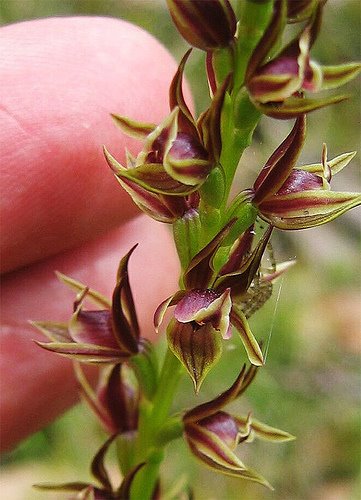
Here it is growing in long grass, in an open site.
There is "heath" shrubbery around,
but the area has been greatly disturbed.
To me, it looks like potentially swampy grassland.
PLantNET says it avoids swampy areas.
What do they know (that this plant does not know)?

I was surprised that it was quite different from my local Leek Orchids, which are not yet properly identified, but which I had been told might be P. fuscum (syn. P. uroglossum - which I am assured it is not). or P. appendiculatum, or maybe P. affine. They look nothing like these plants (well, in a relative sense, "nothing like") - they are clearly Leek Orchids, but...
Firstly the colour is very pale, yellowish almost,
although apparently the colour forms are variable.
The flowers are very finely pointed.
To me, they resemble the children's book illustrations of
"Ali Baba shoes"
with turned up points.
The next point to note is the spacing of the flowers
and the angle of the ovary from the stem.
These are not tightly spaced, as some Leek Orchids are.
And the ovary is held tightly against the stem.
Next to note is that the dorsal sepal
(which is underneath the flower in Leek Orchids)
is finely pointed, and curved upwards.
The two lateral sepals (the little 'ears" pointing up above the flower)
are very fine, and long, and meet together.
Here is an un-cropped version of the same image
to give you a wider perspective.
To me, this is the most distinctive feature of the plant.
The pale pink flanges behind the column seem most unusual to me.
Presumably this is in fact the Labellum of the flower.
Compare that with the prominent labellum of P. brevilabre,
which is very prominent, and strongly reflexed.
The pollinia are clearly visible in this image
(underneath the labellum)
This view is taken looking down into the centre of the flower.
It is important that,
for rare plants like this and the
"Beautiful Beard Orchid" (Calochilus pulchellus),
(which grows in the same habitat)
to survive,
the local Council, and the State and Federal authorities
need to cooperate to conserve certain areas in perpetuity.

Otherwise, developers will eventually (literally) bulldoze
their way through these tiny remnant patches of rare plants.

One day we will wake up to the fact that these plants have gone.

Remember: extinction is forever.


Tuesday, November 30, 2010

Wood Duck Ducklings

This family of Australian Wood Ducks (Chenonetta jubata) is somewhat late, but they have timed their fledging well, as there is water everywhere at present.

As Zoe was driving me through Bowral last weekend I spotted these Wood Ducks close to the road. So we did a "U-ie" (a "U turn") and quietly drove back until we got them in frame.

The road they were beside is Kangaloon Road, a very busy road on the edge of East Bowral. I was genuinely concerned as to their safety. But Zoe told me she saw the family there, late this afternoon. So far, so good.

As usual, the male is standing guard,
on the danger-side of the family group.
Here he is starting to round up the family.
They went round the back of a shrub
to get some shelter from view.
Then I was able to count the number of ducklings.
There are nine ducklings in all.
Dad has the dark head, and Mum is paler.
Mum (now on the left) had decided at this stage
that we had got close enough.
So she is now leading the entire family around the corner,
and out of sight.
Living beside a busy road is dangerous, but the parents are obviously road-aware. Keep safe little guys.

Monday, November 29, 2010

Grevillea acanthifolia

Grevillea acanthifolia is another prickly Grevillea, with a very limited distribution. It is very similar in plant growth to the local Southern Highlands endemic species, Grevillea rivularis (the Carrington Falls Grevillea). G. acanthifolia grows in the far western edges of the Blue Mountains, in the headwaters of the Cox's River, north from Lithgow. It grows on the edges of peat swamps, high in the sandstone ridges above Lithgow. The habitat and plant description is given in the Flora of Australia Online entry.

The over-all plant structure, and leaf and flower structure of this plant is similar to Grevillea raybrownii which I have recently posted about. The flowers (on G. raybrownii) are smaller, but both are "Toothbrush" Grevilleas, but G. raybrownii is creamy, not pink. However, that plant grows on rock shelves high in sandstone gorges, whereas its Lithgow relative grows in wet peat-swamps perched high in the gentle valleys just below the sandstone ridges in the Lithgow area.
This image shows the much-divided (but flattened) leaf structure,
and "toothbrush" flower structure.
Here is a close-up shot of the attractive flowers of this species.

The reason for the descriptive term "toothbrush" Grevillea
is clearly evident.
Here is a shot of an open area of the peat swamp which has been destroyed by drying out, caused by long-wall mining underneath the ridges and the creeks which historically have fed this swamp. The dominant plants have died out. Then off-road vehicle vandals have destroyed the remaining ground-cover plants.
Both forms of habitat destruction are a great pity.

The Coal Mining threat was subject of a weekend regional conference in Lithgow, of the Rivers SOS group, of which I am a member. Our tour of the Cox's River headwaters was part of this Conference.
The denouement of this tour was a visit to one of the marvellous "Pagodas" for which this area north of Lithgow is famous. Fallen cliff-lines are visible in the distance. The damage is recent - caused by Longwall Coal Mining, obviously allowed to approach too close to the clifflines.

So, at the end of this tour, one has to ask if these plants and the other rare plants of the region are threatened by Mining?

I would have to say yes - in all probability. This is because of the impact of Mining on water flows through the rock structure, which alters the natural flow of water which has been the main factor in creating the unique geological structures known as Pagodas; and also in creating the Upland Swamps. Many of the Swamps have been threatened by discharges of highly saline mine water. And the clifflines and pagodas are structurally threatened by cracking and by rock-falls.

Wake up Australia. Value more highly these irreplaceable treasures.

Once our generation has destroyed them there will only be pictures left to tell our Grandchildren what was once here.

Xstrata will not care.
Centennial Coal and their Thai Partners Banpu will not care.
KOREA RESOURCES CORPORATION (Kores) will not care.

Thursday, November 25, 2010

Orange Spider Wasp

Last weekend Kirsten and I found this Orange Spider Wasp (Cryptocheilus bicolor) near Medway. It was a very large, and very busy wasp.

In the two minutes we watched it, the wasp was digging a new hole in the soft sand. It was a process of diving down into the hole; backing out (presumably bringing parcels of sand with it); then diving down the hole again.
Note the older burrow to the right (light coloured sand).
Presumably there is a nest there too.
There are two Orchid leaves just to the left of the burrow.
Only once in those two minutes did the wasp emerge completely from the hole, to walk around a little then resumed its tunnel digging.

She did not have a Spider with her, so presumably she was "planning ahead". But there was great urgency in her activity. so perhaps she had "found" a spider, and was rushing to prepare a burrow, prior to paralysing her prospective prey.I have observed these Wasps with prey in tow, previously, and I know that there is nothing which will distract the Wasp, once she has a Spider to drag to the nest.

Several years ago, at my house, I watched one drag a full-sized Huntsman more than 50 metres, through shrubbery, down a wooden post (from my deck to ground-level); then over rocks, before I lost track of her, in a dense Blackberry shrub.


Here is my old photo of that encounter.
5 March 2008 - at my house.
This Wasp has paralysed the Huntsman Spider (which is several times its own body weight, and with very large leg span). It looks like the Spider is rearing up to strike. In fact it is quite the opposite. The wasp is dragging the Spider (walking in reverse), and the legs of the spider are just catching on grasses, etc, and are lifted up, (more or less accidentally).

Once she arrives at her burrow she will take the live but paralysed spider down the hole and lay her eggs on the Spider. The larvae will hatch out, and proceed to devour the spider.

Wednesday, November 24, 2010

Tiger Snake near Robertson

This story inevitably involves photos of road-killed animals. However, sometimes this is necessary for educational purposes. And so it is today.

Firstly, let me comment that this year, there is a lot of moisture about in the surrounding countryside, after a relatively wet spring. The amount of growth of plants is pretty remarkable. That also means that especially on flat plateau country, there is a great likelihood of ponds and small "runnels" holding water. That means frogs; and frogs mean snakes - especially in warm weather such as we have had in the last few days.

I have heard various stories of "Brown Snakes" in Robertson since my arrival here. I have never seen such a snake here. I did once see a small, pale (almost sandy-coloured) snake in the Banksia scrub at Carrington Falls, but whatever species it was, it was certainly not a "Brown Snake" (Pseudonaja textilis).

Yesterday, I saw the first "Tiger Snake" (Notechis scutatus) which I have seen in Robertson. It was dead on the road, at Lees Road, off Jamberoo Road. This location is above the top of the Illawarra Escarpment. But it is not as high as Robertson, which sits on a basalt ridge above the sandstone plateau. This snake was in a farming area, open grazing pasture land. There are numerous dams on the farms along this section of road. Snake heaven. I would never stop a Tiger Snake and ask it to pose for a photo. So that necessitates me photographing a dead specimen - when I find one (which is unusual).

This Tiger Snake was a little over a metre long.
Quite substantial, with a noticeably dark head.
In order to complete the set of common local snakes, I am going to show the most common snake of the sandstone plateau below Robertson. This Red-bellied Black Snake was freshly killed when I found it, adjacent to Butler's Swamp on Tourist Road, Kangaloon.

This snake was more than a metre long, and relatively slender.
I have seen much heavier Red-bellies than this one.
The largest Red-belly I have seen was outside the Tourist Road Oval.
It was as thick as my arm. Huge.Its head and throat were in good condition, so I took the opportunity to record the details of the scales and the colour underneath.

Red-bellied Black Snakes are always shiny.
There is just a glint of red visible
as the snake is lying on the ground.
But the shiny black scales are a give-away.
The large scale in the centre of the head is probably diagnostic.
But the rest of the snake is sufficiently diagnostic of itself.
The famous red-belly is seldom visible,
except on a dead specimen.
But this shot shows how beautifully the scales are laid out.
In Robertson itself, this is the most common snake:
the Highlands Copperhead.
This one was very much alive.
I used a long lens to catch this image.
It was more than a metre long.
This species is very variable in the Highlands.
Most that I have seen are a dull slaty grey.
But the face is diagnostic.
The light scales above its lips often give a striped appearance.
Check this previous post of mine about Copperhead Snakes.

As far as the local Copperheads are concerned, the name appears to be a bit of a misnomer. But across its range, this species is very variable.