Christmas Bells

Christmas Bells
Christmas Bells - Blandfordia nobilis

Thursday, February 23, 2012

Magnificent Turpentine Tree

Alan and I went into the Barrengarry Nature Reserve last week, looking for Chiloglottis plants.
But I could not resist posing beside the trunk of this magnificent old Turpentine Tree (Syncarpia glomulifera)
How old is this mighty tree?
(Photo: Alan Stephenson)
   I jokingly said I needed to hold my tummy in, but as you can see, that did not work.
Me posing with this huge Turpentine Tree trunk.
(Photo: Alan Stephenson)
Here are some photos of the small ground Orchids from the forest floor.
Chiloglottis reflexa, the so-called "Short-clubbed Wasp Orchid"
These Orchids get their name from their relationship with Wasps
which assist in pollination
through a complex process of scent production to dupe the wasps
into believing the flower is actually a female wasp.
Chiloglottis reflexa - side view
 You can see this nicely formed "pseudo-insect"
or gland, or "osmophore"
on the labellum.
Chiloglottis reflexa

osmophore: a scent-producing gland.


Tuesday, February 21, 2012

Anni's Black House Spider

My friend Anni bumped into me yesterday morning, in the village, and mentioned that she had a Spider which had worried her. As Anni and Andy have Elsie, a toddler, you can join the dots of that conversation yourself.

But Anni had collected the Spider so I could get a proper ID on it. She wanted to know what she might be dealing with, and what is the appropriate action, should this situation arise again, in the future. An eminently sensible approach, I thought.

When I first saw Anni's Spider, it was all shiny black, and quite wet. Seems lots of spray was used to "subdue" it. Oh well, at least the specimen was not squashed unrecognisably by a pair of Hob-nailed Boots. That meant I could get some decent photographs, and examine it in detail.

At first we were not sure if it was a venomous spider, but I thought not.
Anni had already done a thorough check of the appropriate websites for the Sydney Funnel-web Spider, and had ascertained that it lacked the tell-tale spur on the second leg (a device used by male Funnel-web Spiders in the mating ritual with a female Funnelweb). 

I searched for the obvious Funnel-webs and Trapdoors, but both seem to have a shiny "cephalothorax", which this Spider does not have. They also both have very large, prominent fangs, which it seems are quite hard and shiny (useful for serious penetration of hard exoskeletons of their prey - insects). This one's fangs (Chelicerae) have large "mandibles" (the main structural unit of the fangs) which are noticeably hairy, and the pointy bits (true fangs), are barely visible, so they must be small.

The Primitive Spiders, including the Mygalomorphs - the Funnel-webs and Trapdoors we tend to worry about - evolved about 250 million years ago, somewhat before we mere humans appeared on the earth. So Spider anatomy is not designed to harm us. They are natural hunters of insects. Any damage they might cause to humans is virtually incidental to their true function as hunters of insect prey.

So, after a bit of close examination, and some on-line research, we figured it probably was not one of those Spiders - you know the ones we all dread. We all know that they are likely to roam in Summer, especially after rain, when their burrows get flooded. But I was confident that it wasn't either of those Spider families.

The next most likely option (in fact it always was THE most likely option - but one likes to exclude certain "nasties" from the list firstly) was the relatively harmless***, and very common Black House Spider, Badumna insignis.

Black House Spider with $1 coin for scale (24.8mm diam)
You can see how dark it was initially, with hardly any markings visible.
That situation changed after a while as it dried out.
And with the use of a strong flash, markings became more discernible.

I concluded that it was a Black House Spider, Badumna insignis
Black House Spider laid out for ID shots
One leg is missing. Spiders have a quota of 8 legs
 OK - now if you have stuck it out so far, kindly leave this site now, if you are at all Arachnophobic - as the following shots are ultra-close ups, taken and displayed here for identification purposes only.
.
.
.
.
.
.
.
.
.
You ought not be here anyway, if your a bit on the timid side - the title of this post told you what it was about.
.
.
.
.
.
.
.
.
.

OK Here we go.
This is a face on view - to show the layout of the eyes.
Modern Spiders have different layouts of the eyes to the Primitive Spiders
Primitive Spiders usually have 
two rows of small eyes in the centre of the head.

This one has two large eyes in the middle of the head
four tiny eyes below those two main eyes
and it has two more quite large eyes higher up,
which are positioned well to the side of the head.
They presumably give it good "all round vision".
A handy defensive set of eyes.
The fangs, which are vertically aligned, are quite hairy.
The two structures either side of the fangs are the "palps"
(strictly "pedipalps")
which are part of the mouth feeding system.
They are not classed as "legs", 
although they have some structural similarities.

Click on image to enlarge it, to see the details.
Face and "mouth" of the Black House Spider
Side on view of head of the Black House Spider
This view shows the extra eye - set back and to the side
from the main large eye in the centre of the head.
The tiny eyes are just visible in the lower row.
Click on image to enlarge it to see the details


My favourite image of this Black House Spider
it shows the key position of those two main eyes
directly above the fangs.
The four tiny eyes are also strategically located
and they are clearly visible in this shot.
Click to enlarge this shot.


 *** Arachne.org.au says of the Black House Spider that: "People are rarely bitten, but some cases of distressing reactions and illness have been reported."

Now you can all relax.
Good Night.

Monday, February 20, 2012

Nymphes myrmeleonoides - a large yellow "Lacewing" at my door.

On a wet night, last weekend, a strange visitor came to my door.
I knew roughly what it was, but it took a bit more effort than one might have expected, to get the details right, for such a distinctive insect.
Nymphes myrmeleonoides - a large yellow "Lacewing"
I went to my usual source: Brisbane Insects and Spiders and went looking for "Lacewings".
I found my insect after just a few searches of various families within the Lacewing tribe, in the family Nymphidae.

The Chew family lists it as "Blue eyes Lacewing". The slightly informal (and ungrammatical) name struck me as likely to be irregular - more a "nick name" than a proper name. They also refer to it as the Common Lacewing. So I thought I would check further.

I checked under the scientific name given by the Chew website - "Nymphes myrmeleonides".

Dr Google likes to search for a familiar name (the one with the most cross-links), and when I entered "Nymphes myrmeleonides", I got a message asking if I wished to search for Nymphes myrmeleonoides. 
I declined the good Dr Google's suggestion and went with the name I had already found. Bad mistake, which has taken many hours to sort out.

Many people, it seems have followed what is a wrong name.

I found lots of cross-links back to "Blue eyes" but I was not finding any scientific linked sources. That worried me. Where were the authoritative CSIRO and Museum links?

Eventually I found the following note on a Chat Line:
  • Nymphes myrmeleonoides (Neuroptera: Nymphidae)---needs an extra "o" in there. Unfortunately, this name was accidentally misspelled in New's 1981 revision of the Australian species of this insect group, so this misspelling has gained some prominence in recent years.
Armed with that information I went to the Atlas of Living Australia and thence to the CSIRO Australian Faunal Directory. 
I found this note:
  • Nymphes myrmeleonides Leach, 1814 [subsequent misspelling]: Riek, E.F. 1970. Neuroptera (Lacewings). pp. 472-494 in CSIRO (ed.). The Insects of Australia. A textbook for students and research workers. Carlton : Melbourne University Press 1029 pp. [492]; New, T.R. 1982. A revision of the Australian Nymphidae (Inssecta: Neuroptera). Australian Journal of Zoology 29: 707-750 [711]
  • Even that notice has its own spelling error (Inssecta). It should be Insecta.
My mother, who worked in CSIRO, as a typist (that's what they were called back in pre-computer days) knew Edgar Riek personally, and she would be embarrassed on his behalf to see this error reported.

If you look at the previous descriptions for this species you find:
  • Gallard, L. 1935. Notes on the life history of the large yellow lacewing, Nymphes myrmeleonides. Australian Naturalist 9: 118-119 (life history)
  • New, T.R. 1982. The larva of Nymphes Leach (Neuroptera: Nymphidae). Neurology International2: 79-84 (larva)
  • New, T.R. 1996. Neuroptera. 1-104, 184 (App. III), 199-216 (Index) in Wells, A. (ed.). Zoological Catalogue of Australia Vol. 28. Neuroptera, Strepsiptera, Mecoptera, Siphonaptera. Melbourne : CSIRO Publishing, Australia 230 pp. [as Nymphes myrmeleonides [lapsus] of several authors]
Oh Dear! That's how the nice people in the Scientific community deal with spelling errors - they put [lapsus] a nice Latin word (in brackets) to disguise the fact that someone got the name wrong, and lots of people followed along behind.
(So it wasn't just my Mum's pal, Edgar - he was following a long line of Entomologists, since 1935.)

*****

SO - LET US BE CLEAR - THE CORRECT NAME Nymphes myrmeleonoides ENDS IN "OIDES" - MEANING "RESEMBLING" OR "LIKE" AN "ANTLION" (Myrme for Ant, and Leo for Lion).

Nymphes myrmeleonoides - a large yellow "Lacewing"
Anyway, once I had ascertained the correct spelling, the links just tumbled out of the sky.
  1. Donald Hobern has it (many times) in his own site, plus on Encyclopedia of Life (EOL) (image of larvae)
  2. This is the formal entry in the Australian Faunal Directory - the "CSIRO official naming" site.
  3. And here it is in the Atlas of Living Australia. Go to the Gallery page for lots more images.
Nymphes myrmeleonoides - a large yellow "Lacewing"
This is an interesting page "Lacewing Development" which has excellent photos of the adult, eggs and larvae, courtesy of Keith Power in Toowoomba. That page also explains something about why this species is not classed within the "Antlions". The larvae of these insects live in leaf litter, so presumably they cannot form those cute little cones as traps for ants, as those traps only function in dry, loose, flowing sand. That is contrary to the statement at the end of this Wikipedia entry. (note that entry is under the wrongly spelled name). 
Another difference is highlighted on the Chew Family page on the family Nymphidae says: "Comparing with other lacewings families, species in this family have moniliform antennae".  

Moniliform - "The round segments make the antenna look like a string of beads. That certainly fits with my insect's fine long bead-like antennae - e.g. Beetles". 

Head and feet view - click to enlarge.
One can just see the "beetle-like" beaded antennae.
Head and feet of Nymphes myrmeleonoides
Finally another note: The "Split-footed Lacewings", Nymphidae, are a family of winged insects of the order Neuroptera. Split-footed lacewings stand somewhat apart from other living Myrmeleontoidea. The antlions (Myrmeleontidae) and the owlflies (Ascalaphidae) are more closely related to them, but the bulk of the Nymphidae's relatives includes extinct groups known only from fossils. Source: Wikipedia - Nymphidae

As a matter of interest, you can see the "split foot" on my specimen (lower right side of the last image - above).

Sunday, February 19, 2012

Contortionist Caterpillars

I saw several amazingly shaped Caterpillars near the Avon Dam several days ago.
 
Caterpillar - what is it doing, and which end is which?
There were two of them on a small bush of  the Large-leafed Hop Bush (Dodonaea triquetra).
Large-leafed Hop Bush (Dodonaea triquetra)
As I first saw it. Dodonaea stem being stripped by Caterpillar
This is the same shot, cropped so you can start to figure out which end is which.
The head end is on the left, for that's where the leaf was being chewed.
Close-up of Caterpillar at work stripping the leaf.
The full contortionist pose

This pose is the full defensive pose. 
There is an orange protrusion in the middle of the back.
The prolegs (lumps on the abdomen which assist in grasping the stem)
have protective spines.
The real legs are beneath the head end, and are protruding 
to the right of the image.
They look like weapons.
There are 3 pairs - (the insect's normal quota of six legs ***)
There is some visual distortion because of the diagonal angle of the shot.
Click on image to see in full detail.


Caterpillar head (on right) curled back, tail probe extended.

Caterpillar in first defensive pose - head raised (at left)

Caterpillar in second defensive pose (head reflexed)
Now I need to confess that I found it difficult to "visualise the parts of the caterpillar" in its upside down position, so the preceding three images have been inverted.
This is MY limitation, not the Caterpillar's, for it functions perfectly well with its head low down.
But I don't, so I felt it easier to "understand" what was what, by inverting those images.
But for the sake of honesty, I ought show the caterpillar feeding in its normal position
So here it is "the way it was".
Actual position of Caterpillar - the way it was seen (pose 1)
Actual position of Caterpillar - the way it was seen (pose 2)
OK.Now to the challenging bit - finding out what I had seen.
Of course I went straight to the wonderful Australian Lepidoptera site, run by Don Herbison-Evans and Stella Crossley. In fact I went to the page dealing with Caterpillars of Australian Moths

The reason I did that turned out to be the undoing of my search for an ID as well.

I have seen lots of Hawk Moths in my time, and in seeking to ID them, I have looked at many web pages for these moths. I knew therefore, that most have Caterpillars which have a prominent "horn" on their tail end.
And that's what I thought I had here.
Wrong.
Hawk Moths are in the Sphingidae family.
I went there and looked in vain for a match to my Caterpillars.
I knew they were distinctive, so surely somebody must know.
I emailed Don Herbison-Evans who promptly replied the next morning, that I had found caterpillars of  Neola semiaurata.
Sure enough, they have a perfect match for my caterpillars.

I wish to express my appreciation to Don for his assistance, and also for having been largely instrumental in creating the amazing website which is such a valuable resource for people like me, who keep finding moths to be of interest.

OK, that's the ID, but what is it about the strange shape?

Neola semiaurata is in the Notodontidae family.
I had not thought to look in that family, for my caterpillars.
The page for this family says: Many Caterpillars of this family adopt a characteristic posture when they feel threatened: they raise the tail and the head to make a U shape. (Yes)
Many of the species of NOTODONTIDAE have Caterpillars with reduced anal prolegs and several humps on their backs (yes) Some are hairy and some are smooth except for a few spines and fleshy tubercles. (Yes)

The large flat area at the tail end of my Caterpillars are in fact the last pair of "prolegs" which have become modified into serving in a display function, it seems (to me). That is the last bit of the caterpillar on the right hand side of the image above. The red "spike" is not hard tissue. It looks pointy, but is in fact soft tissue, which is capable of being everted, when the caterpillar is in the display role.

The plants on which my Caterpillars were feeding are in the Sapindaceae family. Many plants in that family are contain mildly toxic saponins with soap-like qualities in either the foliage and/or the seeds, or roots. Many of the Caterpillars in this Notodontid family have larvae capable of producing chemical defences (cyanic acid, formic acid, and other ketones not commonly found in other Lepidoptera.

So the plants are likely to be strong chemical producers, and the Caterpillars themselves may contain, or even produce toxic or noxious chemicals. So, there might just be something to back up all that scary defensive posturing. 

It worked well enough to prevent me from touching the caterpillars. I have been stung by Cup Moths previously, and I still remember how sharply that sting hurt me. I wasn't about to take any chances with these caterpillars.

OK, I think we have just about done the Caterpillar story.
What does it become after metamorphosis?
What kind of moth, I mean, and what does it look like?
Once again the specific website says: "The adult moth is rather dull compared to its Caterpillar, having forewings speckled dark grey, and pale orange hind wings. It has a wingspan of about 6 cms". There is a photo of the pinned specimen of an adult moth on that site.

Compared to the spectacular caterpillars, the moths of Neola semiaurata are somewhat disappointing.


*** I referred above to "the insect's normal quota of six legs"
It ain't that simple folks. See this page on "prolegs".
Caterpillars and many other larvae of insects, such as Wasps and Sawflies have developed "prolegs".
These can function like legs, but lack the hard tips typical of true legs (see my images above where the "prolegs" are holding the Caterpillar onto the stem, and the real legs are raised in a defensive posture.

Now for the tricky bit.
There are variations away from the standard, so, while all Caterpillars have six true legs, many caterpillars have up to 5 sets (10 in total) prolegs. These are soft tissue organs, used for walking and clinging on to stems (as in the case of my Caterpillars). These prolegs have a set of microscopic hooks on the base (crochets). The last pair of prolegs are adapted as "claspers".

Then the variations really set in.
The Australian Lepidoptera site says: "The Caterpillars of some species have atrophied prolegs, and appear to only have 8, 6, or 4 prolegs, or even no legs at all. In the metamorphosis, all the prolegs disappear".

It gets even worse, folks.
In the adult phase, in many species of Butterflies, one pair of true legs may disappear. Many butterfly species have only four legs. The Wanderer Butterfly is one such example.

So, where does that leave our understanding that "Insects have six legs"?
Out the window, I suggest.
Well, with the vast majority of  species, and genera and families of insects, it is accurate. But there is no such thing as a "safe" hard and fast rule.

Once again, thanks to Don Herbison-Evans for the information which is the source of most of that discussion on prolegs and real legs.

Friday, February 17, 2012

Scorpion Fly - some interesting facts about them.

I have seen these insects on a few occasions, but the other day I got a pretty clear image of one of them - clear enough to decide to post about them.

Click to enlarge the image - to see it in detail.
A Scorpion Fly or Hanging Fly.
The Chew Family has an excellent pictorial coverage of these insects.

At first I thought my insect was a "Black Crane Fly" which I have seen previously when certain Orchids are in flower - a seasonal link perhaps.
But when I got a good look at it, I knew these amazing hooks on its legs were very distinctive. It had to be something different.

My memory told me to check "Scorpion Fly" on the Brisbane Insects and Spiders Webpage.
Bingo - up came those amazing images and their "back story" of how they capture their prey.
Fascinating.

Thursday, February 16, 2012

Corunastylis apostasioides rampantly in flower at present

Corunastylis apostasioides is famous for being a plant which seldom bothers to open its flowers, in order to get pollinated.

It is not alone in that - a number of other Orchids are said to be self-fertilising***, if conditions are not right for the insects.

But this plant is so completely hairy inside the flower itself, that it seems it has abandoned some of the regular sex organs. I cannot comment upon that, as obviously that requires microscopic analysis, and someone knowing what it is they are looking at or looking for, to make those pronouncements.
Corunastylis apostasioides - labellum open.
As an observer, I can say however, that this week, a humid week, I have seen more Corunastylis apostasioides flowers open than I have ever seen before.
Corunastylis apostasioides - normally shy to open - has 3 open flowers.
*** PlantNET says of this plant: "Flowers cleistogamic or opening to c. 5 mm across, yellowish green with a reddish labellum."
cleistogamous: of flowers that remain closed and are self-pollinating and set fertile seed.

So, there's a Word Challenge for you.

Wednesday, February 15, 2012

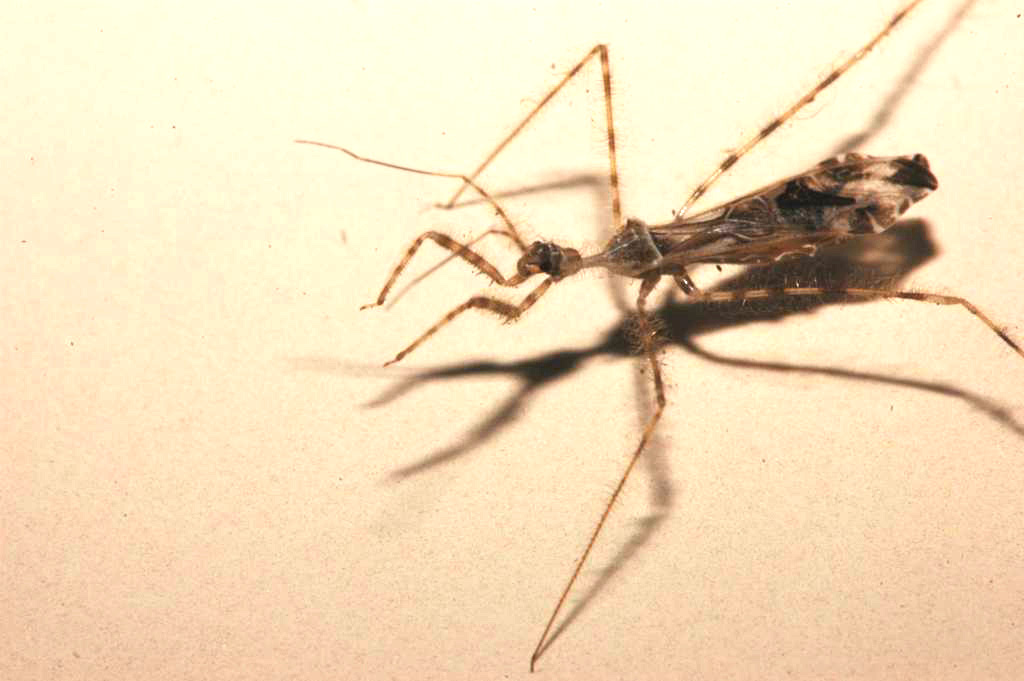
A new Assassin Bug at my house

ALERT FOR VISITORS TOMORROW:
MY SITE METER COUNT, AS I WRITE THIS, IS 249,864

ONE OF YOU IS LIKELY TO CLICK OVER THE COUNT TO ONE QUARTER OF A MILLION VISITORS, TOMORROW. 
IF YOU HAPPEN TO NOTICE THAT NUMBER POP UP ON THE SITE COUNTER (GREEN BOX ON RIGHT HAND SIDE-BAR) 
  1. CONGRATULATE YOURSELF 
  2. AND KINDLY "CLAIM" THE STATUS OF BEING THE QUARTER MILLIONTH VISITOR BY LEAVING A COMMENT ON THE BLOG. 

Several evenings ago I noticed a small insect walking in a strange lurching manner. It had come to my front porch light on 11 February.

It had wings, obviously, but walked along quickly.
But it was incredibly hard to photograph (because it was relatively long and narrow, but active, so it kept walking out of focus).

I had worked out that it was probably yet another species of Assassin Bug. But which one?

There are several odd things which I have still not resolved, but let me say, the closest image I have been able to track down is of the Long Assassin Bug (Australcmena lineativentris)

But mine seems to have strange spotted or alternately coloured and transparent marks on its legs.
Also the neck is very thin - thinner than this image appears to show, from the Brisbane Insects site.

The other feature on this insect which I can observe is the extremely sparse, coarse hairiness of its legs.

You need to click on the images to expand them to get more details.

Assassin Bug, small, hairy, long-legged, with thin neck

Assassin Bug, small, hairy, long-legged, with thin neck
 In this photo you can clearly see how thin the neck is.
Click to enlarge image
Assassin Bug, small, hairy, long-legged, with thin neck

Assassin Bug, small, hairy, long-legged, with thin neck

If anyone can help with identification of the species 
I would really appreciate it.

EDIT: Assistance came via a comment from Joy.
She reminded me that I had posted about a similar insect previously

It was my very first Assassin Bug in fact.
I knew I had one more Assassin Bug 
than I could find on my own blog.
But I had failed to index it properly as an Assassin Bug, 
because when I drafted that post, I hadn't worked it out.
So it was simply indexed under "Bug".


Anyway, the answer is: Stenolemus bituberus.
There is a good image of a "pinned" specimen 
from the WA Dept of Agriculture.


Thanks to Joy for the assistance.
As I said to her, in the comments, it shows I am either

losing my touch, or was simply too tired, when searching 
the sources for this one the other night.
In fact it was
probably because 
I have changed my computer over, 
and have lost all my old "Bookmarks".