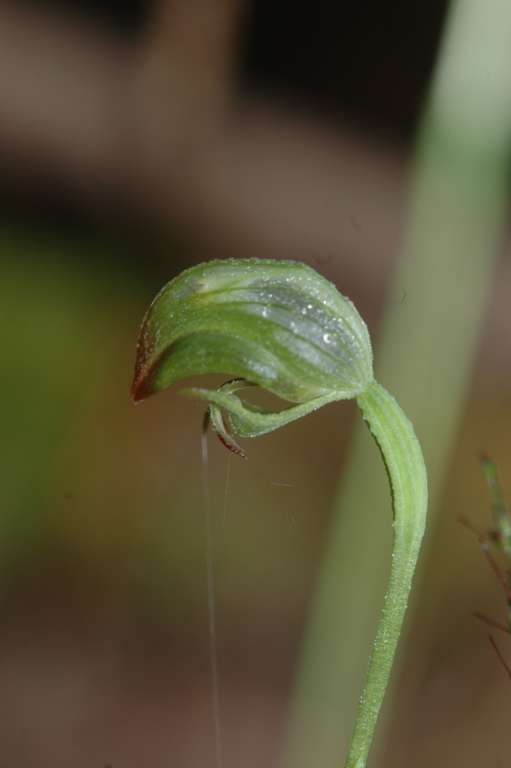
Christmas Bells

Christmas Bells
Christmas Bells - Blandfordia nobilis

Friday, May 03, 2013

Fairy Toadstools are late this year.

Amanita muscaria, the "Fly Agaric" is the quintessential Toadstool. It is the classic Fairy Toadstool of children's literature illustrations.

It is repeatedly referred to in the literature as "toxic". It is also one of the most famous Fungi for being the likely origin of "soma". It is much talked about on the Internet and other places by people advocating experimentation by enthusiasts of hallucinogenic experiences.
I do not indulge in such fantasies, nor do I recommend that any reader do so either. 

A classic Fairy Toadstool
The main reason I do not recommend such experimentation, is that the dose is uncontrolled, and one's reaction is unpredictable. "Muscimol is generally a mild relaxant, but it can create a range of different reactions within a group of people". (Source A) A quick Google Search will reveal an abundance of "literature" or should I say "reports" of supposedly successful experiments. I do not recommend any such experimentation.

I referred in the title to these Fungi being late this year. In previous years, they have started as early as late March. This year, their appearance has been delayed to the first week of May. I have no doubt it is linked to the relative lack of seasonal rainfall.

We had heavy rain at the end of January and at the end of February, with relatively little since (such reports are always relative, given that Robertson is one of the wettest places in NSW). I recorded the following rainfall figures for the first four months of 2013, 196mm, 270mm, 124.5mm, 159.25mm - a total of 749.75m. That is well above the long-term average for Robertson of 654.8mm for those four months. But March is historically, our wettest month, and this year, with 124.5mm it was well under the long-term statistical average figure of 188mm. I have no doubt that this has set back the Fungi fruiting.


The earliest stage of development.
The Fungus is covered with the "Universal Veil"
which is
a temporary membranous tissue

that fully envelops immature
fruiting bodies of certain Fungi.


A half-developed Fruiting Body of the Amanita muscaria.
The characteristic flecks are remains of the veil
which are now separated
because the fungi is increasing in size.
This is much like what happens with markings on a balloon
if marked before it is blown up (filled with air).
Check out this technical illustration showing the
mature and immature stages of development.


Half-grown fungus fruiting body.


This fungus fruiting body is now fully open
and flattened on top.

This is the same fungus as above
photographed from the side,
to show how shallow the top is.
at this stage of maturity,
the fungus is able to release its spores,
to propagate the next generation.


Wednesday, May 01, 2013

Celastrus australis - Staff Climber (aka Staff Vine).

Celastrus australis - Staff Climber (aka Staff Vine).

This is an extremely common climber in the local rain forests. Currently it is very noticeable, because it is fruiting heavily, with orange berries visible in the tops of trees which themselves do not produce orange berries.

It grows right to the top of host trees, and then tries to catch hold of any neighbouring plants. If there is nothing higher, the stems bend over and keep going horizontally, till they find something else to climb on. I saw one recently which presented a solid wall of dense vegetation, approximately 20 metres wide, and more than 20 metres high - reaching to the top of the local Blackwood Wattles and Sassafras trees.


Fruit of Celastrus australis

Large numbers of fruit of Celastrus australis

Mature leaves of Celastrus australis

Lenticels are noticeble on the stems Celastrus australis
"One of the small, corky pores or narrow lines
on the surface of the stems
of woody plants that
allow the interchange of gases
between the interior tissue and the surrounding air."
In other words, these are "breathing holes" for the plant.


Juvenile stem and leaves of Celastrus australis
Once the capsule is opened
it clearly showing it is "three valved".
The seeds have a bright orange "aril"which is a
"membranous appendage, sometimes partially or wholly
covering the surface of the seed"
If one peers closely
one can make out patches of orange seeds
(just below the power lines).
These are Celastrus seeds.
Forgive the poor quality, please, but the distance
is more than 150 metres away.
The three lines are power lines passing between
my house and the trees.

Monday, April 29, 2013

Local Lilly Pilly tree, flowers, fruit

The local Lilly Pilly was known as Acmena smithii when I moved to Robertson. Unfortunately, it is now back with the difficult-to-spell Syzygium tribe, so it is now Syzygium smithii (though PlantNET does not seem to realise it).

The local plants normally have creamy white fruit, but some (few) have pale pinkish/purple fruit. None of the local plants have the strongly coloured Lilly Pilly fruit typical of most of the other members of that genus.

Here is a shot of a single tree, at my friends' property Cloud Farm. There is a large Eucalypt behind the Lilly Pilly. The dense, dark green leaves and white buds and flowers are the give-away.


Syzygium smithiitree at Cloud Farm
 Here are the flowers (taken in December 2011).
Syzygium smithii Buds and open flowers.
These small flowers show some structural similarity
to Eucalypt flowers.
But they lack the distinctive "cap" of Eucalypts.

Typical creamy-white fruit of the local Lilly Pilly plants
Fresh fruit (taken two days ago)
Syzygium smithiiThese fruit are on the same tree as the buds and flowers
But the photos are two years apart.
But the months are characteristic
December for flowering
Late April/May for fruiting.
There is just a bit of pinkish spotting on these fruit.

This tree, being overlooking the escarpment, and hence warmer than Robertson proper, fruits just a little earlier than the best stands of local Lilly Pilly trees on Fountaindale Road, and at Tony and Anna's place.
Leaves of Syzygium smithii


Sunday, April 21, 2013

Having a feel for one's local area. Hunches can pay off.

Sometimes, one's instincts (or hunches) bear fruit.
This morning I set out to check an area opposite the Barren Grounds (approx 10 Km along the Jamberoo Mountain Road from Robertson). I had been in that area several years ago and found what I thought at the time were some Nodding Greenhoods (Pterostylis nutans).

I had a feeling that those plants warranted a good looking at, to double check the ID I had casually ascribed to those Orchids years before. And anyway, I hadn't been in that particular area for a few years.


Sure enough, I stopped opposite the Barren Grounds, walked back about 100 metres, to get past a thicket of native Stinging Nettles and some Native Raspberry prickles. I then walked off the road and quickly found a small colony of Greenhoods.

One look convinced me they were in fact not Pterostylis nutans, but the similar species Pterostylis hispidula (Small Nodding Greenhoods). 


Pterostylis hispidula
(Small Nodding Greehood).
The angle at which the Lateral Sepals
(otherwise known as "points" in most Greenhoods)
are held is distinctive.
Colony of Pterostylis hispidula
(Small Nodding Greehoods).

Pterostylis hispidula
(Small Nodding Greehood).
The bronze tinge on the tip of the "Hood" (Galea)
is also diagnostic.

Lateral view of Pterostylis hispidula
(Small Nodding Greehoods).
In this shot, the labellum is visible (with cobweb)

Pterostylis hispidula
(Small Nodding Greehoods).
The tip of the retracted labellum is just barely visible
These plants have sensitive labellums
which snap shut (inside the flower) if disturbed.
It is part of their pollination process.
I was also surprised to see a few flowers (nearly finished) of Spiranthes australis.
Spiranthes australis
amongst ferns in wet forest.
I am familiar with this species of Orchid, but I expect to see them in open swampy grasslands. But here they were growing in a wet grassy area, surrounded by Tree Ferns, Synoum and Lilly Pilly, and all were growing under tall wet sclerophyll Eucalypt forest.

Tuesday, April 16, 2013

And now for a flock of White-headed Pigeons

Following up on yesterday's brief post, today I saw a flock of White-headed Pigeons on a dead tree, above a thicket of Privet bushes. This is the same area where I say these birds on 19 March.
Flock of White-headed Pigeons
on dead tree opposite the Robertson Nature Reserve.
These White-headed Pigeons seem to like to stick together (apart from occasional appearances of couples on powerlines). In that regard, their behaviour is very different from the Wonga Pigeons, or even the Brown Cuckoo-Doves. Their behaviour is more typical of "fruit-eating" Pigeons in my experience, such as the Top-knot Pigeon (which I have only ever seen over-flying my house, in Robertson, or down below the escarpment at Lee's Road, feeding on Cabbage-Tree Palms).

Three White-headed Pigeons sitting on Street Lamp
which is close to the dead tree where the others are perched.

16 White-headed Pigeons on this tree
(plus 3 on the Street Light behind me)
 So, from my photos today, there are at least 19 White-headed Pigeons in this flock.

Incidentally, just for completing the "set" of local native Pigeons, these birds are very different from the Crested Pigeons which we see in the main street of Robertson and along the railway line. They are a small Pigeon, and exclusively grain feeders. They have probably followed the grain trains (which run down to the ethanol factory at Bomaderry, and sometimes for export via Port Kembla). These small Crested Pigeons are definitely not "natural" to the habitat of Robertson. I never see them at my house, although I am only 500 metres from the railway line. But they do hang around the human-dominated centre of the village and the railway line.

Monday, April 15, 2013

White-headed Pigeons back in Robbo

I wrote about the White-headed Pigeons (Columba leucomela)  (the first I had seen this season) on 19 March, when a flock of them suddenly turned up to feast on the fruit of some Privet bushes. Seeing a flock of these birds in Robertson is unusual.

This morning I saw a pair on the powerline outside my house.

White-headed pigeons
as seen from my back deck.
They are lovely birds, but although i have seen them here before, I am never sure what brings them here, as they are fruit eaters, rather than "seed" eaters. In other words, they do not walk around like Wonga Pigeons picking up dry seeds on the ground. But I have no mature, fruiting Lilly Pilllies at my property, so I am not sure what the attraction is for them.

But, heck, they are such beautiful birds, I am not complaining.

Friday, April 12, 2013

Cordyceps in Rain Forest at Robertson.

Today I was included in a Land for Wildlife seminar organised by Dr Karen Guymer of the Wingecarribee Shire Council. It was very informative, and well organised. It was hosted at the Robertson CTC.

However, for me the highlight was a guided tour of the Robertson Rainforest patch on Tony and Anna Williams "White Birch Farm". This rainforest is significantly different from the Robertson Nature Reserve, in the dominant plants being dense stands of Lilly Pilly trees Syzygium smithii (formerly Acmena smithii). In the Robertson Nature Reserve, the dominant trees are more varied, being Sassafras, Blackwood, Coachwood. It was a lovely forest walk, with fantastic ferns and, of course, beautiful patches of moss on the rocks and tree trunks.

While on the walk I noticed two small black fungi points sticking out of the ground. I called to Tony and pointed them out and explained what I thought they were, and sought permission to dig it up.

As I had expected, it revealed the mummified body of a large caterpillar, with a fruiting body of the Cordyceps gunnii growing out of the top of the caterpillar's original body.

Fruiting body of Cordyceps gunnii
The red line indicates the original ground level
The Caterpillars of the large Swift Moth which have been buzzing around my windows and perching on my front Verandah, are the main local insect which become infected by the Fungal Spores of Cordyceps gunnii.

This shows the entire body of the Caterpillar
and the Fungal Fruiting body
A dual 'head" is unusual, but not unknown,

This is a clearer image (taken on a previous occasion)
you can clearly still see the lumpy "prolegs" of the Caterpillar.
The fruiting body (in this case grey in colour)
grows out of the head of the caterpillar.

I often say to people that when you see an entire organism taken over by a Fungus and then to have a fruiting body grow out of the head of the organism which has been "taken over" by the fungus, it makes one not worry about a small case of tinea between one's toes.