Christmas Bells

Christmas Bells
Christmas Bells - Blandfordia nobilis
Showing posts sorted by relevance for query Tree Dahlia. Sort by date Show all posts

Wednesday, May 22, 2013

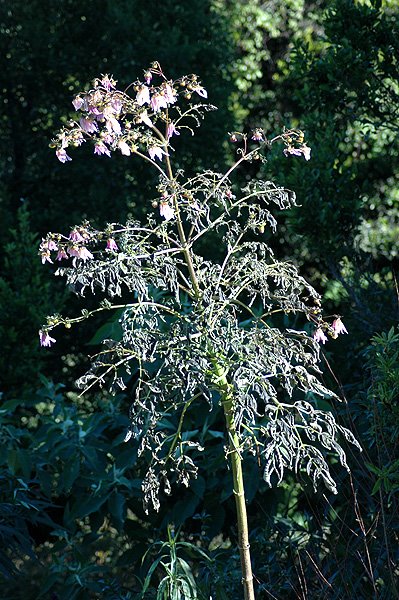
Tree Dahlia - probably its last days of flowering.

I love my Tree Dahlia. It is the most optimistic plant I know of. (I am embarrassed to see that I have used that line over many years). Oh well.

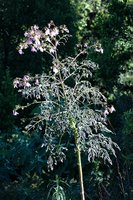
Tree Dahlia flowering up and over other shrubs.
It needs some protection from winds,
otherwise, it gets flattened.
Several stems on left and right have fallen over
but the flowers will still open.
Every winter, it gets cut back to the ground (or under it, technically). Then in mid-spring it starts all over again, growing fast (imagine Jack's Beanstalk plant). Then in April, it starts to open its first flowers. Today it was in something approaching full flower. In old money, these flowers are over 10 feet off the ground.


Tree Dahlia stems holding many flowers
as seen from my Back Deck.
But late this afternoon, it started to rain. If the rain comes on heavily, the flowers will bow to the ground under the weight of the water it has to carry on its 3 metre plus stems.
Normally its enemy is frost. But we have not had any here, yet, because the long dry autumn mild spell. I will know more tomorrow, or the day after.


Tree Dahlia flower
That is a shot of a single flower (as best I could manage, by holding one stem over). The flowers are simple (open) whereas most Dahlia flowers are "double". But as far as I know Tree Dahlias are always delicate flowers, like this. Some are white. A heavy flower, such as the "Exhibition" Dahlias, which the Dahlia people rave about, would surely be too heavy for the stems to carry more than three metres above ground, and catching the wind.


I have a fairly dull Japanese Maple
But today it was looking charming
in the grey light of this afternoon.


Friday, May 14, 2010

Tree Dahlia makes it to flowering stage.

I love my Tree Dahlia plant. To me it symbolises the eternal struggle to succeed. In truth it might not be suitable for this climate, as it barely manages to flower, before the frosts cut it down.

Bare stems (canes) of the plant
and several arching branches carrying flowers.
In my experience, this plant needs other bushes near it
to support the heavy flowering heads.

My Blogging colleague, Martin, shares my interest in these flowers, and told me (in comments on his blog) that when he lived in Canberra, he grew them there, and they would last until the first moderate frost would arrive. It seems that where he now lives, he can no longer grow Tree Dahlias. My commiserations.

This year, my Tree Dahlia has flowered better than in previous years, as Robertson has had a long, dry and warm autumn season. In fact it started life badly as the first tall stem was knocked over by strong winds in late spring, and the plant had to start all over again.

But it has made it.
The pendant flowers always look like "Pixie's Caps" to me
(Well, as Pixie's Caps are traditionally illustrated).A close-up of the "eye" of the Tree Dahlia Flower.
Click to enlarge it, to see the details.
Just lovely, in my opinion.

Wednesday, May 21, 2008

Winter is about to descend on Robertson.

The frost are about to descend upon Robertson, I predict.

How do I know?
Simple - my Tree Dahlia has started to flower.Regular readers may recall two similar posts, from two years ago (OK only dedicated readers will remember these posts). I link to them, for more recently joined-up readers.
The first was entitled "The optimistic nature of Tree Dahlias", published on 7 June 2006.
The second was "The Nature of Frost (and an update on Tree Dahlias)" published on 13 June 2006.

The message is clear. Tree Dahlias take so long to grow to their full height, before they flower, that, inevitably, frosts are just around the corner. This year's flowers are about 2.5 metres above the ground. The plant grows this tall every year, before it flowers. Then the frost kills all the soft tissue material of the plant, leaving only the root stock. As with normal Dahlias, the plant has a set of tubers in the ground which are the perennial part of the plant. The difference for the Tree Dahlias is just how far they have to grow before the plant is mature enough to carry flowers.

In truth we have already had a very light touch of frost - but only once, and only very, very light. I do not know the temperature, but it was not enough to count as a real frost. Just a few signs of ice crystals glinting on the roof of the car.

But real frosts cannot be far away. Get your "Winter Woollies" out of the cupboard (if you have not done so already).
Tree Dahlia growing in front of native Sassafras and Pittosporum trees. The Sassafras (taller tree on right) is about 15 metres high. The low shrubs to the left of the Tree Dahlia are all well over head height.

Cultivation note: Tree Dahlias are easily cultivated by taking a stick of the stem with two growth points (nodes). (A stick about 15 inches long, usually). This will resemble a piece of fresh sugar cane, if you have ever seen that. Lie the stem down on a shallow angle, (bottom end first) so its head is just above the potting mix, in a Styrofoam box filled to the top with potting mix. Water it, and leave it alone for about 3 months in a protected position, and when you look at it (next spring), it will have formed roots on the bottom, and new shoots at the top. Plant it out and wait for a year. My plant came as "cuttings" from a friend in Canberra. I did exactly what I have described above, and my new plant has flowered every year since. Even though it is a silly plant to grow in a cold climate, I love it for its dogged determination to prove it can survive and flower each year.

Tuesday, June 13, 2006

The Nature of Frost, (and an update on the Tree Dahlia)

I moved to Robertson from Canberra, where, undoubtedly it is colder than Robertson. However, there is something different about the "cold" in Robertson. It is a wetter place, and so the cold seems to penetrate more.


Two days ago, we had a lot of rain during the day, then the clouds cleared off in the late afternoon. I know that always means trouble. For example, I was alert to the possibility of black ice on the road, the next morning.


What I had not anticipated was that the heater would run out of gas at 4:00am, and that Zoe, (the great softie that she is) would decline to go out and turn the switch from one gas bottle to the other - 30 seconds work. I was persuaded to go out and do the job myself, by Zoe thumping around the house, trying to get warm - a futile exercise, on such a cold night. Indeed it was the hot water running out when she tried to run a hot bath in order to warm up, which really triggered my decision to turn the gas tap over myself. Incidentally, I have an electric blanket, but until tomorrow's scheduled visit to Bowral, Zoe does not - she just has a cat to keep her warm. She has been promised an electric blanket, though. The cat will be ecstatic!


Anyway, I went outside, to find the switch for the gas tank, only to be surprised by hearing myself crunching over the grass (weeds, really). Odd, I thought - must be a heavy frost to do that. Next morning, I discovered that the source of the sound effects was that I had been crushing thousands of ice crystals, under the soil, as I walked just a few paces to the gas bottle.

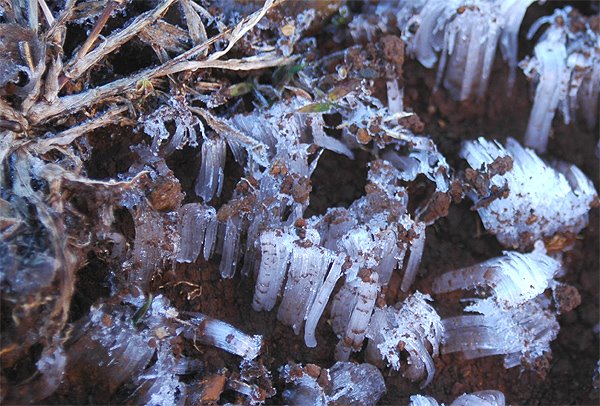
Technically, these crystals which form in the soil are known as "permafrost", but my Northern Hemisphere friends will scoff at the application of that term to this little bit of ice formation, for it is not "permanent", or even semi-permanent. We aren't on the Arctic Tundra here. But what I was experiencing is quite different from a normal frost, where tiny particles of dew freeze on the surface of the grass, or soil. This was moisture in the soil freezing slowly, and, as a result, the crystals growing up out of the soil, and they lift the surface of the soil up to the height of the crystals, about 3 or 4 cms high. These crystals have great lifting power, and tiny pebbles, and small rocks will be lifted as the crystals beneath them form. Such crystals can, indeed crack large rocks, if they form within crevices in the rock, then expand.


Leo and Anni are entitled to tell me that I don't know anything about real cold. But it is cold enough for me, here in Robertson. It is also cold enough for Peonies, which was my primary criterion, when selecting a location when I moved from Canberra.

I mentioned last Wednesday the "Optimistic Nature of the Tree Dahlia". Great timing for that post. Have a look at it, on the morning of our big freeze. That was yesterday. Today it is showing even more damage, but you get the point - its growing season is over - for this year.


Oh well, it will have to start again next year to grow two metres tall, or more, before it will start to form its flowers, in late April or May. And, of course, it is destined never to set any seed, in Robertson. Poor thing. But I love the way it keeps on trying.

One could say that it is a metaphor for someone being treated for Lymphoma, really! No wonder I admire its stubborn hold on life.

Wednesday, June 07, 2006

The Optimistic Nature of Tree Dahlias

Tree Dahlias are the most optimistic of plants. They grow all season in order to produce their large pink "pixie-cap" flowers, just in time to be cut down by the first frosts of winter.


This is a remarkably futile exercise, in our climate. Perhaps where they live naturally, in Mexico, the seasons are longer, the frosts less damaging to plants.


But still I like them. They are well-named, for my young plant, only in its second year, has twice produced tall growths, well over 3 metres high, then thrown some sprays of flowers. And when walking down my street the other day, I saw some towering over a neighbours shed, probably arching some 5 metres into the air. And yet, like any normal Dahlia, they are a true perennial, the annual growth dying off, leaving only the tubers, from which new growth emerges in Spring.


Of course, in the case of the Tree Dahlia, the tubers are massive. The clump from which my plants came was a division, with long tubers 45 Cm or so in length, and a total root mass which was more than the previous owner could lift, without first dividing it with an axe.


It is interesting to think that this tall plant could, overnight, be reduced to a soft brown slimy mass of pulp, after our first serious frost. And yet, from that mess, will emerge next year, even more spires of these tall flowers, in an endless cycle of trying to outlast the season, to make enough growth to flower, before the inevitable result of being cut back to nothingness. As I said at the beginning,Tree Dahlias are the most optimistic of plants.

Monday, June 28, 2010

Big Frost last night

Robertson does not have an automatic weather recording station (official one, anyway). So the closest is Moss Vale.
I know I was trying to do some important writing last night, but I could not keep going, as I was so cold.
Anyway, this morning I checked the Moss Vale Weather site, and it said -5.8* Celsius. That is about 25 Km west,a nd admiotedly is more likely to be colder than Robbo. But because our climate is so moist, we get really dense white frosts, once the temperature drops low enough.
I have a sloping site, below a line of tall hedging trees, so, in winter it is in total shade all day.
Late in the afternoon (4:40PM) there was still an unmelted frost on a sand pile. There was still a "permafrost" (little crystals of ice underneath the soil, lifting up small pebbles and rocks).
I forgot to look at the Tree Dahlia, but I am sure it will have been knocked back to the ground (as it has been in previous years). I shall check tomorrow.

Tuesday, May 11, 2010

Less Common birds at the Feeder Table

I have shown you so many Bowerbirds at the Feeder Table recently that I hesitate to show any more. However, I will, for good reason, I hope.

This image shows how the Satin Bowerbirds take over my feeder tables.
Most afternoons, about 4:30pm, I get up to 10 Bowerbirds coming or going.
There are 6 birds in this frame - all "green birds".
I mostly feed them small apples and occasional pears.
A small price to pay for so much excitement.
But, before I go on, I promised a fellow Nature Blogger "Catmint" that I would show her an immature Crimson Rosella, to clarify some confusion which had arisen. Here are two.
Juvenile Crimson Rosellas start more-or-less green, with blue flashes on their wings, blue in the tail (always) and blue cheek patches (always).
Check out the notes about coloured plumage development in Birds in Backyards (Australian Museum and Birds Australia site).The tricky thing is that there are regional differences in these colour transformations. I get some fully red/blue Crimsons here, but the ratio is probably only 1:5. I know I regularly see a pair of fully coloured birds, but I regularly get a dozen multi-coloured birds in the garden feeding on the grass seeds. These birds (in these images) are typical of most Crimson Rosellas seen in Robertson. They are very common in my garden (yard) but this is the first time I have seen any at my Feeder.

As the Crimson Rosellas mature, they develop the full crimson (dark red) colour for which they are named.
Here is a lovely fully mature, fully red/blue Crimson Rosella, taken in Canberra several years ago.

Back to the Table, this Crimson was holding its own with the Bowerbirds, which is pretty good going, as they tend to mob other birds.
One bird which the Bowerbirds never "mob" is this Pied Currawong.
Note the huge beak (quite dirty, as it has obviously been digging for grubs).
Another unusual visitor to my feeder table is the Grey Butcherbird.
This is the second time I have seen one (both juveniles) experimenting with a fruit diet.
Contrast the sizes of this bird and the Currawong, which is sitting in roughly the same place (reversed directions).
The adult Butcherbirds are much cleaner, especially the males.
This one might be a young male, just developing his full markings.
His head is quite clearly marked, but the belly is still scalloped.
Back to Bowerbirds.
*****
Here is a stunning male.
Note the ivory-coloured beak
and the shiny blue-black plumage.
The "Blue Birds" are pretty nervous.
There is an optical illusion with the male birds.
They are so black that they almost appear to disappear.
If it were not for the pale beak, feet and those weird eyes,
you could almost not see the male.
Note the young bird flying in over the top.
Here is a female bird, showing strong markings on the wings, where a recent "moult" has seen new feathers grow in the wings.
The beak is fully dark, and the eye is purple. On the right is an immature male, just developing the ivory coloured beak.
The green colour around the neck is stronger green than the more bronze colour of the female.
Tree Dahlia flowers and fluffy Sassafras Seeds tomorrow.

Monday, May 26, 2014

A week in the bush, south from Bega, NSW.

This link takes you to a Facebook album, which is "open" and one does not have to sign up to anything to view the photos.

https://www.facebook.com/media/set/?set=a.10152868152694829.1073741926.809229828&type=1&l=86a01c7a40

Here are a few images to be going on with.


Grey Kangaroo standing his ground
at Panboola Wetland Reserve.


A Honey Bee loading its legs with orange-coloured pollen
from a Tree Dahlia flower.

Mt Imlay seen from Eden Wharf.

A plate of Red Pine Mushrooms prepared for cooking.