Try clicking on this link, to see the latest 24 hour reported fires in the Victorian "High Country".
That map will show you the entire region from Melbourne in the south-west (lower left) of the picture, to the East Gippsland lakes, omn the right hand side of the image.
The red flame icons mark fires within the last 12 hours. Yellow flames icons mark fires within the last 24 hours.
You can use the slider bar to the left of the image, to zoom in or out.
Thanks to "anonymous" who sent me the link for this amazing website, put up by "Aus-emaps". This map is one of their thematic maps, part of their "Natural Hazards" series, on bushfire dangers in the last 24 hours.
That last page link contains a very interesting discussion of the facts which this blog has been reporting since October - the unseasonally early summer heat, and what this is likely mean in terms of bushfires this summer.
Do yourself a favour - read that page, to help understand what is happening around you.
Christmas Bells

Christmas Bells - Blandfordia nobilis
Sunday, December 10, 2006


Friday, December 08, 2006
Victoria readying itself for huge fires
 Well, you cannot say they have not been letting people know. The Victorian Government, the CFA, the print media and the ABC have been doing a terrific job. But the reality is that the mountains are burning, in the north east of the State.
This stunning satellite image (from The Age) shows a "moustache" of smoke which curls up, divides and heads south to Tasmania, while on the other hand, much of it curls up and heads north, to the far east Gippsland coast, and into New South Wales.
Miss Eagle tells me: The smoke from the fires is closing in. It is thick outside. Not close in enough so that we feel we are breathing it in. But it is bad and the sky is thick and heavy with smoke and getting thicker.
And she is in Melbourne, a hundred and fifty Kilometres away from the main source of these fires.
*****
Whether the fires do all link into a super fire, and then change direction with a forecast wind change, and burn through to the Gippsland coast - all that remains to be seen.But at least people are being put on notice. Some are being advised to choose whether to leave now, or stay and see it out. "Tomorrow will be too late" is the ominously worded advice.
If you have any involvement with Victoria, then you ought read this link from The Age.
Or try this link, from the ABC's website:
Victorian fire threat grows into a conflagration.
Here is a link to an extraordinary Victorian Government video of the fire threat for Victoria over this coming weekend.
 This is a satellite photo showing smoke from the Victorian Alps fires.
The smoke is coming from fires in the alpine spine of eastern Victoria, and the smoke is drifting south east, towards the Gippsland coast.
We are looking at hundreds of square miles of smouldering, burnt out forest. There are countries in Europe with less area than has been burnt in these fires.
 This is a potential fire holocaust.
This map shows the same area, the central region of Gippsland (the eastern end of Victoria) in pale brown tones. This is the area which is already on fire, or might be, over the next four days.
There are some fifty separate fires, caused by lightning, but the risk is that they might merge into a single huge fire, as temperatures heat up, and north westerly winds increase over the next few days.
But these fires are burning in early December. Some started in November. It is too early. How will the forests be coping at the end of a long, hot summer?
It is time for the Federal Government to wake up, and realise that not only is this an emergency, it is part of a pattern which the Government has denied for years.
This is climate change bearing fruit - burnt fruit.
 This is a satellite photo showing smoke from the Victorian Alps fires.
The smoke is coming from fires in the alpine spine of eastern Victoria, and the smoke is drifting south east, towards the Gippsland coast.
We are looking at hundreds of square miles of smouldering, burnt out forest. There are countries in Europe with less area than has been burnt in these fires.
 This is a potential fire holocaust.
This map shows the same area, the central region of Gippsland (the eastern end of Victoria) in pale brown tones. This is the area which is already on fire, or might be, over the next four days.
There are some fifty separate fires, caused by lightning, but the risk is that they might merge into a single huge fire, as temperatures heat up, and north westerly winds increase over the next few days.
*****
Global warming and climate change at work? Lets just say, these areas have been suubject to huge fires before, most recently in 2002 (in January), and in 1939, the most terrible fires since European settlement of Victoria in the mid 1800s. That fire burnt at the end of summer, on the original "Ash Wednesday" fires.But these fires are burning in early December. Some started in November. It is too early. How will the forests be coping at the end of a long, hot summer?
It is time for the Federal Government to wake up, and realise that not only is this an emergency, it is part of a pattern which the Government has denied for years.
This is climate change bearing fruit - burnt fruit.
Tuesday, December 05, 2006
VICTORIAN ALPS COULD "BURN FOR MONTHS"
 The Victoran Alps could "burn for months" according to the Victorian Premier, Mr Steve Bracks. This is reported in "The Age", 4 December 2006.
This is a very early start to the bushfire season in Victoria. It matched what I have been saying for months about the unseasonal heat we have been having. I first commented on this on 12 October this year.
The Victorian Alps are notorious for their severe fires, as they are covered with dense Eucalypt forests, which frankly, can burn with a terrifying ferocity. Lets hope this prophecy is not lived out in reality. Here is a link to historical photographs of the infamous 1939 bushfires in the Victorian Alps.
*****
 Fortunately, the fires in the New South Wales Blue Mountains, which I mentioned last week, now appear to be under control. But that is not the same thing as saying they are out.
With that difficult terrain of deep gorges, which are utterly inaccessible by road, fires can burn uncontrolled for weeks on end down there.
But the weather has been mild for the last few days, thank goodness.
*****
UPDATE:
Go to "The Age" for another stunning photo of mountains slowly burning, out of control , in the Victoran Alps.
*****
And now for some light relief.  Fortunately, the fires in the New South Wales Blue Mountains, which I mentioned last week, now appear to be under control. But that is not the same thing as saying they are out.
With that difficult terrain of deep gorges, which are utterly inaccessible by road, fires can burn uncontrolled for weeks on end down there.
But the weather has been mild for the last few days, thank goodness.
*****
UPDATE:
Go to "The Age" for another stunning photo of mountains slowly burning, out of control , in the Victoran Alps.
*****
I love the names that early explorers gave to place names. Usually it is Sailors names I notice, like Cape Tribulation, and other cheerful names. But this group of names, all reported in the one story today about bushfires in the Victorian Alps take on an especially bleak tone today:
Mt. Terrible, Black Range, Mt Despair and Mt Buggery.
But, if it were not for the fire story, you would have to have a chuckle, wouldn't you?
I also add in Mt Despair, which is mentioned in the linked photo gallery of someone's bushwalk to Mt Buggery.

Seriously, I am not kidding you - these are real place names.
Monday, December 04, 2006
CRG Report published - but buried !
You can trust consultants to do the job which their clients want.
In this case, Elton Consultants have compiled a report of some 106 pages entitled:
Pages 76 to 88 of this 106 page .pdf file contain Appendix 2 which is the:
In this case, Elton Consultants have compiled a report of some 106 pages entitled:
"Sydney Catchment Authority Groundwater Investigations
Community Consultation and Submissions Report"
Community Consultation and Submissions Report"
Pages 76 to 88 of this 106 page .pdf file contain Appendix 2 which is the:
"Report to the Sydney Catchment Authority
on the Proposed Borefield at Kangaloon NSW"
"Upper Nepean Groundwater Community Reference Group"
September 2006
*****
That is, of course, the report of the:
"Upper Nepean Groundwater Community Reference Group"
September 2006
*****
So, it is up on the web. But you need to be extra-ordinarily patient to download all 106 pages of the Consultants report.
Alternatively, you can look at it on this Blog site.
Sure, it is 7 or 8 pages of text, but it is easier than downloading 106 pages on a .pdf file.
Enjoy!
Alternatively, you can look at it on this Blog site.
Sure, it is 7 or 8 pages of text, but it is easier than downloading 106 pages on a .pdf file.
Enjoy!
Thursday, November 30, 2006
The Moths and Butterflies Man.
The Internet is a wonderful resource, and some of the best sites - for me, are those of the Moths and Butterflies Man, Don Herbison-Evans. In fact there is a group of related sites, to do with Moths, Butterflies and their larvae (Caterpillars). These sites are very comprehensive (sure, there are gaps, but many species have yet to be named, or studied in detail).
If you want to have a look, I suggest you start with Butterfly Larvae of Australia:
http://linus.socs.uts.edu.au/~don/larvae/butter.html
If you scroll to the bottom of any page, you will find links to "Caterpillars of Australian Moths" and to "Caterpillar FAQs".
It is a great resource - with a mountain of information. Most pages have photos of adults (Butterflies or Moths) and their immature stages - caterpillars.
It is known variously as the Corn Ear Worm, Tomato Grub, Tobacco Budworm, Cotton Bollworm. It is in the family: HELIOTHINAE, of the Order: NOCTUIDAE
If you want to have a look, I suggest you start with Butterfly Larvae of Australia:
http://linus.socs.uts.edu.au/~don/larvae/butter.html
If you scroll to the bottom of any page, you will find links to "Caterpillars of Australian Moths" and to "Caterpillar FAQs".
It is a great resource - with a mountain of information. Most pages have photos of adults (Butterflies or Moths) and their immature stages - caterpillars.
*****
Don's websites enabled me to hazard a guess that my caterpillars, from yesterday's story were of an introduced pest moth in the Helicoverpa genus. I wrote to Don Herbison-Evans yesterday, I said:
Dear Don,
I am enclosing some photographs of 2 caterpillars which I found inside a Mud Wasp nest, which my daughter asked me to remove, as they were on the glass on her window - and she judged the Wasps to pose a risk to her.
I would not normally break open a wasp nest, nor kill the larvae inside, but the location of the nest made this a question of safety, (in my daughter's opinion).
I am writing to ask if it is possible to identify the type of caterpillars in these Mud Wasp nests? I am guessing that they might be something like the Helicoverpa caterpillars, as per your illustrations on:
http://linus.socs.uts.edu.au/~don/larvae/heli/armi.html
*****
Tonight I got this reply back. (Thanks Don, for such a prompt reply.)
Hi Denis,
Very good: yes I think that your wasps are doing a good job keeping the pest Helicoverpa armigera under control, as your illustrated caterpillars appear to be this species. I doubt that the caterpillars are feeding on the Acacia or Doryphora, but are more likely on various herbaceous plants in the understory or open areas.
Your mud wasps are mainly from the family SPHECIDAE, and can deliver a painful sting if annoyed, but being solitary you only have to fend off one beastie. In this way they are less of a threat than the communal wasps (family VESPIDAE) where one needs to fend of dozens if they get annoyed.
Cheers,
Don
*****
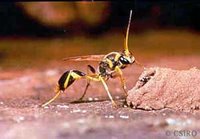 Wow, two answers, not just one: The species of Moths (I guessed correctly, based on Don's wonderful website (that is a very satisfying thing).
 Wow, two answers, not just one: The species of Moths (I guessed correctly, based on Don's wonderful website (that is a very satisfying thing).
Plus, I get the family of the Mud Wasps identified too - just from their nest, and their habits.
Fantastic.
I want you all to go to one of those links above, and then "bookmark" it, or save it to "Favourites" - or whatever terminology your computer uses. From one site, you can always jump across to the others. These sites are a "Gold Mine" of photographs, and information. It is especially useful for residents of the Southern highlands, as we are blessed with an abundance of wonderful Moths, in particular. And they are so beautiful, and so intricate in design.
Love your local Moth, I say.
*****
In fact, you do not have to love this particular Moth, as it is a pest species.It is known variously as the Corn Ear Worm, Tomato Grub, Tobacco Budworm, Cotton Bollworm. It is in the family: HELIOTHINAE, of the Order: NOCTUIDAE
Wednesday, November 29, 2006
Life and slow death on the front verandah
 Today Zoe asked me to remove a new Mud Wasp nest on her window, out on the front verandah. As this is Zoe's favourite sitting area, I agreed to remove the nests, before the wasps got too fond of going back to that spot, time and time again.
The basic safety of humans does count, a bit, in this household.
Anyway, it turned out to be a bit more macabre than I had anticipated. The first thing was that one of the two nests was not completed, and I could see some spotted or bi-coloured creature moving around inside the nest.

I assumed that this was a spider, as I have previously seen wasps carrying or dragging spiders towards their nests.
Turns out both nests had caterpillars inside. Both were still alive, though slightly paralysed.
The Caterpillars were about 4 cm long, and each nest was about 2.5 cm in diameter. I am giving the dimensions, as this nest resembles a large Mexican clay stove. It was quite small (smaller than an Aussie 20 cent coin).
 This is what the wasps do, to provide food for their larvae. They sting their prey and semi-paralyse their victims, then lay an egg inside the nest.
I actually thought they laid their egg inside the body of the prey, but evidence in one case clearly shows otherwise.
 The last photo clearly shows the larva (or is it the developing egg) inside the remains of the nest, after I had broken it off the window.
From a nature lover's point of view, I can only claim one good aspect of my human intervention. That is, the two caterpillars, which were surely doomed to a terrible, slow death, were despatched under my boot, to a quick death.
I am sure that the wasp will be back making new nests somewhere around the house - but I hope it is not to be at head height on my front verandah.
Subscribe to:
Posts (Atom)