Christmas Bells

Christmas Bells
Christmas Bells - Blandfordia nobilis

Monday, October 10, 2011

Robertson Railway Festival and then some unusual Diuris variations,

Yesterday the good burghers of Robertson turned out in numbers for the annual Robertson Heritage Railway Station spring festival.
Of course, the gentlemen from the 
Berrima District Old Machinery Club Inc turned up. 
It wouldn't be a major event in Robbo without them.


Berrima District Old Machinery Club members (many from Robbo)

Miniature Steam Train riders.
And the band played on too.

And what would a Robertson Railway Fair be without Waratahs?
An unusual Waratah cultivar. Possibly "Fire and Brimstone".
After having a Roast Beef Roll, provided buy the RHRS volunteers, using freshly cooked beef from Mauger's Meats at Burrawang, I headed out to Fitzroy Falls, to check on some unusual Diuris which Alan Stephenson and I had found the previous day. 

They turned out to be Diuris chryseopsis, 
the so-called "Small Snake Orchid" 
(a fairly unfortunate name for a beautiful little Orchid). 
The flower has large "side lobes" on the labellum 
(click on the image to enlarge it)
pointed outwards, flanking the column.
Classic Diuris chryseopsis with fine black line markings
But what about this one?
A relatively tall, heavy flower.
The first of these Diuris plants we found.
 Here it is in close-up.
The "side lobes" on the labellum 
are very different to the previous flower.
They are held vertically, flanking the column.
Diuris with no black markings and really thick callus ridges.
And this one?
Kindly ignore the spots of rain on the petals.
It is a lovely, fresh, clear lemon yellow colour.
Tiny Diuris - without marks, and small "side-lobes", with dark edges.

I have no doubt that all these plants are related.
They are in an isolated community, 
well away from any other known colony of this Diuris.
So logic has it that we are simply looking at individual variations
between plants of the same species.

I conclude they are all Diuris chryseopsis.
I just wish they would not vary from the classic species description
(as per the first Diuris flower shown). 
It makes it hard for the Orchid chasers 
when plants don't follow the "rules".

Sunday, October 09, 2011

Carrion Beetle (Ptomaphila lacrymosa)

Nature invented what we humans call "recycling".
If it were not for things like Carrion Beetles, the world would be full of dead animal bodies.
These guys are an integral part of cleaning up the world.
Before I proceed, I must give you an image warning.
If you are inclined to be a bit squeamish, kindly come back tomorrow.

I have to say that Google Image Search is amazing.
Today I found some large beetles feeding on the carcase of a long-dead Kangaroo.
I assumed, at first, that they were cockroaches, so I immediately thought Dave Rentz will be happy.
But on close examination of the first few images I realised they had beetle antennae. Bad luck, Dave!
(He shall have to console himself  with memories of his recent "Ig Nobel Prize in Biology".)

However, back to these Beetles -  what on earth are they?

I started out looking at "Brisbane Insects and Spiders" - without luck.
I then tried Nick Monaghan's "Lifeunseen"
- which has excellent photos, and is always worth a visit when tracking down an ID of an unfamiliar insect or spider. But I drew a blank there, too.
I then Googled "Carnivorous Beetles", and that told me that many beetle larvae eat flesh, 
Charming! But not what I had seen - adult Beetles feeding on a carcase.
Then I saw mention of Carrion Beetles. 
Hello!
Refine the search to Carrion Beetles + Australia
Bingo!
First hit was Dave's Garden (a very wide-ranging website) with a picture of a Beetle which had been found feeding on a dead Wombat! 
How Aussie is that? 
It also gave me a name to search >>> Ptomaphila lacrymosa

Next step: Google Image search for that name.
Bullseye!

The Atlas of Living Australia came through with the necessary images and descriptions to confirm I had the right ID. 
  • "The Silphidae adults feed in a saprophagous manner, which means they feed on decaying matter. The beetles colonize the carrion during all four stages of decomposition which are fresh, bloated, decay, and dry. The main areas of decomposition for adults are during both the bloated and decaying stages. ... " (ALA)
The ALA had a further link to CSIRO's Entomology Division's "What Bug is That?"
  • "In Ptomaphila the elytra are provided with short, longitudinal ridges and tubercles and completely conceal the abdomen...."
  •  el·y·tron noun, plural -tra
  • one of the pair of hardened forewings of certain insects, as beetles, forming a protective covering for the posterior or flight wings.
  • Also called wing case, wing cover.
Here is the clearest (and cleanest) image.
The lumps (tubercules - as we now know to call them) are clearly obvious.
Carrion Beetle (Ptomaphila lacrymosa)
(Ptomaphila lacrymosa) - on the leg of a Kangaroo carcase
Two Beetles actively feeding (head down) (Ptomaphila lacrymosa)
(Ptomaphila lacrymosa) going for a walk along the bare bone
More Carrion Beetles actively feeding (Ptomaphila lacrymosa)
Close-up of a Carrion Beetle (Ptomaphila lacrymosa)
Nature is not always pretty, but it is all necessary, one way or the other.
Fungi break down trees into material plants can use as soil nutrients. 
Insects play their part in that decomposition process, too.

Friday, October 07, 2011

Strange tiny Fungi

I have refrained from calling this Fungus "weird" as I have used that adjective too many times - I think.

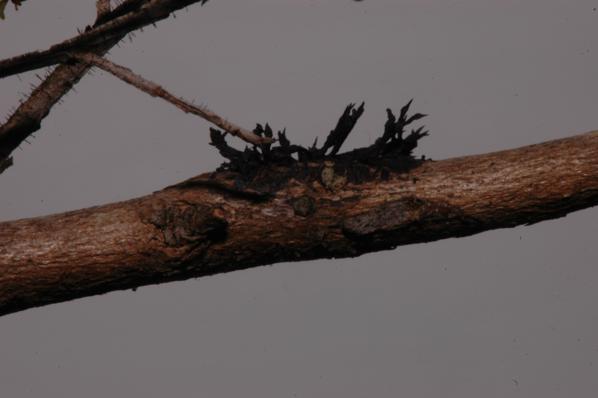
Septobasidium clelandii on Tea Tree stem.
The first thing I noticed was not the dark "stems" of the fruiting body of the fungus, but rather, the black stained bark of the Tea Tree Branch. It reminded me immediately of the kind of "mold" one sees in the corner of a very old bathroom.
Black stains on the Tea Tree bush - and Fungal fruiting bodies
In this photo you can see a grey tip of the fruiting body - presumably the spores.
The fruiting bodies - the little black spikes - are about 12 mm long.
Septobasidium clelandii with spores showing
This fungus has an interesting lifestyle, somewhat reminding me of the lifestyle of the Cordyceps group of Fungi. According to the usual sources, these fungi are not related in any way to the Cordyceps (Basidiomycetes versus Ascomycetes). Both fungi parasitise the body of a larval insect - in this case a gall-forming Coccid bug called Callococcus leptospermi. That insect is a relative of the Scale insects, so I have sent the photos and notes to Dr Penny Gullan of the ANU in Canberra, a specialist in Scale insects (and their relatives).

As you can tell from the name, the insect favours Leptospermum shrubs. This was the case with my fungus/gall-forming insect. I confess to not being sure of the plant species, yet, as it was not in flower.I collected a small branch to show to my friend Joan Freere who is very experienced with Fungi. We found it in Bruce Fuhrer's book "Field Guide to Australian Fungi". That book told us that the fungus attacks a coccid bug, which forms galls on the host Leptospermum plant. Sure enough there were lumps wherever the fungi were appearing. I had not noticed them at first, until we read Fuhrer's book.
Tea Tree branch swelling where the fungus is.
The swellings are caused by a bug which has burrowed into the shrub

A good example of the gall forming (on the right of the stem)

Leaves of the Tea Tree (Leptospermum) host plant
close-up of the Leptospermum leaves.

Wednesday, October 05, 2011

Diuris sulphurea, and an odd pure white "Caladenia"

There is a small colony of Diuris sulphurea that I wait for every year, to come into flower. They are right on the roadside verge of Tourist Road, Kangaloon.

Unfortunately, there are only two flowers out yet, and not many coming on. 
It is not looking like a good year for Diuris in the Southern Highlands, at least not yet. 
Maybe it is just our extended cold wet spell which is holding things back a bit? 
Or maybe I am just impatient?
I confess to being reluctant to lie on the ground and get closer photos.
Why?
The Tiger Orchids were being guarded by a nest of black "Jack Jumper" Bullants with yellow pincers.
I did the best I could, just stooping over and then moving away quickly, flicking Bullants off my jeans.
Diuris sulphurea - Tiger Orchid

Diuris sulphurea - Tiger Orchid - side view.
Here is another lovely Orchid, which I figure is actually an "alba form", rather than a different species.
I does not have any yellow tips on the "calli"
(the little lumps along the labellum)
nor on the rolled down tip of the labellum.
It retains a hint of green in the solid part of the flower (the Column)
Petalochilus species - an "alba form"?
Side view of "alba form" of Petalochilus species.
This plant was surrounded by a loose group of other Petalochilus fuscatus plants (or so I believe). 

So unless or until I hear otherwise, I shall just call this an "alba form" of Petalochilus (otherwise known as "Caladenia").

Monday, October 03, 2011

Vine Moth on Diuris pardina - the "Leopard Orchid"

On Saturday I went back to Medway to get better images of the Diuris pardina (the Leopard Orchid) flowering over there (as promised).
Diuris pardina - the Leopard Orchid
The first thing I found was a large Day-flying Moth, a Grapevine Moth, (Phalaenoides glycinae) apparently feeding on one of the Orchid flowers. Given the size and position of the Moth, it was attempting to feed, not attempting pseudo-copulation with the Orchid.
Grapevine Moth attempting to feed on the Diuris flower
Here it is in close-up view.
Note how the flower bends over under the
unexpected weight of such a chunky Moth.
Grapevine Moth on Diuris pardina - cropped image


Wings of the Grapevine Moth

Head, legs and body of the Grapevine Moth

Front on view of  Diuris pardina (note the wide lateral lobes)
Side view of Diuris pardina
A different flower of Diuris pardina (note the pointed "lateral lobes")
Diuris pardina - note the fine dots of brown on the rear of the "ears"
Don Herbison-Evans' wonderful moths website has the following note about the Grapevine Moth (which is a pest species in Australia). He says: "The Indian Myna ( Acridotheres tristis ) was introduced into Australia in 1862 to deal with a number of insect pests including the Vine Moth. In this it was unsuccessful, and indeed the bird is now itself a considered a pest in many parts of Australia." 
DJW note: the "Indian Myna" is now known as "Common Myna".

We haven't learnt much about biological control agents, have we?
CSIRO is demonstrating a "blind spot" on this subject, claiming lots of success stories. Presumably they mean their own successes - not claiming success for Biological Pest Controls in general.
No mention of the Cane Toad, or the Indian Myna, or the Gambusia - the mis-named Mosquito Fish which do not eat Mosquito larvae, but which have become a pest of plaque proportions in Australia.

Sunday, October 02, 2011

Freycinet's Frog at the Royal National Park

Last Friday, I was driven out from Robertson by the cold wind.
It was genuinely an awful day to be inside or outside. On such days I sometimes try to escape to warmer climes - by the simple expedient of driving down Macquarie Pass, to the coastal plain below the Escarpment. The difference between 700 metres of altitude and 50 metres often makes a considerable difference in temperature, as it did on Friday. Although it was still windy, the weather was more than 7 degrees C which I was seeking to escape from.

I went to the heathlands of the Royal National Park. I was looking for Orchids, but found not one in flower. Very disappointing. But I stumbled upon this frog.

It sat still for me to photograph it, then it leapt at least a metre and a half. That surprised me. It seems more athletic than the frogs I normally find here. But they are mostly Tree Frogs. This one is not. It was in a patch of moist grasses and herbs and rush-like plants. We were in a slashed patch of "grassland" in what I would call wet heathland. Mick, in Queensland would probably call it "Wallum". This Frog also bears the name "Wallum Rocket Frog". That tells me something about its liking for this habitat.

You can read more about this Frog at the two basic Frog sites I usually refer to, and also Wikipedia.
http://en.wikipedia.org/wiki/Freycinet%27s_Frog

Freycinet's Frog in the Royal National Park
Freycinet's Frog (a.k.a. Wallum Rocket Frog)
Freycinet's Frog - note the triangular mark on forehead.
The things I noticed in the field were the triangular shape of the entire head, and the orange stripes along the hind legs, and the coarse spots over the upper body.

Once again, I note the contribution of the amazing French biologists who toured with the early French explorers, (La Perouse and d'Entrecasteaux and Baudin and Freycinet (these latter explorers on the ships La Naturaliste and La Geographe. "Baudin and Freycinet managed to have their map of the Australian coastline published in 1811, three years before Flinders published his." (Wikipedia)
These French explorers were here for such a short time, yet they managed to record so very much of the unique and "novel" Australian flora and fauna.

Saturday, October 01, 2011

A perfect Waratah

Despite our clever hybidising techniques, which have greatly increased the floriferousness of the modern hybrid Waratahs, we have not improved the form of the flower of the NSW Waratah, Telopea speciosissima

These are several of the many Waratahs in flower in the East Kangaloon area, just north from Robertson.
Waratahs grow well in Robertson as cultivated plants.They are a feature of our gardens, and our Parks and the local Railway Heritage Railway Station.

However, in my opinion, nothing can beat the perfect form of the wild Waratah.
NSW Waratah - with the bracts still half closed

Here is what I regard as a perfect Waratah flower. 
The bracts are fully open.
NSW Waratah - Telopea speciosissima
Here is the same flower image, cropped a little to show the details.
Cropped image to show tubular flowers of the NSW Waratah
That image shows some of the lower flowers just opening.
The Waratah "flower" is actually a "conflorescence" - a head of flowers.
Each individual flower is tubular in shape, with the inner "stigma" protruding as the flower matures.

For details of the Waratah flower structure, please visit that previous Blog on the subject.