Christmas Bells

Christmas Bells
Christmas Bells - Blandfordia nobilis
Showing posts sorted by date for query "August Winds". Sort by relevance Show all posts

Friday, August 10, 2012

Why my Magnolia never flowers.

I grow a lovely dark-flowered form of Magnolia x soulangeana. It might not be this exact form, but it is close in colour and form to "Mag x soulangeana var. "Lennei".

Trouble is, I selected this plant, and grew it on for a while, in Canberra. But in Canberra I did not have Satin Bowerbirds in my yard.

Now I live amongst an active flock of these birds, and they love my Magnolia flowers. They eat them at the tight bud stage, long before the flowers ever get to open fully.

This afternoon, in howling winds, the cunning Bowerbirds sat amongst the dense foliage of the Camellias (to get protection from the winds), but they can reach out and pick at the buds of the Magnolias in the next bush. I even saw one of the "green birds" feeding a choice tidbit to another "green bird".
Bowerbird hiding in Camellia
Bronze colours on wing visible
above spotted abdomen.
 
Gorgeous deep pink Magnolia flower bud
(one of the few buds not yet eaten)
Photo taken through Study window,
looking through another deciduous tree.
On another subject, it is my self-appointed duty as chronicler of weather and other natural phenomena of Robertson, to record that the "August Winds" have arrived in August this year. The Bureau of Meteorology has issued a severe weather alert, and fire fighters are attempting to control a bushfire on Bulli Tops, near Maddens Plains, south from Helensburgh (on the exposed top of the Woronora Plateau).

The strong winds are the main problem facing the Firies and the SES. Lets wish them the best in bringing this fire under control.

Tuesday, August 16, 2011

Daffodils "Tete-a-Tete" in flower (early) and Spring Wattles

Last year I published photos of these lovely little Miniature Daffodils "Tete-a-Tete" on 27 August. It coincided with Daffodil Day.

This year, these same plants are flowering two weeks earlier than last year.
Miniature Daffodils "tete-a-tete"
They are lovely little flowers, which I always find to be "cheerful" plants. Linguistically, I should say the make me feel cheerful.

The other thing which also makes me feel cheerful, at this time of year, are the Wattles. In fact I had some assistance today to clean up several trailer loads of branches of Wattles which were damaged several weeks ago, in the heavy winds which caused havoc around Robertson. So, this is a photo from two years ago. But the flowers were just as spectacular this year.
Acacia decurrens in my yard.
But this next one is a puzzle. The only truly natural wattles in Robertson are the Blackwood Wattles - Acacia melanoxylon. This other plant, however, is self-seeded in my front yard, but does not actually belong here.

It is now well over 2 metres tall, but I have been waiting for it to flower, so I could identify it, before deciding whether or not to let it grow. I wanted to know what it was, and where it might have come from, before making that decision. 

Acacia longifolia grows commonly at my friend Jim's place, at Carrington Falls, on the sandstone plateau there, in the heavy, black soil. It is rampantly in flower down there at present. My plant is just starting to flower.
Acacia longifolia - a native wattle which is not natural in Robertson
The leaves of this species are very variable, as demonstrated by these leaves taken from three separate plants, all growing along the same roadside edge, at Cloonty Road, Carrington Falls.

The top leaf is 230mm long.  The shortest leaf is approximately 130mm. These were all mature leaves - the longest ones on each branch I selected from. In other words, the shortest one was not just a small (undeveloped) leaf, on the end of a branch.
Acacia longifolia leaves - very variable in length.
Acacia longifolia - note "pulvinus" and gland at base of leaf.

"pulvinus: the swelling at the base of the petiole, often capable of changing form to bring about movement of leaf, sometimes glandular or responsive to touch. A similar swelling near the apex of a petiole is referred to as an upper pulvinus."

Flowers of this species of Wattle are in a "rod" formation.

Here is a better image of the flowers of another specimen of A. longifolia growing at Ulladulla - in flower last Saturday.
Acacia longifolia - flowers
I have tagged this post as "Spring 2011", even though that is technically incorrect. It looks, smells and feels like Spring, so damn it, I am going to call it a Springtime post.

Wednesday, July 06, 2011

Robertson - an island in a sea of broken trees

Last night saw record winds blow down trees all around the place.
The Illawarra Highway, linking Robertson to Moss Vale and Bowral and the rest of the world (to the west), was closed.
The Illawarra Highway, to the east, going down Macquarie Pass, towards the coast, and Wollongong, still remains closed.
The Jamberoo Mountain Road, linking Robertson with Jamberoo and Kiama, still remains closed as I write.
We are in effect an island, cut off from the rest of the world.

The wind has been extraordinarily strong.
The local "Firies" (Rural Fire Service) weather station reports the highest gust - 90.1 km/h at 20:51 on 05.07.2011.

The Blue Mountains, (further west and higher) have dominated the News reports with their number of trees down, and power outages. But this storm has been pretty severe locally, too.

Several local businesses are closed, for reasons to do with power brown-outs affecting their security systems, apparently. The Robertson Inn (the "Robbo Pub" had a problem with their historic roof trying to lift off. A team of builders from Wollongong, who happened to be staying there last night got the job of providing a temporary "fix". But they wisely decided not to try anything heroic in the middle of the night. But they were up on the roof this morning.

The wind affected me last night, in a small way, by having brought down a large Pittosporum tree across the road, just outside my place. I was due to drive to the Pub for a regular Trivia night, but the road was completely blocked. This is what it looked like this morning.


Tree across my road (from the downhill side)


This is the view from the other side.
This is the road to the local Cemetery, 
and there are a few properties along that road too.
So it is not just me who was cut off.
The trunk of the tree was about 600mm in diameter
Fortunately the Council emergency services road clearing team turned up this morning with 6 blokes, chain saws, a large backhoe and a truck to clear the road. For once, let me say I am happy to pay my rates.

The Council guys were surprised that a Pittosporum would grow so large. But I know that there are far larger ones in the local Robertson Rain Forest.

The neighbouring village of Burrawang (home of the largest Eucalypt trees in the district) was without power from 4:00pm, The Burrawang Pub was closed, so the Robbo Pub had a few stragglers visit for tea and they stayed to join our Trivia Night event.

As far as I know, the only damage to trees on my own block is minimal. But I will wait till the wind dies down completely before doing a full patrol.


The Wattle trees which Zoe and I planted, below my house in May 2004 have had their heads snapped off (again). But I regard that as mere pruning. It saves the power company guys from having to cut the heads off these trees, to ensure the Power Lines are not likely to be touched anyway.

This is a good reminder that the famous "August Winds" do not just blow in August. In 2006 I wrote about them on 11 July.

Last night's winds equate to Force 10 on the Beaufort Scale: Technically, a "Storm" which is two steps up from a "Gale" (techo speak is different from our general usage of those words.


10  Storm  
48-55 knots Seldom experienced inland; trees uprooted; considerable structural damage.

Our local reports fit their description perfectly.

Sunday, August 15, 2010

A friendly "Snout Moth"

Several days ago I had an unusual visitor in my kitchen.
It was a strange looking moth, with a large "snout", and densely hairy body, and a strongly "upright" stance.

Note the long legs and upright stance of this moth.
Its antenna is visible clearly, held close against the body.
I sought assistance from some "Moth-ers" on the "mothing-aus" Yahoo group.
Ian responded, suggesting that my moth was a "Snout Moth" - named for obvious reasons.

Photo of the "snout" from underneath.
One eye is hidden by dense hairs.
The Antennae are held low, close to the body.
The "palpi" are held parallel and together they form the "snout".

The family is known as the Lasiocampidae (in scientific parlance)
According to Wikipedia: "Their common name 'snout moths' comes from their unique protruding mouth parts of some species that resemble a large nose."

The moth was resting on the side of a cut-down plastic drink bottle.

I searched Donald Hobern's Flickr Album of Lepidoptera. Found the appropriate "set" the sub-family - the Lasiocampinae (Australian)
The closest match for my moth (almost a "dead ringer" I would suggest) is Pararguda nasuta.

It is interesting that this moth has ventured out in the famous "August Winds" (which in Robertson blow between June and September). They were blowing on the day I found this moth inside my house. and they are still blowing outside as I write this story.

Thursday, August 05, 2010

Some Camellias coming into flower

These are just a few of my Camellias which are coming into flower about now. One in fact has been flowering for several weeks, but the weather has not been suitable for good flowers.

To clarify, I should mention that I have many of the autumn and winter-flowering "Sasanqua" or "Hiemalis" varieties of Camellias, but while I love them, i do not regard them with the same affection as the "Williamsii Hybrids" and other more classic large-flowered Camellias. One of the problems with names of Camellias is that they are super-fertile (in general) and so chance seedlings arise, and nobody can be totally sure of their parentage (and hence which "group" to place them in.

This is one of my all-time favourites - "Bryan"
It is a Camellia williamsii x reticulata hybrid.
I grew this plant or another very similar to it in Canberra.

The weather has not been kind to Camellias this year. Yesterday, I decided to take my chances, in case I should miss out completely on recording some of these plants in flower. That was because of the horrendous "August Winds" which blew on schedule this year (unlike previous years).

I believe this to be E.G. Waterhouse,
but I am not quite sure yet.
I want to see several flowers open fully before I am positive.
This is a lovely petite flower with a delicate "picotee" edge
Yet another Camellia with the distinctive "fuchsine" colour
which is typical of the "Williamsii Hybrids" group of Camellias.
This is a lovely delicate flower.
That flower (above) is quite small,
but not as tiny as many of the other "species" Camellias
such as those descended from C. rosaflora.

By contrast, this is a veritable "monster" of a flower.
The flowers are at least 6 inches across, some may be more.
It is my only true C. reticulata.
The leaves are nearly twice the size
of "normal Camellias" (the classic "Japonicas").
I bought it as a "seedling" of Dr Clifford Parks.
But the true Camellia "Dr Clifford Parks" is said to be a sterile plant
So who knows?
I am prepared to grow it to see how it survives the winds of Robertson.

Many are obviously heavily in bud, and will probably flower for several weeks, but others are less certain, especially those which I moved this year because of the house renovations work which is going on. Those plants were pruned heavily to help them survive the move, and in some cases I only left a few buds on, for them to just "prove" themselves.

Sunday, January 24, 2010

Bar-tailed Godwit from Alaska visits Tuross, NSW

What I am about to write here is probably not news to some of our keen "Wader Studies" participants (and Bloggers) namely Mick, from Sandy Straits and Beyond, and Duncan (from Ben Cruachan) and Gouldiae. They all report periodically on Wader studies they participate in. Mick reports on such outings very frequently indeed, frequently on Bar-tailed Godwits.

Today I am writing about the migrations of several specific Bar-tailed Godwits (Limosa lapponica).

Interestingly, Sebastian wrote about the flexibility of the beaks of these birds, which use their long beaks to probe into wet sand, to find Marine worms and other tiny marine creatures. And several days ago he reported on them feeding on grass, on The Esplanade at Cairns.

Another Blogger, Steve Happ has also written about a"flagged" Godwit from New Zealand

So, many of my Blogging colleagues know about Godwits. So this might not be news to them - but it is to me. Hopefully some of you will find it of interest too. To me, these journeys sounds a positively "heroic".

Female Bar-tailed Godwit - known as "E7"
Photographed in Alaska by the USGS.
I have today posted two messages on the Canberra Ornithologists Group "Chat Line". My brother, Brendan, who lives at Dalmeny, has sent me this interesting report of an article in the "Narooma News" about a Bar-tailed Godwit (a migratory "Wader" bird) which seemingly has been flagged with a clearly visible marker code indicating it was banded in Alaska.

Brendan says: There is a story (and photo) in the Narooma News this week.

A Bar-tailed Godwit banded "flagged" with a tag that can be read without capturing the bird. I take it the flags are not individual but are a batch number - P1 black with white letters. It is quite clear in the photo.

******
Details of the bird's history are as follows:

Banded at Punoaray Point - Yukon-Kuskokwim Delta - Alaska on 9th September 2009
Identified 21st November 2009 - Tuross estuary
January 12th 2001 still at Tuross.
11,500k in 10 weeks.

*****
Brendan then asks: More significantly is this the "normal" north south migration? Has it gone across the pacific - or maybe across the top end of the pacific and then south. (I have looked on the electronic version of the Narooma News, but it has not rated an electronic entry.)

*****
The following report might help answer some of the questions which Brendan was hinting at - which way do the migrating Godwits go: (a) around the top of the Pacific or (b) directly across it?

I have located the following report from the Alaska Science Centre (part of the USGS - i.e., their "Geological Survey" Department) which provides a likely answer:

"We used satellite telemetry to follow the migrations of two populations of Bar-tailed Godwits, a group of 9 from New Zealand (NZ) and a group of 15 from Western Australia (WA). The birds from WA represent a subspecies that nests in eastern Siberia whereas the New Zealand birds nest in Alaska."

Map of the basic migratory route of Bar-tailed Godwits
from north-west Australia to Asia.
This represents the largest population of
migratory Godwits visiting Australia

There is a special report on one particular individual bird (E7) which took the "short cut" non-stop directly across the Pacific from Alaska to New Zealand. She flew for 9 days, non-stop.

* "On the early morning of August 29, she took off southeast back across the Alaska Peninsula, went out over the vast North Pacific and headed towards the Hawaiian Islands. When less than a day's flight from the main Hawaiian Islands, she turned southwest, crossing the Hawaiian Archipelago over open ocean 125 miles west of Kauai, heading towards Fiji. She crossed the dateline about 300 miles north-northeast of Fiji, and then appeared to fly directly over or slightly west of Fiji, continuing south towards New Zealand.
* "In the early afternoon of September 7th she passed just offshore of North Cape, New Zealand, and then turned back southeast, making landfall in the late evening at the mouth of a small river, eight miles east of where she had been captured seven months earlier." (a distance of 7,200 miles according to the USGS) Source: "Bird Completes Epic flight across the Pacific"
9/12/2007 7:27:02 AM U.S. Department of the Interior, (U.S. Geological Survey)
Complete Migratory Route of Godwit known as "E7"
She was flagged with the numbers E7
and tagged with a small satellite transmittor.
She was then tracked from New Zealand to China,
then to her nesting grounds in Alaska and back to New Zealand.
Source: USGS
This is clear evidence that some Godwits fly the Pacific - seemingly without even landing once. There are very small numbers in the survey, of course.

But if one can do it, and knows the way, then that's pretty impressive evidence as far as I am concerned. (In fact, thanks to radio telemetry several other records confirm this is more or less the regular southerly migratory route for Godwits which breed in Alaska).

*****

I have done some reading up about the (Shorebird) Wader Study research done in Australia.
  1. "Sightings of Waders Leg-flagged in Victoria" Report Number 15 Clive Minton, Roz Jessop and Heather Gibbs. "Full details of all sightings are of course kept in the Leg Flag Database and updated versions of this are periodically exported to the Australian Bird Banding Scheme in Canberra for incorporation into their data storage facilities".
  2. "Sightings of Waders Leg-flagged in South Australia" Report Number 8 Clive Minton, Roz Jessop, Maureen Christie, Iain Stewart and Heather Gibbs "Bar-tailed Godwit 24/5/07 (2 birds) Yukon-Kuskokwin Delta, S.A. ALASKA 11,195 km. NNE 28/5/08 ..... 3/7/08 (breeding – with chicks) Aropuk Lake, Y-K Delta, ALASKA. Note: Only a handful of Vic-flagged Bar-tailed Godwits have been recorded on northward migration or during the breeding season in Alaska.
  3. "2007 Breeding Success, based on juvenile ratios of Northern Hemisphere waders which spend the non-breeding season in Australia" Clive Minton, Rosalind Jessop, and Chris Hassell (REPRINTED FROM STILT 53: 15-19) A flag sighting in South Korea on southward migration is unusual as baueri Bar-tailed Godwits (a sub-species), normally make a direct return to Australasia from Alaska across the Pacific. Maybe this bird was on its first northward migration and didn’t make it all the way to Alaska?
  4. Recoveries of Waders Banded in Victoria" Clive Minton, Roz Jessop and Maureen Fitzgerald Alaska 86403144 Juv 7/9/04 Yukon-Kuskokwim Delta, S.W. ALASKA 5/3/08 Corner Inlet (Victoria) Note: The individually leg-flagged (AO) bird from Alaska seen in Corner Inlet in March was the first Alaskan-marked bird recorded in Victoria. In contrast, there have been a few recoveries and many flag sightings of VWSG-marked Bar-tailed Godwits in Alaska.
Source for all these reports:
JOURNAL OF THE VICTORIAN WADER STUDY GROUP
VWSG BULLETIN
Number 31, August 2008


If we now add in the extra information from Steve Happ's report, we know some Godwits migrate across the Tasman.

Indeed, many seem to do that, as a preparation for a return journey northwards along the Asian (Pacific) coastline. One theory I have read today is that they follow this route, to avoid the perils of catastrophic weather on the northern end. By not flying directly, they can "stop off" safely till the weather clears - in Korea, or Kamchatka Peninsula, or Siberia, or Alaska.

By contrast - the theory goes - the southerly migration is not likely to meet such catastrophic weather (as they are not migrating to such extreme latitudes in the Southern Hemisphere) on their southerly journey.

Makes sense to me.

Wikpedia reports a modification of this story, namely that the New Zealand birds mostly fly directly north-west from New Zealand, (skirting around Papua New Guinea) across the equatorial and sub-tropical zones of the Pacific Ocean, until they reach the Yellow Sea (China).

Godwit northerly migration route from New Zealand
(Source: Wikipedia)

Post Script:

I was thinking about whether the Godwits follow the "Great Circle Route". I hope readers understand the basic concept there. It is the plot of the shortest route between two point on the surface of the oddly elliptical shaped Globe we call home. It is not the straight line between two points on a map.

Here is the Great Circle Route from Anchorage, Alaska to Auckland, New Zealand. It goes south-west from Alaska. but after an initial s-w departure, the birds go south-east from Alaska. (Refer to the second map above - the plotted chart of E7's flight.)
Map generated by the
Great Circle Mapper -
copyright © Karl L. Swartz.

Short answer is the Godwits do not closely follow the Great Circle Route. They are more influenced, especially in the early part of the trip, by prevailing Northern Pacific storm winds (Low pressure systems have anti-clockwise winds in the Northern Hemisphere, so, with a storm north from them (in Alaska), they get pushed south-east).

The following is my own interpretation of the information in a highly technical paper by Bob Gill of the USGS, who has done the flight analysis and all sorts of energy consumption modelling, flight efficiency (drag) coefficients, and more besides. His excellent paper was referred to me by Mick of Sandy Straits and Beyond.

In fact the Godwits' route follows the best prevailing winds. They appear to "ride" low-pressure storms as they leave Alaska, heading south-west initially with a strong tail wind kick off, then turning south-east from Alaska, parallel to the Pacific Coast (but a long way out, given that they are starting from the peninsula in the west extreme of Alaska), with the tail wind from the storms, which may assist them for up to 1500 miles. By then they have crossed into prevailing westerlies. They then head south-west towards Hawaii. Then they follow the northern Hemisphere Trade Winds, which flow south-west. After they cross the Equator, the birds can again gain some benefit from the southern Trade Winds, which take them towards Fiji. Some juveniles do appear to stop there. Flagged bird "E7" headed past, going directly to New Zealand. Remember they are doing this in September/October when weather in the last part of their route is generally benign.

The birds obviously "bulk up" prior to departure:
  • "The small-sized juvenile Bar-tailed Godwits with a lean mass of only 166 g and a fat store of 200g (Piersma and Gill 1998) are predicted to be able to cover more than 11 000 km nonstop". (Gill)
  • In fact, they are predicted to lose all fat, and have reduced pectoral muscle mass in the course of the flight. It is obviously on the limits of their endurance, but they make it - mostly.
  • Other immature birds are said to divert to Fiji if they cannot make the full direct flight. Presumably they then resume the journey after rebuilding fat and muscle tissue.
I am sure no Doctor would recommend such an extreme wait loss program as these birds engage in.

Wednesday, December 02, 2009

Tree removal in the heart of Robertson

The Robertson Pub is right on the main road through Robertson. There is a corner which is the favourite meeting point for people coming into or through the village. "Meet you are the corner below the Pub" is a popular phrase for groups of bushwalkers and others who I arrange to meet, before going out for the day.

Two weeks ago, somebody removed three huge Cedar trees (Cedrus species).
Admittedly these large, mature trees were planted directly underneath powerlines - so they were probably not suitable to be planted where they were.

However, I have written to one of my local Councillors asking the obvious questions, about whether an approval was required to remove those trees, and if so, was it obtained? If not, why not?

These trees were on public land - the Nature Strip ("roadside verge").

Yesterday a group of private tree loppers turned up at the bottom end of the block of land on which the Pub is located, and butchered 5 large Pinus radiata trees (Monterey Pines). They shaved several of these trees - leaving just a bare trunk. Several had their tops left untouched.
I photographed these trees yesterday morning, but as it was raining all day, the workers did not touch the trees at all, all day.
As these trees formed a wind break below the pub (western side is the prevailing wind direction in Robertson (for the nasty "August winds" ), I included this bit of tree butchery in my query to the Councillor.

These trees are on private property, and there is a DA going through for a proposed redevelopment of the hotel building. But given the location of these trees, right adjacent to the property boundary, it is highly unlikely that these trees would be required to be removed, in order to make way for any proposed building.

Again, I asked if any approval process or any consultation is required to remove these trees (which are on private land).

My reason? It has turned a reasonable streetscape in the middle of the village into a bloody eyesore! It is a disgrace.

Sunday, September 14, 2008

Spring Pruning - preparing for a hot windy summer

Integral Energy, our local electricity supplier, and one which the last NSW Premier and Treasurer wanted to sell off, has come through and pruned trees along Missingham Parade. And then, yesterday morning, shortly after 7:00am, they were knocking on my front door, to advise me that they were going to prune some trees on my block. This is part of their planning for a forthcoming hot and windy season. Sounds fair enough to me. I know that the line across my paddock feeds down to rural property along Belmore Falls Road, down in the valley below my place.

I have shown photos of these plants when they were first planted by Zoe and myself on 17 May 2004 (Click here to see Zoe celebrating having planted plants in the otherwise bare paddock). These plants have been pruned 3 times since they were first planted. Once to "top them" to reduce their direct vertical leaders, and make them bush out (when they were young saplings). Then in July 2007, my friend Peter came with his chain saw to knock them back - because I could see they were growing too tall, under the powerlines (when just 3 years old). Now, a year later, the Integral Energy guys gave them a real "Boy Prune", as the phrase is.
I last wrote about these trees under the heading Green and Gold, back on 11 August, as they were just coming into flower.

I originally anticipated that these plants would grow quickly (not as quickly as they have done) - and act as a temporary screen and wind break, while other plants established themselves, down in the paddock below the house. Wind is the issue down there - it is very exposed to southerly winds.The reality is that the Wattles have jumped out of the ground, but other plants have been less successful. So I will keep on cutting their heads off, and hope that other self-sown seedlings of plants like Pittosporum and Sassafras do establish themselves under the shelter of these trees.

One Wattle which has grown reasonably well is this small shrub of Acacia fimbriata "compact form". The true species grows in a much more open manner. This one will never pose a problem for the power lines. Nor will the few Camellias which are growing down there.I mentioned recently, when writing about the leaves and phyllodes of Blackwood Wattles, that mature Blackwood Wattles eventually form an open crown. This is what I meant. Most of the Blackwoods on my place are young plants (regrowth) and have not reached that stage - and still have dense crowns.

And, here is a surprise visitor - a Willy Wagtail - which was on the fence while I was taking the other photos, late in the afternoon. Lousy light, but it is the first time I have ever seen a Willy Wagtail at my place (it is definitely not a rainforest bird) - so I was not going to miss the chance to try and get a photo. Sorry, but it was the best I could manage - the bird was a bit nervous of my presence.

Thursday, August 14, 2008

Wind, wind, wind - and more to come.

The wind outside my window has been howling, like a train going past, for days. I am sick of the noise, and the bad psychological effects which wind has on me. I get edgy, irritable, and a little bit scared. Fortunately I have had tree branches trimmed away from the house. Given our high rainfall and rich soil, even sapling Wattle trees reach my roof height in 3 years. I do not have large trees planted close to the house which are likely to cause problems, but it is the noise of the branches scratching against the windows and the gutters which I do not like.

Here is the Bureau of Meteorology's official weather warning for coastal NSW for this afternoon and this evening. You will recall that Robertson is sitting directly on top of the Illawarra Escarpment, at approx 750 metres above sea level, so we cop all these supposedly "coastal" winds. This photo is taken overlooking Macquarie Pass - from just 5 Km east of Robertson. It shows Lake Illawarra and the Pacific Ocean beyond. Although taken late one
peaceful afternoon, the point is to show our proximity to the coast, and our exposure to "coastal" weather when warnings are relevant, as is the case tonight.
Australian Government Bureau of Meteorology
New South Wales

Coastal Waters Wind Warning
For NSW Waters South of Port Macquarie
Issued at 4:10 pm EST on Thursday 14 August 2008

Synoptic situation
Vigorous southwesterly airflow over southwestern Tasman Sea with embedded cold fronts is expected to persist until Sunday.

Gale Warning
For the South Coast, from Gabo Island to Montague Island

W/SW wind 25/33 knots, reaching 34/40 knots chiefly offshore. Sea around 3 metres, reaching 4 metres offshore. S'ly swell increasing to about 3 metres.

Strong Wind Warning
For the Mid North Coast, Hunter Coast, Sydney Coast, Illawarra Coast, South Coast, from Port Macquarie to Montague Island

W/SW wind reaching 25/33 knots Sea rising 2 to 3 metres. S'ly Swell to 3.5 metres.

The next warning will be issued by 11 pm EST Thursday.

Please be aware
Wind gusts can be a further 40 percent stronger than the averages given here, and maximum waves may be up to twice the height.

Here is the Weather Chart for Thursday evening 14.8.08 at 4:00pm Eastern Standard Time. It clearly shows closely aligned barometric readings in the form of closely set parallel lines. With a low to the east of us (with winds circulating in a clockwise pattern), and a high to the west (with winds circulating in a anti-clockwise pattern), those two systems combine to push a huge volume of air, in a north-westerly direction, from the Antarctic region, well to the south of Australia, right up the length of the NSW coast, bringing about cold winds right up into Queensland.

And this is the four day prognosis - in chart form.
The winds should start to ease on Sunday night. If these are the famous "August winds" then I am sick of them. We all know that, in Robertson, they blow from May to December, but that's another story.

Saturday, August 02, 2008

The mighty August Winds are on schedule.

Robertson nearly blew away last night.

Regular readers will realise that the occasional references to the "August Winds" are something of an on-going Robertson joke. The "August Winds" can blow any time from May to December. Last night, they blew on schedule. That's pretty unusual - really!

Our winds were classed officially as "gale force" which is pretty exciting. It is a relatively rare event, to be officially described as such. It equates to Force 8 on the Beaufort Scale, with wind speeds between 63 - 75 Km/h or between 34 - 40 Knots.

Fortunately, we survived this, without any power outages.

Macquarie Pass was blocked by a fallen tree overnight, but that's not surprising, given the huge trees which line that famous mountain pass, down the Illawarra Escarpment. The Illawarra suffered considerable power outages, but they are not as used to wind as we are, and so perhaps their trees are less adapted to excessive wind.

Anyway, this afternoon, the weather broke enough to allow Dorothy and Jasmine to take a few minutes off to test out the wonderful new park bench which has been installed by the local community group, beside the Big Potato. Allan Hollis and Paul, our Village Postmaster, had fixed the new table and bench seats into position yesterday. They assured me they are fixed onto several reinforced slabs of concrete which are deeply buried. And anyway, the table itself required the use of Nat Waters's backhoe to move it - it is that heavy. Lets hope it survives the attention of vandals.Talking of which, persons who know me may be shocked to learn that I used the "F... Word" to day, in public, and at full volume. Something like "Hey You ... Get the F... out of there!" was heard to echo up and down Hoddle Street. I did it with deliberate intent, for I was ordering off a car load of what were once known as "callow youths". They had got out of their car, and run around to the back of the "Big Spud", and were proceeding to try to kick in the walls which Allan had put up, just a few weeks ago, to close off the original doorways - which had long since been vandalised.

When the doors at the back of the Big Spud were open, it allowed all sorts of vandalism to occur, and other illegal and illicit activities to occur inside. That was why the whole thing was a concern to the Chamber of Commerce, and many other local residents. That's precisely why the refurbishment of the Big Spud has been undertaken.

But even I (who am not easily shocked) was stunned to see these little idiots trying to kick in the new panels - in full daylight, and in full view of a group of other people. Fortunately Allan appears to have done a good job of reinforcing the concrete and mesh which he used to close off the original doorways.Allan Hollis closing over the original doorways in the Big Potato on 14 July 2008. Fortunately he has applied a number of very thick layers of render, over a solid and reinforced base structure. This wall panel withstood its first attack, today (with a little help from the "F... Word").

Friday, August 10, 2007

Huge, screaming "Westerlies" are blowing.

Here is what the weather chart looks like, as I write.
Most unusual. Lows south of the continent are linking up together, driving westerly winds directly across the country.

A far more normal pattern would be a low off the east coast, with a high somewhere in the Great Australian Bight, and winds flow from the high pressure cell to the low pressure cell.

But, while we often talk about the "August Winds" in Robertson, this is pretty exceptional. The wind was blowing early in the week, dropped a little on Wednesday, picked up again on Thursday, and today it has been howling. Last time I wrote exclusively about the "August Winds", was last year, on July 11 (ever so slightly un-seasonal, but self-consciously so).

Kim was going to come over here this morning, to give me a helping hand in the garden. But when we spoke in the morning, by phone, she commented that the wind would "blow the dog off the chain". A lovely piece of rural Australiana, that expression ***. Needless to say, we did not do the gardening (spraying). That's on hold for next week, now.

The winds are screaming outside the house. Fortunately, the trees have already been trimmed back, so little damage has occurred - the bulk of the wind damage having occurred already, several weeks ago. But it is hard to credit how unpleasant it is being out in the winds, even for a few minutes. Car doors slam shut, when you open them. Hats? Forget them. Put your head down and scurry for the door - and stay inside.

*** The following is an extract from a website for "Kang guru - Radio English" (a program apparently funded by AusAid, for people wishing to familiarise themselves with Aussie Spoken English.

"Please note: If you like idioms be sure to listen to KGRE. The radio program averages 10 ‘new’ idioms every month - a great way to learn them easily.

The first one - it is so windy it would blow the dog of a chain.

"Last night there was a terrible storm. The wind was so strong it would have blown the dog right off the chain".

Think about this! If a dog is chained up and the wind is so strong that it breaks the chain and the dog goes free then we know the wind must have been very strong. This is highly unlikely of course, but idioms do not always make too much sense."

Tuesday, July 11, 2006

The Nature of the "August winds"

The August Winds are blowing.

Local opinion in Robertson has it that the "August Winds" might blow from July right through October. In that case, the word "August" should be interpreted as the classical adjective, not a seasonal (or monthly) descriptor.

The Macquarie Dictionary says: "august - adjective - dignified and imposing, calling forth the utmost respect; grand; majestic."

There is nothing dignified about holding one's hat onto one's bald head, I can assure you.


However, I can accept the "utmost respect" part of the definition. Certainly, in windy conditions such as today, it is appropriate to watch out for fallen tree branches, as one drives the country roads of the district.

I have not noticed whole trees down, just yet - that usually happens when these winds coincide with rain, which softens the soil, and loosens the roots.

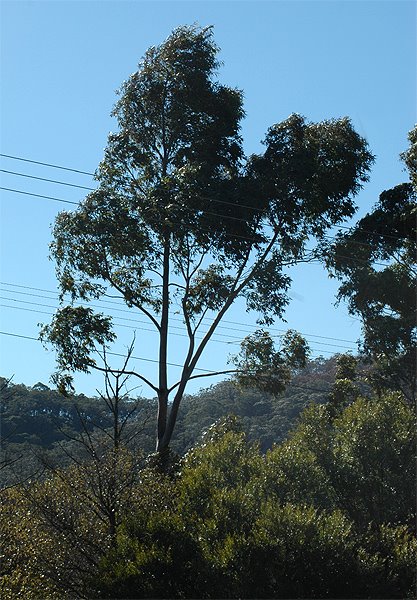
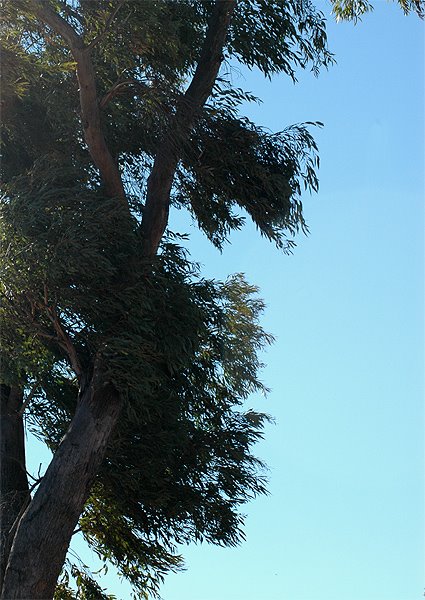
Astute observers will note that these are Eucalypt trees, not Robertson's rainforest trees. Rainforest trees are mostly denser in their foliage, and greener in their colour. The crown of Eucalypt trees tend to be open, allowing wind to pass through easily. The young tree in the top image shows that characteristic well. The second tree has been pruned, and these branches are re-growth.

Today's images come from Welby, the very early settlement near Mittagong. It happens to be where the Road Transport Authority has its Southern Highlands office, where I had to go today to register my car.